
Reviewed · BERLIN WALL AND COLD WAR TOURS
Berlin Wall History Small Group Cycling Tour
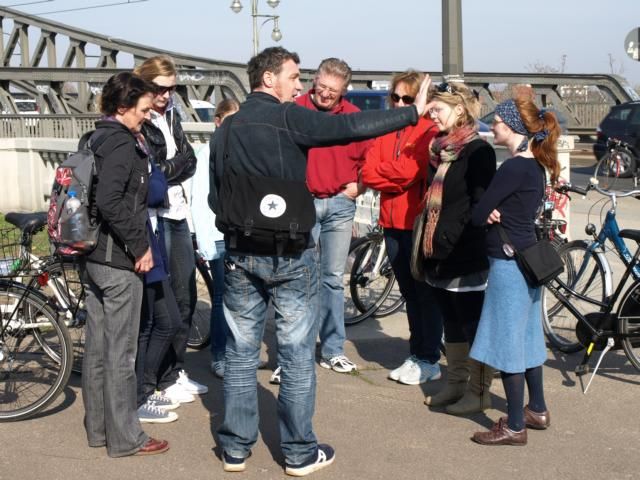
Berlin’s Wall is mostly gone, but its route still cuts through the city in a series of sharp, moving clues: a watchtower here, a preserved strip of open ground there, a memorial where people once tried to escape. This four-hour bike tour links those places better than a sightseeing bus can, taking you from the first border crossing to Checkpoint Charlie.
I like the small group, limited to eight people, and the way the route mixes major sights with quieter traces such as the Invaliden Graveyard and the Parliament of Trees. I also like that the tour gives the Wall a human face through stories of escape, separation, and loss. The main drawback is that the live tour is in German, so you need enough German to follow the explanations.
Key points at a glance
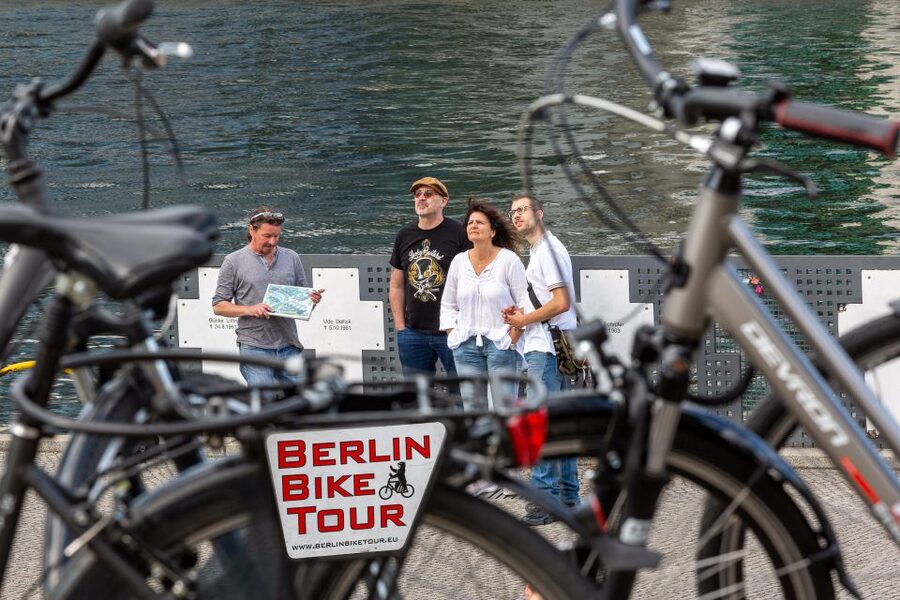
- Begin at Bornholmer Straße: Start at the Square of the 9th November 1989, where East German citizens first crossed the border when the Wall opened.
- See surviving Wall evidence: Pass an original watchtower, sections of the Death Strip, and memorials at Bernauer Straße.
- Ride through central Berlin: Continue past the Brandenburg Gate, Museum Island, the New Synagogue, and the former border crossings at Chausseestraße and Invalidenstraße.
- Follow a compact route: The tour begins and ends at 75 Bornholmer Straße, with a bicycle supplied for the full four hours.
- Keep the group personal: A maximum of eight people allows the guide to explain details without the feel of a large city tour.
- Plan for the weather: The tour runs in all weather, and a rain poncho is provided when needed.
Starting where the Wall first opened
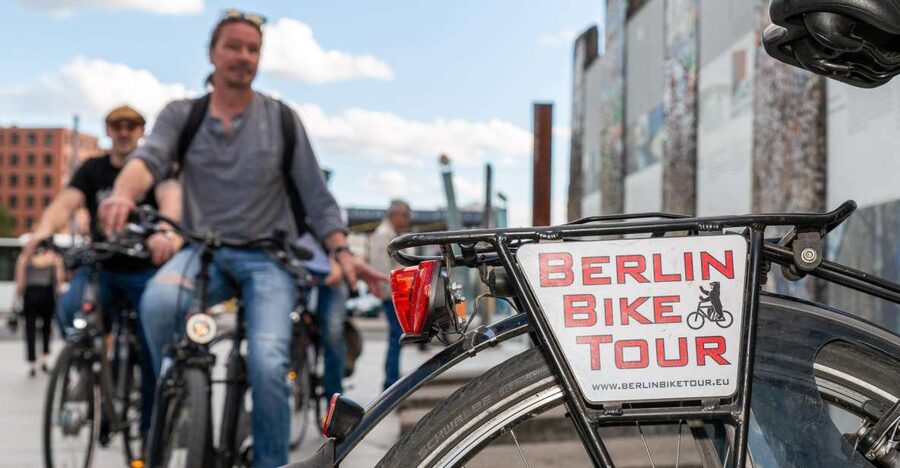
Your ride begins at 75 Bornholmer Straße, a short walk from the former border crossing. The location is practical as well as meaningful: the Björnsonstraße tram stop is about one minute away, and Bornholmer Straße S-Bahn station is roughly two minutes on foot.
The first stop is the Square of the 9th November 1989. This is a fitting place to begin because the tour starts at the point where the Wall story changed direction. On that night, the Bornholmer Straße crossing became the first place where East German citizens crossed into West Berlin after the border announcement.
The guide uses this opening scene to explain how a tense border post became a passage to freedom. You are not simply cycling past a former checkpoint. You are standing at the place where a political announcement, confusion, and public pressure broke through a system that had divided the city for decades.
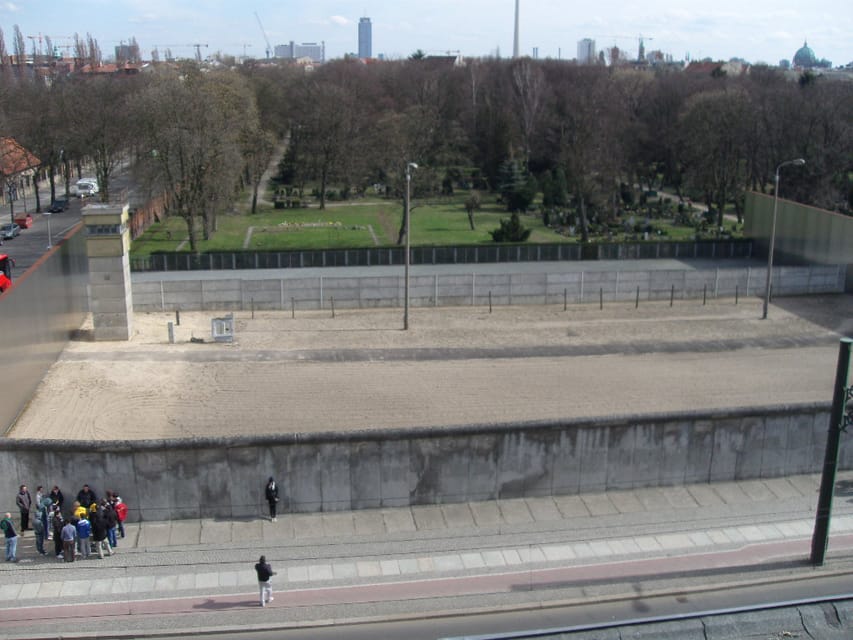
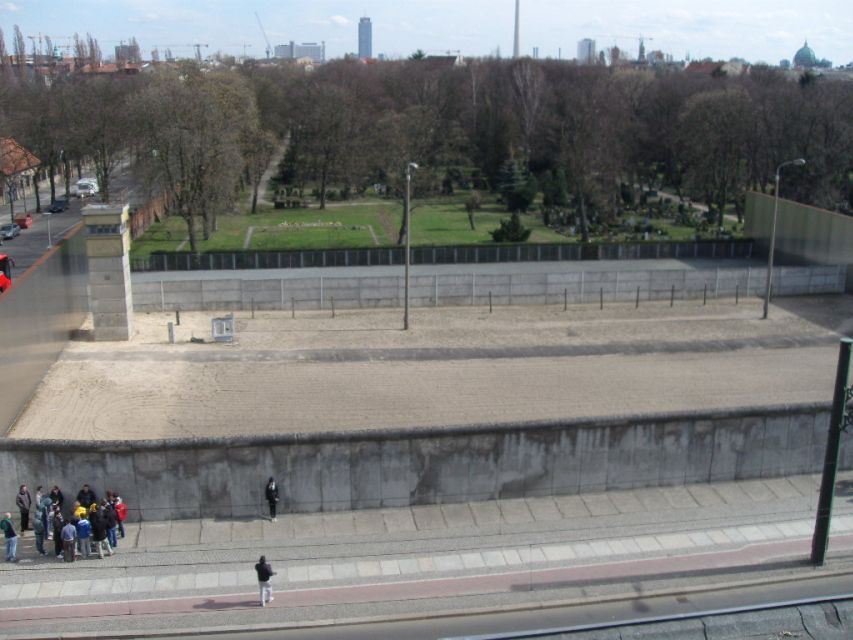
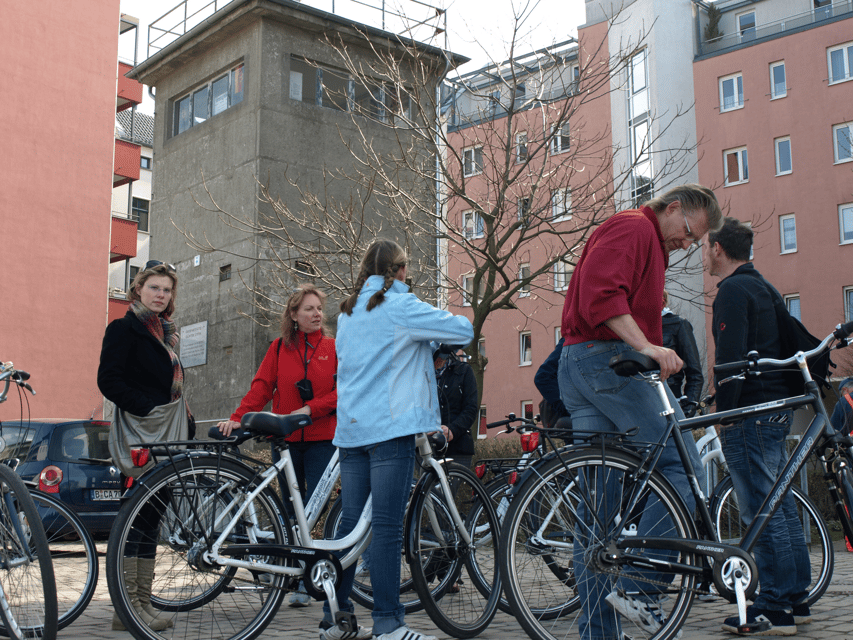
You will also hear why cherry trees came to line Bornholmer Straße. The route then brings you to an original watchtower and surviving sections of the former Death Strip. These remnants matter because they show that the Wall was not only a concrete barrier. It was a controlled zone of fences, patrol routes, towers, open ground, and strict rules.
More Bike Tours in Berlin
- Berlin: Sights and Highlights Bike Tour with a Local Guide
★ 4.8 · 2,698 reviews - Berlin Highlights 3-Hour Bike Tour
★ 5.0 · 948 reviews - Berlin City Bike Tour with Beer Garden Stop
★ 5.0 · 917 reviews
From Mauerpark to Bernauer Straße
From Bornholmer Straße, you cross toward Mauerpark. The name means Wall Park, and the setting shows how Berlin has changed since reunification. A former border zone now serves as open public space, but the old division is still marked by the route beneath your wheels.
The guide follows the former Wall path, known as the Mauerweg. Since only small parts of the original Wall remain, the route depends on markers, memorials, preserved structures, and careful explanation. A bicycle makes sense here because the Wall once ran across a wide part of the city, not along one neat museum corridor.
At Bernauer Straße, the history becomes especially clear. The Wall cut directly through a built-up neighborhood, separating homes, streets, and families. The memorial area preserves sections of the border system and gives you a better sense of the space between East and West than a single slab of concrete could provide.
This is one of the strongest parts of the ride because it combines physical remains with personal stories. The guide can point out the former border line and explain the tragic attempts to cross it. You may find this section more sobering than the famous sights later in the day, but that is also its value. The Wall was not an abstract Cold War symbol. It shaped daily life at street level.
Mauerpark and Bernauer Straße also provide a useful contrast. One is a public park created from a former border zone. The other preserves evidence of the division. Together, they show both the disappearance of the Wall and the effort to remember what happened there.
Ghost stations and former checkpoints
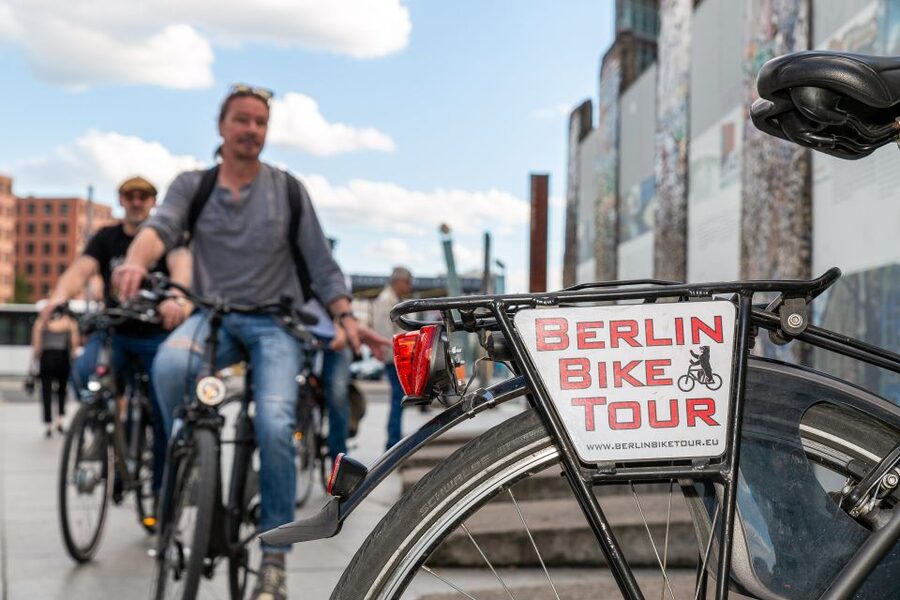
The route continues toward Chausseestraße, where you see a former border crossing and hear about the ghost stations of divided Berlin. During the city’s division, some underground stations in West Berlin were closed or tightly controlled when their train lines passed through East Berlin. Trains could pass beneath the East, but passengers could not get off.
The phrase ghost station gives this part of the route a strange, almost theatrical quality, but the story is rooted in practical control. A train station that should have been part of an ordinary city journey became a sealed space. At Chausseestraße, the guide connects that underground history with the visible border crossing above ground.
You then ride past the Invaliden Graveyard and the former crossing at Invalidenstraße. This stop adds another layer to the tour because it is not only about walls and checkpoints. It shows how the border ran through older parts of Berlin and affected places that had existed long before the Cold War.
The cemetery and crossing also help break up the route. You are not seeing the same concrete remains over and over. Each stop offers a different clue: a checkpoint, a cemetery, an underground station, a watchtower, or an open strip of land.
Along the Government Quarter to the Parliament of Trees
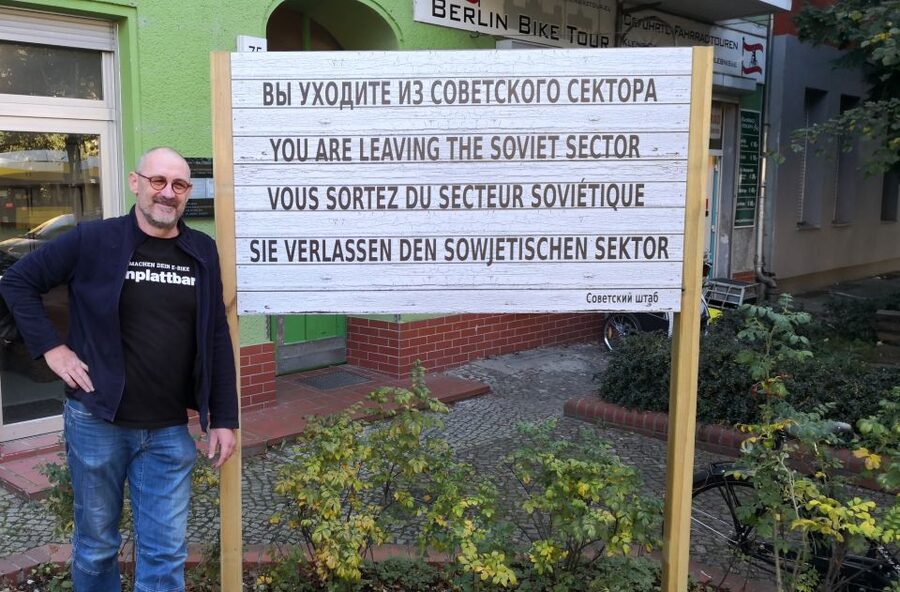
The ride next follows the Government Bank toward the Parliament of Trees. This section moves through the area around Germany’s present-day political center, where the old border once divided the city and the country.
The Parliament of Trees is a memorial made from elements connected to the former border. Its location near the Spree gives you a quieter pause in the middle of the route. The site is less immediately famous than Brandenburg Gate or Checkpoint Charlie, yet it helps show how remembrance has been built into modern Berlin.
I like this portion because it connects the Wall story to the city’s current civic life. Government buildings and public spaces now occupy an area once shaped by confrontation and restricted movement. You get a sense of Berlin as a capital rebuilt around, and sometimes directly on top of, its divided past.
The guide also follows pictures of rabbits painted on the ground. These images refer to the animals that once lived in the Wall’s open border zones, where people were kept out and nature had room to spread. It is a small, memorable detail, and a good reminder that the route is not only a list of dates and political names.
More History Tours in Berlin
- Berlin: Natural History Museum Entrance Ticket
★ 4.6 · 3,382 reviews - Berlin Historical Highlights Walking Tour
★ 4.9 · 657 reviews - Berlin Private Complete History All Day Walking Tour
★ 5.0 · 474 reviews - Berlin: Historic Boat Sightseeing City Center Tour
★ 4.5 · 415 reviews
Brandenburg Gate, Friedrichstraße, and the Palace of Tears
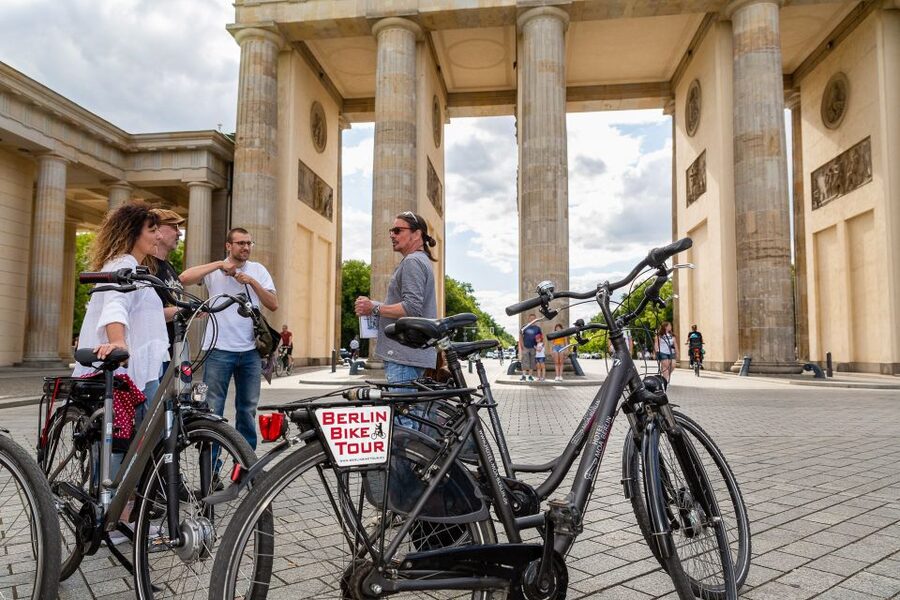
The ride then reaches the Brandenburg Gate, perhaps Berlin’s most recognizable monument. Passing through it by bicycle gives the tour a strong visual turning point. The gate once sat beside the divided border, but today it is a central public landmark.
From there, the route continues to the Tränenpalast on Friedrichstraße, known in English as the Palace of Tears. This former border-crossing hall handled departures between East and West Berlin. Its nickname reflects the farewells that took place there, when people had to separate after short visits or uncertain reunions.
You also pass the Friedrichstadt Palace, Museum Island, the New Synagogue, and the Old Berlin Post Office. These stops widen the tour beyond the Wall itself. Berlin’s division did not occur in an empty zone. It ran through a city filled with theaters, museums, religious buildings, transport links, and ordinary streets.
The central section can feel denser than the opening parts of the tour, with more landmarks competing for attention. That is where a guide adds real value. Instead of trying to identify everything yourself, you can keep moving while the guide explains how the old border related to the city around it.
Potsdamer Platz and Checkpoint Charlie
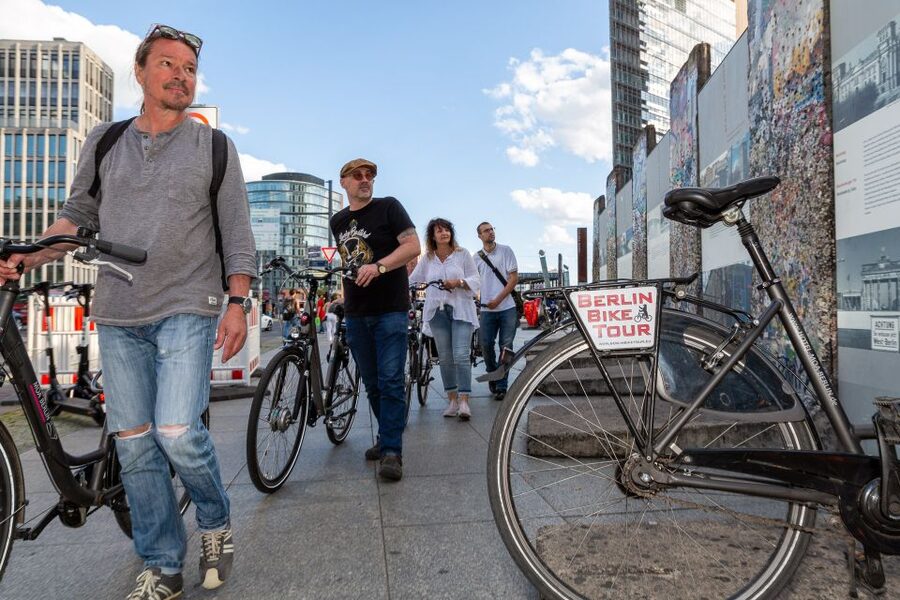
The final stretch brings you to Potsdamer Platz and Checkpoint Charlie. Potsdamer Platz is now known for its modern buildings, but its Wall-era role gives the area a very different meaning. The former border ran through a place that is now a major urban center.
Checkpoint Charlie is the most famous border crossing on the route, and it is also the most polished and commercialized stop. You should see it, but you should not expect it to carry the same quiet force as Bernauer Straße or Bornholmer Straße. The value here is understanding its role in the Cold War and comparing the famous public image with the less obvious remains seen earlier.
By ending at Checkpoint Charlie, the tour creates a clear line across Berlin. You begin where the border first opened and finish at the crossing most associated with Cold War confrontation. The ride connects political history with ordinary geography, showing how far the Wall stretched and how varied its remains are.
The tour returns to the original meeting point at Bornholmer Straße after about four hours. That return matters when planning the rest of your day. You are not left at Checkpoint Charlie with a bicycle to return or an unclear finish point.
Why a bicycle works better than a standard city tour
The Wall route is spread across several neighborhoods. A bicycle lets you cover more ground than a walking tour while still allowing frequent stops. You can see how the border moved from residential streets to parks, government areas, major landmarks, and transport corridors.
The small group also helps. With no more than eight participants, the guide can keep the pace manageable and explain a detail when someone has a question. The experience is not built around a large crowd gathering at one monument. It is a moving lesson, with the city itself providing the map.
Previous participants singled out the relaxed, informative style of the guides. Marcus was praised for combining strong historical explanations with quiet streets, including parts of central Berlin that are easy to miss. Kathrin was noted for adding personal insights to the history. Guide assignments can vary, but those comments give you a useful idea of the tone to expect: serious about the subject, yet not stiff.
The tour is listed at $36 per person. For four hours, that is a solid price if you want the bicycle, guide, route planning, and historical interpretation in one package. You would pay less by walking between a few memorials on your own, but you would cover less ground and miss the connections between separate Wall sites.
Practical details before you book
The tour is offered in German. This is the most important booking decision. If you understand German well enough to follow a spoken explanation while riding and stopping, the format should work well. If not, the tour’s value will be limited because the stories and context are central to the experience.
Bring a passport or ID card, sunglasses, a sun hat, and a camera. Do not bring luggage or large bags. You need to travel light so the bicycle remains comfortable and the group can keep moving.
The tour runs in all weather. On rainy days, a rain poncho is provided, but you should still dress for an outdoor four-hour ride. The listing does not promise food or drinks, so plan to eat before or after the tour rather than expecting refreshments along the way.
You can cancel up to 24 hours in advance for a full refund, and you can reserve now while paying later. Starting times vary, so check the available departure when booking.
Who will enjoy this ride most
I would choose this tour if you want more than the standard Berlin landmarks and are curious about how the Wall affected real streets and real people. It suits anyone interested in Cold War history, political change, urban design, or the way a city remembers painful events.
It is also a good choice if you prefer a calm, active tour rather than a long indoor museum visit. The four-hour length gives the subject room to breathe, though it may feel long if you are not comfortable cycling or have little interest in 20th-century history.
Families and mixed-age groups may appreciate the variety of the route, but every participant needs to manage a bicycle for the full outing. Anyone carrying large luggage should make other arrangements before arriving.
Should you book the Berlin Wall cycling tour?
Book it if you want to understand the Wall as a route through the city rather than as a single surviving monument. Bornholmer Straße, Bernauer Straße, the ghost-station story, the Parliament of Trees, Brandenburg Gate, and Checkpoint Charlie each show a different part of Berlin’s divided past.
Skip it if you need an English-language tour, dislike cycling in changeable weather, or want a short visit focused only on the most famous landmarks. For German-speaking visitors who value clear storytelling, personal guide attention, and a well-planned route, $36 buys a useful four hours and a much fuller picture of Berlin than a quick stop at Checkpoint Charlie alone.
FAQ
Where does the Berlin Wall cycling tour begin?
The tour begins at 75 Bornholmer Straße, Berlin 10439.
Where does the tour end?
The activity ends back at the meeting point on Bornholmer Straße.
How long does the tour last?
The tour lasts four hours.
What language is the tour conducted in?
The live tour guide speaks German.
How many people can join the tour?
The group has a minimum of three participants and a maximum of eight.
Is a bicycle included?
Yes. A bicycle is included in the tour price.
Is a rain poncho provided?
Yes. A rain poncho is provided when necessary on rainy days.
Does the tour run in bad weather?
Yes. The tour takes place in all weather.
Are food and drinks included?
No. Food and drinks are not included.
What should I bring?
Bring a passport or ID card, sunglasses, a sun hat, and a camera. Large bags and luggage are not allowed.
More Berlin Wall and Cold War Tours in Berlin
- Berlin: Third Reich and Cold War 2 Hour Walking Tour
★ 4.9 · 6,830 reviews - Berlin’s Best: 2 Hour Walking Tour Third Reich and the Cold War
★ 5.0 · 5,486 reviews - Berlin: DDR Museum Tickets
★ 4.3 · 3,443 reviews - Skip-the-Line: Berlin Wall Museum at Checkpoint Charlie
★ 4.1 · 2,041 reviews
Just added in Berlin
- Berlin & The Third Reich Private Guided Tour★ 5.0 · 3 reviews
- Third Reich Quest Experience in Berlin★ 4.5 · 7 reviews
- Private Analogue Photography Experience in Berlin★ 5.0 · 3 reviews
- Berlin Urbex Adventure and History Tour★ 5.0 · 9 reviews
- The Beauty of Berlin by Bike: Private Tour★ 5.0 · 59 reviews
- Berlin: Guided Bike tour of the Berlin Wall and Third Reich★ 5.0 · 160 reviews
- Shared Underground Party Tour in Berlin★ 4.5 · 9 reviews
- Beyond Currywurst: Berlin’s Hidden Street Food & Culture Tour★ 5.0 · 100 reviews
Berlin Wall and Cold War Tours, compared.

Berlin’s Best: 2 Hour Walking Tour Third Reich and the Cold War
Read our review →
Skip-the-Line: Berlin Wall Museum at Checkpoint Charlie
Read our review →
East Side Gallery Spree Cruise in a Solar Catamaran
Read our review →
Cold War, Berlin Wall, Spies and the East Side Gallery
Read our review →
Guided Bike Tour of the Berlin Wall and Third Reich
Read our review →
Browse the lists this tour appears in