
Reviewed · HISTORICAL TOURS
Berlin Historical Highlights Walking Tour
Berlin’s story is packed into a single walk here: Cold War checkpoints, Nazi-era ruins, royal boulevards, and modern glass towers all appear within a few hours. You move from Potsdamer Platz to Brandenburg Gate, then along Unter den Linden toward Museum Island, while your guide connects the sites instead of treating them as isolated photo stops.
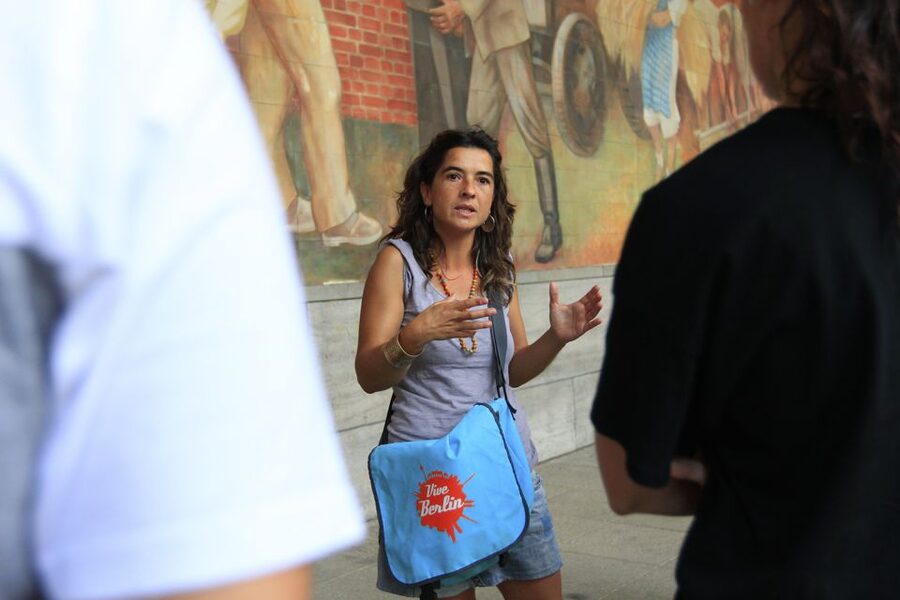
I like the route’s two big strengths. First, it gives you a useful map of central Berlin on your first day. Second, the guides bring plenty of human detail, with Paul, Jean Charles, Céline, and Paolo all receiving special praise for clear explanations, warmth, and steady handling of difficult weather.
The main consideration is the pace. You cover a lot of ground in about three hours, and most stops are outdoor explanations rather than long interior visits. Bring comfortable shoes, dress for Berlin weather, and buy a public transport ticket because the walk does not end at its starting point.
Key points to know before you book
- The route links major eras: Potsdamer Platz, the Berlin Wall, Nazi sites, Prussian landmarks, and Museum Island appear in one continuous walk.
- The three-hour core tour is information-heavy: You get a broad introduction to Berlin rather than long visits inside museums.
- Checkpoint Charlie and the Wall add Cold War context: These stops help explain how Berlin was split and later reunited.
- The Holocaust Memorial and Hitler’s bunker site require a thoughtful tone: Your guide provides context, but these are places for reflection, not quick entertainment.
- Private groups are available for up to six people: At $389 per group, the price makes more sense when shared by a small party.
- Guides can work in four languages: Tours are offered in English, French, Italian, and Spanish, with optional hotel pickup arranged in advance.
Why this walk works as a first look at Berlin
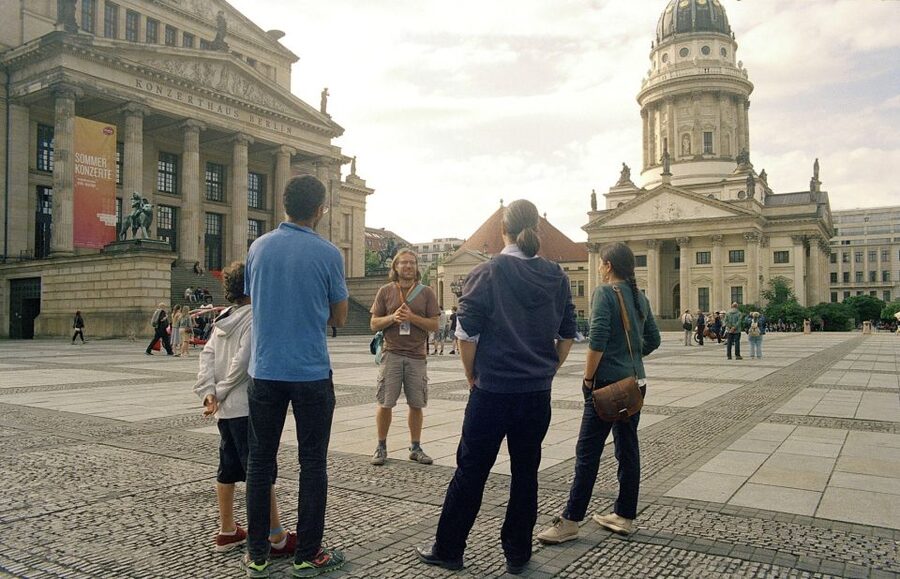
Berlin can feel confusing at first. Its main sights are spread across a large central area, and the city’s story does not follow a neat timeline. A grand avenue may begin beside a former royal building, pass a Nazi-era memorial, and end near a structure rebuilt after German reunification.
This tour gives you that framework on foot. You begin at Potsdamer Platz, a symbol of modern Berlin, then move through the remains and memories of the 20th century before reaching the older center around Unter den Linden and Bebelplatz.
I like this order because it shows how much the city changed. You see sleek modern architecture, fragments of division, memorials to mass murder, an 18th-century gate, a 19th-century parliament building, and reconstructed historic institutions in one route.
You should think of the experience as an outdoor history class with a long walk attached. The guide is the key part. The route itself is easy to find on a map, but the meaning behind each stop is what turns it into a worthwhile introduction.
More History Tours in Berlin
- Berlin: Natural History Museum Entrance Ticket
★ 4.6 · 3,382 reviews - Berlin Private Complete History All Day Walking Tour
★ 5.0 · 474 reviews - Berlin: Historic Boat Sightseeing City Center Tour
★ 4.5 · 415 reviews
Potsdamer Platz and the Berlin Wall
Potsdamer Platz is the starting point for the standard route, with about 15 minutes devoted to the area. It is an apt place to begin because few parts of Berlin show the city’s recent changes so clearly.
Before World War II, this was a major urban crossroads. War damage and the later division of Berlin left it cut off and neglected. After reunification, it became one of the city’s best-known modern building zones.
Your guide uses the square to set up the larger story: Berlin was once the center of imperial power, then the capital of Nazi Germany, then a divided city, and finally a reunited capital trying to reshape itself.
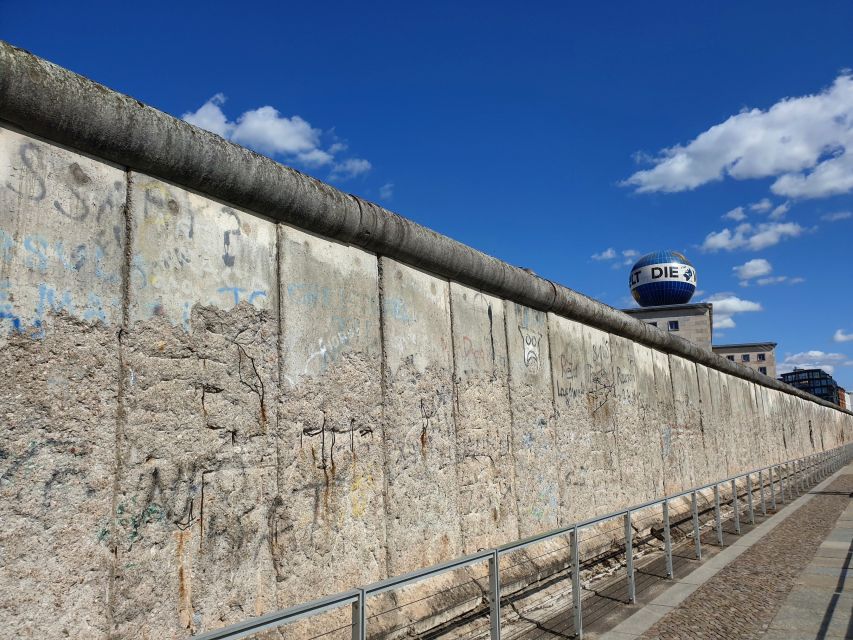
From here, the tour reaches a section of the Berlin Wall for about 20 minutes. Do not expect a long preserved stretch at every point along the route. The value is in understanding what the Wall did to daily life and city geography.
This stop also helps you see why Berlin’s division was not just a political idea. Streets, neighborhoods, transport links, and families were affected. The guide’s explanation gives you a better sense of how the city was split into two separate systems before the Wall came down.
Topography of Terror and Checkpoint Charlie
The next stops focus on Germany’s Nazi dictatorship and the later Cold War. At the Topography of Terror, the guided portion lasts about 10 minutes. That is enough for an introduction, but not enough for a full museum visit.
The site is important because it deals with the institutions behind Nazi terror. Your guide can place the surrounding area into context, helping you understand that the violence was organized through government structures, not carried out by some distant force disconnected from ordinary civic life.
You then reach Checkpoint Charlie, with another 10-minute explanation. The crossing is one of Berlin’s most famous Cold War symbols, though the modern setting can feel theatrical and commercial. That contrast is worth knowing before you arrive.
I appreciate the stop most when it is treated as a starting point for questions rather than the final word on the Cold War. Your guide explains why this crossing mattered and how it represented the division between East and West Berlin.
Because these two stops are short, you will want to visit a museum on your own if you want detailed exhibits. The tour gives you the orientation. You provide the extra time later if the subject catches your interest.
Hitler’s bunker site and the Holocaust Memorial
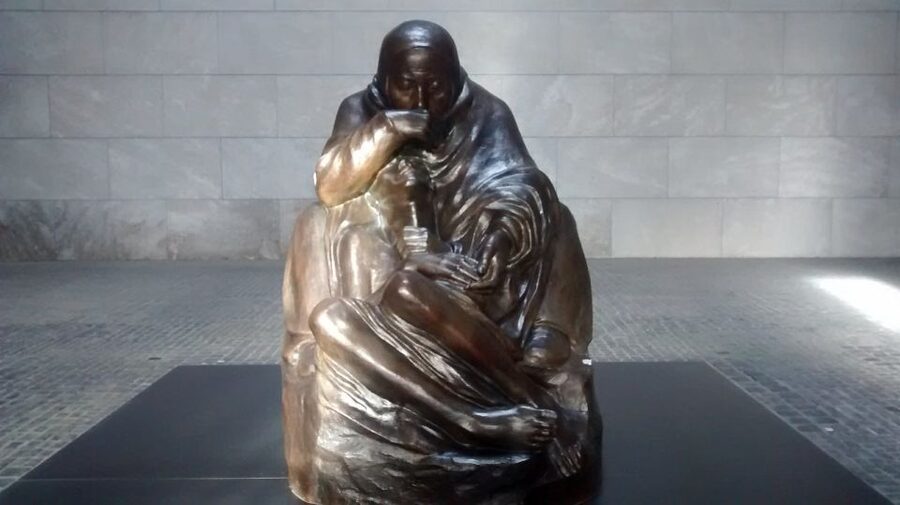
The route then moves to the area of Hitler’s bunker, with roughly 10 minutes of guided explanation. There is no grand underground attraction to enter here. The site is intentionally low-key, and that restraint is part of the point.
Your guide explains where the bunker area was and what happened there during the final days of the Nazi regime. The surrounding city has changed greatly, so the location can be hard to picture without help.
This is a brief stop, but it connects the political history to the physical streets around you. You are not being asked to admire a monument. You are being shown how a place tied to dictatorship and war became part of an ordinary modern city.
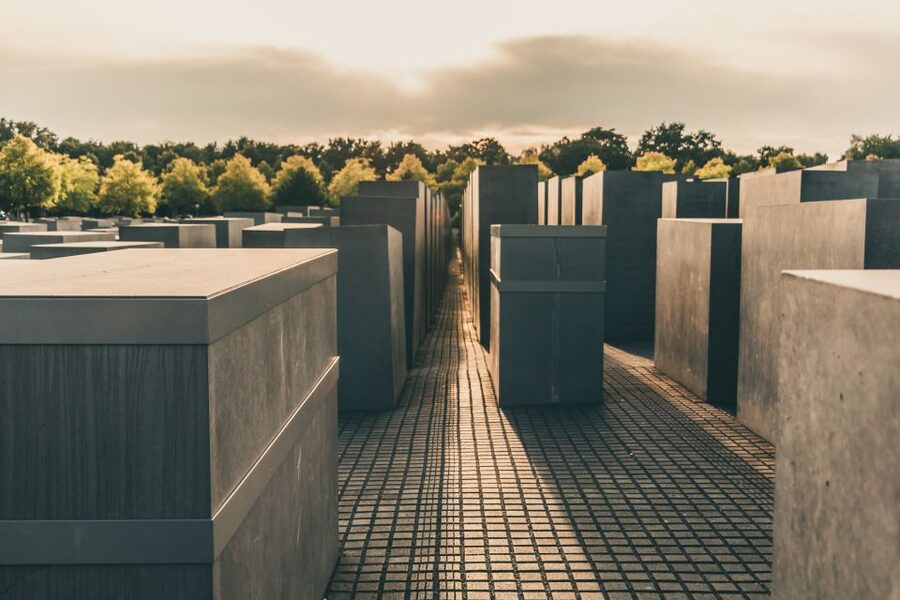
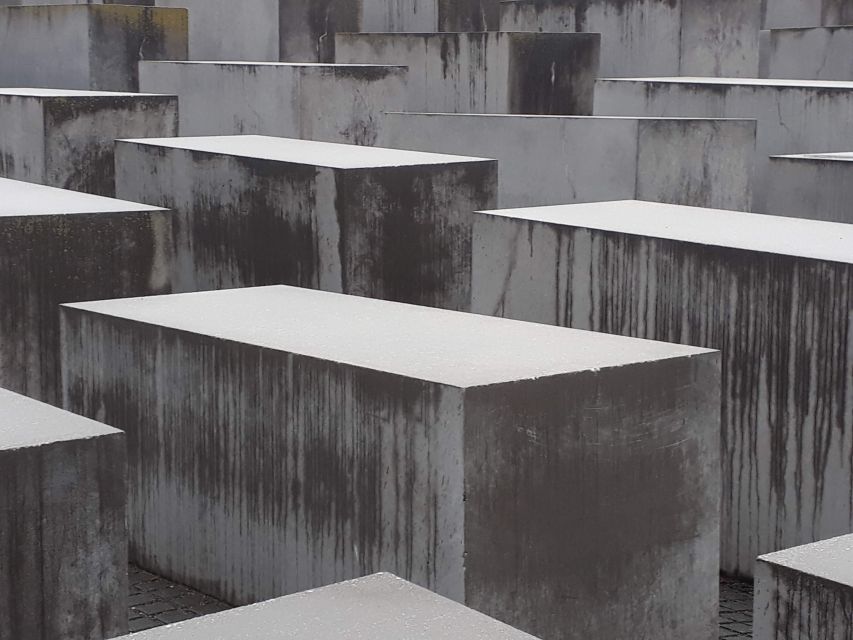
The Holocaust Memorial receives about 20 minutes. Its field of concrete slabs is difficult to take in quickly, and your guide’s context helps you approach it with the seriousness it deserves.
Give yourself time to walk through the memorial at your own pace. The guided explanation is useful, but this is also a place where silence and personal reflection matter. Families with young children may want to explain beforehand why the memorial exists and how to behave there.
I consider this section one of the strongest parts of the tour because it does not treat Berlin’s past as a collection of impressive buildings. It places moral responsibility beside sightseeing.
More Walking Tours in Berlin
- Discover Berlin Half-Day Walking Tour
★ 5.0 · 9,624 reviews - Berlin: Third Reich and Cold War 2 Hour Walking Tour
★ 4.9 · 6,830 reviews - Berlin: Discover Berlin Walking Tour
★ 4.9 · 5,998 reviews - Berlin’s Best: 2 Hour Walking Tour Third Reich and the Cold War
★ 5.0 · 5,486 reviews
Reichstag and Brandenburg Gate
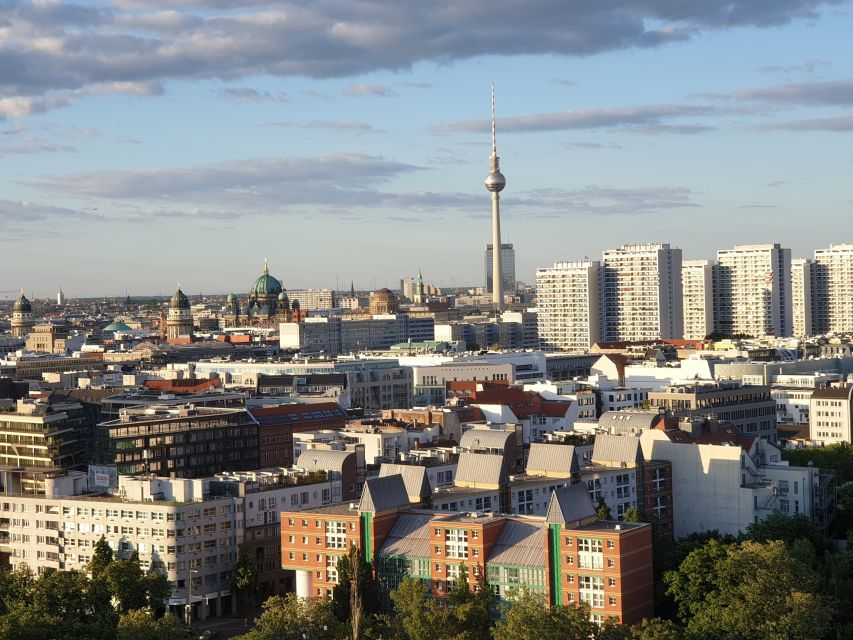
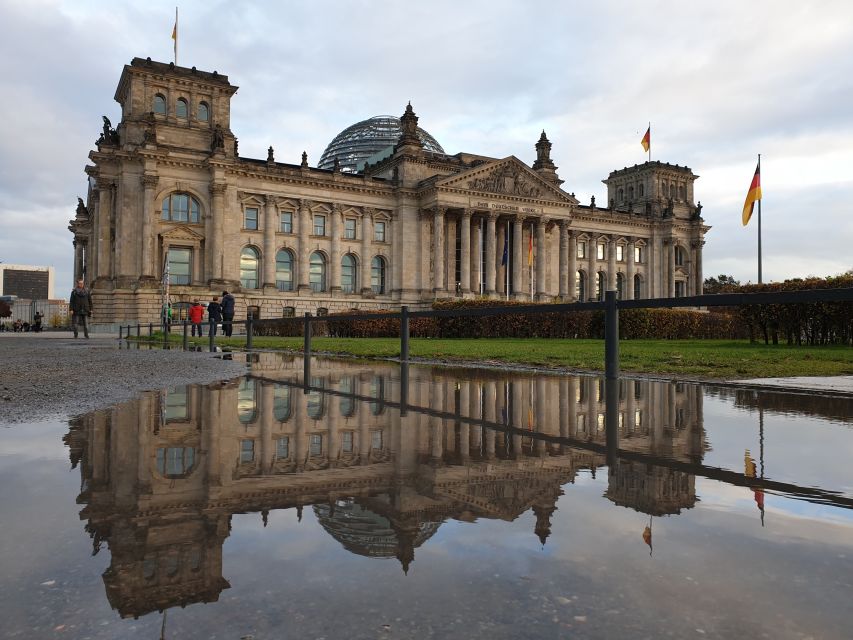
The route continues to the Reichstag, where you get about 10 minutes of background. The building represents Germany’s parliamentary tradition, but its story also includes war, dictatorship, division, and democratic renewal.
You will not spend this tour inside the Reichstag dome. Instead, the guide explains its place in Berlin’s political story from the outside. If you want to visit the interior, that requires separate planning and is not included in the walk.
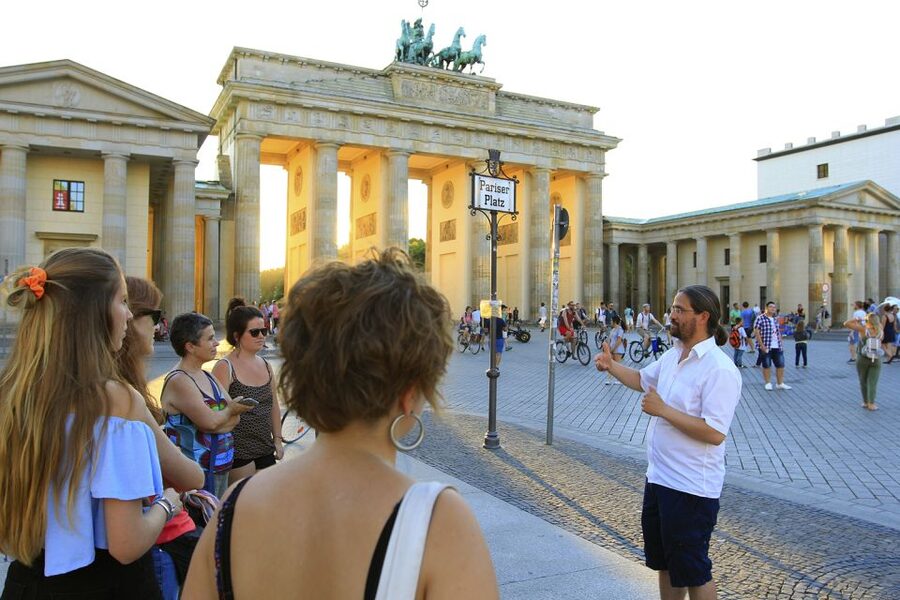
A short walk brings you to Brandenburg Gate, one of Berlin’s essential sights. The gate was built in the late 18th century and once marked an edge of the city. It later became a powerful symbol of division when the Wall stood nearby, and then a symbol of reunification after 1989.
The guide spends about 15 minutes here, followed by a 10-minute break. That pause is welcome. It gives you time for photographs, a drink, or simply a chance to let the earlier material settle.
Brandenburg Gate is often crowded, and the open space can feel exposed in cold or windy weather. Still, its location makes the history easy to read. You can stand beneath a royal monument and look toward a modern capital shaped by war and political change.
Unter den Linden and Bebelplatz
After the break, you walk for about 15 minutes along Unter den Linden. This broad avenue is one of Berlin’s most important historic routes, lined with institutions linked to Prussia, the German state, and the city’s intellectual life.
Walking here gives you a change of mood. The earlier part of the route focuses heavily on war and dictatorship. Unter den Linden brings you into the older ceremonial center, where grand buildings and formal spaces reflect Berlin’s royal past.
The walk reaches Bebelplatz, with about 10 minutes of guided interpretation. The square is associated with Humboldt University, the State Opera, and the Nazi book burning of 1933.
This is a good example of why a guide helps. The buildings may look stately and calm, but the square also carries a reminder of censorship and political persecution. You see how Berlin’s architecture can preserve several layers of history at once.
The route does not offer long indoor visits to the opera or university. You are seeing the setting and learning its importance from the outside. If you want to attend a performance or explore university-related collections, plan that separately.
Museum Island and Humboldt Forum
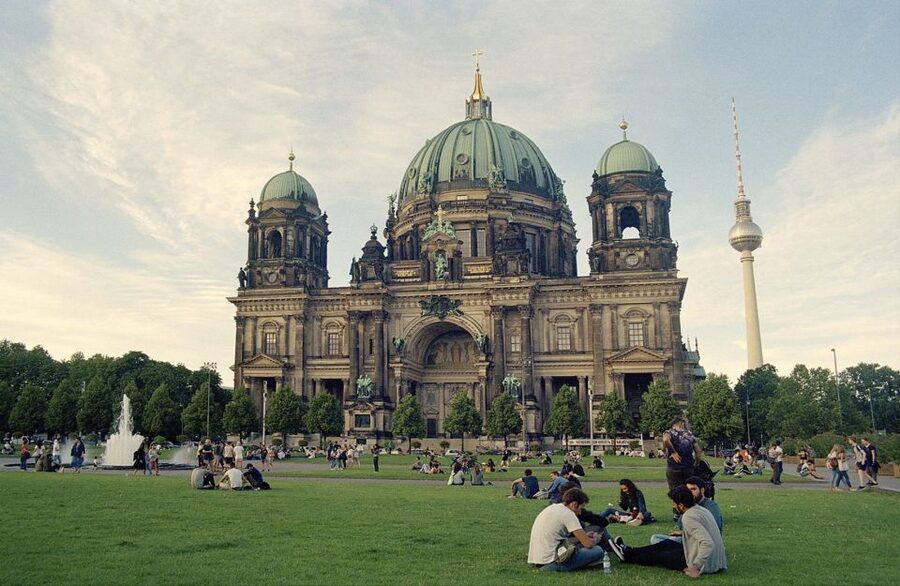
The final section reaches Museum Island, with about 15 minutes of guided explanation, followed by around 10 minutes at the Humboldt Forum. This is where Berlin’s older cultural center meets its reconstructed and modern identity.
Museum Island is home to several major museums, but this walking experience does not include museum admission. That distinction matters. You get an introduction to the island and its buildings, then you can decide which museum deserves your own afternoon.
The Humboldt Forum is especially interesting from the outside because it combines a reconstructed palace façade with modern interior spaces. Your guide explains its place in the rebuilt center of Berlin and points out how the city has chosen to present its past.
For me, this ending works well. You finish not with a single historical event, but with a question about how cities rebuild, remember, and explain themselves. The modern center is not simply old Berlin restored. It is a new version of the city, built around selected pieces of the past.
The scheduled endpoint is around Unter den Linden 5, rather than back at Potsdamer Platz. That is convenient for continuing toward Museum Island or central Berlin, but it also means you need to plan your way onward.
Walking distance, timing, and weather
The central experience lasts about three hours, though the available options may run from three to six hours. Check the selected option carefully because the longer format may allow more time or a different arrangement.
This is a walking tour in the true sense. You move between many stops, with some short talks and several longer stretches on foot. Comfortable shoes are essential, and winter clothing matters. One particularly snowy outing was handled well by guide Paolo, but bad weather can still change the feel of the day.
The route may use the metro if conditions become difficult. Public transport is not included, so I recommend buying a day ticket for Berlin’s AB zones. You may need it to reach the starting point, and you will almost certainly find it useful after the tour because the walk ends elsewhere.
Meeting points vary by the option you choose. Hotel pickup is available by arrangement, but you must provide your hotel name and address and allow at least 72 hours for the private tour to be organized.
The experience is wheelchair accessible according to the activity details. Still, because this is a long city walk with multiple outdoor stops, discuss your specific needs when booking.
What $389 means for the value
The price is $389 per group of up to six people. That is a serious cost for a couple, but the calculation changes for a family or small group. Six people sharing the price pay about $65 each before any transport costs.
The real value is personal service. You are paying for a guide who can explain the route, adjust the discussion, answer questions, and help you make sense of a city that does not always explain itself clearly.
For solo visitors or two people on a tight budget, a group tour or self-guided walk may be better value. For a family, a group of friends, or anyone wanting a private introduction in a chosen language, the price is easier to justify.
The guide quality matters greatly here. Paul has been praised for explaining the key sights and suggesting ways to continue exploring independently. Jean Charles handled a cold-weather walk with warmth and care, while Céline was appreciated for adding anecdotes to the city’s story. Paolo also managed a snowstorm effectively and remained helpful throughout.
Those details point to the main strength of the experience: the people leading it. Berlin’s landmarks are free to see from the pavement. The fee pays for the connections between them.
Who should book this Berlin walk?
I would choose this tour for a first visit, especially if you want a clear introduction before exploring museums on your own. It suits anyone who likes history explained through places rather than presented as a list of dates.
It also works well for families and small private groups. The guide can give you a shared starting point, and the route shows enough of Berlin to help you decide what deserves a longer visit later.
You should think twice if you want extended time inside museums, a leisurely photography walk, or a slow café-to-café outing. The schedule is full, and the historic sites are mainly viewed from outside.
The tour is also better for people ready to discuss difficult subjects. The Nazi period, the Holocaust, Hitler’s bunker, and Berlin’s division are central to the route. The tone is informative and respectful, but the material is not light.
Should you book it?
Book this walk if you want Berlin’s major central sights tied together by a guide rather than visited as disconnected stops. The strongest reasons are the broad route, the personal attention of a small group, and the guides’ ability to make the city’s changes feel understandable.
I would book it early if you need a private guide in English, French, Italian, or Spanish, since the private format requires advance organization. Bring sturdy shoes, buy an AB transport ticket, and leave time later for the museums and interiors the walk only introduces.
At $389, it is best value for up to six people. For a small group seeking a thoughtful first day in Berlin, this is a useful and serious introduction, with enough practical direction to keep exploring after the guide says goodbye.
FAQ
How long does the Berlin Historical Highlights Walking Tour last?
The main walking experience is described as three hours, while available options range from three to six hours. Check the available start times and selected option when booking.
What sights are included?
The route includes Potsdamer Platz, a section of the Berlin Wall, Topography of Terror, Checkpoint Charlie, the area of Hitler’s bunker, the Holocaust Memorial, the Reichstag, Brandenburg Gate, Unter den Linden, Bebelplatz, Museum Island, and the Humboldt Forum.
Where does the tour begin?
The starting point depends on the option booked. The standard route begins at Potsdamer Platz, while hotel pickup can be arranged for a private tour.
Where does the tour end?
The tour has two listed drop-off locations around Unter den Linden 5, 10117 Berlin. It does not end back at the starting point.
Is hotel pickup available?
Yes. Pickup is optional for the private tour. Provide your hotel name and address when booking, wait in the lobby 10 minutes before pickup, and allow at least 72 hours for the private tour to be organized.
Which languages are available?
The tour is offered in English, French, Italian, and Spanish.
Is public transportation included?
No. Public transport tickets are not included. An AB-zone day ticket is recommended to reach the meeting point and continue your journey after the walk.
Is the tour wheelchair accessible?
Yes, the activity is listed as wheelchair accessible. Because the experience covers a long route on foot, contact the provider in advance to discuss your specific needs.
Can I cancel the booking?
You can cancel up to 24 hours before the tour for a full refund. A reserve-now, pay-later option is also available.
Just added in Berlin
- Berlin & The Third Reich Private Guided Tour★ 5.0 · 3 reviews
- Third Reich Quest Experience in Berlin★ 4.5 · 7 reviews
- Private Analogue Photography Experience in Berlin★ 5.0 · 3 reviews
- Berlin Urbex Adventure and History Tour★ 5.0 · 9 reviews
- The Beauty of Berlin by Bike: Private Tour★ 5.0 · 59 reviews
- Berlin: Guided Bike tour of the Berlin Wall and Third Reich★ 5.0 · 160 reviews
- Beyond Currywurst: Berlin’s Hidden Street Food & Culture Tour★ 5.0 · 100 reviews
- Berlin Third Reich & Cold War Walking Tour With A Guide★ 5.0 · 7 reviews
Historical Tours, compared.
City History Canal Sightseeing Tour on a Motorboat
Read our review →


Browse the lists this tour appears in