
Reviewed · THIRD REICH TOURS
Berlin & The Third Reich Private Guided Tour
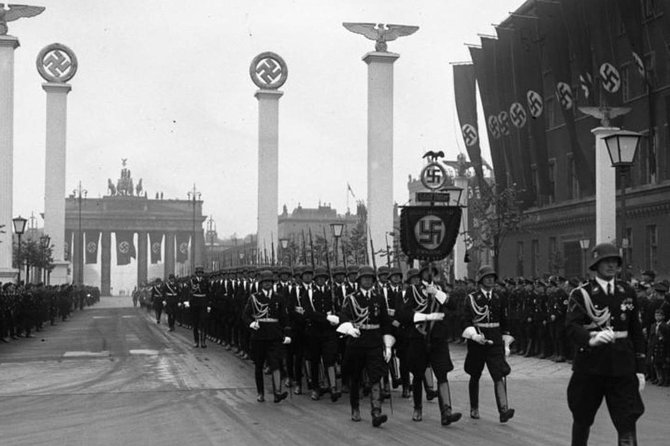
Berlin’s Nazi past is not tucked away in one museum. It is spread across ordinary streets, grand government buildings, empty lots, and famous squares. This private tour connects those places into a clear story, from Hitler’s rise to power through the destruction of 1945. I like the way the route links major sights you might otherwise pass without understanding, and I like having one guide for a private group rather than sharing the walk with strangers.
The four-hour length gives you time to pause at important locations instead of rushing from plaque to plaque. Guides named Walid, Campbell, and Gregor have led this experience, and the strongest praise centers on their ability to explain Berlin’s modern history in an engaging way. The main consideration is that this is primarily a walking and outdoor tour, and several stops are viewed from outside or marked only by a simple sign.
Key points to know
- The route covers Berlin’s central Nazi and Cold War landmarks, including the Reichstag, Brandenburg Gate, Holocaust Memorial, Führerbunker site, Potsdamer Platz, and Checkpoint Charlie.
- Your group gets a private guide for about four hours, with space for up to 15 people.
- The Führerbunker site is now an ordinary parking area, so the value comes from the explanation and location, not from an underground visit.
- The Holocaust Memorial is given about 20 minutes, enough for a quiet look but not a full museum visit.
- The tour begins at Pariser Platz by the Brandenburg Gate and ends back at the meeting point.
- No admission tickets are needed for the listed stops, but the experience is non-refundable after booking.
Berlin’s Nazi story told on the streets
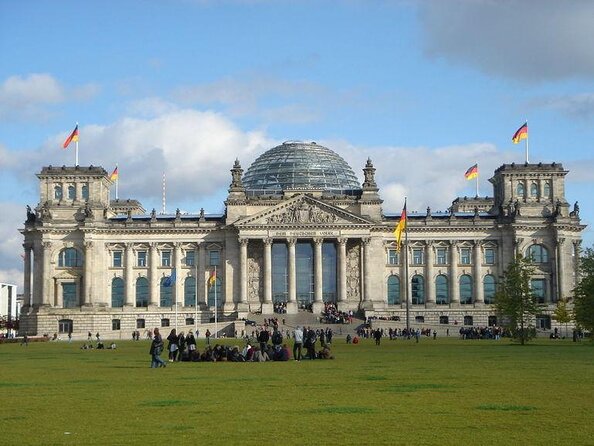
I find this tour most useful for one reason: it places political history on a walkable map. You are not simply told that Hitler rose to power, ruled Germany, and died in Berlin. You see the locations tied to that story, often within a short walk of one another.
The route focuses on how the Nazi movement gained control, how the regime operated from Berlin, and how the city was damaged during the Second World War. It also reaches into the Cold War, showing how the same city later became a frontline between the United States and the Soviet Union.
That range gives the walk a strong sense of time. Berlin changes from royal capital to Nazi headquarters, from bombed battlefield to divided city, and finally to the reunified capital you see today. I appreciate that the tour does not stop at 1945. The visits to Potsdamer Platz and Checkpoint Charlie explain what happened to Berlin after the war, too.
A private format matters here. Your guide can explain a point, pause for questions, or adjust the pace for your group. The experience is priced at $329.92 per group of up to 15, not per person. For a full group, that can be good value. For one or two people, it is a more expensive way to tour than joining a shared walk, but you are paying for privacy and direct attention.
More Third Reich Tours in Berlin
- Berlin: Third Reich and Cold War 2 Hour Walking Tour
★ 4.9 · 6,830 reviews - Berlin’s Best: 2 Hour Walking Tour Third Reich and the Cold War
★ 5.0 · 5,486 reviews - Third Reich Berlin: Hitler and WWII Walking Tour
★ 5.0 · 3,301 reviews
Pariser Platz and the Brandenburg Gate
The tour starts at Pariser Platz, Berlin’s most prestigious square, at the eastern end of Unter den Linden. The Brandenburg Gate occupies the square’s western edge and is one of the city’s most familiar sights.
At first glance, this may feel like a standard photo stop. The guide’s job is to give the gate political weight. It was built as a royal entrance for the Hohenzollern family and was one of 18 former entrances through Berlin’s city walls. Its meaning changed over time as Berlin moved through monarchy, war, division, and reunification.
The Brandenburg Gate survived Napoleon and the Second World War. During the Cold War, it sat inside the restricted area around the Berlin Wall, becoming a symbol of division. Today, it represents a reunified Germany.
The 15-minute stop is a sensible opening. You can get oriented, hear the basic story, and begin the walk without spending too much time on a sight you may already have photographed. I would arrive a few minutes early, since Pariser Platz is the stated meeting point and the route begins here.
The Reichstag and the political machinery of power
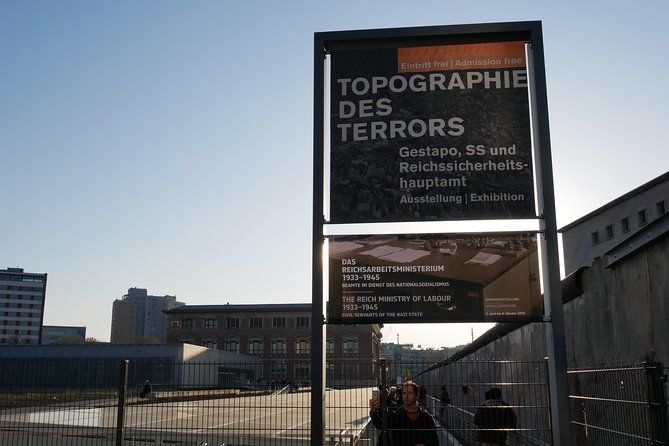
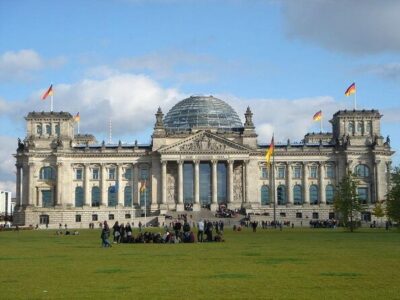
The Reichstag Building is only about 10 minutes on the route, but it carries a great deal of political meaning. It is the home of the German Parliament and is closely tied to the fire that helped Hitler claim sweeping control.
The guide explains the building’s role in the Nazi takeover and later in the Battle of Berlin, when German and Soviet forces fought over the city. That combination makes the Reichstag more than a grand government building. It is a place where the collapse of democracy and the final battle of the war meet.
The building is now topped by a glass dome designed by British architect Norman Foster. That modern addition gives you a visual reminder that the building belongs to a different Germany from the one ruled by the Nazis.
The information provided for this tour does not include entry into the Reichstag or the dome. Treat this as an exterior explanation rather than a parliament visit. That is important if you are hoping to go inside. The tour keeps moving, and the stop is short.
The Holocaust Memorial and the need for quiet
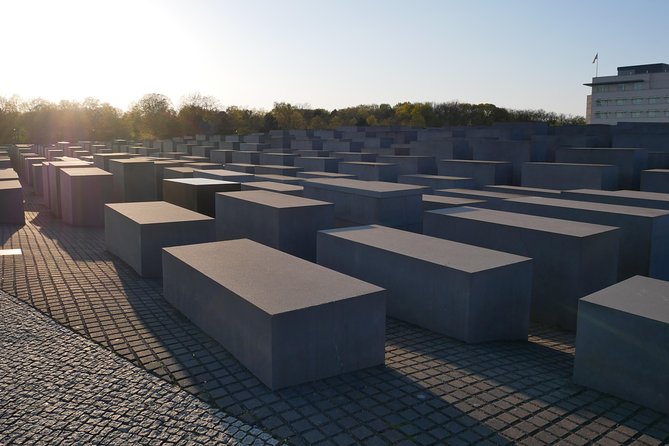
The Memorial to the Murdered Jews of Europe is one of the most serious stops on the route. Its broad field of concrete stelae creates an austere space near the Brandenburg Gate and the former government district.
The memorial is Germany’s central memorial to the Jewish victims of the Holocaust. The tour allows about 20 minutes here, longer than at most other stops. That extra time is useful. You can walk among the blocks, look across the changing levels, and consider the scale of the crime without being pushed immediately to the next landmark.
I value the restraint required at this site. A guide can provide context, but the memorial also needs silence. This is not a stop for rushed photographs or light conversation. If your group includes children, you may want to prepare them for a serious subject before the tour begins.
The memorial itself is not a museum visit in this itinerary. The tour gives you the outdoor site and the guide’s explanation. If you want a longer examination of individual victims, documents, or personal stories, you would need to add another Berlin visit separately.
Same city, a completely different kind of day:
- Berlin: Reichstag, Dome and Government District Guided Tour
★ 4.7 · 18,288 reviews - Berlin: 1-Hour City Tour by Boat with Guaranteed Seating
★ 4.3 · 16,993 reviews - Berlin: Boat Tour Along the River Spree
★ 4.4 · 11,252 reviews - Discover Berlin Half-Day Walking Tour
★ 5.0 · 9,624 reviews
The Führerbunker site, where almost nothing remains
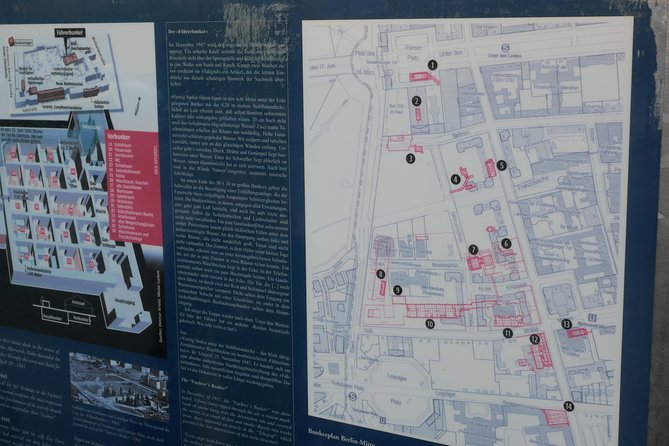
The stop at the Führerbunker is one of the most striking because the physical setting is so plain. Hitler spent his final days there, married, and committed suicide during the final days of the war in Europe. Today, the location is a parking lot with a simple sign.
That mismatch between the importance of the place and its ordinary appearance can make the stop especially effective. You are not entering a preserved bunker or walking through a dramatic ruin. You are looking at a normal part of modern Berlin while standing at the location where the Nazi regime ended.
The guide provides the meaning that the site itself cannot provide. I would expect the explanation to focus on the final days of the war and the end of Hitler’s rule, not on spectacle. The lack of a major structure also keeps the stop grounded. There is no grand monument celebrating the dictator, and no theatrical reconstruction.
The planned 15 minutes should be enough to hear the account and understand the setting. If you want extensive bunker access, this tour will not provide it. The attraction is the historical location and the guide’s narration.
Potsdamer Platz and Berlin’s startling reconstruction
Potsdamer Platz shifts the story from dictatorship and war to urban recovery. Before the war, it was one of Europe’s busiest traffic intersections. The area was almost completely destroyed in the Second World War and later rebuilt as one of Berlin’s most modern districts during the 1990s and early 2000s.
The stop lasts about 10 minutes. That is brief, but it helps you read Berlin as a city rebuilt in layers. At the Führerbunker, you see how little remains. At Potsdamer Platz, you see a deliberate attempt to create a new city center.
This is also a useful break from the most somber parts of the route. The modern buildings and busy streets show how far Berlin has moved from the ruins of 1945. At the same time, the guide can explain how war damage and the Berlin Wall affected this central area.
Do not expect a long architecture tour here. The value is the contrast. You move from the final days of the Nazi regime to a modern precinct shaped by reunification and redevelopment.
Checkpoint Charlie and the Cold War after 1945
Checkpoint Charlie is the final major stop listed on the route. It was a frontline crossing point manned by American and Soviet forces during the Cold War, and its name remains tied to Berlin’s years of division.
This stop broadens the tour beyond the Third Reich. The Nazi period ended in 1945, but Berlin’s political importance did not. The city became a tense meeting point between the Western Allies and the Soviet Union, with the Berlin Wall dividing neighborhoods and families for almost 30 years.
The tour does not treat Checkpoint Charlie as an isolated Cold War curiosity. It helps you see the connection between the destroyed Nazi capital and the divided city that followed. That is one of the route’s best features. You get a continuous story rather than separate history lessons.
The listed visit is about 10 minutes. I would use that time to ask your guide how the city’s division affected the areas you have just crossed. Since the tour ends back at the original meeting point, Checkpoint Charlie is not the final drop-off location.
What the four-hour format means for you
Four hours is long enough to make this feel like a serious history walk, but short enough to fit into a busy Berlin schedule. The timing also gives the guide room to stop for discussion at key locations instead of delivering one continuous speech.
The route includes six major areas, with stop times ranging from 10 to 20 minutes. The rest of the experience is spent walking between them and listening along the way. The available feedback describes the tour as a four-hour stroll with breaks for historical explanations, so comfortable footwear is a practical choice.
Pickup is offered, but the stated start is Brandenburg Gate at Pariser Platz and the activity ends back at that meeting point. Confirm the exact pickup arrangement when booking if you need collection from your accommodation. The listing also says the tour is near public transportation, and most people can participate.
Service animals are allowed. The experience is private, so only your own group takes part. That makes it a good fit for families, couples, friends, or a small educational group that wants to ask questions without holding up strangers.
The value of a private guide
The guide is the heart of this experience. Buildings and memorials provide the setting, but the route only makes sense when someone explains the connection between them.
Names associated with this tour include Walid, Campbell, and Gregor. Walid led a four-hour walk praised for covering the important central historical locations while pausing at key sites. Campbell guided a private June visit, and Gregor was described as exceptionally well informed about Berlin’s modern history. Guide assignments can change, so you should not assume that one of these three will lead your booking.
A private guide also lets you control the questions. You can ask for more detail on the Nazi rise to power, the Battle of Berlin, the Holocaust Memorial, or the Cold War. If your interest is mainly military history, politics, architecture, or the personal stories behind the memorials, say so early.
At $329.92 for up to 15 people, the math works best when you fill several places. A group of 10 pays about $33 per person, while a couple pays about $165 each. That is the key value question. The tour gives you privacy and a connected explanation, but it does not include entry tickets, museum admissions, or a meal.
Who should book this Berlin walk?
I would recommend this tour to anyone who wants a strong first framework for Berlin’s 20th-century history. It suits you especially well if you prefer sites in the city itself over a museum-only visit, or if you want to understand why familiar landmarks matter.
It is also useful for a group with mixed interests. The Brandenburg Gate, Potsdamer Platz, and Checkpoint Charlie provide visual landmarks, while the Reichstag, Holocaust Memorial, and Führerbunker site carry the heavier historical material.
I would be more cautious if you want to spend a long time inside museums, enter the Reichstag dome, or visit a preserved bunker. Those activities are not part of the stated route. You should also think carefully about the non-refundable booking rule. The full amount is lost if you cancel or request a change, so book only when your plans are firm.
Should you book Berlin and the Third Reich Private Guided Tour?
Book it if you want a private, four-hour walking explanation of central Berlin’s Nazi, wartime, and Cold War history. The route is well chosen, the stops are free, and the guide adds the context that ordinary sightseeing often misses.
I would book for a group of several people, since the flat price becomes more reasonable as your party grows. I would also book early enough to secure the date you need, since the experience is typically reserved about 12 days ahead.
Skip it if you need guaranteed indoor access, a museum-heavy day, or a flexible cancellation policy. For everyone else, this is a focused way to understand how Berlin’s streets carry the marks of dictatorship, destruction, division, and reunification.
FAQ
Where does the tour begin?
The tour begins at Brandenburg Gate on Pariser Platz, 10117 Berlin, Germany.
Where does the tour end?
The activity ends back at the original meeting point.
How long does the tour last?
The tour lasts approximately four hours.
Is this a private tour?
Yes. Only your own group participates.
How many people can join one booking?
The price covers a group of up to 15 people.
What is the price?
The listed price is $329.92 per group of up to 15 people.
Is hotel pickup available?
Pickup is offered, although the stated meeting point is Brandenburg Gate. Confirm the exact pickup details when booking.
Does the tour include admission tickets?
The listed stops have no admission ticket charge. The information provided does not include entry into the Reichstag or any museum.
Are service animals allowed?
Yes, service animals are allowed.
Can I cancel or change the booking?
No. The experience is non-refundable and cannot be changed for any reason. If you cancel or request an amendment, the amount paid is not refunded.
Just added in Berlin
- Third Reich Quest Experience in Berlin★ 4.5 · 7 reviews
- Private Analogue Photography Experience in Berlin★ 5.0 · 3 reviews
- Berlin: Guided Bike tour of the Berlin Wall and Third Reich★ 5.0 · 160 reviews
- Berlin Urbex Adventure and History Tour★ 5.0 · 9 reviews
- The Beauty of Berlin by Bike: Private Tour★ 5.0 · 59 reviews
- Beyond Currywurst: Berlin’s Hidden Street Food & Culture Tour★ 5.0 · 100 reviews
- Berlin Third Reich & Cold War Walking Tour With A Guide★ 5.0 · 7 reviews
- Shared Underground Party Tour in Berlin★ 4.5 · 9 reviews
Third Reich Tours, compared.

Berlin’s Best: 2 Hour Walking Tour Third Reich and the Cold War
Read our review →
Third Reich Berlin: Hitler and WWII Walking Tour
Read our review →
Walking Tour of Former Nazi Party Rally Grounds
Read our review →
Berlin Third Reich Sites: Half-Day Walking Tour
Read our review →Browse the lists this tour appears in