
Reviewed · THIRD REICH TOURS
Third Reich & WWII Walking Tour
Munich’s Nazi past is not tucked away in one museum. It is spread across ordinary squares, grand buildings, beer halls, and government streets. This 2-hour-45-minute walking tour connects those places into one clear story, from the movement’s early days to the ruins left behind in 1945.
I like the route’s focus on real locations, especially Königsplatz, Feldherrnhalle, Hofbräuhaus, and the Hofgarten. I also like the guides’ approach: Josh, Michael, Alex, Ulrich, Danielle, Bridget, Joel, and others are described as clear, serious, and open to questions. The main drawback is physical, not historical: you will walk and stand for most of the tour, with little time to sit or eat.
Key points to know before booking
- Munich’s Nazi story unfolds on foot: The route links the Hofbräuhaus, Feldherrnhalle, Königsplatz, and Hofgarten rather than treating each site as an isolated sight.
- The White Rose adds a resistance story: The tour does not focus only on Hitler and the Nazi Party. It also discusses Munich’s brave student resistance movement.
- Guides bring different strengths: Josh is praised for context and passion, while Michael, Alex, Ulrich, Danielle, Bridget, and Joel are also named as strong guides.
- Plan for nearly three hours outside: Comfortable shoes, a drink, and weather-appropriate clothing matter.
- The group size needs checking: The tour is presented as limited to 10 people, although the booking information also gives a maximum of 30.
- You finish at Königsplatz: The endpoint is at Hitler’s former headquarters, making it easy to continue with nearby historical sights.
Why this Munich tour matters
A tour about the Third Reich can easily become a parade of dates and dictators. This one has a more useful aim: it shows how Munich became a center of the Nazi movement and how public spaces were used to build political power.
You begin at Marienplatz, Munich’s central square. That is a practical meeting point, but it also gives the guide a chance to place the city in the difficult years after World War I. Germany was defeated, inflation was severe, and Bavaria was shaken by revolution and political violence. Those conditions helped create an opening for radical movements.
I value this kind of setting because it connects national events to local streets. You are not simply hearing that the Nazi Party grew in Munich. You are shown the places where speeches, marches, meetings, and attempted power grabs took place.
The subject is heavy, and the tour is not designed as light sightseeing. It is best for adults and older teenagers with an interest in modern German history. The experience is specifically not recommended for children under 12.
More Third Reich Tours in Munich
- Munich: Third Reich & WWII Walking Tour
★ 4.6 · 6,181 reviews - Third Reich Walking Tour Munich
★ 4.5 · 4,291 reviews - Munich: Birthplace of the Third Reich Guided Walking Tour
★ 4.6 · 771 reviews
From Marienplatz to the Hofbräuhaus
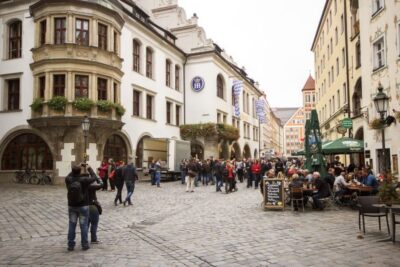
The walking route begins in central Munich and moves toward locations linked to the Nazi Party’s early growth. Hofbräuhaus is one of the most important stops because it was connected with the movement’s first mass meeting in Munich.
The building is also a working beer hall and a major city attraction, so you will see it in a normal urban setting rather than behind museum glass. That contrast is useful. It shows how political history can sit alongside everyday Munich life, even when the original events were anything but ordinary.
Your guide explains how Hitler and the Nazi movement used public gatherings, speeches, and group identity to gain support. The aim is not just to list what happened inside the hall. It is to explain how political movements gain attention during periods of fear, uncertainty, and social division.
This is also where an interactive guide can make a real difference. Josh and Michael are repeatedly praised for answering questions and explaining the subject in plain terms. Alex is noted for welcoming discussion, while other guides are described as warm and engaged despite the serious topic.
The practical issue is pace. There is little scheduled time for food or a proper break, so bring water and perhaps a small snack. You may pass cafés and shops along the way, but the tour itself is not built around stopping for refreshments.
Feldherrnhalle and the failed power grab
Feldherrnhalle is tied to the 1923 Beer Hall Putsch, Hitler’s failed attempt to seize power in Bavaria. The site helps explain the difference between a political movement gaining followers and a movement successfully taking control.
This part of the tour is valuable because it covers the early Nazi period before the dictatorship was fully established. You learn about ambition, propaganda, confrontation, and failure, as well as the way later Nazi storytelling reshaped the meaning of the event.
Your guide will also help you read the setting. Feldherrnhalle is a prominent monument in central Munich, surrounded by busy streets and grand architecture. Without explanation, it can be easy to walk past without understanding why it matters.
The stop is not long enough for a full museum treatment, and that is worth keeping in mind. You receive an overview connected to the wider route, not an academic seminar on every political faction in Bavaria. For most people, that is a sensible balance during a walking tour.
Königsplatz and the power of public space
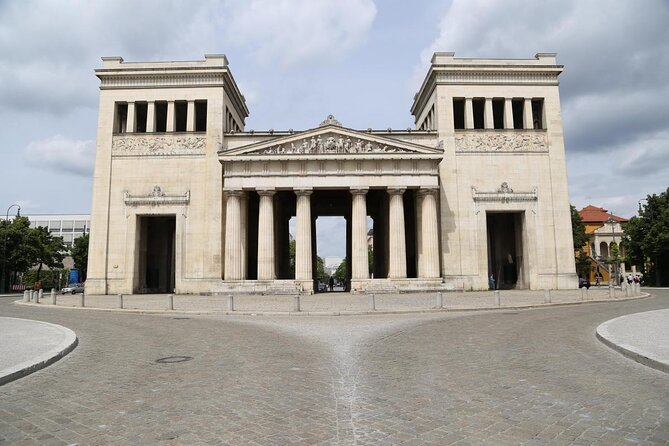
Königsplatz is the tour’s major visual and political setting. The square was used for mass Nazi Party rallies and became closely associated with the regime’s public image.
Here, the guide can show how architecture and open space were used to create a sense of order, scale, and collective power. A large square can turn a political gathering into a carefully staged performance. The location makes that idea easier to understand than a paragraph in a book.
Königsplatz is also the ending point, near Hitler’s former headquarters. That gives the route a strong finish, since the final location ties together the movement’s rise, its years in power, and Munich’s destruction during World War II.
The endpoint is practical as well as historical. You can continue exploring nearby sites after the tour, and the guide may offer suggestions for museums and landmarks. Alex, in particular, is praised for helping people plan the rest of their time in Munich.
One point needs clarification before booking. The tour is described as a small group limited to 10 people, which would make it easier to hear the guide and ask questions. The additional booking details list a maximum of 30 participants. I would confirm the expected group size if a small group is important to you.
More Walking Tours in Munich
- Munich: Night Watchman Walking Tour
★ 4.7 · 2,092 reviews - Munich Ghosts and Spirits Evening Walking Tour
★ 5.0 · 1,900 reviews - Munich Old Town Walking Tour
★ 4.5 · 1,287 reviews - Munich: Walking Tour Old Town and Viktualienmarkt
★ 4.7 · 839 reviews
The Hofgarten and the White Rose
The tour’s treatment of the White Rose is one of its most important features. The White Rose was a resistance movement associated with students who opposed the Nazi regime.
Including this story keeps the tour from becoming a simple account of Nazi power. Munich was not only a city where the movement grew. It was also a place where people resisted, took personal risks, and rejected the pressure to conform.
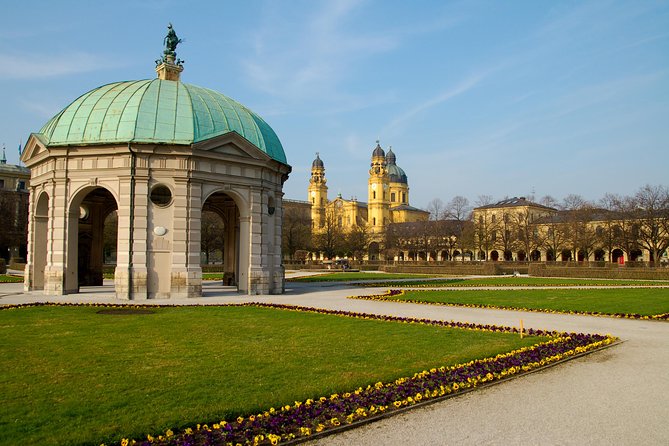
The Hofgarten stop gives the guide room to discuss that resistance in relation to the city around you. This section may be especially meaningful if you want to understand how Germans today remember and confront this period.
The subject calls for care, and the strongest guides appear to handle it with restraint. They explain the facts without softening them, but they also allow quiet moments for reflection. That is the right tone for a tour dealing with persecution, war, and mass death.
Do not expect entertainment in the usual sightseeing sense. The guides can be personable and even lightly humorous when appropriate, but the purpose here is reflection and understanding.
What the guides add to the experience
The guide is the key variable on any history walk, and this tour has several named guides with strong feedback.
Josh is praised for explaining the rise of the Nazis, the political setting, and the psychology behind the movement. He also uses historical photographs and visual material, which can help you compare modern Munich with the city as it appeared during the period.
Michael is described as easy to follow, interactive, and able to handle detailed questions. Alex receives praise for both historical storytelling and group management, particularly when Munich is crowded during the Christmas market season.
Ulrich is noted for suggesting a visit to the documentation museum at the end of the route. Danielle is praised for keeping the group engaged in cold weather, while Bridget is described as helpful with ideas for places to eat, rest, and continue sightseeing.
You should not assume that every guide will use exactly the same examples or presentation. Still, the repeated pattern is clear: the tour depends heavily on a guide who can explain difficult material without turning it into a lecture.
Hearing can be an issue. One participant found the guide difficult to hear and suggested amplification. If the group is larger than expected or the streets are noisy, position yourself close to the guide and ask for repetition when needed.
Walking conditions, weather, and timing
The advertised duration is about 2 hours and 45 minutes, and the tour involves a good deal of walking and standing. One account describes roughly three and a half hours of walking and standing, so allow some flexibility in case the pace or stops run longer.
You will be outdoors for most of the experience. Munich can be cold, especially during the Christmas market season and winter months. Several guides kept the group engaged in freezing weather, but good clothing remains your responsibility.
Wear comfortable shoes. Bring water and a snack because there is little time for a formal break. If you have difficulty walking or standing for long periods, this may not be the right way to study Munich’s past.
The tour is offered in English and includes a mobile ticket. It starts at Marienplatz and ends at Königsplatz, so you do not return to your starting point. That one-way route is efficient for sightseeing, but you should plan your next stop from Königsplatz rather than Marienplatz.
Is $35.09 a fair price?
At $35.09 per person, the tour is priced reasonably for nearly three hours with a professional guide and a route covering several important sites. You are paying for explanation and structure, not admission to a museum or a meal.
That distinction matters. Admission tickets are not included, and food and drinks are also your responsibility. The value comes from having someone connect the sites, explain the political setting, and answer questions as you move through central Munich.
I think the price works best if you have limited time in the city or want a clear introduction before visiting a documentation center or museum on your own. You may get less value if you already have a strong command of Munich’s Nazi history and prefer to study each site independently.
The tour is booked, on average, 22 days ahead, so it is sensible to reserve early if your Munich dates are fixed. Free cancellation is available up to 24 hours before the start time. Changes or cancellations inside that window are not accepted for a refund.
Who should book this walking tour?
I would choose this tour if you want local history explained at the actual sites where it happened. It suits adults, students, history readers, and anyone who wants more than a general city tour.
It is also a good choice if you prefer conversation. The guides appear willing to take questions and adjust explanations for beginners, while still offering enough detail for people who already know the broad outline of World War II.
You should think twice if you dislike serious historical subjects, have limited mobility, or need frequent indoor breaks. The route is not a relaxed stroll with long café stops. It is a focused history walk with a steady pace.
Should you book the Third Reich and WWII Walking Tour?
Book it if you want to understand why Munich mattered to the Nazi movement and how the city remembers that past today. The route covers the early meetings at Hofbräuhaus, the failed attempt at Feldherrnhalle, the rally ground at Königsplatz, and the White Rose resistance in the Hofgarten.
The strongest reasons to go are the site-by-site storytelling, the range of guides, and the willingness to discuss both Nazi power and German resistance. Bring water, wear good shoes, dress for the forecast, and confirm the expected group size if that matters to you.
At $35.09, it offers solid value for a serious, well-organized introduction to Munich’s most difficult chapter.
FAQ
How long does the Third Reich and WWII Walking Tour last?
The advertised duration is approximately 2 hours and 45 minutes. You should allow extra time because the tour includes substantial walking and standing.
How much does the tour cost?
The listed price is $35.09 per person.
What language is the tour offered in?
The tour is offered in English.
Where does the tour start?
The meeting point is Marienplatz in Munich, at 80331 München, Germany.
Where does the tour end?
The tour ends at Königsplatz 1, 80333 München, near Hitler’s former headquarters.
Are museum admissions included?
No. Admission tickets are not included in the tour price.
Is food or drink included?
No. You need to arrange your own food and drinks. Bringing water and a small snack is useful because the tour has little time for a formal break.
Is the tour suitable for children?
The tour is not recommended for children under 12 years old.
What is the cancellation policy?
You can cancel up to 24 hours before the experience starts for a full refund. Cancellations or changes made less than 24 hours before the start time are not accepted for a refund.
Just added in Munich
- Private transfer: Vilshofen to Munich with 2h sightseeing stop★ 5.0 · 6 reviews
- Pub crawl incl. Oktoberfest museum guided tour with beer tasting (private)★ 5.0 · 5 reviews
- South Tyrolean specialties and wine tasting★ 5.0 · 5 reviews
- Size Matters Beer Tour Munich★ 4.6 · 105 reviews
- Short & sweet: Tasting the Viktualienmarkt★ 4.8 · 37 reviews
- Secret Food Tours Munich★ 4.8 · 5 reviews
- Munich: Romantic Wine Experience for Two at Viktualienmarkt★ 4.2 · 14 reviews
- Munich: Resistance against Hitler – Historical Walking Tour★ 5.0 · 5 reviews
Third Reich Tours, compared.


Berlin’s Best: 2 Hour Walking Tour Third Reich and the Cold War
Read our review →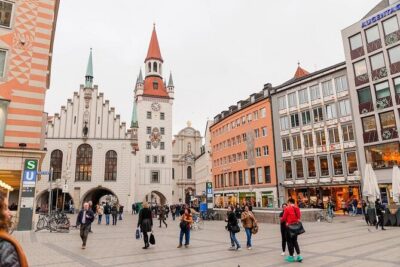
Third Reich Berlin: Hitler and WWII Walking Tour
Read our review →
Walking Tour of Former Nazi Party Rally Grounds
Read our review →
Berlin Third Reich Sites: Half-Day Walking Tour
Read our review →Browse the lists this tour appears in