
Reviewed · HISTORICAL TOURS
Charité Hospital Walking Tour: Exploring Berlin’s Medical History
Berlin’s Charité campus is more than an old hospital. It is where stories of medical breakthroughs, political pressure, and human courage meet. On this two-hour walk, you move from Robert Koch’s monument to a neoclassical veterinary theater, then through the red-brick campus and along the canal where East Berliners tried to swim west.
I like the tight route and the small-group limit of 15. I also like that the guide connects famous names such as Koch, Rudolf Virchow, and Albrecht von Graefe with real ethical questions. The main drawback is clear: you do not enter buildings where clinical or university work takes place, so this is an outdoor history walk rather than an inside tour of Charité.
Key points at a glance
- Robert Koch’s monument begins the story: Learn how Berlin’s oldest hospital was established in the 18th century and hear about Koch’s work on tuberculosis, anthrax, and cholera.
- Six stops fit into two hours: Each stop receives about 20 minutes, making this a useful choice when your Berlin schedule is already full.
- The tour tackles hard subjects: Expect discussion of medical abuse during the Third Reich, doctors who resisted it, and hospital life under socialism.
- The Tieranatomisches Theater adds architectural interest: This surviving 18th-century academic building shows how animal disease was studied before modern medical science.
- The canal provides a Cold War ending: At Humboldthafen, you hear about East Berliners who attempted to reach the West by swimming.
- Small-group English guiding keeps it focused: The maximum group size is 15, and a guide is included in the $30.12 price.
Why Charité makes such an unusual Berlin walk
You can visit Berlin for days and still hear little about the city’s medical past. Charité changes that. Its story reaches from 18th-century public health to Nobel Prize science, from modern pathology to Nazi crimes, and from socialist hospital life to escape attempts during the division of Berlin.
That range gives the walk more weight than a simple tour of plaques and statues. You are not only learning who the doctors were. You are also considering how medicine can help people, serve governments, or be misused by both.
The format is easy to manage. The tour lasts about two hours, with roughly 20 minutes at each of six stops. That steady pace gives you enough time for explanation without turning the outing into a full-day commitment.
The walk is offered in English, and the price is $30.12 per person. Since all admission stops are free, much of what you are paying for is the guide’s interpretation and the structure of the route. For me, that is the key value here. You could visit several of these outdoor sites on your own, but you would miss the connections between them.
More History Tours in Berlin
- Berlin: Natural History Museum Entrance Ticket
★ 4.6 · 3,382 reviews - Berlin Historical Highlights Walking Tour
★ 4.9 · 657 reviews - Berlin Private Complete History All Day Walking Tour
★ 5.0 · 474 reviews
Robert Koch’s monument and the hospital’s 18th-century beginnings
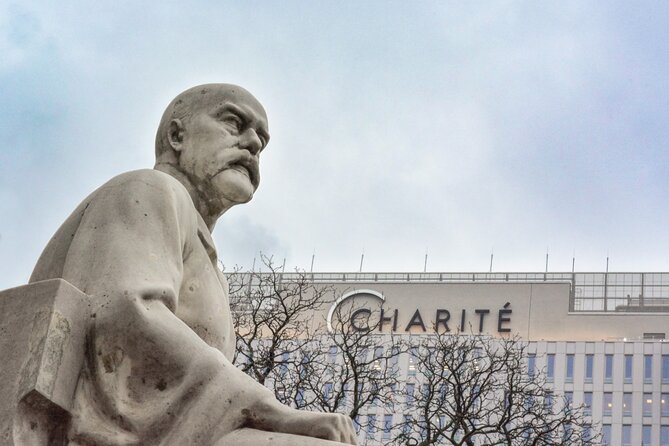
The meeting point is Robert-Koch-Platz, at the Robert-Koch Denkmal. This is a sensible place to begin because the first stop combines the origins of Charité with one of the most important names in medical science.
You hear why and how Charité was established in the 18th century. It is described as Berlin’s oldest hospital, and the early story helps explain the institution’s place in the city. Medicine at the time was far removed from today’s laboratory-based practice, which makes Koch’s later work feel even more significant.
Robert Koch discovered the causes of tuberculosis, anthrax, and cholera. Those diseases were not abstract academic problems. They affected ordinary families and could spread with frightening speed. His work helped establish the germ theory of disease and changed how doctors thought about infection.
The stop also includes a less comfortable part of Koch’s story: his role in the first pharmaceutical scandal in medical history. That detail matters because it keeps the tour from turning a famous scientist into a spotless hero. Medical progress can come with mistakes, disputes, and harm, and the guide brings that tension into the conversation.
You spend about 20 minutes here. The monument itself is free to see, but the value comes from having the scientific and institutional background explained before you move on.
The Tieranatomisches Theater and medicine before modern science
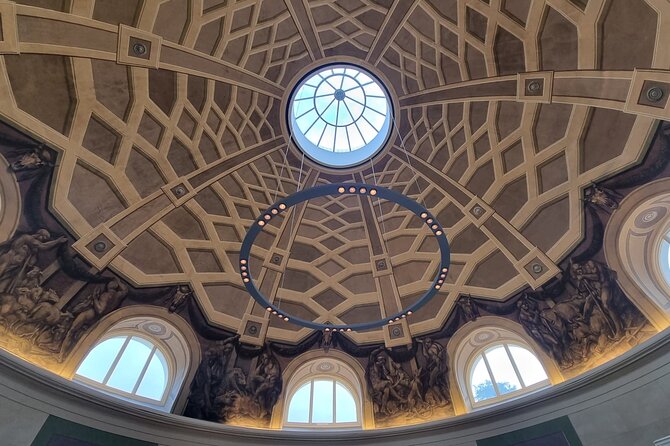
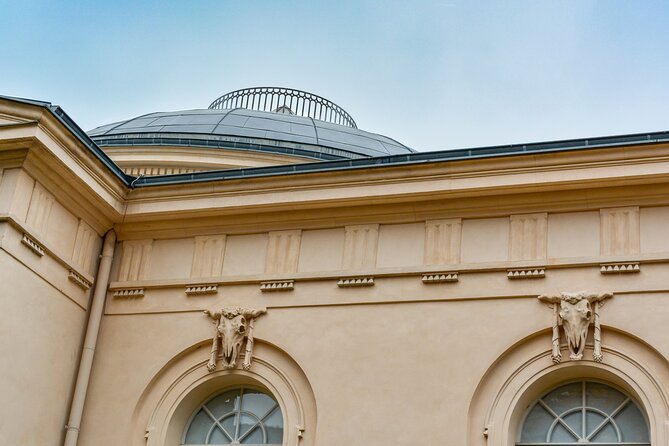
The next stop is the Tieranatomisches Theater, an 18th-century neoclassical building and the oldest surviving academic building in Berlin. Even from the outside, it gives the route a change of mood. The clean classical design feels formal, while the subject matter involves animal disease and early medical study.
Veterinarians studied here, and the guide explains how diseases were treated before the arrival of modern science. That question is more revealing than a simple list of old remedies. It shows how doctors and veterinarians worked with limited evidence, uncertain theories, and methods that could be ineffective or dangerous.
This is one of the strongest stops for visitors who enjoy the history of science. It also helps you understand that medical progress did not happen in one sudden leap. Institutions such as this one created places where observation, teaching, and debate could gradually replace guesswork.
You should keep your expectations practical. The building is part of the outdoor route, and you are not promised an interior visit. The attraction here is the architecture and the explanation, not a museum-style display inside.
Rudolf Virchow and the birth of social medicine
At the monument to Rudolf Virchow, the tour shifts from individual diseases to the wider conditions that shape health. Virchow is presented as the father of modern pathology and the founder of social medicine.
Pathology studies disease by examining what happens inside the body. Social medicine asks a broader question: how do living and working conditions affect health? That makes Virchow especially important for understanding medicine as a public concern, not only a private service between doctor and patient.
This stop gives the walk a useful link to modern life. Hospitals and laboratories matter, but so do housing, sanitation, poverty, employment, and access to care. You do not need a medical background to follow the discussion. The monument serves as a starting point for a larger look at the duties of doctors and the role of society.
At roughly 20 minutes, the stop is long enough for context but short enough to keep the walk moving. If you want a tour focused only on famous buildings, this may feel talk-heavy. If you like ideas tied to real places, it is one of the more rewarding sections.
More Walking Tours in Berlin
- Discover Berlin Half-Day Walking Tour
★ 5.0 · 9,624 reviews - Berlin: Third Reich and Cold War 2 Hour Walking Tour
★ 4.9 · 6,830 reviews - Berlin: Discover Berlin Walking Tour
★ 4.9 · 5,998 reviews - Berlin’s Best: 2 Hour Walking Tour Third Reich and the Cold War
★ 5.0 · 5,486 reviews
Albrecht von Graefe and the rise of modern eye care
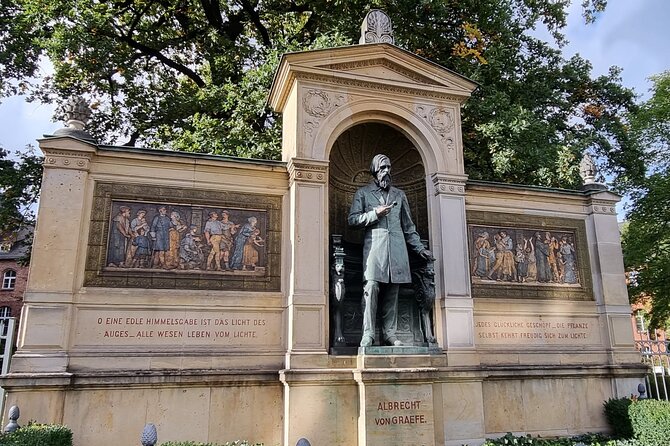
The monument to Albrecht von Graefe introduces another major figure. Von Graefe was a groundbreaking ophthalmologist, and his monument was the first in Berlin dedicated to a scientist.
That fact gives the stop a second subject beyond eye medicine. Public monuments reveal whom a city chooses to honor and when scientific achievement became worthy of the same civic recognition given to political and military figures.
The tour uses von Graefe’s story to show how a specialized branch of medicine developed. Ophthalmology may seem narrow compared with the wider history of Charité, but focusing on one field makes medical change easier to picture. You move from broad theories about disease to the work of a doctor known for treating problems of sight.
Again, this is an outdoor stop. Do not expect a clinic visit or a technical demonstration. The appeal is the combination of a scientist’s biography, the history of eye care, and the meaning of the monument itself.
Charité Campus Mitte, red brick, and medicine under dictatorship
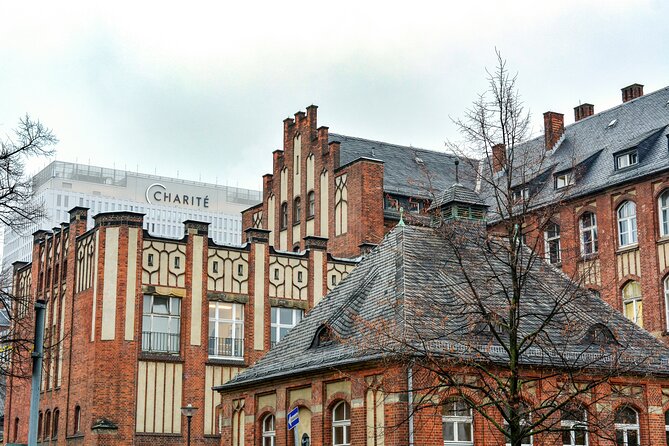
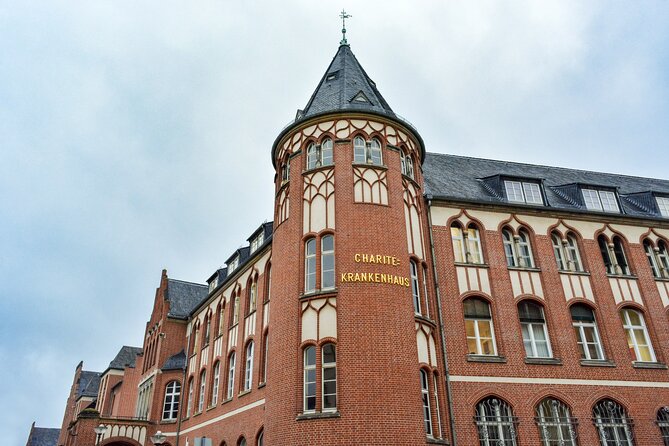
Charité Campus Mitte is the visual centerpiece of the walk. Its neogothic red-brick buildings give the route a strong sense of place, and you finally see the hospital campus as a working institution rather than a collection of separate monuments.
This is also where the subject matter becomes most serious. You hear how some doctors abused medicine during the Third Reich, while others continued helping people without discrimination until the final days of the Second World War.
That contrast deserves time. It prevents an easy story in which all doctors were either victims or villains. Medical workers had choices, and those choices could protect patients or become part of a system of persecution. The guide’s role here is especially important because the buildings alone cannot explain what happened within them.
You should expect a sober section, not a light sightseeing stop. The tour does not present the Nazi period as a footnote to scientific achievement. Instead, it asks you to consider professional responsibility when institutions are under political control.
The campus is still tied to clinical and university operations, so you do not enter working buildings. That restriction may disappoint anyone hoping to see hospital interiors, but it also keeps the route respectful of an active medical center.
Humboldthafen and the Cold War’s human scale
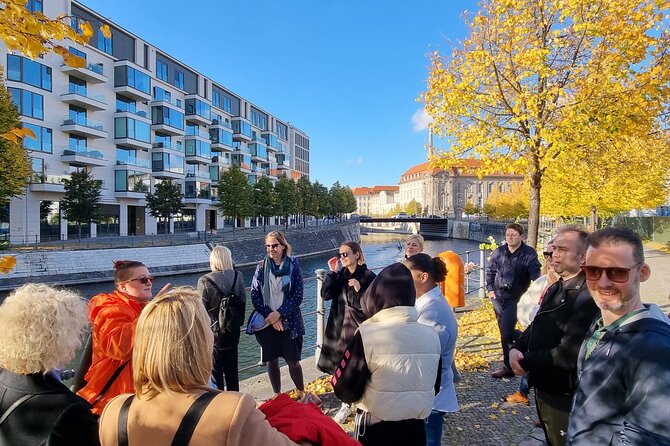
The final stop takes you to the area beside the Humboldthafen canal, ending on Alexanderufer. This is about a 10-minute walk from Berlin Central Station, which makes the finish convenient if you plan to continue sightseeing or catch a train.
Here, the focus moves to East Berlin. Several people attempted to escape to the West by swimming across the city canal just outside the Charité campus. The setting makes the story especially direct. You are standing beside the water rather than hearing about the Berlin Wall only from a distant viewpoint.
The guide also discusses hospital life during the socialist era and after the Berlin Wall fell. This gives Charité a modern political chapter and shows that the institution’s history did not end with the war.
Ending at the canal is a good choice. The route begins with laboratory science and hospital foundations, then moves through dictatorship and professional ethics before reaching divided Berlin. The final stories bring large political events down to individual choices and risks.
The end point is not the same as the beginning. You finish by the Humboldthafen canal, near Alexanderufer, so plan your next move rather than assuming you will return to Robert-Koch-Platz.
What the $30.12 price buys you
At $30.12, this is not an expensive Berlin attraction, but it is not simply a free walk either. The monuments, exteriors, and public spaces cost nothing to visit. Your payment covers the guide, the organization of the route, and the explanations that connect six separate places.
I see the value most clearly if you would otherwise walk past the campus without understanding it. Charité is not a place where every story announces itself. A plaque may identify Koch or Virchow, but it will not necessarily explain the medical, social, and political links between them.
The small-group limit also matters. With no more than 15 people, the guide can keep the group together without the feel of a large procession. That does not guarantee a private tour, but it should make the experience more personal than a crowded city walk.
The tour has received a 5 out of 5 rating from 26 reviews, with 100 percent recommending it. The praise centers on the guide’s command of the subject and ability to tell stories, including a particularly positive description of the leader as a strong storyteller. Since no guide name is provided, you should book this for the subject and format rather than for a specific individual.
Who will get the most from this tour
I would choose this walk if you like history that crosses several subjects. It suits people interested in medicine, science, architecture, ethics, Berlin under dictatorship, or life during the Cold War.
It also works well for a short stay. Two hours is long enough to develop a theme but short enough to fit before another appointment. The route has six stops, so you will not spend the entire time at one monument.
The tour may be less suitable if you want to enter historic hospital rooms, see medical instruments, or tour active Charité buildings. The experience stays outside, and the stated exclusions make that clear.
Most people can participate, and service animals are allowed. The tour runs near public transportation, with the start at Robert-Koch-Platz and the finish near Berlin Central Station. Since it requires good weather, bring suitable clothing and keep the cancellation rule in mind: you can receive a full refund if you cancel at least 24 hours before the start. If poor weather causes cancellation, you are offered another date or a full refund.
Should you book the Charité walk?
Book it if you want a focused, story-led look at a side of Berlin that standard city tours often skip. The best reasons are the unusual range of subjects, the short two-hour format, and the way the route links famous doctors with the moral choices made inside a major hospital.
Skip it if your priority is going indoors or seeing medical collections. You will spend the tour outside, and the buildings that still serve clinical or university purposes are not open as part of this experience.
For the right audience, $30.12 is fair value. You are paying less for admission than for a guide who can turn monuments, brick buildings, and a canal into one connected account of Berlin’s medical past.
FAQ
Where does the Charité Hospital Walking Tour start?
The tour starts at Robert-Koch-Platz, 10115 Berlin, Germany.
Where does the tour end?
It ends at Alexanderufer, 10117 Berlin, by the Humboldthafen canal.
How long does the tour last?
The tour lasts approximately two hours.
What language is the tour offered in?
The tour is offered in English.
How much does the tour cost?
The listed price is $30.12 per person.
How many people can join the tour?
The maximum group size is 15 travelers.
Are admission fees included?
All fees and taxes are included. The outdoor admission stops listed for the tour are free.
Can I enter Charité’s clinical or university buildings?
No. Buildings used for clinical or university operations are not visited as part of the tour.
Is the tour accessible by public transportation?
Yes. The route is near public transportation, and the end point is about a 10-minute walk from Berlin Central Station.
What happens if I need to cancel?
You can cancel at least 24 hours before the start time for a full refund. Changes or cancellations made less than 24 hours before the start are not accepted for a refund. If poor weather cancels the tour, you are offered a different date or a full refund.
Just added in Berlin
- Berlin & The Third Reich Private Guided Tour★ 5.0 · 3 reviews
- Third Reich Quest Experience in Berlin★ 4.5 · 7 reviews
- Private Analogue Photography Experience in Berlin★ 5.0 · 3 reviews
- Berlin Urbex Adventure and History Tour★ 5.0 · 9 reviews
- The Beauty of Berlin by Bike: Private Tour★ 5.0 · 59 reviews
- Berlin: Guided Bike tour of the Berlin Wall and Third Reich★ 5.0 · 160 reviews
- Beyond Currywurst: Berlin’s Hidden Street Food & Culture Tour★ 5.0 · 100 reviews
- Berlin Third Reich & Cold War Walking Tour With A Guide★ 5.0 · 7 reviews
Historical Tours, compared.

City History Canal Sightseeing Tour on a Motorboat
Read our review →



Browse the lists this tour appears in