
Reviewed · HISTORICAL TOURS
Berlin History Walking Tour with a French-Speaking Guide
Berlin’s story is written into its streets, and this three-hour French-language walk puts the hardest chapters right in front of you. You move from the former Nazi government district to Cold War dividing lines, then finish among the grand buildings of Museum Island.
I like two things here. First, the route connects major sights instead of treating them as isolated photo stops. Second, the guides, including Anouk, Martin, Arthur, Paul, and Céline, are praised for clear explanations, humor, patience, and useful advice for the rest of your stay. The main drawback is that you walk the entire route, and the group can include up to 25 people.
Key points to know before booking
- A strong first morning in Berlin: You see many central landmarks before lunch, making this a useful introduction for a first visit.
- History comes before sightseeing: The Holocaust Memorial, Hitler’s bunker site, Checkpoint Charlie, and the Brandenburg Gate are explained in political and human context.
- Conducted entirely in French: This is a good fit if you want history explained naturally rather than pieced together from signs and guidebooks.
- A walk, not a bus tour: Transportation between stops is not included, so wear practical shoes and expect a steady pace.
- Ends near Museum Island: You are well placed for the Berliner Dom, Humboldt Forum, museums, or a walk toward Alexanderplatz.
- Good value at $27.81: For a half-day orientation with a professional guide, the price is modest, especially if you are new to Berlin.
Why this Berlin walk works as a first introduction
Berlin can feel scattered at first. Its major sights are spread across a large central area, and the city’s past is not arranged in a neat timeline. A palace may sit beside a Nazi-era memorial, while a Cold War landmark appears among modern glass towers.
This walk gives you a useful framework. You begin at Potsdamer Platz, once split by the Berlin Wall and now filled with modern architecture. From there, the route heads toward Checkpoint Charlie, the former crossing point between East and West Berlin, before moving through sites tied to the Nazi dictatorship, Prussian Berlin, the Cold War, and reunification.
I especially like the way the route joins modern Berlin with its visible scars. You are not only looking at famous buildings. You are learning why the city was rebuilt in such an uneven way and why open spaces, memorials, and empty lots matter.
The tour begins at 10:00 a.m. and lasts about three hours. Several descriptions indicate that the walk may run closer to three and a half hours, so do not plan a tight lunch reservation immediately afterward. The morning departure is still convenient. You finish around lunchtime near Museum Island, with plenty of options for continuing your day.
More History Tours in Berlin
- Berlin: Natural History Museum Entrance Ticket
★ 4.6 · 3,382 reviews - Berlin Historical Highlights Walking Tour
★ 4.9 · 657 reviews - Berlin Private Complete History All Day Walking Tour
★ 5.0 · 474 reviews
Potsdamer Platz: from divided ground to modern Berlin
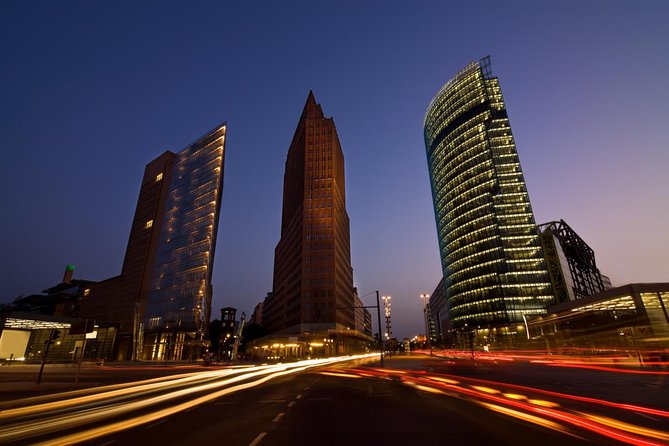
Meet your guide at Potsdamer Platz 10, at the corner of Gabriele-Tergit-Promenade. This is a sensible starting point because the area quickly introduces one of Berlin’s central themes: destruction, division, and rebuilding.
Before World War II, Potsdamer Platz was one of Europe’s busiest city intersections. War damage and the Berlin Wall later left it cut off and largely empty. Today, glass towers and broad public spaces give it a very different look.
Your guide uses the area to explain how Berlin changed after reunification. The Sony Center is one of the most recognizable modern landmarks here, with its large roof and sleek commercial buildings. It is not old Berlin, but that is precisely the point. The architecture shows how the reunited city tried to create a new center.
The stop is brief, about 10 minutes, so expect an overview rather than a detailed architectural tour. I would take a moment to look around before the group moves on. The contrast between old photographs and the present-day buildings is one of the most useful visual lessons of the morning.
Checkpoint Charlie and the logic of the Cold War
At Checkpoint Charlie, your guide explains the former crossing between East and West Berlin. The site became famous as a place where American and Soviet forces confronted one another, and it remains one of the city’s strongest Cold War symbols.
The physical checkpoint is not a preserved border crossing in the full historical sense. The area is now a busy urban site with tourism businesses and displays. That can make it feel more commercial than solemn, but the location still matters.
A good guide helps you separate the historical event from the modern presentation. You will learn why this crossing mattered, how Berlin was divided, and how the city’s residents experienced a border running through their neighborhoods.
The scheduled stop lasts about 10 minutes. That is enough for the main story, but not enough for every detail of the Wall or daily life in East Germany. If the Cold War is your main interest, plan another visit to a longer Wall memorial or museum later in your stay.
Hitler’s bunker site: an important place without a visible bunker
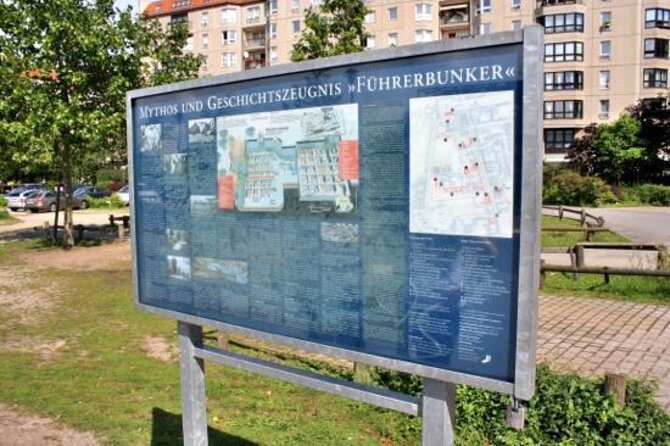
The walk continues to the site of Hitler’s bunker, where Adolf Hitler spent his final days in 1945. You do not visit an intact underground bunker. The structure was destroyed, and the site is now marked in a deliberately low-key way.
That lack of a grand memorial is part of the story. Your guide explains what happened here and why the location has been treated with restraint. The point is not to create a shrine or spectacle. It is to understand the final phase of the Nazi regime and the choices made about how to mark the place afterward.
This is one of the stops where a French-speaking guide can add real value. The subject is difficult, and a good explanation prevents the site from becoming a shallow piece of dark tourism. Guides such as Martin and Paul are praised for making complicated history understandable, while still keeping the tone appropriate.
You spend about 10 minutes here. The stop is short, but it fits well within the larger route because the next location provides a broader memorial to the people who suffered under the regime.
More Walking Tours in Berlin
- Discover Berlin Half-Day Walking Tour
★ 5.0 · 9,624 reviews - Berlin: Third Reich and Cold War 2 Hour Walking Tour
★ 4.9 · 6,830 reviews - Berlin: Discover Berlin Walking Tour
★ 4.9 · 5,998 reviews - Berlin’s Best: 2 Hour Walking Tour Third Reich and the Cold War
★ 5.0 · 5,486 reviews
The Holocaust Memorial: space for reflection
The Memorial to the Murdered Jews of Europe is made up of 2,711 concrete slabs arranged across an open field near the Brandenburg Gate. The ground rises and falls as you walk between them, changing the feeling of the space from one corner to the next.
The guide explains the memorial’s purpose and the crime it commemorates. This is not a place for a quick photograph and a dash to the next sight. Even with only about 15 minutes scheduled, you should expect a serious pause in the morning.
The memorial can feel confusing by design. The blocks vary in height, and the paths do not give you one fixed viewpoint. You may find yourself walking from the edge into a narrower, more enclosed section, then back into open air.
The tour includes the memorial stop, but the underground Information Centre is not listed as part of the visit. If you want names, family stories, and a fuller record of individual victims, ask your guide about returning separately. This walk provides context and orientation rather than a full museum visit.
Unter den Linden and Bebelplatz: Berlin’s grand avenue and dark memories
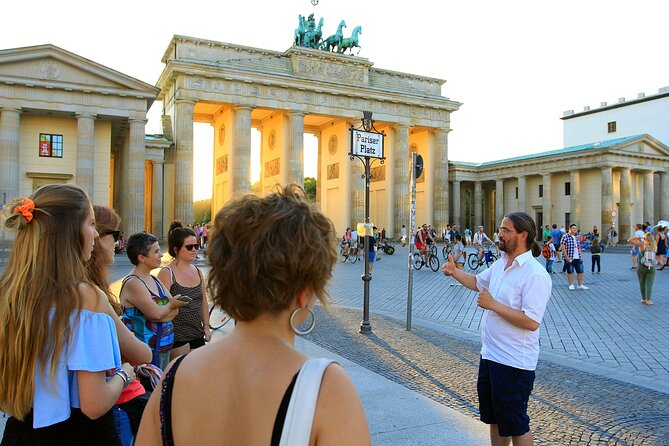
From the memorial, the group walks along Unter den Linden, Berlin’s famous east-west avenue. It once led toward the royal palace and remains one of the best places to see how different periods of the city sit side by side.
Your guide points out changes in architectural style and signs of wartime damage. You may see formal buildings associated with Prussian power, later additions from the German capital, and areas reconstructed after the war. The 20-minute walk gives the guide time to explain the city’s changing political centers.
Bebelplatz offers a sharp change in tone. It is known for the Nazi book burning of 1933, when works by Jewish, socialist, pacifist, and other writers were destroyed in a public act of intimidation.
The square is also home to Humboldt University and the Catholic Cathedral, often called the Berlin Cathedral of St. Hedwig. That combination makes Bebelplatz especially useful for understanding Berlin. It is not only a site of Nazi persecution. It is also a working civic and academic space shaped by centuries of religious, royal, and intellectual life.
The planned stop is about 10 minutes. Your guide’s explanation matters more here than the view itself. The book-burning memorial is subtle, and you could easily miss its meaning without someone pointing it out.
Brandenburg Gate: from royal entrance to reunification symbol
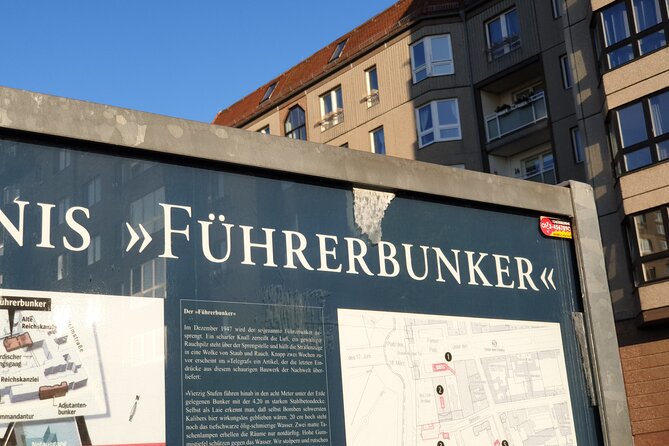
The Brandenburg Gate is one of Berlin’s most familiar sights, but its meaning has changed many times. Built as a grand entrance to the city, it once expressed the authority of the Prussian monarchy.
Later, the gate became linked with Nazi rule, then stood near the Berlin Wall and the border between East and West Berlin. After reunification, it became a symbol of a country trying to make a new political beginning.
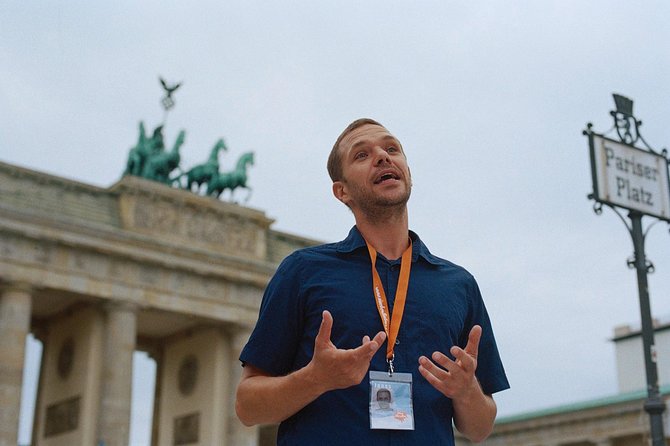
The guide explains these layers during the 10-minute stop. The gate itself is photogenic, but the stronger experience comes from understanding what stood around it during the divided years. A single landmark can represent royal power, dictatorship, division, and unity, depending on the period.
Because the area is popular, it can be crowded. Keep close enough to hear your guide, especially since the tour does not provide audio receivers. One person specifically wished for an audiophone, and this is the kind of open, noisy location where that limitation matters most.
Museum Island and the route’s useful finish
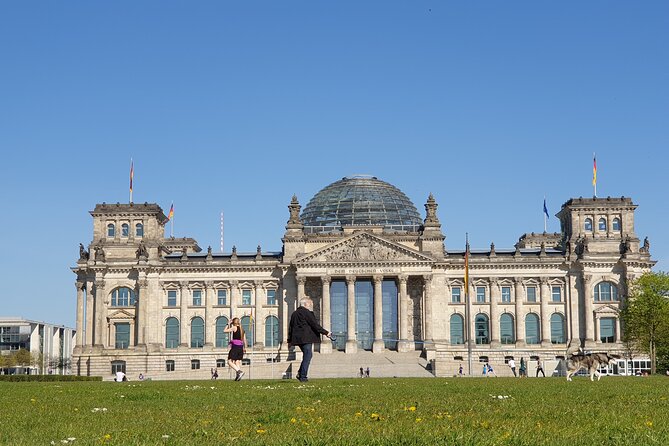
The tour concludes near Museum Island, close to the Berliner Dom and the reconstructed Humboldt Forum. This is a practical ending because you are near several of Berlin’s leading cultural sights and not far from Alexanderplatz.
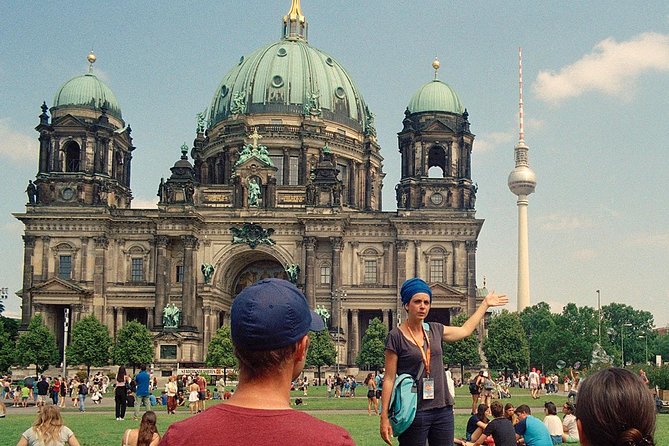
The Berliner Dom provides a dramatic finish to the walk, with its large dome and formal riverside setting. The Humboldt Forum occupies the reconstructed Berlin Palace facade and presents another example of the city rebuilding and debating its past.
The tour does not include museum admission. That is not a weakness for a first orientation, since a proper museum visit needs much more time than this walk allows. Instead, you finish with enough information to choose what deserves your afternoon.
You might visit one of the museums on Museum Island, continue toward Alexanderplatz, or stop for lunch nearby. Ask your guide for restaurant suggestions if you want local advice. Several guides are praised for offering practical ideas beyond the scheduled route.
French-speaking guides and the group experience
The tour operates in French, which is its main advantage over a general English-language city walk if French is your strongest language. Berlin’s history includes many names, dates, political shifts, and sensitive subjects. Hearing those explanations in comfortable French can make the material easier to follow.
The guide roster includes Anouk, Martin, Arthur, Paul, and Céline. The strongest descriptions emphasize clear speech, humor, patience with questions, and a personal interest in Berlin. Arthur is praised for his precise delivery and wit, while Martin is described as passionate about both the city and his work. Anouk is noted for answering individual questions carefully.
That does not mean every guide will use the same style. A three-hour walking tour depends partly on the person leading it. One critical assessment raised concerns about a few historical details being imprecise. That is worth keeping in mind if you are a specialist in Nazi or Cold War history and need academic-level precision.
The maximum group size is 25 people. That is large enough to affect sound and personal attention, but still manageable for a city walk. Since no audio equipment is provided, stand near the guide and ask to move closer if the street noise makes French hard to hear.
Physical effort, weather, and practical value
The route is entirely on foot. Transportation to and from the attractions is not included, and the tour requires a moderate level of fitness. You should wear comfortable shoes and dress for the weather.
Berlin’s weather can change quickly, and the walk operates in all conditions. Bring a rain layer when needed, since much of the experience takes place outdoors. There are several brief stops, but this is not a museum-based tour where you can warm up indoors for long stretches.
At $27.81 per person, the price is fair for a professional, French-language orientation lasting about three hours. You are paying for structure and explanation rather than admission-heavy attractions. The Holocaust Memorial itself is an open public memorial, and the former bunker is a historical site, not an underground attraction you enter.
I see the value in booking this early in your stay. You cover a large part of central Berlin, learn how the main districts connect, and finish near places you can explore on your own. A private tour would offer more flexibility, but it would cost more. A free self-guided walk would cost less, but it would ask you to assemble the history yourself.
The tour is free to cancel up to 24 hours before the 10:00 a.m. start time. Last-minute cancellations and changes are not accepted for a refund, so keep that deadline in mind.
Who should book this walk
You should consider this tour if you are visiting Berlin for the first time, want a French-speaking guide, and prefer a clear introduction before choosing museums and longer memorial visits.
It also suits you if you care more about historical context than polished sightseeing. The route includes famous places, but the best parts are the explanations of why those places matter and how the city has handled its past.
You may want something else if you dislike group walks, need extensive time inside museums, or want a highly specialized study of the Holocaust, the Berlin Wall, or Prussian architecture. The tour gives you a broad foundation, not a full treatment of any one subject.
Should you book it?
I would book this as a first morning in Berlin, especially if you are comfortable walking and want the city explained in French. The route is well chosen, the timing works before lunch, and the finish near Museum Island helps you plan the rest of the day.
Go in expecting a thoughtful overview, not a museum tour or an intimate private experience. Stay near the guide, wear good shoes, and leave extra time after the scheduled three hours. For $27.81, it is a practical way to put Berlin’s landmarks into historical order before you explore them on your own.
FAQ
Is the tour conducted in French?
Yes. The experience operates in French and includes a professional French-speaking local guide.
How long does the walking tour last?
The scheduled duration is about three hours. Some tours may run closer to three and a half hours, so avoid booking an immediate appointment afterward.
Where does the tour start?
It starts at Potsdamer Platz 10, at the corner of Gabriele-Tergit-Promenade, with a 10:00 a.m. departure.
Where does the tour finish?
The tour ends near Museum Island, close to the Berliner Dom, Humboldt Forum, and the route toward Alexanderplatz.
Does the tour include food, drinks, or transportation?
No. Food, drinks, and transportation to or from the attractions are not included. The route is walked on foot.
What happens if I need to cancel?
You can receive a full refund if you cancel at least 24 hours before the experience start time. Cancellations or changes made less than 24 hours beforehand are not accepted for a refund.
Just added in Berlin
- Berlin & The Third Reich Private Guided Tour★ 5.0 · 3 reviews
- Third Reich Quest Experience in Berlin★ 4.5 · 7 reviews
- Private Analogue Photography Experience in Berlin★ 5.0 · 3 reviews
- The Beauty of Berlin by Bike: Private Tour★ 5.0 · 59 reviews
- Berlin: Guided Bike tour of the Berlin Wall and Third Reich★ 5.0 · 160 reviews
- Berlin Urbex Adventure and History Tour★ 5.0 · 9 reviews
- Beyond Currywurst: Berlin’s Hidden Street Food & Culture Tour★ 5.0 · 100 reviews
- Berlin Third Reich & Cold War Walking Tour With A Guide★ 5.0 · 7 reviews
Historical Tours, compared.
City History Canal Sightseeing Tour on a Motorboat
Read our review →

Browse the lists this tour appears in