
Reviewed · HISTORICAL TOURS
Historical Walking Tour of Augsburg
Augsburg’s story comes alive through its grand Renaissance Town Hall, powerful Fugger family connections, and the homes of two famous sons: playwright Bertolt Brecht and Leopold Mozart. This tour gives you a useful first look at the city without sending you far from the old town center.
I like the clear route, which links the Rathaus, Perlach Tower, Fugger Square, Little Venice, and Augsburg Cathedral. I also like that guides Michael, known as Mike, can adjust the tour to suit the group, while still covering the main sights.
The main drawback is the walking. You’ll be on your feet for about 2.5 hours, and the tour is not suitable for wheelchair users or people with mobility impairments. It also does not run in rain or snow.
Key points to know before booking
- Rathausplatz is the easy-to-find starting point: Meet at 11 a.m. under the yellow umbrella in front of Augsburg’s central Town Hall square.
- The route combines famous names with local history: You’ll learn about the Fuggers, Bertolt Brecht, and the Mozart family in the places tied to them.
- Augsburg Cathedral is included: The tour visits the Romanesque and Gothic church, including its 12th-century stained-glass windows and bronze door.
- Little Venice adds a quieter change of pace: Canals and old-town scenery break up the grand civic and religious sights.
- The tour costs $20 per person: For 2.5 hours with an English-speaking guide and cathedral access, that is a reasonable price for a first visit.
- Comfortable shoes matter: The route involves a moderate amount of walking and finishes back at Rathausplatz.
Starting beneath Augsburg’s Town Hall
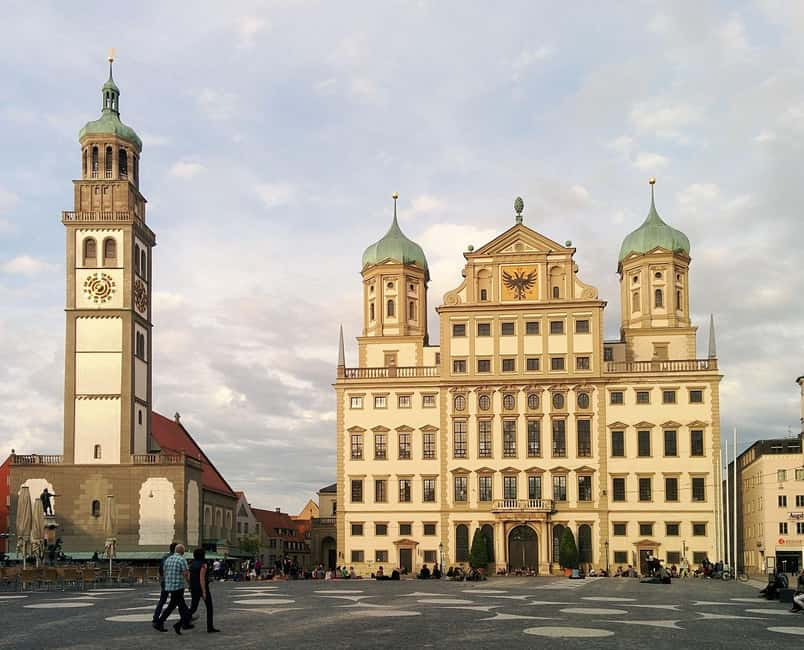
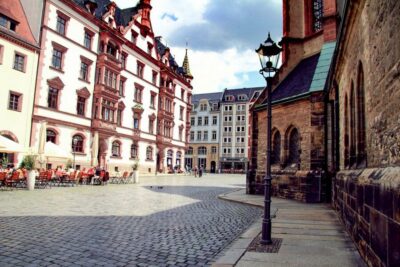
Your tour begins at Rathausplatz, the city’s central square. Look for the yellow umbrella at 11 a.m. This is a practical meeting point, since Augsburg Town Hall and Perlach Tower are two of the city’s easiest landmarks to spot.
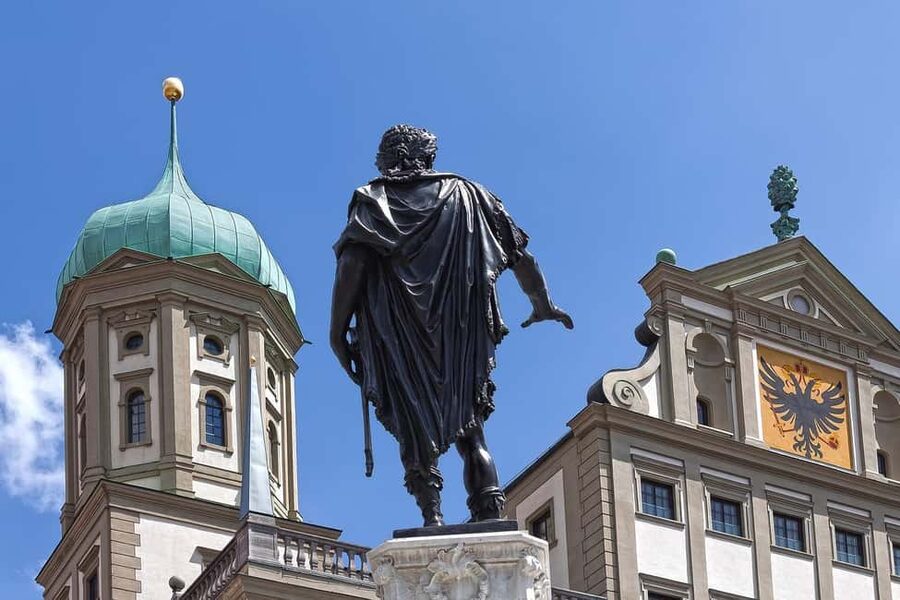
The square gives you a strong opening lesson in Augsburg’s public life. The Town Hall is the star here, designed by Elias Holl and built in the Renaissance style. You’ll hear why it matters to the city and get a closer look at its famous Goldener Saal, or Golden Hall.
That detail is one reason a guided visit helps. You can admire the building on your own, but a guide gives the grand facade a place in Augsburg’s story. The Town Hall is not simply a pretty stop for photographs. It represents the city’s wealth and confidence during a period when Augsburg played an important role in European trade and finance.
Perlach Tower rises nearby. It began as a watchtower and now provides a familiar vertical marker in the city center. The tour does not promise a climb or a panoramic visit, so think of the tower as a visual reference and a historical stop rather than a separate viewpoint experience.
Take a moment here to get your bearings. The tour returns to this same square at the end, so you’ll know exactly where you are when the walk is over.
More Walking Tours in Bavaria
- Augsburg: Walking Tour with Fuggerei
★ 4.6 · 2,245 reviews - Regensburg: Guided City Walking Tour of the Old Town
★ 4.7 · 1,395 reviews - Passau: City Highlights Guided Walking Tour
★ 4.8 · 351 reviews
Following the Fugger fortune at Fugger Square
From Rathausplatz, the route continues to Fugger Square. This section introduces the Fuggers, one of Europe’s most powerful merchant families.
For you, this is one of the most useful parts of the walk because the Fugger name appears throughout Augsburg. The family’s influence helps explain why the city has such ambitious civic buildings and why its history reaches well beyond Bavaria. A guide can connect the family’s business power with the streets and buildings you are seeing, instead of leaving you with a list of names and dates.
The tour focuses on the family’s place in European history. You will not be visiting every Fugger site in Augsburg, but Fugger Square gives the subject a physical setting. This is the point where the city’s grand architecture begins to make more sense.
I would pay close attention here if you enjoy social and economic history. The tour is not limited to kings, churches, and battles. The Fuggers offer a look at merchants, money, and the way private wealth helped shape a city.
You should also keep your expectations in check. The experience is a walking tour, not a full museum visit devoted to the Fugger family. If the Fuggers are your main reason for coming to Augsburg, you may want to set aside extra time after the tour for further exploration.
A slower walk through Little Venice
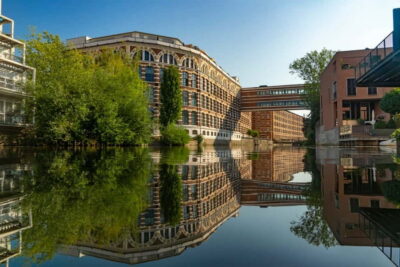
The route then reaches Little Venice, a picturesque district marked by canals. This is a welcome shift after the formal scale of Rathausplatz and Fugger Square.
The nickname points to the canal-side character of the area, not to a replica of Venice. You’ll see a more intimate side of Augsburg, with water, old buildings, and a change in pace from the city’s major squares. It is a good place to take photographs, and photography is allowed throughout the tour.
This stop also helps you see how varied Augsburg can feel within a short walk. The city is not only grand civic buildings and cathedral stonework. Canal-side views bring a softer, more residential mood to the route.
The tour description does not promise a long stop or time for a meal here. Food and drinks are not included, so carry water and plan your own café break for before or after the walk. I would treat Little Venice as a scenic part of the route rather than a destination where you will linger for a long time.
Meeting Bertolt Brecht at Brechthaus
Next comes Brechthaus, the birthplace of playwright Bertolt Brecht. The former home now serves as a museum honoring his life and work.
This stop gives the tour a cultural focus that is quite different from the Fuggers and the Town Hall. You are not just looking at old stone buildings. You are connecting Augsburg with a major writer and playwright whose work became important far beyond the city.
The key value here is the setting. Brecht’s birthplace is not an abstract connection on a museum label. It is a specific place in the old town, tied directly to his early life. Your guide can help place the building within the wider route and Augsburg’s cultural identity.
The information provided for the tour does not include a separate museum admission or an extended interior visit at Brechthaus. The stop is best understood as part of the guided city walk. If you want a detailed examination of Brecht’s work, check how much time is available for the museum on your chosen day.
Still, the inclusion makes the tour more rounded. You get architecture, commerce, religion, music, and literature in one compact walk.
More History Tours in Bavaria:
- Regensburg: City Highlights Historical Boat Tour
★ 4.0 · 259 reviews - Classic city tour in the World Heritage City of Augsburg
★ 4.0 · 41 reviews - Augsburg: Historical Highlights Private Walking Tour
★ 4.9 · 9 reviews - Augsburg – Private Historic Tour
★ 5.0 · 3 reviews
Leopold Mozart’s Augsburg connection
The next major personal story belongs to Leopold Mozart, father of Wolfgang Amadeus Mozart. Leopold was born in Augsburg, and the Leopold Mozart Haus now presents the musical history of the Mozart family.
This is a useful distinction for anyone who associates the Mozart name mainly with Salzburg or Vienna. Augsburg gives you a direct connection to Leopold, whose family story began here. The stop adds another layer to the city’s cultural history without requiring a separate trip outside the center.
You’ll see how the tour moves from a writer’s birthplace to a musician’s birthplace. That variety keeps the walk from feeling like a single-theme architecture tour. It also suits visitors who want a broad introduction to Augsburg rather than a specialist lecture on one period.
Again, the tour information does not promise a full museum visit inside the Leopold Mozart Haus. You should expect the guide to explain the site and its importance as part of the walking route. If the Mozart family is your priority, allow extra time to return and explore the museum at your own pace.
Entering Augsburg Cathedral
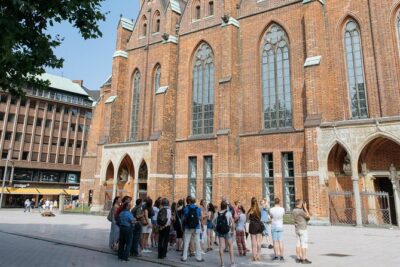
The final major stop is Augsburg Cathedral, or Dom. The building brings together Romanesque and Gothic elements, giving you a clear look at how churches can change over time as additions and renovations accumulate.
Cathedral access is included in the tour price, which improves the value of the experience. You are not left standing outside while the guide describes the building. Inside, look for the 12th-century stained-glass windows and the detailed bronze door.
These features reward a slower look. The stained glass reaches back into the medieval period, while the bronze door gives you an opportunity to examine craftsmanship up close. Your guide can point out what deserves attention, which helps when you have limited time inside a large church.
The cathedral is a fitting finish because it brings several themes together: Augsburg’s age, its religious importance, and the skill used to build and decorate its major institutions. The route then returns to Rathausplatz, so you finish where you began rather than needing to find your way across the city.
Keep in mind that churches can have changing access because of services or other practical matters. The stated tour includes cathedral access, but you should still follow the guide’s instructions once inside. Dress respectfully and avoid treating the cathedral only as a photo stop.
What the $20 price really covers
At $20 per person, this is a modestly priced introduction to Augsburg. You receive 2.5 hours of guided walking in English, a route through the main historic center, and access to Augsburg Cathedral.
The value comes from the connections between the stops. You are not paying simply to walk past a Town Hall, a tower, a canal, and a church. The guide links those places to the Fuggers, Brecht, and the Mozart family, giving you a basic framework for understanding the city.
The price does not cover food, drinks, hotel pickup, or separate museum admissions. That keeps the cost clear, but you should budget for your own refreshments. There is no hotel pickup, so you need to reach Rathausplatz independently.
The tour earns a strong rating of 4.9 from 10 reviews, and the praise centers on the guides. Michael, also called Mike, is singled out for being friendly, funny, and full of useful historical detail. One group also appreciated that he adapted the tour to its wishes, while Australian visitors especially enjoyed the Fuggerei connection.
That flexibility matters. A good city guide should explain the main route while noticing what interests the people in front of him. The available feedback suggests Mike does this well. Still, guide style can vary from one departure to another, so book this for the route and content first, with the personal touch as an added benefit.
Timing, walking, and weather
The advertised duration is 2.5 hours. That is long enough to cover the central sights without taking up an entire day, making it a good choice for a short stay or a first morning in Augsburg.
You’ll need comfortable shoes. The route involves a moderate amount of walking, and you may spend much of the time standing while the guide explains each stop. Bring water, a camera, and clothing suited to the weather.
The tour operates in normal weather but not when it is raining or snowing. This is important in a city where the experience depends on walking between outdoor landmarks. Check the forecast and dress for the conditions, rather than assuming the cathedral and museums will keep you indoors for most of the route.
The experience is not suitable for wheelchair users or people with mobility impairments. The information does not provide details about step-free access, seating, or alternative routes, so anyone with access concerns should check before booking.
Free cancellation is available up to 24 hours before the start for a full refund. You can also reserve now and pay later, which gives you some flexibility when arranging a wider Bavaria itinerary.
Who will enjoy this Augsburg walk?
I would recommend this tour if you want a clear introduction to Augsburg and prefer to understand a place through its people and buildings. The route works especially well for first-time visitors who want the Town Hall, Fugger connections, cultural figures, canals, and cathedral in one outing.
It also suits you if you enjoy a guide who can add personal detail. The positive feedback about Michael and Mike points to an easygoing style, humor, and attention to group interests. That can make a difference when a walking tour covers many subjects in a short period.
Families with older children may find the mix of canals, towers, famous names, and grand interiors more engaging than a long lecture on dates. Music lovers will appreciate the Leopold Mozart connection, while literature fans will want the Brechthaus stop. Architecture fans get the Rathaus, Perlach Tower, and Dom.
I would think twice if you dislike walking, need guaranteed step-free access, or want lengthy visits inside each museum. This tour offers a broad city overview, not a deep examination of Brecht, Mozart, or the Fuggers.
Should you book the Historical Walking Tour of Augsburg?
Book it if you want a reasonably priced, English-language introduction to Augsburg with a friendly guide and a well-connected central route. The best parts are the Renaissance Town Hall, the Fugger story, Little Venice, and the unusual chance to link Brecht and Leopold Mozart to the same city walk.
I especially like the included cathedral access and the return to Rathausplatz. You finish with a better sense of where Augsburg’s main sights fit together, which makes independent exploring afterward much easier.
Skip it if bad weather is likely, if a moderate walking route is difficult for you, or if you want full museum tours at Brechthaus and the Leopold Mozart Haus. For most able walkers spending a day or two in Augsburg, though, $20 buys a useful first chapter in the city’s story.
FAQ
Where does the Augsburg walking tour begin?
The tour begins at 11 a.m. at Rathausplatz Augsburg. Look for the yellow umbrella.
Where does the tour finish?
The tour ends back at the starting point at Rathausplatz.
How long does the tour last?
The walking tour lasts 2.5 hours. Starting times should be checked when you make your booking.
What language is the tour conducted in?
The live guided tour is conducted in English.
Is Augsburg Cathedral included?
Yes. Access to Augsburg Cathedral is included, and the route highlights its Romanesque and Gothic elements, 12th-century stained-glass windows, and bronze door.
Can I cancel for a full refund?
Yes. You can cancel up to 24 hours in advance for a full refund. You can also reserve now and pay later.
Just added in Bavaria
- Rafting classic Iller – Level 2 white water tour★ 4.5 · 29 reviews
- Canyoning Starzlachklamm★ 5.0 · 51 reviews
- Family rafting Iller – white water rafting level 1★ 5.0 · 12 reviews
- Bavarian Schnitzel Cooking Class in Oberaudorf Farmhouse★ 5.0 · 21 reviews
- Augsburg – Private Historic Tour★ 5.0 · 3 reviews
- Classic city tour in the World Heritage City of Augsburg★ 4.0 · 41 reviews
- Kloster Andechs: Brauerei-Tour mit Virtual Reality entdecken★ 4.7 · 15 reviews
- Regensburg citytour rickshaw-pedicab★ 4.3 · 20 reviews
Historical Tours, compared.
City History Canal Sightseeing Tour on a Motorboat
Read our review →


Browse the lists this tour appears in