
Reviewed · HISTORICAL TOURS
Classic city tour in the World Heritage City of Augsburg
Augsburg’s most revealing feature is its water system, not just its grand town hall. This two-hour walk connects the Augustus Fountain, medieval canals, Fugger buildings, and the 500-year-old Fuggerei, showing how water, trade, wealth, and social policy shaped the city.
I like the route because it mixes big sights with smaller streets, and I like the value: for $16.20, you get a guided walk plus admission to the Fuggerei and another major historic site. The main caution is language and sound. Tours may run in German and English, and a soft-spoken guide can be hard to hear outdoors.
Key points to know before you book
- Augsburg’s water system is a major theme: The canals in the Lechviertel help explain the city’s growth and are more than a quick photo stop.
- Two admissions are included: Your ticket covers the Fuggerei and either the Golden Hall, Roman Camp, or Brecht House, depending on the date and day.
- The tour ends at the Fuggerei: You finish at Jakoberstraße, not back at the central meeting point.
- The group is limited to 25 people: That keeps the walk fairly manageable, though hearing the guide still depends on where you stand.
- The tour may be bilingual: English explanations can be shorter when German and English groups are combined.
- Be early: The walk begins at 2 p.m., and the operator may leave promptly. A one-minute delay once meant missing the entire tour without a refund.
Why Augsburg’s water story makes this walk worthwhile
Augsburg is easy to underestimate. Many people come for the Renaissance town hall, glance at the Fuggerei, and move on. This tour gives those sights a useful connection: the city’s wealth grew alongside its water channels, craft trades, merchants, and powerful families.
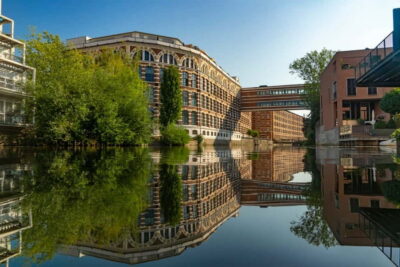
The Lech canals are the surprise. They run through the old craftsman’s quarter in narrow channels beside small lanes and older buildings. The route helps you see the water as working infrastructure, not decoration. It supported trades and helped Augsburg become an important city.
I also like that the walk places the Fugger family in a wider civic setting. Their buildings and charitable housing are central to Augsburg, but the tour also touches on the city’s Roman beginnings, its role in the Protestant movement, and other historical threads. The balance can vary with the guide. Some tours give the Fugger story most of the attention, while other guides build a broader picture of Augsburg.
The experience has a 4.2 rating from 41 ratings, which fits the nature of the tour. Strong guides make the two hours lively and useful. Less effective sessions can feel too quiet, too focused on one subject, or too compressed when the guide has to switch between German and English.
More History Tours in Bavaria:
- Regensburg: City Highlights Historical Boat Tour
★ 4.0 · 259 reviews - Historical Walking Tour of Augsburg
★ 4.9 · 10 reviews - Augsburg: Historical Highlights Private Walking Tour
★ 4.9 · 9 reviews
Starting at the Town Hall and Golden Hall
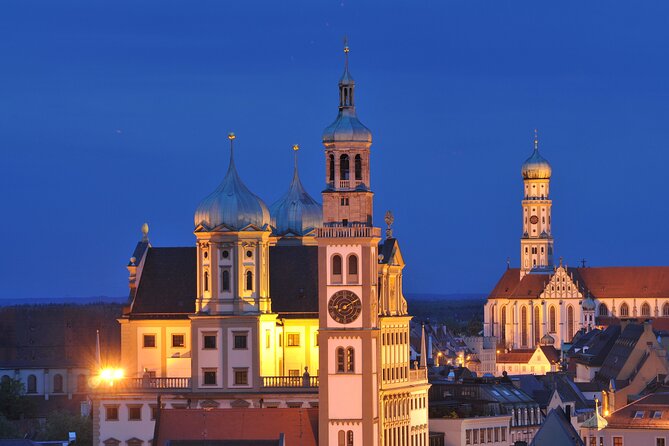
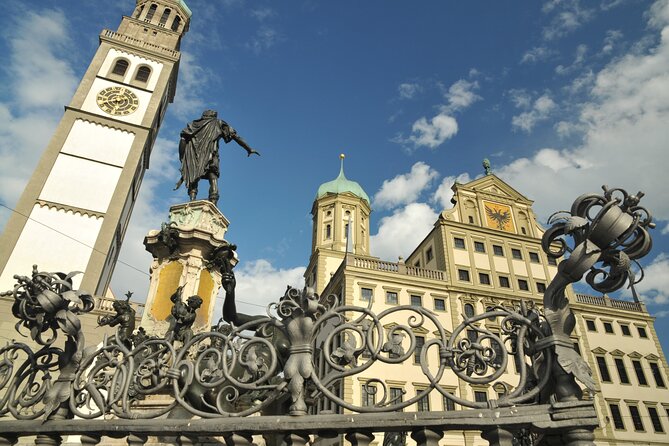
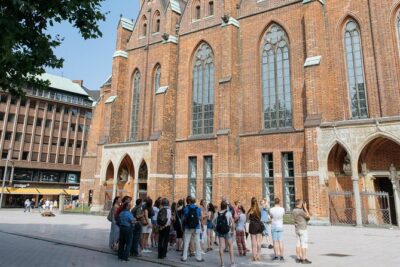
Meet at the Tourist Information at Rathausplatz 1 at 2 p.m. The first major stop is Augsburg Town Hall, where the planned visit depends on the date.
For tours through the end of July 2024, the visit includes the Golden Hall. This is the grand interior that gives the city hall its real visual punch. The stop lasts about 30 minutes, enough time for the guide to explain the building and for you to look around without turning the whole afternoon into an indoor museum visit.
From August 2024, the scheduled indoor stop changes. Tuesday through Friday includes the Roman Camp, or Römerlager, while Saturday and Sunday includes the Brecht House. Check the exact program for your date when booking, since this change affects the character of the tour.
The Roman Camp connects the walk to Augsburg’s Roman past. The Brecht House takes the route in a different direction, linking the city to Bertolt Brecht. The supplied schedule does not promise the Golden Hall after July 2024, so do not book assuming you will see it.
The entry is included, which improves the value of the ticket. It also means you are not simply looking at the outside of the town hall before moving on. Still, the quality of this part depends on timing, language, and the guide’s delivery. Some English-speaking participants have found the bilingual format efficient but brief.
Augustus Fountain and the center of Rathausplatz
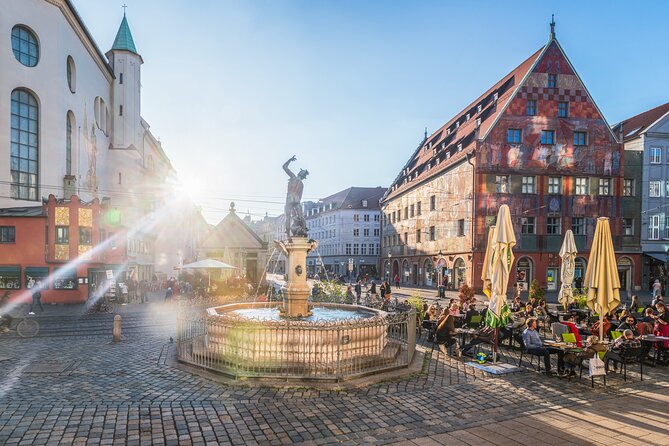
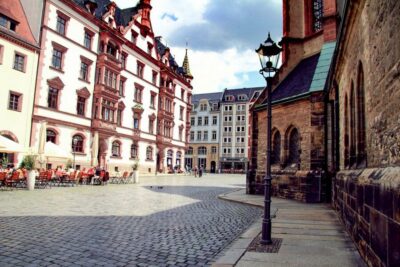
The Augustus Fountain is a short but important stop. You spend about 15 minutes at one of Augsburg’s three grand fountains, located on the town hall square.
The fountain works best as part of the larger story. It is not an isolated monument. From here, the guide can connect public display, civic pride, and Augsburg’s long importance. The open square also gives you a clear look at the town hall setting before the route turns into narrower streets.
Because this is an outdoor stop, sound matters. One guide may carry easily across the square, while another may speak too softly for people at the back. I would position yourself close to the guide and ask for repetition early rather than quietly miss half the explanation.
The tour offers a free optional sound amplifier system called elysium. You use your own smartphone, headphones, and internet connection. That is a useful solution if you already have the equipment, especially in a busy square or on a bilingual tour. It is not a substitute for preparation, so bring charged headphones and make sure your phone can connect to the internet.
The Lechviertel canals and old craft streets
The 15-minute walk through the Lechviertel is one of the most distinctive parts of the route. Here, small alleys and canals replace the broad ceremonial space around the town hall.
This section gives the tour its sense of place. Augsburg’s history is not only about wealthy families and painted halls. The old craftsman’s quarter shows how ordinary work and urban water management shaped daily life. You get a closer look at the channels that helped the city become an industrial and commercial center.
The stop is short, so expect an introduction rather than a detailed technical study of the water system. If this subject interests you, pay close attention and ask questions. The guides who make the most of this section can turn a few canals into one of the clearest explanations of Augsburg’s growth.
The route also offers a welcome change of pace. After the formal town hall, you walk through a more intimate part of the city. I value that contrast. It keeps the tour from becoming a parade of famous names and gives you a better feel for Augsburg’s older street plan.
A few more half-days in Bavaria worth comparing
- Augsburg: Walking Tour with Fuggerei
★ 4.6 · 2,245 reviews - Regensburg: Guided City Walking Tour of the Old Town
★ 4.7 · 1,395 reviews - Regensburg: City Tour with the Bimmelbahn Train
★ 4.3 · 1,010 reviews - Passau: Crystal Ship Sightseeing Cruise
★ 4.6 · 705 reviews
Entering the Fuggerei after 500 years
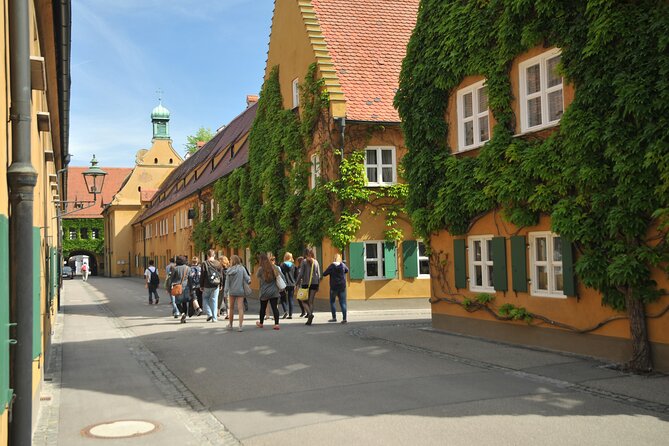
The final major stop is the Fuggerei, and the tour ends here at Jakoberstraße 26. Admission is included, and the stop lasts about 30 minutes.
Founded more than 500 years ago, the Fuggerei is known as the world’s oldest social housing settlement. The site is still tied to its original charitable purpose, which gives the visit more weight than a standard historic house tour. You are looking at a living civic idea, not only a preserved collection of old walls.
The guide explains how the Fugger family built wealth and put money back into the community. That story is central to understanding Augsburg, but it can also dominate the tour. If you want equal time on Roman Augsburg, the Protestant movement, the Mozart family’s origins, or the canals, ask about those subjects before the group reaches the Fuggerei.
Thirty minutes is enough for a clear introduction, but it may feel long if you are mainly interested in the city’s broader history. One practical advantage is that you finish at a major sight rather than returning to the starting point. You can continue exploring from there, though the tour itself does not include a return transfer.
The Fuggerei is also where the tour’s balance becomes most obvious. Some guides make its social purpose and history engaging, with good stories and useful context. Others spend so much time on the Fugger family that the final section feels out of proportion to the rest of Augsburg.
The language question: German, English, or both
This is not always a cleanly separate English experience. The group may include German and English speakers, and the guide may present the tour in both languages.
That arrangement can work well. Several guides have handled both languages clearly and answered questions in a friendly way. It can also shorten the English explanation, especially when the guide gives the German version first and then summarizes in English.
If you need detailed English commentary at every stop, this is the main point to consider before booking. The information can be strong, but the format may not provide equal time to each language.
Sound is another practical issue. A soft-spoken guide can be difficult to hear in the town square, beside the canals, or in a larger group. The free elysium system may help if you bring your own smartphone, headphones, and internet connection. Stay near the guide and keep the group size in mind. The maximum is 25 people, which is reasonable for a city walk but not intimate.
Price, pace, and what you actually receive
At the stated price of $16.20 per person, this is a good-value introduction to central Augsburg. You are paying for about two hours with a local guide, plus entry to the Fuggerei and the scheduled indoor attraction. If you visited the included sites separately, you would lose the useful connection between them.
The tour also saves planning time. You do not need to build your own route from Rathausplatz through the Lechviertel to the Fuggerei. The guide provides the historical links, and the end point puts you near one of Augsburg’s most important sights.
The pace is moderate, but you should expect to walk outdoors for most of the experience. Wear shoes that suit paved streets and smaller lanes. Weather can affect comfort. A cold or wet day makes a quiet guide harder to hear, and there is limited benefit in rushing through the open-air sections.
The tour is limited to 25 people, and most people can take part. Service animals are allowed, and the starting point is near public transportation. Confirmation is provided when you book.
Be punctual. The meeting point is at the Tourist Information, Rathausplatz 1, and the start time is 2 p.m. The operator may not wait for late arrivals. Cancellation is free up to 24 hours before the start time. Inside that window, the payment is not refunded, and changes are not accepted. If the minimum number is not met and the operator cancels, you are offered another date or experience, or a full refund.
Who should choose this Augsburg walk?
I would choose this tour if you have only a short time in Augsburg and want a clear first look at the city. It covers the main civic square, the canals, the Fugger story, and the Fuggerei without requiring you to research the route yourself.
It suits people who enjoy context more than a checklist of monuments. The best guides explain why the water system mattered, how wealthy families shaped the city, and why the Fuggerei still matters today.
It is less suitable if you want a long, detailed history lecture in English, a small private group, or a tour centered mainly on Roman Augsburg, Protestant history, or the Mozart family. The bilingual format can limit English detail, and the Fuggerei receives a large share of the time.
For families and first-time visitors, the two-hour length is practical. For history-minded visitors, the walk is a useful orientation, but you may want more time afterward at the sites that interest you most.
Should you book this tour?
Book it if you want an inexpensive, well-organized introduction to Augsburg and value the included entries. The canals and Fuggerei give the walk more substance than a simple town-center stroll, while the town hall provides the grand opening.
Go in with realistic expectations. Guide quality, volume, and language balance can shape the experience. Arrive early, stand close, bring headphones for the optional audio system, and check which indoor stop applies to your date.
For a first visit lasting only a few hours, I think the tour earns its place. It gives you the basic framework, leaves you at the Fuggerei, and shows why Augsburg is more than a pretty town hall and a famous charitable housing project.
FAQ
How long does the Augsburg city tour last?
The tour lasts approximately two hours.
Where does the tour begin?
It begins at the Tourist Information, Rathausplatz 1, 86150 Augsburg, Germany.
What time does the tour start?
The scheduled start time is 2 p.m.
Where does the tour end?
The tour ends at the Fuggerei, Jakoberstraße 26, 86152 Augsburg, Germany.
Are admission fees included?
Admission to the Fuggerei is included. The second included indoor visit depends on the date and day. Through the end of July 2024, the program includes the Golden Hall. From August 2024, Tuesday through Friday includes the Roman Camp, while Saturday and Sunday includes the Brecht House.
Can I cancel for a full refund?
Yes. You can cancel at least 24 hours before the local start time for a full refund. Cancellations or changes made less than 24 hours before the start time are not refunded or accepted.
Just added in Bavaria
- Rafting classic Iller – Level 2 white water tour★ 4.5 · 29 reviews
- Canyoning Starzlachklamm★ 5.0 · 51 reviews
- Family rafting Iller – white water rafting level 1★ 5.0 · 12 reviews
- Bavarian Schnitzel Cooking Class in Oberaudorf Farmhouse★ 5.0 · 21 reviews
- Augsburg – Private Historic Tour★ 5.0 · 3 reviews
- Kloster Andechs: Brauerei-Tour mit Virtual Reality entdecken★ 4.7 · 15 reviews
- Regensburg citytour rickshaw-pedicab★ 4.3 · 20 reviews
- Regensburg: Private Walking Tour With Professional Guide★ 4.2 · 16 reviews
Historical Tours, compared.
City History Canal Sightseeing Tour on a Motorboat
Read our review →



Browse the lists this tour appears in