
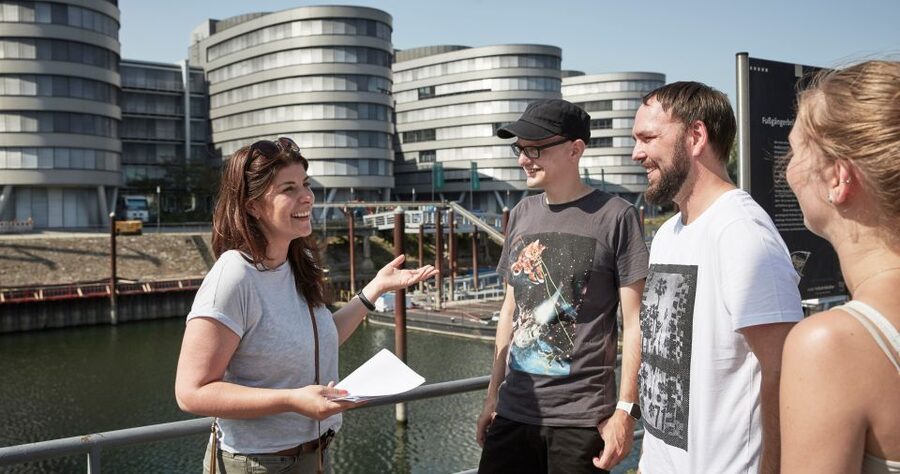
Reviewed · WALKING TOURS
Duisburg: Guided Walking Tour through the inner harbour
Duisburg’s inner harbour is a fine example of a city changing its course without erasing its past. On this 1.5-hour walking tour, you follow the water from former grain-trading docks to a district of yachts, museums, restaurants, and striking modern buildings shaped by Sir Norman Foster’s plan.
I like two things right away: the tour explains why the harbour changed, rather than simply pointing at buildings, and it gives you a clear look at the old and new Duisburg side by side. The main consideration is language: the live guide speaks German, so this works best if you understand German well enough to follow a spoken history talk.
- The harbour’s transformation: Learn how the former bread basket of the Ruhr area became a modern waterfront district.
- The Five Boats: See one of the inner harbour’s most recognizable modern architectural sights.
- Old beside new: Compare nostalgic warehouse rows with glittering office buildings and newer public spaces.
- Waterfront atmosphere: Pass the marina, restaurants, museums, and boats that now replace much of the former freight activity.
- Practical timing: The walk lasts 1.5 hours and costs $16 per person, a fair price for a focused introduction.
- All-weather access: The tour runs in rain and is wheelchair accessible.
From grain port to modern waterfront
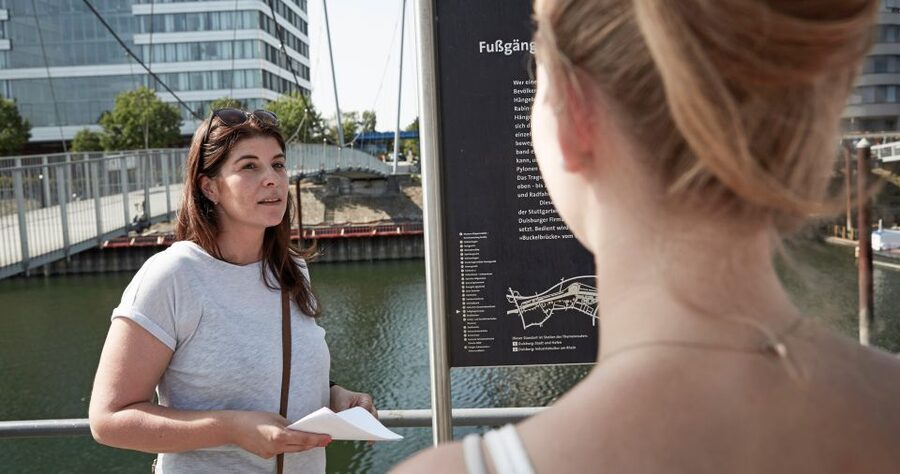
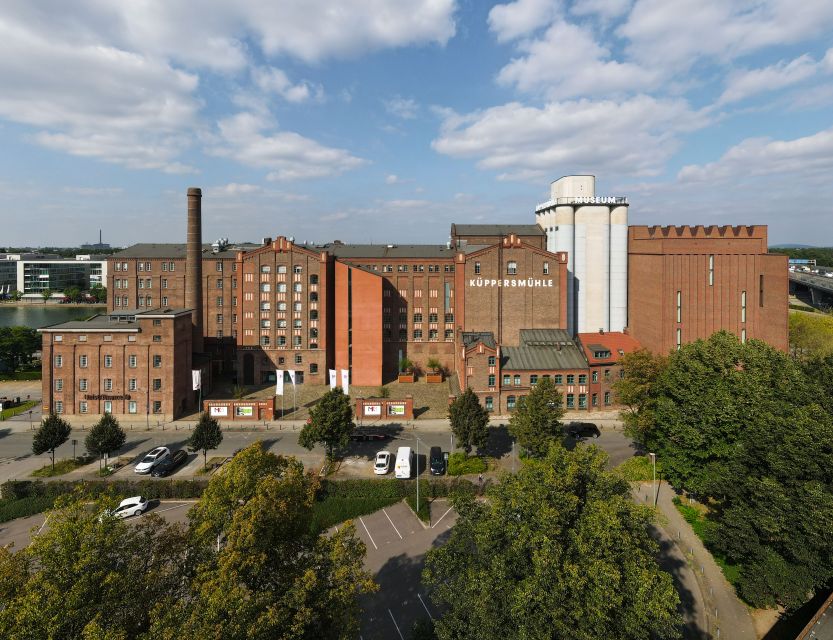
The best part of this tour is the story of change. Duisburg’s inner harbour was once known as the bread basket of the Ruhr area because huge quantities of grain were handled here. Mills and warehouses gave the district its purpose, and cargo activity shaped the daily life of the waterfront.
That trade declined sharply by the end of the 1960s. Once the grain mills faded away, the old inner harbour could not simply carry on as before. Empty industrial property can become a serious burden for a city, especially when it sits close to the centre.
Duisburg chose another path. From the mid-1990s, a plan by British architect Sir Norman Foster helped guide the harbour’s rebirth. The result is not a brand-new district dropped onto a blank site. It is a mix of preserved industrial character, modern offices, cultural buildings, public spaces, and leisure facilities.
That mix gives the walking tour its purpose. You are not just looking at handsome waterfront architecture. You are seeing how a working port adjusted when its old business disappeared.
Meeting at the Mercator fountain
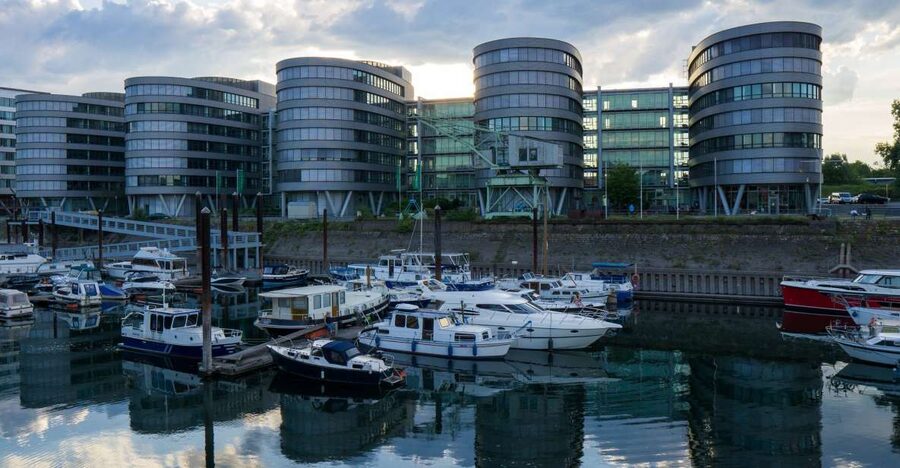
The tour begins in front of the Mercator fountain, outside Duisburg’s town hall. This is a practical central meeting point, and you should allow enough time to find the fountain before the scheduled start.
The walk is guided in German. That detail matters more here than it might on a simple sightseeing stroll because the value comes from the explanations. You will hear how the port functioned, why the old activity declined, and how the Foster plan changed the area.
The available feedback points to a guide style that is informative and humorous. One recent participant still enjoyed the tour in poor weather, noting the good mood maintained by the guide. That is useful to know because this is an outdoor experience with no promise of sunshine.
The exact guide’s name is not provided, so you should not book expecting a particular individual. What you can expect is a live German-speaking guide rather than an audio recording or self-guided route.
More Walking Tours in the Ruhr
- Münster: Old Town Historical Walking Tour by “Geo Epoche”
★ 4.7 · 51 reviews - Aachen: Private Walking Tour With A Professional Guide
★ 4.8 · 22 reviews - Münster Private Guided Walking Tour
★ 4.5 · 18 reviews
Following the old harbour’s working past
As you walk into the inner harbour, the first thing to keep in mind is how heavily industrial this water once was. Freighters were loaded and unloaded here, and grain moved through mills and storage buildings before heading into the wider Ruhr area.
Today, the physical traces of that trade remain important. Nostalgic warehouse rows help you picture the former port, even as the uses around them have changed. The tour’s strength is the contrast: the buildings are not treated as isolated sights, but as pieces of a larger story about industry, decline, and reuse.
I find this kind of explanation more useful than a list of dates. You begin to understand why the waterfront looks the way it does. A warehouse row may look picturesque now, but it once belonged to a hard-working freight district. The marina may feel relaxed, yet it occupies water that was once part of a much more practical transport system.
The route does not turn the old harbour into a museum frozen in time. Instead, it shows how the city kept selected elements of its past while giving the district a new economic role.
The Five Boats and the new Duisburg
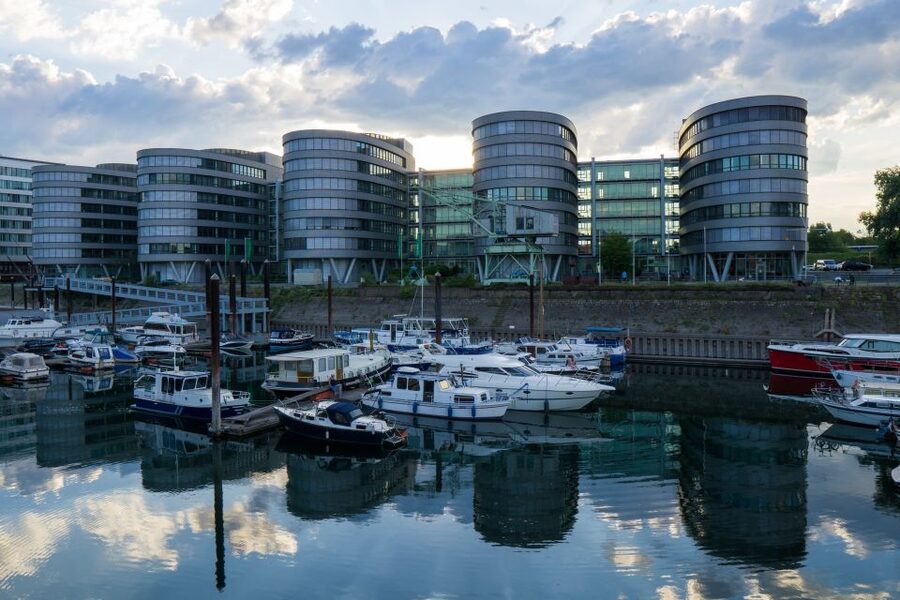
The Five Boats is one of the tour’s key modern sights. Its bold architecture represents the new face of the inner harbour and gives you a clear example of the contemporary design that followed the redevelopment plan.
You will also pass modern office complexes. Their glassy, polished appearance creates a strong visual contrast with the older warehouses. That contrast is part of the appeal, but it can also divide opinion. If you prefer historic districts where every building belongs to the same period, the inner harbour may feel visually mixed.
For me, that mixture is exactly what makes the district worth seeing. Duisburg is a city shaped by industry, and the new architecture does not pretend otherwise. The modern buildings show where the city is going, while the old warehouse rows keep the port’s earlier identity visible.
The guide’s explanation helps you judge the architecture in context. You can ask whether the newer buildings fit the harbour, how the redevelopment changed the area, and what happens when a former industrial zone becomes a place for offices, culture, and leisure.
The marina and a changed waterfront mood
Where cargo ships once worked, yachts now lie at anchor. This is the most obvious sign of the inner harbour’s new role, and it gives the area a more relaxed, almost Mediterranean mood.
The marina is not the only attraction. Restaurants line parts of the water, inviting you to stay after the walk rather than simply pass through. Events for young and old also form part of the district’s newer identity, making the harbour a place for leisure as well as business.
You should keep your expectations in check. This is not a long boat cruise or a food tour, and the tour does not include a meal. The guide leads you on foot and explains the setting. The restaurants are useful before or after the walk, but they are separate from the ticket.
That separation is actually helpful. You can finish the tour, decide which waterfront restaurant appeals to you, and enjoy the setting at your own pace. You might also use the walk as an orientation before returning later in the day.
Same city, a completely different kind of day:
- BVB Signal Iduna Park: Stadium Access and Self-Guided Tour
★ 4.4 · 2,332 reviews - Bottrop: Movie Park Full-Day Admission Ticket
★ 4.4 · 511 reviews - Dortmund: German Football Museum
★ 4.6 · 484 reviews - Dortmund: Borusseum Borussia Dortmund Museum Entry Ticket
★ 4.6 · 315 reviews
Museums worth adding before or after
The inner harbour has enough cultural attractions to make the walking tour part of a larger visit. The Küppersmühle Museum of Modern Art is specifically worth considering if modern art interests you. Its presence adds another layer to the district’s architectural renewal.
The Museum of Cultural and Urban History is another option. It offers a different angle, helping connect Duisburg’s urban development to the wider story you hear on the walk.
The tour itself does not include museum admission, and you should treat these as optional additions. Still, they make the $16 ticket more useful because the walk can serve as a framework for exploring the area rather than being your only activity.
If you have limited time, take the tour first and use its historical background to decide which museum suits you. If you already know you want to visit the Küppersmühle, check its opening details separately so your timing works.
What the 1.5-hour format does well
Ninety minutes is a sensible length for an outdoor urban walk. It is long enough to explain the harbour’s past and redevelopment, but short enough to fit into a day of sightseeing in Duisburg.
The route focuses on the inner harbour rather than attempting to cover the entire city. That keeps the subject clear. You get a concentrated look at the waterfront, including the Five Boats, marina, museums, restaurants, older warehouses, and modern offices.
A shorter tour would risk reducing the story to a few quick photographs. A much longer tour might feel repetitive, especially if you are mainly interested in the harbour’s redevelopment. The current length gives you a useful introduction without taking over your day.
The pace should suit most people who are comfortable with a 1.5-hour walking route, though the information supplied does not give a precise distance or number of stops. If walking comfort is a concern, note that the tour is listed as wheelchair accessible.
Is $16 a fair price?
At $16 per person, the tour is reasonably priced for a live guided walk lasting 1.5 hours. You are paying for interpretation, not entry to a museum, a meal, or transportation.
The price makes the most sense if you want to understand the inner harbour rather than simply photograph it. Without context, you may see attractive offices, boats, and warehouses but miss the reason this district changed so sharply.
One German-language assessment described the tour as very informative and humorous, with especially strong value for money. That matches the structure of the experience: the ticket covers a focused walk through a district where the backstory is as important as the views.
The value drops if you do not understand German. Since the guide speaks German, you may not receive much benefit from the commentary if you can only follow a few words. In that case, a self-guided visit to the waterfront might be more practical, though it would not provide the same live explanation.
Rain, access, and what to wear
The tour takes place even when it rains. That is both a plus and a warning. You have more flexibility when planning, but you should dress for an outdoor walk and bring rain protection if the forecast looks unsettled.
Rain may make the waterfront less comfortable, especially when you stop to listen. On the other hand, the tour’s value is not dependent on perfect views. The main subject is the harbour’s transformation, and the buildings and urban plan remain there in poor weather.
The experience is listed as wheelchair accessible. That is important for visitors who need a route designed with access in mind. The available information does not specify the exact surface conditions, gradients, or restroom arrangements, so you may want to confirm those points before booking if they are essential to your plans.
Free cancellation is available up to 24 hours in advance for a full refund. You can also reserve now and pay later, which helps if your schedule in Duisburg is still taking shape.
Who will enjoy this walk most?
I would choose this tour if you like cities that show their working past openly. The inner harbour is especially interesting for people curious about urban planning, industrial change, architecture, and the reuse of old port areas.
It also suits visitors who want a calm introduction to Duisburg before spending time in its museums or waterfront restaurants. The walk gives you a sense of how the district fits together, so later stops feel less random.
Families may appreciate the manageable length and the changing scenery. The marina, boats, modern buildings, and old warehouses offer more variety than a walk focused on a single historic style.
The main group I would hesitate to recommend it to is anyone who does not understand German. The guide’s commentary is central to the experience, and the tour does not list another language option.
How I would plan the visit
I would place the walking tour near the start of my time at the inner harbour. Meet at the Mercator fountain by the town hall, follow the guided route, and then choose a museum or restaurant afterward.
If modern art is your priority, plan time for the Küppersmühle Museum of Modern Art. If you want more urban background, consider the Museum of Cultural and Urban History. You can also simply sit near the water after the walk and enjoy the marina atmosphere.
Do not treat the tour as a replacement for exploring on your own. Its job is to explain the district. The best plan combines the guided introduction with time to look closely at the buildings, pause beside the water, or eat at one of the restaurants.
Should you book the Duisburg inner harbour tour?
Book it if you understand German and want the story behind Duisburg’s waterfront redevelopment. The strongest features are the clear industrial-to-modern contrast, the explanation of Sir Norman Foster’s plan, and the chance to see old warehouses, the Five Boats, yachts, museums, and offices within one compact walk.
At $16, it offers solid value for a focused 1.5-hour introduction. The rainy-weather policy adds planning flexibility, and the wheelchair-accessible listing makes it practical for more visitors.
Skip it if you want a tour in English, a boat ride, or a museum ticket included. For everyone else, this is a sensible way to see how a former grain port became one of Duisburg’s most active new districts.
FAQ
Where does the tour meet?
The guide meets you in front of the Mercator fountain outside Duisburg’s town hall.
How long does the tour last?
The guided walking tour lasts 1.5 hours.
What language is the tour in?
The live tour guide speaks German.
How much does the tour cost?
The listed price is $16 per person.
Is the tour wheelchair accessible?
Yes, the tour is listed as wheelchair accessible.
Does the tour run in rainy weather?
Yes, the tour takes place even when it rains.
What will I see during the walk?
You will see the inner harbour, the Five Boats, the marina, museums, restaurants, modern office buildings, and older warehouse rows.
What is the main subject of the tour?
The tour explains how Duisburg’s inner harbour changed from a major grain-handling area into a modern waterfront district.
Who planned the redevelopment of the inner harbour?
The redevelopment plan discussed on the tour was created by British architect Sir Norman Foster.
Can I cancel the booking?
You can cancel up to 24 hours in advance for a full refund. You can also reserve now and pay later.
Just added in the Ruhr
- Adventure Darkness – Guided tour in the dark★ 4.6 · 32 reviews
- Schimmi tour pure (without catering)★ 4.9 · 19 reviews
- Private crime city tour by rickshaw including guide★ 5.0 · 21 reviews
- Oberhausen: Legoland Discovery Center Ticket★ 4.1 · 110 reviews
- Paderborn: “Beschwipste” Nachtwächter-Führung (mit Umtrunk)★ 4.6 · 27 reviews
- Osnabrück: “Beschwipste” Nachtwächter-Führung (mit Umtrunk)★ 5.0 · 4 reviews
- Osnabrück: “Gallows, graves & crooks” (adventure tour)★ 4.8 · 22 reviews
- Osnabrück: Altstadt-Highlights (Stadtführung)★ 4.7 · 42 reviews
Walking Tours, compared.


Berlin’s Best: 2 Hour Walking Tour Third Reich and the Cold War
Read our review →
Third Reich Berlin: Hitler and WWII Walking Tour
Read our review →Browse the lists this tour appears in