
Reviewed · MUSEUMS
Dresden: Guided Walking Tour and Chocolate Museum Ticket
Dresden’s Old Town gives you a compact lesson in German history, from medieval struggles and Renaissance energy to Baroque showmanship and the peaceful revolution of 1989. This tour adds an appealing second act: a visit to Dresden’s Chocolate Museum, where the city’s sweet industrial past includes the claim that milk chocolate was invented here.
I like the efficient route through the Old Town, which brings together the Frauenkirche, Semperoper, Zwinger, Dresden Castle, Brühl’s Terrace, and the Procession of Princes. I also like the flexible chocolate visit, since you can use your museum voucher at any time on the tour day instead of being tied to the guide.
The main consideration is language and independence. The live tour is in German, and the guide does not accompany you into the museum. If you choose the 4:00 PM walking tour, you must visit the museum first, since it closes at 6:00 PM.
Key points to know before booking

- Dresden’s major Old Town sights fit into 1.5 hours, giving you a useful first look without taking up a whole morning.
- The walking tour is conducted in German, so it suits German speakers best.
- The Chocolate Museum is self-guided, with no need to enter at the same time as the walking tour.
- The museum traces Dresden’s chocolate industry, including milk chocolate, cocoa processing, factory production, and Anton Reiche’s large mold collection.
- The $18 price includes a tasting and coffee coupon, not just admission and a guide.
- Franziska is one guide praised for clear, informative historical explanations, though guide assignment is not guaranteed.
A smart pairing of Dresden’s grand center and its sweet past
This experience works because it joins two different sides of Dresden. The walking portion gives you the city’s grand public face: domes, palaces, river views, royal courtyards, and ceremonial monuments. The museum then shifts attention to food, trade, manufacturing, and everyday pleasure.
You begin at Dresden Information on the lower level of the QF-Passage shopping center, close to Neumarkt. That location is practical because Neumarkt sits at the heart of the Old Town, right beside the Frauenkirche. You do not have to spend time finding an out-of-the-way meeting point.
The tour lasts 1.5 hours. That is enough time to get your bearings and hear the main stories, but not enough for long interior visits at every landmark. Think of this as an orientation walk with a strong historical thread, not a full museum tour or a detailed architectural study.
That short format is useful if you have only a day in Dresden, or if you want a guided introduction before exploring on your own. It also leaves room for the Chocolate Museum, which you visit independently.
More Museum Tours in Dresden
- Dresden: Church of Our Lady Guided Tour of Gallery
★ 4.7 · 2,421 reviews - Dresden: Zwinger Museum Entry Ticket
★ 4.7 · 1,436 reviews - Dresden: Dresden Transport Museum Entrance Ticket
★ 4.6 · 189 reviews
Neumarkt and the Frauenkirche: Dresden’s symbolic heart
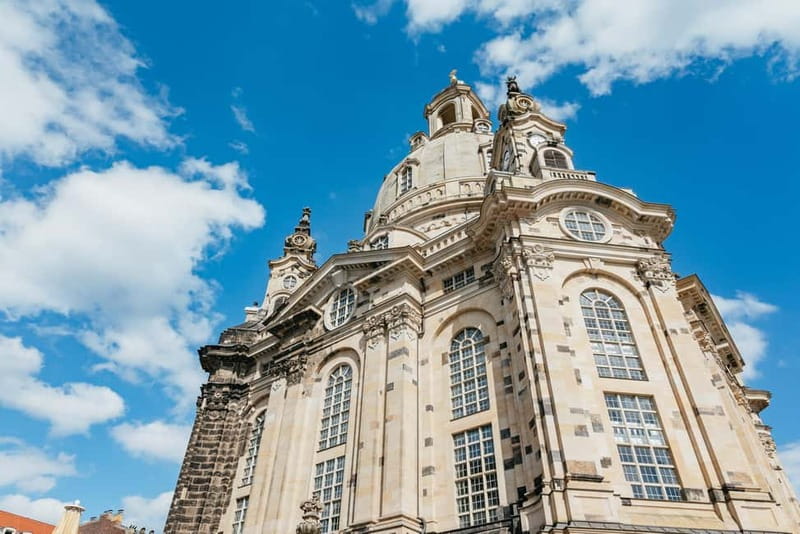
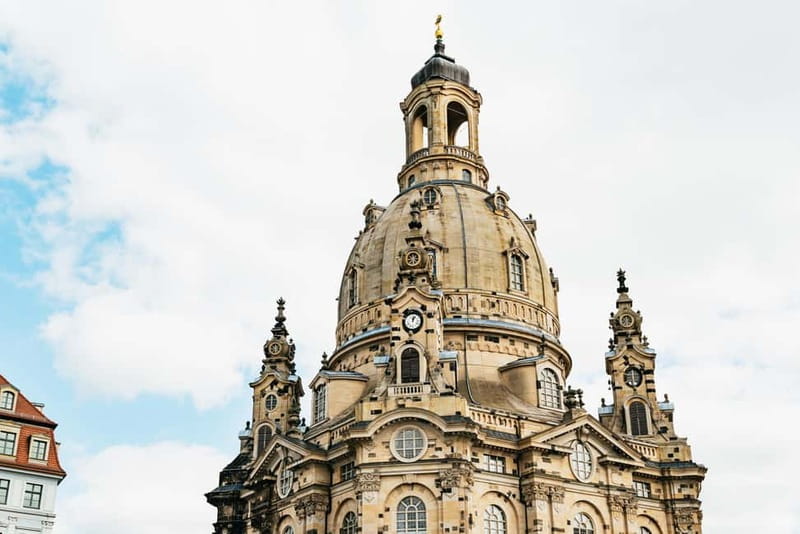
The walk begins around Neumarkt, one of Dresden’s most recognizable squares. The Frauenkirche dominates the setting with its large stone dome and carefully restored Baroque form. The church is more than a handsome landmark. It also gives the guide a natural way to explain Dresden’s destruction during the Second World War, its later reconstruction, and the city’s changing identity.
From the start, you are in the part of Dresden most visitors come to see. The benefit of a guide here is not simply naming buildings. A good guide helps you place them in time, showing how medieval Dresden developed into a Renaissance center and then into a royal Baroque capital.
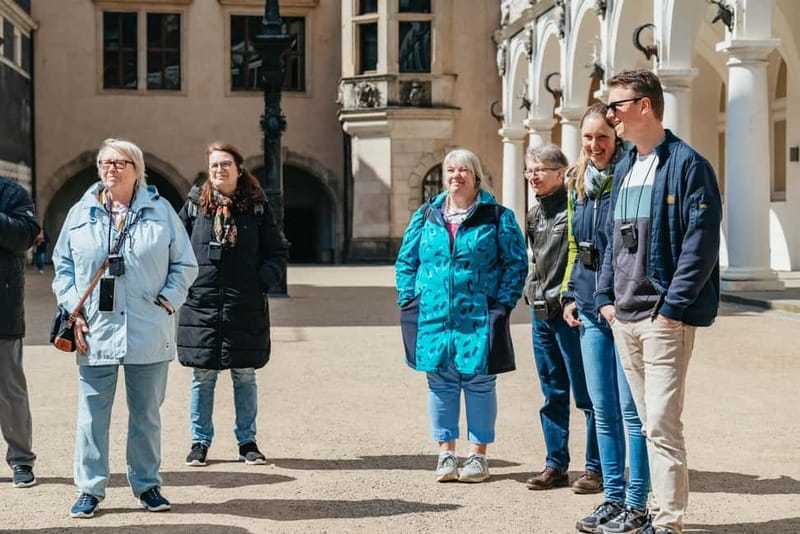
You should expect plenty of looking up and stopping for explanations. Wear comfortable shoes, since the tour is entirely on foot. The city center sights are close together, but cobblestones and regular standing can make the walk feel more tiring than the 1.5-hour length suggests.
Dresden Castle and the route through royal history

From the Old Town, the route reaches Dresden Castle. The castle connects several periods of the city’s story and helps explain the role of Saxony’s rulers. It is an important stop because Dresden’s Baroque appearance did not happen by accident. Courts, royal ambitions, art collections, and public ceremony shaped the center you see today.
The tour also brings you through the Stallhof, or stable yard, an atmospheric part of the former royal complex. Here you can see how court life was organized beyond the grand palace rooms. The setting is especially useful for understanding the difference between Dresden’s public display and its practical working spaces.
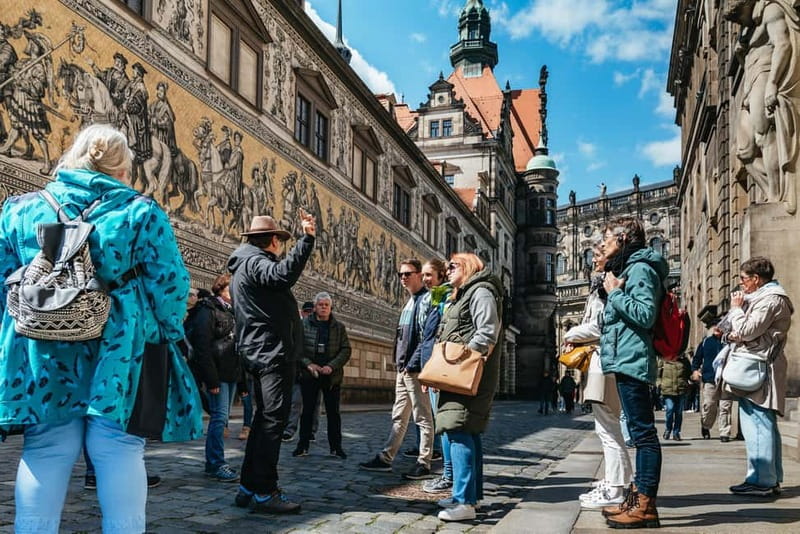
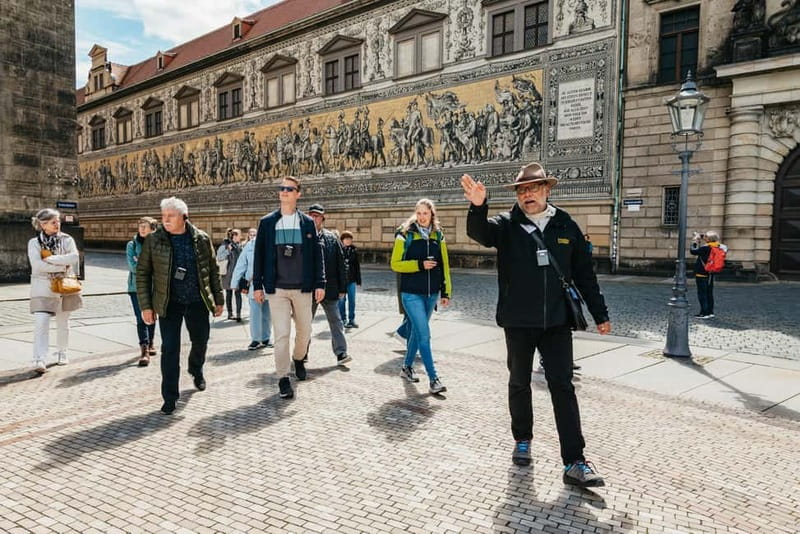
Nearby, the Procession of Princes stretches along the wall with its long parade of Saxon rulers. It is one of the easiest places to see Dresden’s habit of turning history into public art. The work gives the guide a chance to explain the succession of rulers and the city’s long connection with Saxon power.
You will not have time to study every figure closely during a fast walking tour. If this mural catches your interest, note its location and return later for a slower look. The guided stop gives you the context; your own second visit gives you the detail.
Baroque Dresden at the Zwinger and Semperoper
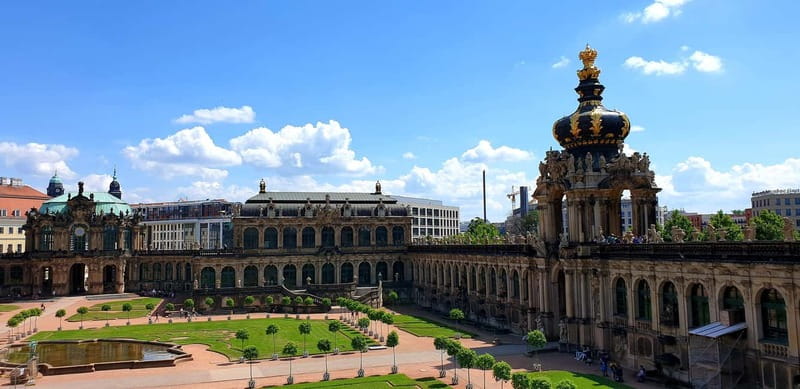
The Zwinger is one of Dresden’s great Baroque showpieces. Its ornate courtyards and formal design reflect the ambitions of the Saxon court. Even if you do not enter its museums on this activity, seeing the complex from the outside helps you understand why Dresden earned its reputation for grand architecture.
The Semperoper offers a different kind of grandeur. This opera house is tied to Dresden’s musical and artistic life, while the Zwinger expresses court ceremony and display. Seeing both in the same walk gives you a quick lesson in how many different forms Dresden’s cultural identity can take.
The tour also includes views of the Taschenbergpalais and Dresden Cathedral. These stops may appeal most to visitors who like architecture and city planning, since the buildings make more sense when seen together. The guide can show you how palace, church, theater, and civic spaces were arranged around the royal center.
The walk then reaches Brühl’s Terrace, often associated with broad views along the Elbe. It is a pleasant change from close streets and palace walls. The terrace gives you a chance to pause, look outward, and see how Dresden’s position beside the river shaped its appearance.
More Walking Tours in Dresden
- Dresden: City & Semperoper Guided Walking Tour
★ 4.8 · 2,293 reviews - Dresden: Guided City Walk with a Cup of Coffee
★ 4.7 · 1,568 reviews - Dresden: Complete Walking Tour with Frauenkirche Visit
★ 4.8 · 700 reviews - Dresden: Walking Tour with a Night Watchman and Meal
★ 4.4 · 487 reviews
From medieval hardship to the Peaceful Revolution
The strongest part of this experience is its range of historical periods. The guide covers the Middle Ages, Renaissance, and Baroque era, but also addresses the darker chapters of Dresden’s past and the Peaceful Revolution of 1989.
That last subject matters. Dresden was part of East Germany, and the events of 1989 helped lead to the end of the German Democratic Republic and the reunification of East and West Germany. Including this period keeps the tour from turning Dresden into a collection of pretty old buildings with no modern political story.
The historical explanations are a major reason to choose a guided walk rather than simply following a map. A guide can connect a palace wall to royal power, a church to war and reconstruction, and a city square to the political changes of modern Germany.
Guide quality naturally affects this part of the experience. Franziska is one guide specifically praised for strong historical explanations and an informative approach. The tour is conducted in German, so you will get the most from it if you understand German comfortably. If you do not, the monuments are still attractive, but the central value of the activity is the spoken history.
The Chocolate Museum and Dresden’s sweet industrial story
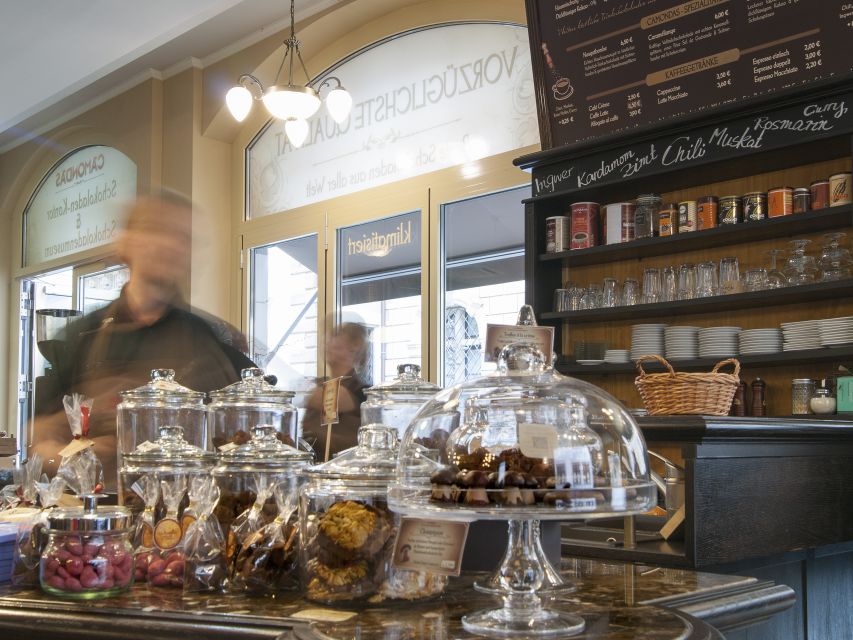
After the walking portion, you visit Dresden’s Chocolate Museum on your own. The museum is open daily from 11:00 AM to 6:00 PM, and your voucher can be used at any time on the day of the walking tour. That flexibility is helpful because you can fit the museum around lunch, other sightseeing, or the walking tour’s scheduled start.
The museum looks at Dresden’s former role as Germany’s capital of chocolate. That is a surprising angle, especially in a city better known today for churches, palaces, and museums. You learn about the city’s many chocolate factories in the 19th century and the development of milk chocolate, which is said to have been invented in Dresden.
The exhibits also explain the ingredients that make good chocolate and follow the process from cocoa bean to finished product. That basic journey is familiar, but the Dresden connection gives it a local reason to hold your attention.
One of the museum’s most unusual features is its large collection of chocolate molds made by Anton Reiche. The molds show how chocolate was shaped into bars, figures, and other forms before modern production methods took over. This is the sort of practical industrial detail that can make a small museum more interesting than a simple display of packaged sweets.
You can also find out what early chocolate bars may have tasted like. The tasting gives the visit a clear finish, allowing you to compare the museum’s history with the product itself. Germany’s milk chocolate is the focus here, and the experience includes a chocolate tasting rather than only a display behind glass.
Timing the two parts without rushing
Most people should visit the museum after the morning or early afternoon walking tour. That order lets you hear the city story first, then enjoy the chocolate museum at your own pace.
The 4:00 PM walking tour needs special planning. Since the museum closes at 6:00 PM, you must visit it before the walk. Do not treat the voucher as an open-ended ticket for another day. It is valid on the same day as your walking tour.
The exact walking-tour start time depends on availability, so check the schedule before booking. The activity is listed as ending back at the meeting point, while the route itself brings you through the central sights near the Frauenkirche. Keep your confirmation details handy if you need to coordinate the museum with other plans.
The free coffee coupon is a small but useful extra. It will not transform the value of the tour, but it gives you a simple break after the walk or museum visit. Since the exact coffee redemption details are not provided, check the voucher for the participating location and conditions.
What the $18 price really covers
At $18 per person, this is a modestly priced way to combine a guided city walk with a museum admission, tasting, and coffee coupon. The value depends mainly on how much you want the German-language guide.
If you would otherwise pay separately for a walking tour and a small museum visit, the package is convenient. You get a route through the key Old Town sights, historical commentary, museum entry, and something to taste at the end. You also avoid the need to arrange two separate bookings.
The price is less compelling if you only want a quick look at Dresden’s buildings and do not understand German. In that case, much of what you are paying for is the guide’s historical explanation. The chocolate museum still adds interest, but it is self-guided and does not replace an English-language city tour.
The free cancellation option, available up to 24 hours before the activity, gives you a reasonable safety net. You can also reserve now and pay later, which helps if your Dresden schedule is still changing. These are useful booking terms, but the bigger value question remains simple: will you listen to the German tour and visit the museum on the same day?
Who will get the most from this experience
I would recommend this activity to German-speaking visitors who want a compact introduction to Dresden. It is especially suitable if you enjoy architecture, political history, royal stories, and food museums, but do not want to spend an entire day with a guide.
Families may like the chocolate section because the tasting and molds add a hands-on element to the historical material. People with limited time can also use it well, since the walk covers many central sights in 1.5 hours.
It is less suitable if you want a slow architectural tour with interior visits. It is also not the right pick if you need an English-speaking guide, since the live tour is in German. The museum is wheelchair accessible, but the activity remains a walking tour, so consider your comfort with a sustained route through the Old Town.
Should you book the Dresden walking tour and Chocolate Museum?
Book it if you want a short, well-packed introduction to Dresden and you understand German. The combination of royal Old Town landmarks, modern German history, chocolate production, a tasting, and a coffee coupon gives you more variety than a standard sightseeing walk.
Plan the timing carefully, especially for the 4:00 PM departure. If you want the most relaxed visit, see the museum before or after an earlier walking tour, then return to any landmark that deserves more time. At $18, this is a sensible choice for a first look at Dresden, provided you value the guide’s German commentary and are happy to explore the museum on your own.
FAQ
Where does the walking tour begin?
The tour begins at Dresden Information on the lower level of the QF-Passage shopping center.
How long is the walking tour?
The guided walking tour lasts 1.5 hours.
What language is the live tour in?
The live tour guide speaks German.
Which Dresden landmarks are included?
The route includes views of the Frauenkirche, Semperoper, Baroque Zwinger, Dresden Castle, Brühl’s Terrace, the Procession of Princes, Stallhof, Dresden Cathedral, Taschenbergpalais, and Augustus Bridge.
Is the Chocolate Museum part of the guided tour?
No. You visit the Chocolate Museum on your own after or before the walking tour.
When can I enter the Chocolate Museum?
You can use your voucher at any time on the day of your walking tour. The museum is open daily from 11:00 AM to 6:00 PM.
What happens if I choose the 4:00 PM walking tour?
You must visit the Chocolate Museum before the walking tour, since the museum closes at 6:00 PM.
Is chocolate tasting included?
Yes. The activity includes a chocolate tasting featuring German milk chocolate.
Is the activity wheelchair accessible?
Yes, the activity is listed as wheelchair accessible.
Just added in Dresden
- Test Drive Electric Vehicles from the VW brand (ID. model)★ 4.8 · 190 reviews
- SRF CoBi | City Tour by ConferenceBike★ 4.7 · 38 reviews
- Dresden: Scavenger Hunt to Elbe River & Castles★ 4.7 · 15 reviews
- Dresden: Bike Rental – City Bike with Option Children Seat★ 4.5 · 13 reviews
- Private trip from Prague to Dresden, Moritzburg & Meissen★ 5.0 · 5 reviews
- Moritzburg: Scavenger Hunt Self-Guided Walking Tour★ 4.8 · 12 reviews
- Historical tour of the old town including a Saxon dinner★ 4.7 · 23 reviews
- Climb the mountains together with goats★ 4.8 · 8 reviews
Museums, compared.



Skip-the-Line: Berlin Wall Museum at Checkpoint Charlie
Read our review →
Browse the lists this tour appears in