
Reviewed · BERLIN WALL AND COLD WAR TOURS
Berlin: The Wall and Cold War – a Private Walking Tour
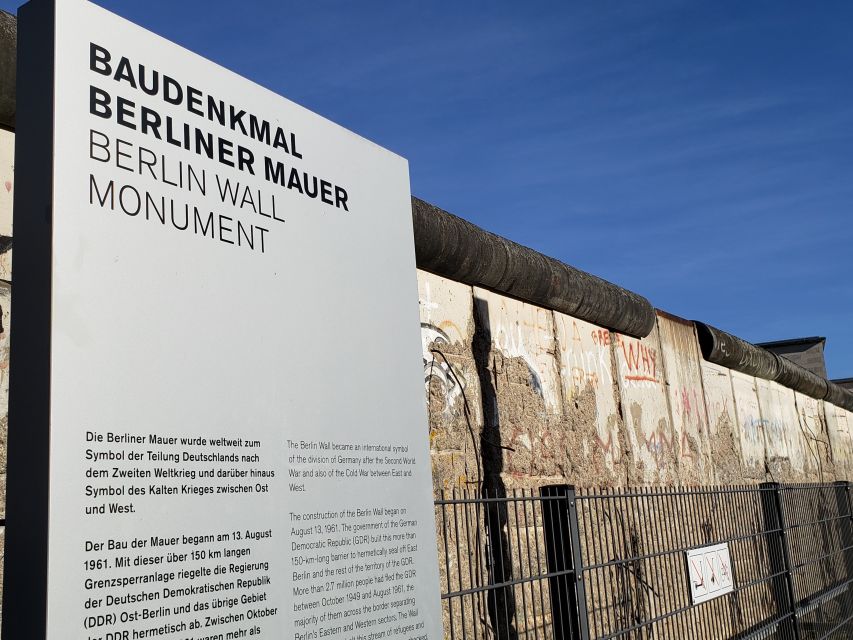
Berlin’s Cold War story becomes clearest when you follow the former border on foot. This private tour starts at Bernauer Strasse, where an open-air documentation site preserves traces of the Wall, then leads through central Berlin to Checkpoint Charlie. Along the way, you hear how the border changed ordinary streets, families, and escape plans.
I like the small private format, since it gives you room to ask questions instead of standing at the back of a large group. I also like the mix of physical remains and human stories, especially at the Palace of Tears and the former death strip. The main drawback is time: two hours gives you a strong introduction, but not a full study of every Cold War site in Berlin.
Key points to know before booking
- Bernauer Strasse provides the strongest opening: The tour begins beside an open-air documentation site with surviving Wall remains and a clear sense of the former border.
- The route connects history to daily life: You hear about divided families, escape attempts, and the experience of living in a city cut in two.
- The Palace of Tears is a former border station: This stop helps explain how ordinary departures and reunions were controlled.
- The viewing platform depends on opening hours: If it is open, you can look across the former death strip from above.
- Checkpoint Charlie is the final stop: The walk ends at one of Berlin’s best-known former border crossings.
- The private guide is the main value: Guides such as Stephanie and Stefan have been praised for clear storytelling, friendly delivery, and strong knowledge of Berlin’s Cold War past.
Starting at Bernauer Strasse, where the Wall still feels close
Meet your guide upstairs at the U Bernauer Strasse station, at the exit marked Bernauer Strasse. Look for a sign with your name. This is a useful meeting point because the tour begins right beside one of the city’s most important Wall memorial areas.
Bernauer Strasse is not just a place where you hear that the Wall once existed. The street itself helps show how the border worked. The former divide ran through a lived-in part of Berlin, splitting streets, homes, neighbors, and transport links. The open-air documentation museum gives your guide material to explain what happened here and what remains visible.
I like beginning here because it avoids the common problem of starting with a famous name but little context. By the time you reach Checkpoint Charlie, you have already seen the border as a real barrier rather than a Cold War symbol on a postcard.
The site also gives the guide a chance to explain the Wall’s construction and later fall. You can expect the focus to stay on Berliners and their choices, not only on the actions of governments. That human scale is important. The Cold War was shaped by major political decisions, but its effects were felt in stairwells, apartments, train stations, and family visits.
More Walking Tours in Berlin
- Discover Berlin Half-Day Walking Tour
★ 5.0 · 9,624 reviews - Berlin: Third Reich and Cold War 2 Hour Walking Tour
★ 4.9 · 6,830 reviews - Berlin: Discover Berlin Walking Tour
★ 4.9 · 5,998 reviews
Following the former borderline through Berlin
From Bernauer Strasse, you follow the former borderline toward central Berlin. The walk is designed to connect separate places into one story, so you are not simply moving between unrelated monuments.
Your guide explains daily life in the divided city and points out places linked to escape attempts. These details help you understand why the Wall was so difficult to cross. The story is not limited to dramatic escapes. It also includes the many small restrictions that shaped life on both sides of the border.
This is where a private tour can be more useful than a self-guided walk. If a detail catches your attention, you can ask about it immediately. You can also tell the guide what interests you most, whether that is architecture, political history, family separation, escape methods, or the practical operation of the border.
English and German are available. One especially useful feature is that the guide can work across both languages. During one tour, Stephanie explained the subject in English for Canadian visitors and in German for children in the same group. That makes this a practical choice for mixed-language families and groups.
The route is a walking tour, so comfortable shoes are sensible. The supplied information does not give a precise distance or terrain description, but you should expect to be on your feet for the full two hours. Wheelchair access is available, which may make this tour easier to consider than some older Berlin walking routes, though you should still confirm any personal route needs when booking.
The Palace of Tears and the mechanics of separation
The Tränenpalast, or Palace of Tears, is one of the most meaningful stops on the route. It was a former border crossing station, and the tour includes a guided visit there.
The name points to the emotional role of the building. This was a place where people said goodbye under the rules of a divided city. It was not simply a checkpoint for cars or military personnel. It handled personal departures and meetings, making the politics of the border painfully close to ordinary families.
Your guide uses the stop to explain how crossing controls worked and what separation meant in daily life. This gives the tour a useful change of pace. At Bernauer Strasse, you see the physical border and its wider effect on the city. At the Palace of Tears, you focus on the personal experience of passing through a controlled crossing.
I would give this stop real weight when deciding if the tour suits you. A visitor looking only for Wall fragments might find the Palace of Tears less visually dramatic than a long stretch of preserved concrete. But if you want to understand how the division affected people, it is one of the most valuable parts of the walk.
Viewing the former death strip, if the platform is open
The tour may include access to a viewing platform overlooking the former death strip. This is subject to the platform being open, so do not treat it as guaranteed.
From above, the layout of the border becomes easier to read. You can look across the zone designed to stop escape attempts and understand that the Wall was more than a single slab of concrete. The viewing point helps you take in the space between the city’s two sides and the system built to control movement.
This stop is a good example of why timing matters. The tour lasts two hours, but the platform’s availability may depend on opening conditions. If this view is especially important to you, ask about access before setting out. Even if it is closed, the guide can still explain the site and the role of the former border zone.
The wording matters here: access is possible if the platform is open. A careful booking decision means treating it as an added feature, not the sole reason to reserve.
More Berlin Wall and Cold War Tours in Berlin:
- Berlin’s Best: 2 Hour Walking Tour Third Reich and the Cold War
★ 5.0 · 5,486 reviews - Berlin: DDR Museum Tickets
★ 4.3 · 3,443 reviews - Skip-the-Line: Berlin Wall Museum at Checkpoint Charlie
★ 4.1 · 2,041 reviews - Berlin: East Side Gallery Spree Cruise in a Solar Catamaran
★ 4.0 · 1,039 reviews
Ending at Checkpoint Charlie
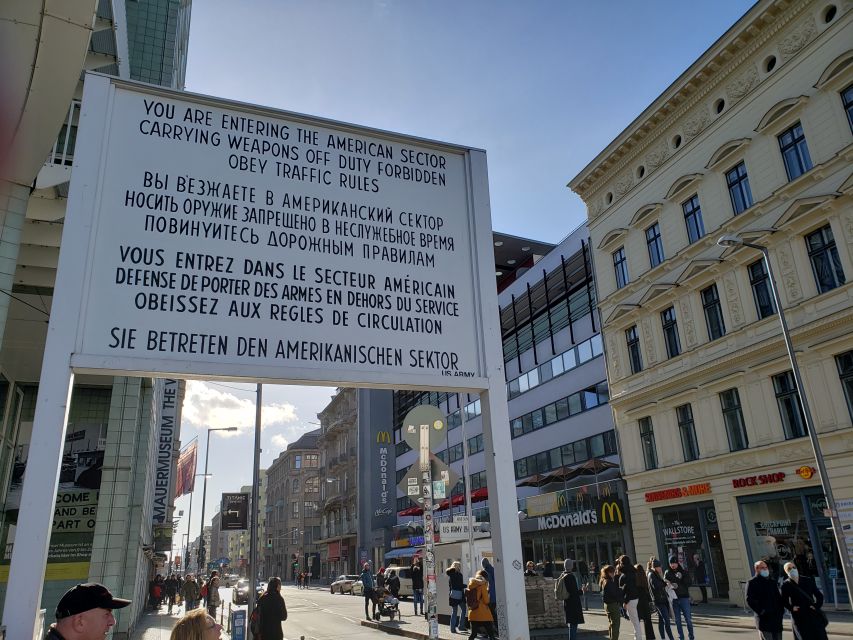
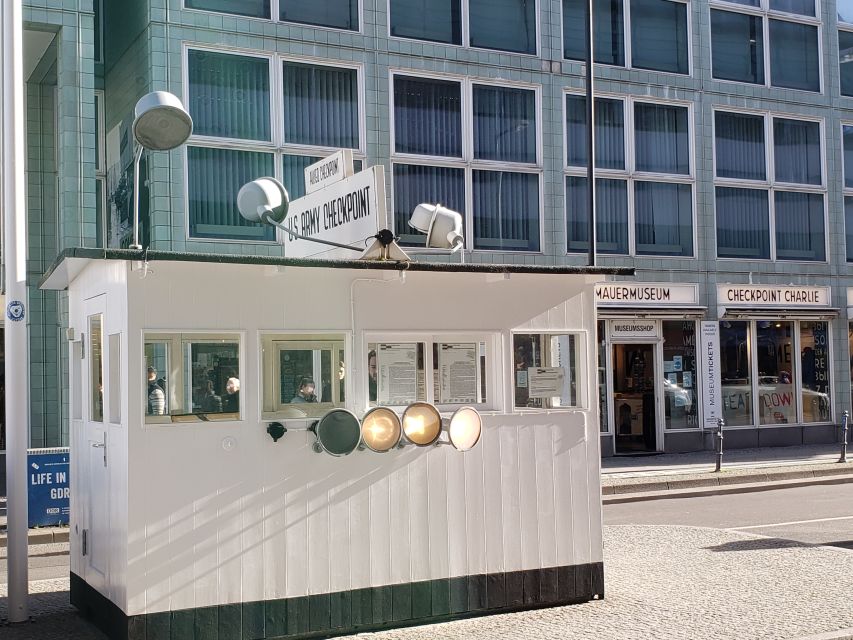
The walk concludes at Checkpoint Charlie, another former border crossing station. It is one of Berlin’s most recognizable Cold War locations and an easy place to continue sightseeing after the tour.
Checkpoint Charlie works well as a final stop because the tour has already given you the background needed to understand it. On its own, the site can feel like a quick photo stop. After walking from Bernauer Strasse and hearing about border controls, escape attempts, and divided-city life, it becomes part of a larger story.
The ending also gives you a clear sense of the route’s structure. You begin at a section where the Wall’s effect on residents is strongly documented, pass through a former crossing connected with personal departures, and finish at a famous international symbol of the divided city.
Do not expect the tour to end back at the starting station. It is a point-to-point walk, beginning at U Bernauer Strasse and finishing at Checkpoint Charlie. That is helpful if you plan to continue sightseeing in central Berlin, but you should allow time to make your own way onward.
What the guides add to the experience
The guide makes or breaks a history walk, and the strongest praise for this experience concerns the storytelling. Stephanie has been described as an authentic storyteller with a friendly manner and inside knowledge of Berlin’s history. Stefan has also been praised for guiding visitors clearly through the Cold War and its meaning for a divided city.
Those details suggest the tour’s best quality is interpretation rather than spectacle. The Wall itself is powerful, but concrete alone cannot explain the choices and pressures behind it. A good guide connects a street, a border station, or a viewing point with the lives that passed through it.
You should expect a live guide in either German or English. The tour is private, so your group is not combined with strangers. That matters most if you prefer a slower pace, have children who need explanations adjusted to their level, or want to focus on a particular part of the story.
The private format also makes the price easier to assess. At $22 per person, the cost is modest for a two-hour private walk, especially if you are sharing it with family or friends. It is less of a bargain for one person traveling alone, since the private format usually provides its best value when divided among several people. Still, the cost includes the guide and the private walking tour, without requiring you to organize the route yourself.
Who will get the most from this two-hour walk
I would recommend this tour to first-time visitors who want a clear introduction to Berlin’s Cold War past. It covers the Wall’s construction and fall, the border’s effect on daily life, escape attempts, former crossing stations, and key surviving locations in a short period.
It also suits visitors who prefer history told through places rather than a long indoor museum visit. You move through the city while the guide explains what happened at each point. The open-air beginning at Bernauer Strasse gives the tour a physical connection to the subject.
Families may appreciate the private setting and the ability to hear explanations in German and English. The bilingual example involving Stephanie shows that the format can work for groups with different language needs. Children may also find the escape stories and visible remains easier to follow than a purely political lecture, though the subject can be serious.
This is less suitable if you want an exhaustive examination of Berlin’s entire twentieth-century history. The walk focuses on the Wall and the Cold War, not on every major museum, monument, or wartime site in the city. Two hours is enough for a focused route, not a complete Berlin history course.
Practical details that affect your choice
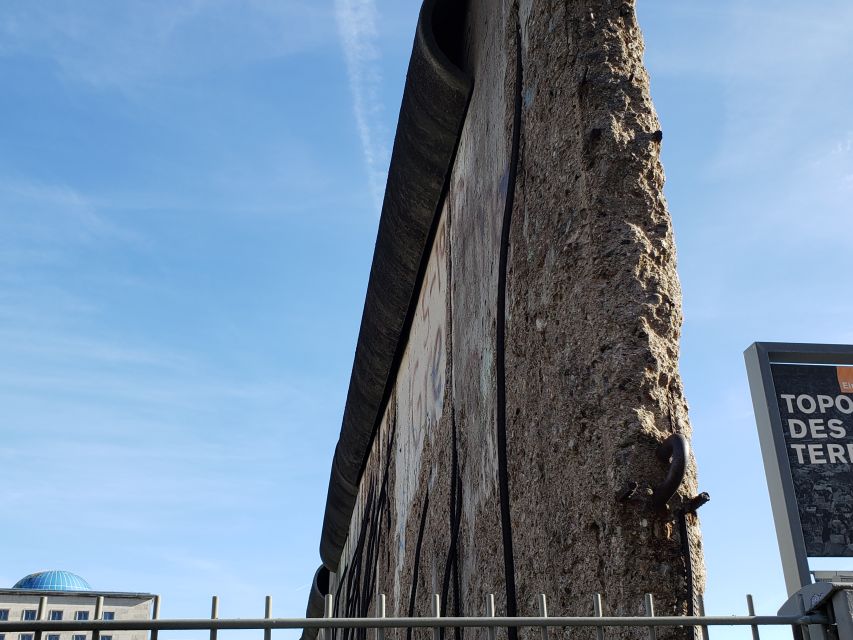
The duration is two hours, with starting times available according to the date you choose. Since the tour ends at Checkpoint Charlie, consider what you want to do next before booking. You will not need to return to Bernauer Strasse unless you choose to do so.
Meet upstairs at the U Bernauer Strasse exit marked Bernauer Strasse. Your guide carries a sign with your name. If you are late or cannot locate the guide, use the local partner’s phone number on your voucher.
The tour is wheelchair accessible, and the guide speaks German or English. It is offered for a private group, with a local guide included.
You can cancel up to 24 hours before the start for a full refund. Reserve now and pay later is available, which is useful if your Berlin schedule is still changing. These policies do not change the content of the tour, but they reduce the risk of fitting it into a busy city break.
Should you book Berlin: The Wall and Cold War?
Book it if you want a focused, human explanation of Berlin’s divided past and prefer walking between real sites rather than reading labels on your own. The route from Bernauer Strasse to the Palace of Tears and Checkpoint Charlie is well chosen, and the private format gives the guide room to adapt the story to your group.
The best reasons to choose it are the personal accounts, the former border stations, and the chance to connect surviving Wall sites with everyday life. Guides such as Stephanie and Stefan appear to bring warmth and clarity to a difficult subject.
Skip it if you want a longer tour with many museums, or if the possible viewing-platform stop is your main goal. The platform may be closed, and two hours will only introduce the wider story. For most visitors, though, the price is fair and the route offers a solid, direct way to understand why the Berlin Wall mattered.
FAQ
Where does the tour begin?
The tour begins at the underground station U Bernauer Strasse, upstairs at the exit marked Bernauer Strasse.
Where does the tour finish?
The tour finishes at Checkpoint Charlie, a former border crossing station.
How long does the walking tour last?
The tour lasts two hours.
Is this a private tour?
Yes. It is offered as a private group walking tour.
What languages are available?
The live guide is available in German and English.
What does the tour include?
The price includes a local guide and a private walking tour.
Will I see the Berlin Wall?
You will learn about the construction and fall of the Berlin Wall, see what remains, and follow the former borderline through Berlin.
Is the Palace of Tears included?
Yes. The route includes a guided visit to the Palace of Tears, a former border crossing station.
Can I see the former death strip?
You can view the former death strip from a viewing platform if the platform is open.
Is the tour wheelchair accessible?
Yes. The activity is listed as wheelchair accessible.
Just added in Berlin
- Berlin & The Third Reich Private Guided Tour★ 5.0 · 3 reviews
- Third Reich Quest Experience in Berlin★ 4.5 · 7 reviews
- Private Analogue Photography Experience in Berlin★ 5.0 · 3 reviews
- Berlin Urbex Adventure and History Tour★ 5.0 · 9 reviews
- The Beauty of Berlin by Bike: Private Tour★ 5.0 · 59 reviews
- Berlin: Guided Bike tour of the Berlin Wall and Third Reich★ 5.0 · 160 reviews
- Beyond Currywurst: Berlin’s Hidden Street Food & Culture Tour★ 5.0 · 100 reviews
- Berlin Third Reich & Cold War Walking Tour With A Guide★ 5.0 · 7 reviews
Berlin Wall and Cold War Tours, compared.

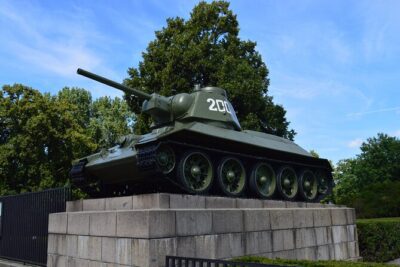
Berlin’s Best: 2 Hour Walking Tour Third Reich and the Cold War
Read our review →
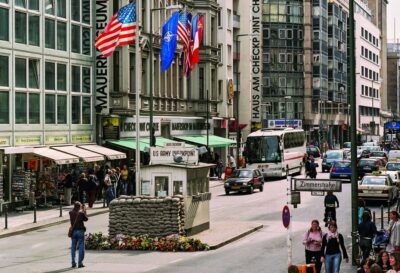
Skip-the-Line: Berlin Wall Museum at Checkpoint Charlie
Read our review →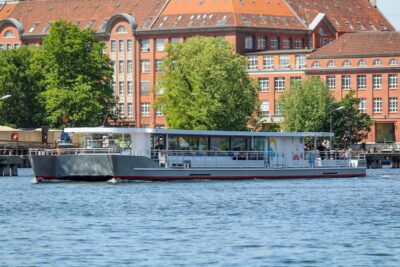
East Side Gallery Spree Cruise in a Solar Catamaran
Read our review →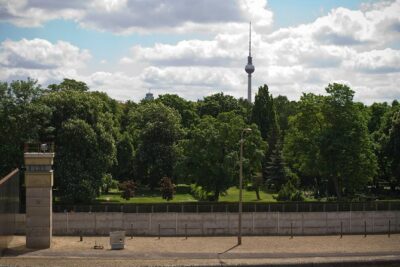
Cold War, Berlin Wall, Spies and the East Side Gallery
Read our review →
Guided Bike Tour of the Berlin Wall and Third Reich
Read our review →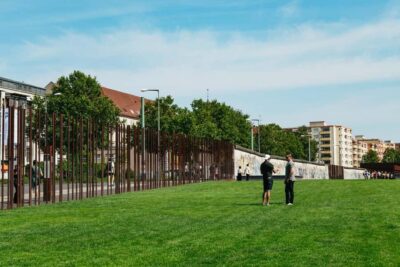
Browse the lists this tour appears in