
Reviewed · WALKING TOURS
Rostock: Private Guided Walking Tour
Rostock’s story is written in stone, but it is not a neat story. You’ll see a grand Town Hall shaped by medieval trade, a church clock that has measured time for centuries, and fortifications that recall a more guarded city. You’ll also learn how wartime destruction changed Rostock and how the city rebuilt itself.
I like the private format, especially for a group that wants to ask questions or adjust the pace. I also like the mix of major sights and smaller details, such as the figures on the Seagulls’ Fountain and the Latin motto on Stone Gate. The main consideration is price: at $280 for up to 15 people, this is best value with a larger group, not a solo booking.
Key points at a glance
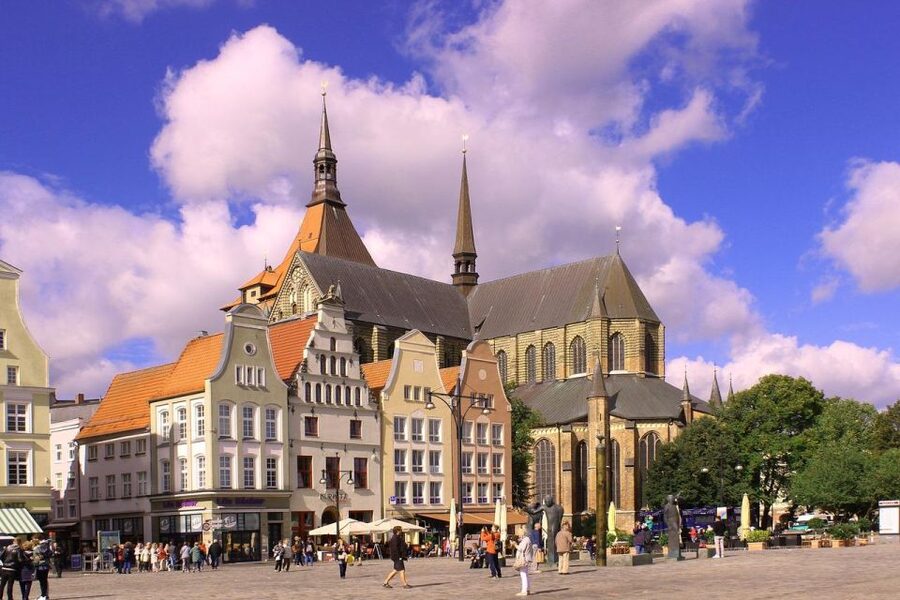
- New Market Square begins the story: Start at the Seagulls’ Fountain beside Rostock’s striking Town Hall.
- The Town Hall mixes styles: Its Gothic and Baroque elements, plus seven towers, show how the building changed over time.
- St. Mary’s Church holds the star interior sight: Its 15th-century astronomical clock survived the air raids that destroyed much of the city.
- Rostock’s defenses remain visible: Ramparts, guard houses, a section of wooden wall walk, and Stone Gate bring the medieval city to life.
- Wartime history is part of the walk: St. Petri Church and other landmarks help explain Rostock’s destruction and rebuilding.
- The tour is private and flexible: Your guide speaks English or German, and some changes can be made on the spot.
Starting at New Market Square and the Seagulls’ Fountain
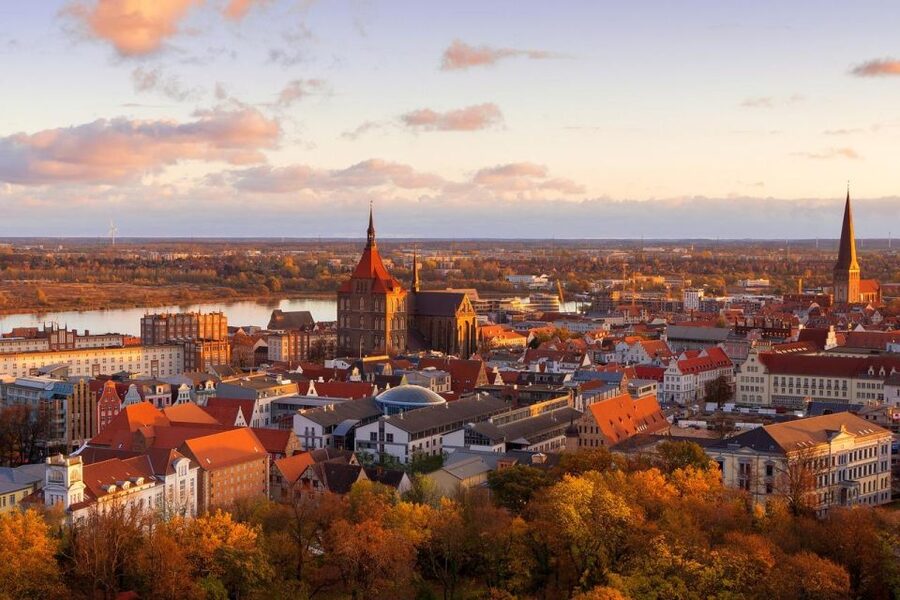
Your walk begins at the Seagulls’ Fountain in New Market Square, or Neuer Markt, at the heart of Rostock’s old center. This is a useful meeting place because the square gives you several important sights before you take your first steps.
The fountain depicts Neptune, the god of the sea, with his sons. That is more than decoration. Rostock grew through its connection to the Baltic Sea, and the fountain points to the city’s long relationship with shipping, fishing, and trade.
Your guide can also explain where Rostock’s name came from and why the city mattered. The tour places this local story within the wider rise of the Hanseatic League, the trading network that connected northern European ports. Rostock was not simply a pretty stop on the Baltic. It was part of a commercial system that helped shape the city’s wealth and public buildings.
New Market Square is a good opening because it gives you the broad picture quickly. You see power, religion, trade, and civic pride gathered in one place. If you like to understand a city before taking photographs, this first stop does useful work.
More Walking Tours in Rostock:
- Rostock: City Walking Tour
★ 4.9 · 198 reviews - Warnemünde: Guided Walking Tour
★ 4.3 · 102 reviews - Discover Berlin Half-Day Walking Tour
★ 5.0 · 9,624 reviews
Rostock Town Hall and its seven towers
The Town Hall is one of the tour’s clearest visual highlights. Its appearance combines Gothic and Baroque elements, so it does not look like a single-period building. Instead, it reflects changes made as Rostock grew, prospered, and adapted.
The seven towers are the feature you will notice first. Your guide can help you read the building rather than simply glance at it. The point is not only that the Town Hall is old or attractive. It was a public statement about the city’s importance, especially during the period when Hanseatic trade brought money and influence to Rostock.
This stop should suit you if you enjoy architecture but do not want a tour that gets lost in technical terms. The building gives your guide a way to explain how civic authority worked in a trading city. You can also connect it to the fountain nearby, where the sea is represented in mythological form.
The main limitation is that a two-hour tour cannot cover every architectural detail. You will get the building’s role and major features, not a specialist lecture on each construction phase. That is a fair trade for a walk that also includes churches, walls, and wartime history.
St. Mary’s Church and the astronomical clock
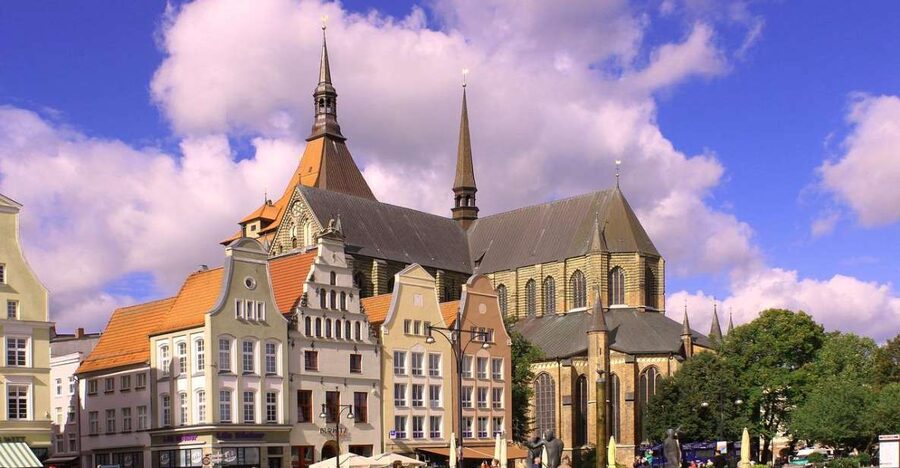
St. Mary’s Church offers the most distinctive indoor sight on the route. It is the only main church in Rostock to survive the World War II air raids, and its 15th-century astronomical clock is the reason many people will remember this stop.
An astronomical clock is not simply a large wall clock. It tracks several types of time and reflects the medieval desire to organize the heavens through machinery. The clock gives you a direct link to the period when churches were centers of science, art, religion, and public life.
This is also where the tour’s wartime story becomes especially clear. St. Mary’s survived, while other major buildings did not. You are not just looking at a historic object. You are seeing one of the few major pieces of old Rostock that remained in place through the air raids.
Entrance fees are not included, so check the arrangements for going inside. The tour clearly includes the church as a sight, but the exact access and any admission cost should be confirmed when booking. If entering St. Mary’s is important to you, ask your guide how much time can be given to the interior.
St. Petri Church and the city’s rebuilding
St. Petri Church adds a different note. Its Gothic tower was a familiar landmark for local fishermen, linking the church to the working life of the port. From the water and surrounding area, a tall church tower could serve as a point of orientation long before modern navigation tools.
The church was destroyed during World War II and rebuilt later. That makes it a useful counterpoint to St. Mary’s. One building survived the raids, while another had to be reconstructed. Together, they show that Rostock’s past is not preserved in one untouched block. Some of what you see is original, some is repaired, and some is rebuilt.
I appreciate this part of the route because it avoids presenting history as a series of pretty façades. You learn that Rostock suffered major damage and still had to recover its public identity. The city’s rebirth is not treated as a footnote. It is one of the main themes of the walk.
The information provided does not specify whether the tour enters St. Petri Church or goes up the tower. Plan on seeing the Gothic landmark as part of the walking route, and ask your guide about interior access if that matters to you.
A few more half-days in Rostock worth comparing
- Rostock: Guided tour of the historic city center
★ 4.5 · 311 reviews - All-in-One Berlin Shore Excursion from Warnemunde
★ 4.5 · 293 reviews - Best Berlin Shore Excursion from Warnemunde or Rostock Port
★ 4.8 · 200 reviews - Rostock: Full-Day, Half-Day, or Sunset Sailing Experience
★ 4.7 · 174 reviews
Walking the surviving fortifications
Rostock’s old defenses appear in fragments rather than as one complete medieval barrier. You may see sections of ramparts, built-in guard houses, and part of the wooden wall walk. These pieces help you picture a city that was once enclosed and protected.
The fortifications are valuable because they shift your attention away from individual monuments. A church or town hall can tell you about religion or government. A wall tells you about the shape of the whole city, its limits, and the need to control movement through its gates.
The surviving sections also make the walk feel more physical. You are not only hearing about Hanseatic Rostock. You are following the edge of the old city and seeing how defensive structures fitted into everyday urban life.
Do not expect a complete fortress experience. The fortifications are only partially standing, and the tour lasts two hours. Their appeal comes from connecting separate remains into a larger picture, not from one dramatic, fully preserved wall.
Stone Gate and its message of civic order
Stone Gate, or Steintor, brings a strong Renaissance note to the route. It is described as a Dutch Renaissance city gate, an architectural style that fits Rostock’s northern European trading connections.
The Latin motto carved on the walls translates as May harmony and prosperity reign within your walls. It is a compact statement of what a city wanted to project: order inside, prosperity through trade, and confidence at the gate.
This is a good place to listen closely to your guide. A gate is easy to photograph and pass by, but its position and message reveal how Rostock wanted to present itself. The building connected the city to the outside world while also marking the boundary of the protected center.
The gate’s real value is its context. On its own, you might admire the design for a minute. With an explanation of the motto, the trade network, and the fortifications, it becomes part of Rostock’s larger civic story.
The University of Rostock and the Fountain of Happiness
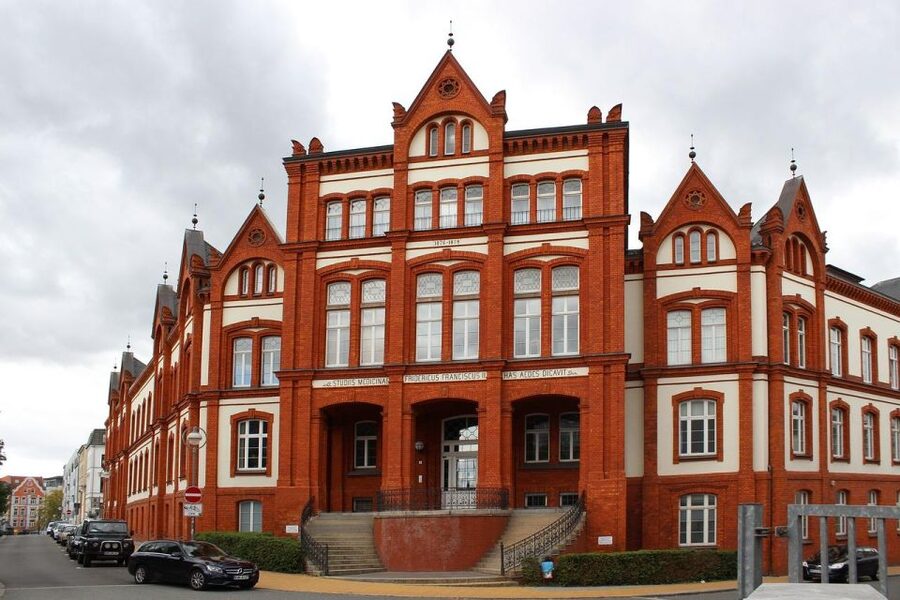
The University of Rostock dates from 1419 and is described as the oldest university in the Baltic region. It is also one of the oldest universities in the world. That gives the tour another side beyond merchants, churches, and walls.
You’ll learn about the university’s place in the city and see the Fountain of Happiness. The fountain offers a lighter stop after the heavier wartime material. It also shows that Rostock’s public spaces are not all about medieval power or destruction.
For you, the university is especially worthwhile if you care about how cities keep their identity across centuries. Rostock was a trading port, but it was also a place of learning. The university helps explain why the city’s importance was cultural as well as economic.
The tour does not promise a campus visit or a university interior. Think of this as an exterior stop and a chance to understand the institution’s role in Rostock.
What the two-hour pace feels like
Two hours is enough to cover the main sights in the historic center without turning the walk into an all-day commitment. You’ll move between the square, churches, fortifications, gate, and university, with the guide supplying the links between them.
The private format matters here. A group of your own family or friends can ask about the parts that catch your attention. You can also request some customization on the spot. That might mean spending more time on architecture, Hanseatic trade, wartime rebuilding, or the university, although the exact adjustment depends on the guide and the time available.
The walk is led in English or German. A local professional guide stays with your group only, rather than combining you with a larger party. That can make the experience feel more personal, though it does not guarantee that every requested change will be possible.
Wear practical shoes. The experience is a walking tour through the historic center, with sections of walls, squares, churches, and city streets. No transport is included or needed for the route described.
How the $280 price works for your group
The price is $280 per group of up to 15 people. That figure needs to be judged by group size. For 15 people, it works out to about $18.67 per person. For 10 people, it is $28 each. For five people, it rises to $56 each, and for two people it becomes $140 per person.
That makes this a sensible choice for a family group, friends traveling together, or a shore excursion party that wants a private guide. A couple or solo visitor may find a shared walking tour better value, if one is available.
The price includes the local professional guide and the private arrangement. Entrance fees are not included, so budget separately if you want to go inside any site that charges admission. The ability to customize the walk adds value for people with a clear interest, but less so if you simply want a quick orientation.
The booking terms are useful for uncertain plans. You can reserve and pay later, and cancellation is free up to 24 hours in advance for a full refund. Starting times vary, so check availability before you commit your schedule.
Who will get the most from this Rostock walk
I would choose this tour if you want a compact introduction to Rostock with a guide who can explain what you are seeing. It is particularly suitable for:
- First-time visitors who want the main historic sights in two hours
- Families or friends who value a private group
- People interested in the Hanseatic League and Baltic trade
- Anyone who wants wartime destruction and rebuilding included in a city walk
- Cruise passengers or short-stay visitors with limited time
- Travelers who prefer English or German guiding
It may be less suitable if you want a long museum visit, a full church tour, or a detailed specialist study of Gothic architecture. The schedule covers many landmarks, so each stop receives a focused explanation rather than an extended examination.
The guide can tailor parts of the walk, but customization is not unlimited. You still have a fixed two-hour window and a set of central sights to cover.
Final call: book it for context, not just photos
Book this private Rostock walking tour if you want the city’s monuments connected into one story. The best parts are the contrast between St. Mary’s surviving astronomical clock and St. Petri’s rebuilt tower, the Hanseatic setting around New Market Square, and the old defenses that show how the city was organized.
The strongest personal touch may come from your guide. Jana has been singled out for providing especially good local details, so if she is available, her style may suit you if you enjoy small stories beyond the standard facts. Still, guide availability is not guaranteed.
At $280, I would book it for a group of several people, not for one or two unless private guiding is a priority. If you have only a short time in Rostock and want a clear introduction in English or German, the two-hour format is practical. If you mainly want to enter churches or inspect monuments at length, confirm admission details and interior time before booking.
FAQ
Where does the Rostock walking tour begin?
The meeting point is by the Seagulls’ Fountain in New Market Square, Neuer Markt, 18055 Rostock.
How long does the tour last?
The walking tour lasts two hours.
How much does the private tour cost?
The price is $280 per group of up to 15 people.
Is the tour private?
Yes. It is offered as a private group experience, with a local professional guide accompanying only your group.
Which languages are available?
The tour is available in English and German.
What sights are included?
The route includes New Market Square, Rostock Town Hall, St. Mary’s Church, St. Petri Church, parts of the old fortifications, Stone Gate, the University of Rostock, and the Fountain of Happiness.
Is the astronomical clock at St. Mary’s Church included?
St. Mary’s Church and its famous astronomical clock are part of the described route. Entrance fees are not included.
Are entrance fees included in the price?
No. Entrance fees are not included.
Can the tour be customized?
Some customization is possible on the spot with your local guide.
Can I cancel for a full refund?
Yes. You can cancel up to 24 hours in advance for a full refund. You can also reserve now and pay later.
Just added in Rostock
- Rostock: Tour with the Rostocker Executioner★ 4.7 · 28 reviews
- Rostock: Hot Rod Sightseeing Tour to Warnemünde★ 5.0 · 19 reviews
- Rostock: Hot Rod Harbor City Tour★ 4.9 · 16 reviews
- Güstrow: Guided tour of the historic city center★ 4.6 · 12 reviews
- Distillery tour with guide!★ 4.7 · 14 reviews
- Discover Rostock: A Guided City Tour for Cruise Guests★ 3.7 · 7 reviews
- Brewery tour with guide!★ 4.8 · 13 reviews
- Berlin and Sachsenhausen: Shore Trip from Warnemünde Port★ 4.8 · 40 reviews
Walking Tours, compared.


Berlin’s Best: 2 Hour Walking Tour Third Reich and the Cold War
Read our review →
Third Reich Berlin: Hitler and WWII Walking Tour
Read our review →Browse the lists this tour appears in