
Reviewed · WALKING TOURS
Private Walking Sightseeing Local Berlin Tour Guides up 15 Person
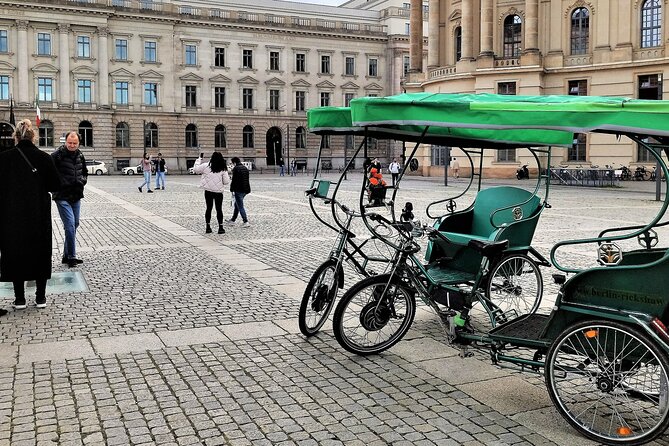
Berlin’s central sights make far more sense when you move through them in one continuous sweep. This private e-rickshaw tour carries you from Alexanderplatz to the Reichstag, passing royal squares, Nazi-era sites, Cold War landmarks, the Wall, and modern Potsdamer Platz along the way. It is a smart way to get your bearings quickly without spending four hours on foot.
I like the easy pace and the personal format. Your guide can adjust the route to your interests, and the e-rickshaw can reach places that are awkward for a larger vehicle. I also like the small comforts: blankets and bottled water are provided, and hotel pickup and drop-off in central Berlin remove much of the day’s fuss.
The main consideration is time. The listed route has ten stops, but most are short photo and explanation breaks of five to ten minutes. If you want to enter museums or spend serious time at the Holocaust Memorial or Topography of Terror, you will need a longer option or a separate visit.
Key points at a glance
- Alexanderplatz to the Reichstag in one outing: Cover Berlin’s major central sights without piecing together several transit rides.
- Private for your group: The tour is reserved for your party, with group sizes of up to 15 people.
- Flexible duration: Choose a route lasting about two hours, four hours, or a full day.
- Guides with local personality: Guides named Levi and Levent are specifically associated with warm, entertaining, highly personal tours.
- Useful for limited mobility: The e-rickshaw reduces walking while still allowing you to reach historic areas and pedestrian-friendly spaces.
- A sightseeing tour, not a museum tour: Admission is not included, and the stops focus on outdoor views and short explanations.
Why an e-rickshaw works well in central Berlin
Berlin is spread out. Alexanderplatz, Museum Island, the Brandenburg Gate, Potsdamer Platz, and the Reichstag are close enough to connect, but far enough apart to make a walking tour tiring, especially for children, older visitors, or anyone with mobility limits.
The e-rickshaw gives you a moving view of the city instead of a window seat in a van. You are close to the streets, squares, monuments, and remaining Wall sections. The tour can also pass through park areas and routes where a car cannot easily go. That matters in a city where some of the best views come between the famous stops.
You should think of this as a private orientation tour with a local guide, not a standard sightseeing bus. You can ask questions as you go, request more time at a particular area, or focus on Berlin’s royal, Nazi, Cold War, or modern story.
The experience is offered in English, and the guides named in the supplied information include Levi and Levent. Levi is praised for adding less obvious places to the planned route, while Levent is noted for covering a large part of the city in a short time and speaking excellent English. Guide assignment is not guaranteed, so book this for the format and route rather than for one particular person.
More Walking Tours in Berlin
- Discover Berlin Half-Day Walking Tour
★ 5.0 · 9,624 reviews - Berlin: Third Reich and Cold War 2 Hour Walking Tour
★ 4.9 · 6,830 reviews - Berlin: Discover Berlin Walking Tour
★ 4.9 · 5,998 reviews
Alexanderplatz and Museum Island
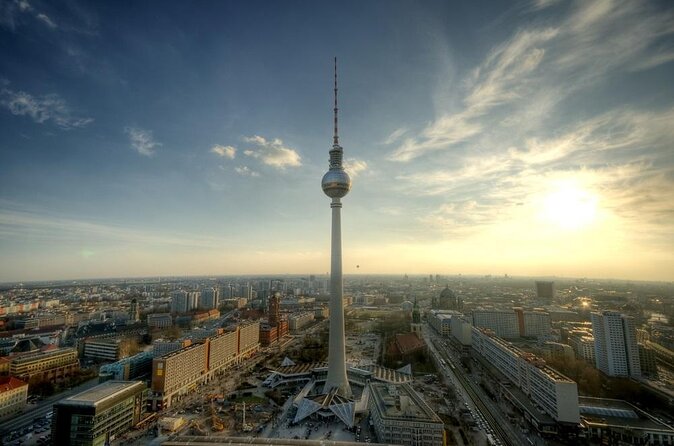
The tour begins at the Berliner Fernsehturm, Berlin’s famous television tower in Alexanderplatz. At 368 meters, it is Germany’s tallest structure and an easy landmark for starting a city tour.
You will pass the Red Town Hall, Marien Church, and Neptune Fountain before reaching Museum Island. These opening minutes introduce several layers of Berlin at once: the former East Berlin setting around Alexanderplatz, older church architecture, civic buildings, and the restored historic center.
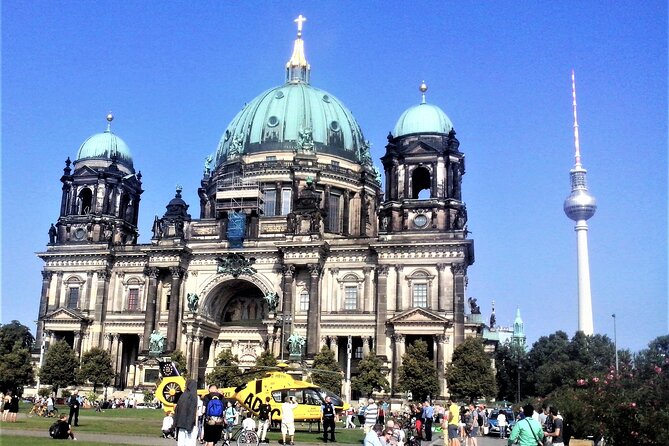
Museum Island is one of Berlin’s essential areas. The complex is a UNESCO World Heritage Site and includes the Berlin Cathedral, the Old Museum, the Old National Gallery, the Pergamon Museum, and the Bode Museum. You will also see the reconstructed City Palace area and Unter den Linden, the grand boulevard leading west toward the Brandenburg Gate.
The listed stop lasts about ten minutes and does not charge an admission fee because the tour is viewing the exterior areas. If you want to visit any museum, plan a separate visit. Ten minutes is enough to understand the layout and take photographs, but not enough to see the collections.
This is one of the tour’s best uses of time. Museum Island can feel confusing on a first visit, and a guide helps you connect the buildings to Berlin’s former royal center.
Bebelplatz and the memory of 1933
Next comes Bebelplatz, part of the Forum Fridericianum. The square is framed by major institutions and buildings, including the State Opera, Humboldt University, the State Library, and St. Hedwig’s Cathedral.
Bebelplatz is also the site of the Nazi book burning in 1933. A memorial beneath the square recalls the event, and the empty underground library can be viewed through a glass panel in the pavement. The memorial is easy to miss if you do not know where to look, which makes a guide useful here.
The stop is listed at about five minutes. That is enough for a brief explanation and a look at the memorial, but the subject deserves more time if you want to examine the site carefully. Treat this part as an introduction, then return on foot if Berlin’s Nazi-era history is a main reason for your visit.
Gendarmenmarkt and Berlin’s grand center
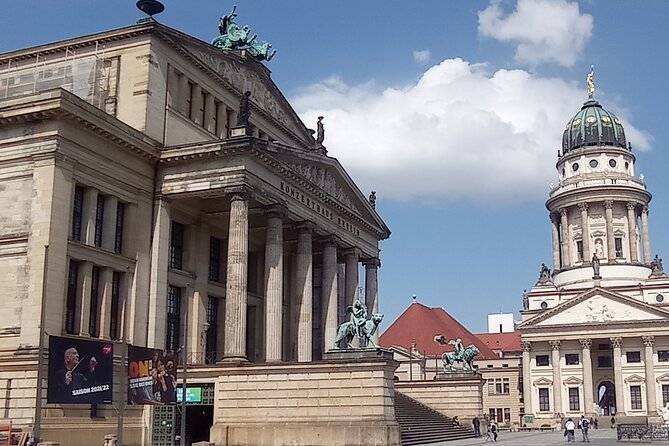
Gendarmenmarkt is one of Berlin’s most handsome squares. The former Royal Concert Hall sits between the German Cathedral and French Cathedral, creating a formal composition that feels quite different from the open spaces around Alexanderplatz.
The square gives you a quick look at Berlin’s Prussian and royal past. It is also a good photo stop because the three major buildings are close together and easy to see from the e-rickshaw.
The listed visit lasts ten minutes. That works well for a first look, though restoration work or changing access conditions can affect what you see. The tour does not include entry to the buildings.
Same city, a completely different kind of day:
- Berlin: Reichstag, Dome and Government District Guided Tour
★ 4.7 · 18,288 reviews - Berlin: 1-Hour City Tour by Boat with Guaranteed Seating
★ 4.3 · 16,993 reviews - Berlin: Boat Tour Along the River Spree
★ 4.4 · 11,252 reviews - Berlin: Hop-on Hop-off Bus Tour with Live Commentary
★ 4.3 · 8,579 reviews
Checkpoint Charlie and the Wall story
Checkpoint Charlie is one of Berlin’s best-known Cold War locations. It was a border crossing between East and West Berlin, and the confrontation there in 1961 brought American and Soviet forces dangerously close to a larger conflict.
Today, the site is heavily visited and more commercial than many first-time visitors expect. The famous guardhouse and checkpoint sign are part of a recreated presentation, not an untouched border post. That does not make the location unimportant, but it does mean you should keep your expectations realistic.
The e-rickshaw tour gives you context without asking you to spend a long time in the crowded area. If you want a fuller understanding of the Wall, pair this stop with the Topography of Terror or another dedicated Wall museum.
Topography of Terror and an original Wall section
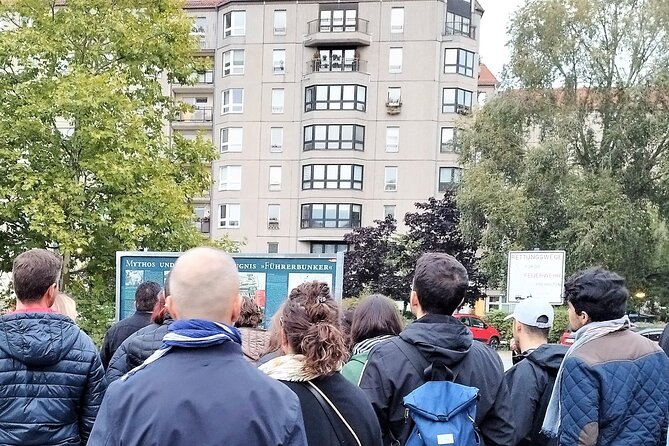
The route then follows the former border area to the Topography of Terror. The documentation center occupies the former headquarters area of the SS and Gestapo, making it one of the most serious historical stops on the route.
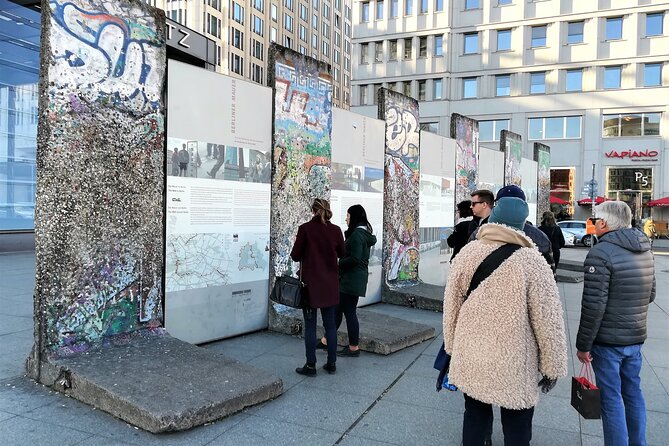
You can also see original sections of the Berlin Wall nearby. This combination matters. Checkpoint Charlie explains the Cold War border in popular memory, while the Topography of Terror deals with the machinery of Nazi persecution and dictatorship.
The stop is listed at five minutes, so you should not expect to visit the documentation center during the standard sightseeing schedule. The exterior and Wall sections provide a useful preview. If you want to read the exhibits, return independently with more time.
Nearby sights include Martin-Gropius-Bau, known for major temporary exhibitions, and the former Prussian Parliament. The guide can point out how this part of Berlin changed from a heavily controlled border strip into an area filled with museums and public institutions.
Potsdamer Platz and Berlin’s modern face
Potsdamer Platz shows another kind of Berlin history. Before the Second World War, it was an important city crossroads. After the war and the division of Berlin, the area became part of the empty border zone. After reunification, it turned into one of Europe’s largest construction sites.
Today, skyscrapers and futuristic buildings fill the area, including the Sony Center. This is a sharp visual change from Gendarmenmarkt or Museum Island. In a few minutes, you move from royal Berlin to wartime destruction, Cold War emptiness, and post-reunification redevelopment.
The listed stop lasts ten minutes. That is enough to see the scale of the buildings and understand the basic story. Architecture fans may want to return later, since the tour’s short stop cannot cover the area in detail.
The Holocaust Memorial and the Brandenburg Gate
The Memorial to the Murdered Jews of Europe is one of Berlin’s most important modern memorials. Its field of concrete blocks changes as you walk through it, becoming lower or higher around you. The experience is deliberately open to personal interpretation, but it should be approached quietly and respectfully.
The tour allows about ten minutes here. You can see the memorial from the e-rickshaw and walk briefly among the blocks, but you will not have time for an unhurried visit to the underground information center. That center adds personal stories and names, so return if you want more than the exterior memorial can offer.
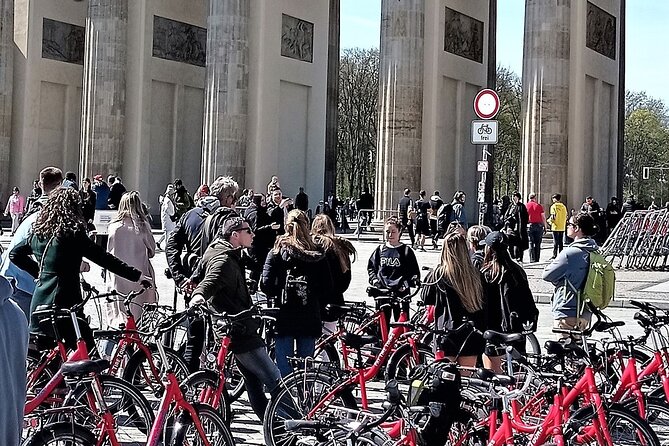
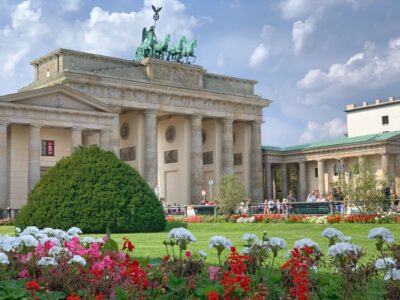
From here, the route reaches the Brandenburg Gate. Once a royal gateway, it later became a symbol of divided Berlin because the Wall ran close by and ordinary people could not pass freely through it. After reunification, it became a national symbol of a united Germany.
The gate is one of the tour’s essential photo stops, but it is also a place where the guide’s context matters. Without explanation, it is simply an elegant neoclassical monument. With the story of kings, war, division, and reunification, it becomes a clear marker of Berlin’s changing fortunes.
The Reichstag and the government district
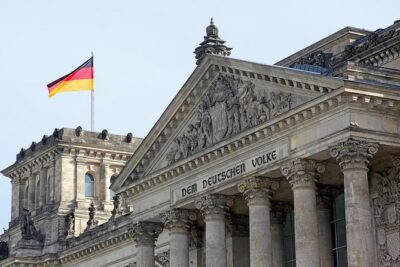
The final section moves toward the Memorial to the Murdered Sinti and Roma and the government district. The Reichstag, home of the German Bundestag, is the main landmark here, along with the Chancellery.
This part of the route helps complete the city’s political story. You have seen the old royal center, Nazi government sites, the Wall, and the reunified city. The Reichstag area shows where Germany’s present-day government operates.
The stop is listed at five minutes, so the tour offers an exterior orientation rather than a building visit. Entry arrangements are separate, and no admission is included. If you want to visit the glass dome, make a separate plan.
Time choices, comfort, and value
The advertised price is $174.22 per person, while the experience offers different lengths from about two hours to a full day. The value depends heavily on your group size and the option you select.
For a small party, the price is higher than a shared walking tour or public transit. In return, you get private use of the vehicle, hotel pickup and drop-off in central Berlin, an English-speaking certified guide, bottled water, blankets, and a route built around your interests.
For a larger group, the calculation improves because the private format can be shared among up to 15 people. Group discounts are also offered. This can make the e-rickshaw more appealing than buying several separate tickets for a private guide or arranging multiple taxis.
The four-hour option is the best fit if you want the full central route without rushing too badly. A two-hour tour can cover a surprising amount, but the stops become brief. A full-day version makes more sense if you want to add museum visits, spend longer at memorials, or build the route around one subject.
Pickup and drop-off are offered at central Berlin hotels. If your hotel is around the western city center near Kurfürstendamm, allow extra time for crossing the city. One supplied guide response noted that returning from Berlin Mitte to the western city center can lengthen a short tour considerably.
Who will enjoy this tour most
I would recommend this experience to first-time visitors who want a clear city overview on their first day. It gives you a practical sense of where the main sights are, which makes later independent visits easier.
It is also a strong option for families, mixed-age groups, and anyone who cannot comfortably walk for several hours. The e-rickshaw reduces the amount of walking while keeping you close to the streets. It is not a promise that every part of the city is fully step-free, but the format is more manageable than a long walking tour.
History-focused visitors should choose the longer option. The route touches on Prussian Berlin, Nazi Germany, the Holocaust, the Berlin Wall, reunification, and modern government, but the standard stops are short. You will get the framework, then decide which places deserve a return visit.
You should choose a different experience if your main goal is museum interiors, a long academic lecture, or a slow examination of every memorial. This is a moving overview with a personal guide, not a four-hour indoor history course.
Should you book it?
Book this tour if you want to see Berlin’s central landmarks quickly, prefer a private route, or need to limit walking. The combination of hotel pickup, a flexible itinerary, blankets, bottled water, and an e-rickshaw makes it especially practical for a first day or a mixed-mobility group.
Choose the four-hour or full-day option if you want the experience to feel relaxed. The two-hour version is useful for orientation, but it will skim the surface. If you are drawn to the personal style associated with guides such as Levi and Levent, the format should suit you, though a specific guide cannot be guaranteed.
The tour is fully refundable when canceled at least 24 hours before the start time. Changes or cancellations inside that window are not refunded. For a private Berlin overview with strong historical coverage and a local touch, this is a worthwhile choice, provided you understand that most stops are brief outdoor visits.
FAQ
How long does the Berlin e-rickshaw tour last?
The experience is listed at about four hours, with shorter two-hour options and tours lasting a full day also available.
How many people can join the private tour?
The private tour can accommodate groups of up to 15 people. Only your group participates.
Is hotel pickup available?
Yes. Pickup and drop-off are offered at central Berlin hotels.
Is the tour offered in English?
Yes. The experience is offered in English and includes a certified guide meeting DIN EN15565 standards.
Are entrance tickets included?
No. The route includes outdoor sightseeing, but admission tickets are not included. The listed stops at Museum Island and the other landmarks are viewed from outside.
What is the cancellation policy?
You can cancel at least 24 hours before the local start time for a full refund. Cancellations or changes made less than 24 hours before the start time are not accepted for a refund.
Just added in Berlin
- Berlin & The Third Reich Private Guided Tour★ 5.0 · 3 reviews
- Third Reich Quest Experience in Berlin★ 4.5 · 7 reviews
- Private Analogue Photography Experience in Berlin★ 5.0 · 3 reviews
- Berlin Urbex Adventure and History Tour★ 5.0 · 9 reviews
- The Beauty of Berlin by Bike: Private Tour★ 5.0 · 59 reviews
- Berlin: Guided Bike tour of the Berlin Wall and Third Reich★ 5.0 · 160 reviews
- Beyond Currywurst: Berlin’s Hidden Street Food & Culture Tour★ 5.0 · 100 reviews
- Berlin Third Reich & Cold War Walking Tour With A Guide★ 5.0 · 7 reviews
Walking Tours, compared.


Berlin’s Best: 2 Hour Walking Tour Third Reich and the Cold War
Read our review →
Third Reich Berlin: Hitler and WWII Walking Tour
Read our review →Browse the lists this tour appears in