
Reviewed · WALKING TOURS
Nuremberg: Private Guided Walking Tour
Nuremberg’s past is unusually broad for a 90-minute walk. You move from imperial power and medieval legends to Albrecht Dürer, the city walls, Nazi-era crimes, and the Nuremberg Trials without leaving the old town. The route begins at the Historic City Hall and keeps you close to the city’s best-known sights.
I like the private format, especially for families or groups with a clear interest in art, medieval Germany, or 20th-century history. I also like the focus on small details, such as which way to turn the rings on the Schöner Brunnen and when to watch the figures move at the Frauenkirche.
The main limitation is time. Ninety minutes goes quickly, and entrance fees are not included, so this is best viewed as an orientation walk rather than a full museum or castle visit. An evening departure may also be canceled if it becomes too dark, as one guest experienced.
Key points at a glance
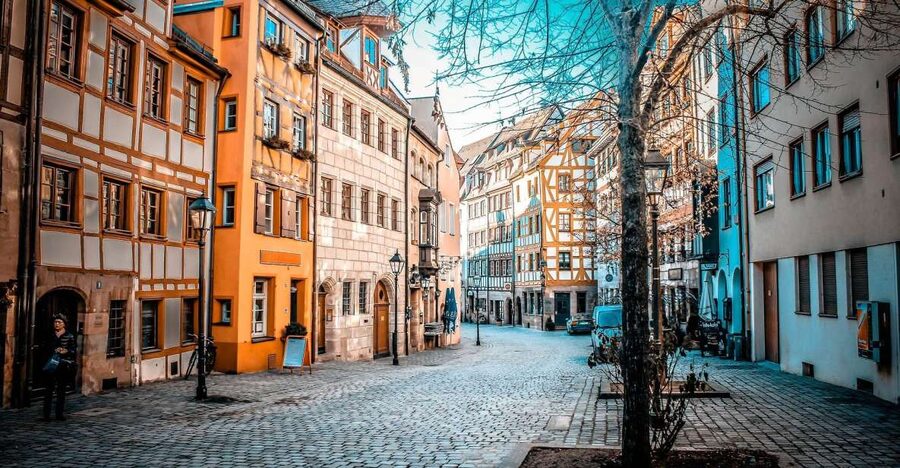
- Medieval Nuremberg in one compact walk: See the old town lanes, city walls, timbered houses, Hauptmarkt, Frauenkirche, and Schöner Brunnen.
- A private guide for up to 15 people: Your group stays together instead of joining a large public tour.
- History beyond the Nazi era: The route covers royal power, artists, trade, industrial growth, the Third Reich, and the Nuremberg Trials.
- Legends with a practical twist: Learn the story behind the fountain’s golden rings and how to turn them.
- Guides with strong personal feedback: Thomas, Justina, and other local guides have been praised for clear English, local tips, and engaging storytelling.
- Good value for a full group: At $294 per group, the cost works out to about $19.60 per person if all 15 places are filled.
Starting at Rathausplatz and Hauptmarkt
You meet at Rathausplatz, at the main entrance of the Historic City Hall, Hauptmarkt 18. This puts you in the heart of Nuremberg’s old town from the first minute, with the Hauptmarkt landmarks close at hand.
The starting point matters because Nuremberg rewards context. A quick look at a Gothic church or ornate fountain can feel like sightseeing by checklist. A private guide can explain why the square matters, how the city grew in political importance, and how its public spaces changed over time.
At the beginning, expect an introduction to Nuremberg as a former center of royal power. The city was an important residence for German kings and had a major role in the Holy Roman Empire. That background helps you read the streets differently. Nuremberg was not simply an attractive old town. It was a place where rulers, merchants, craftsmen, and artists crossed paths.
The route is conducted in English or German. A private group means you can ask for clarification and guide the conversation toward the subjects your group cares about most. On-the-spot customization is possible, although the 90-minute length means you should tell the guide early if one theme matters most.
More Walking Tours in Nuremberg
- Nuremberg: Old Town Guided Walking Tour
★ 4.6 · 2,416 reviews - Nuremberg: Walking Tour of Former Nazi Party Rally Grounds
★ 4.7 · 1,665 reviews - Nuremberg Old Town and Nazi Party Rally Grounds Walking Tour in English
★ 4.5 · 504 reviews
Walking the medieval streets and city walls
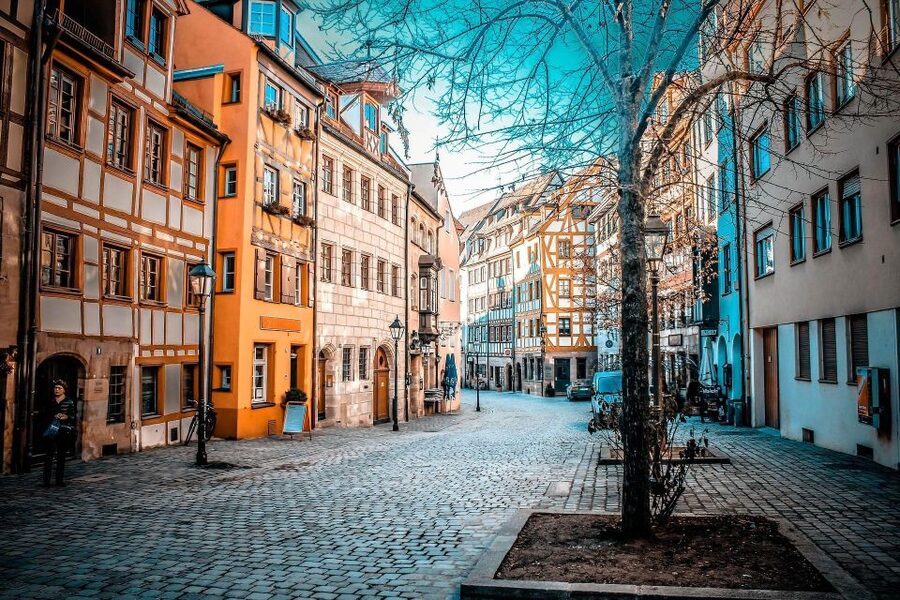
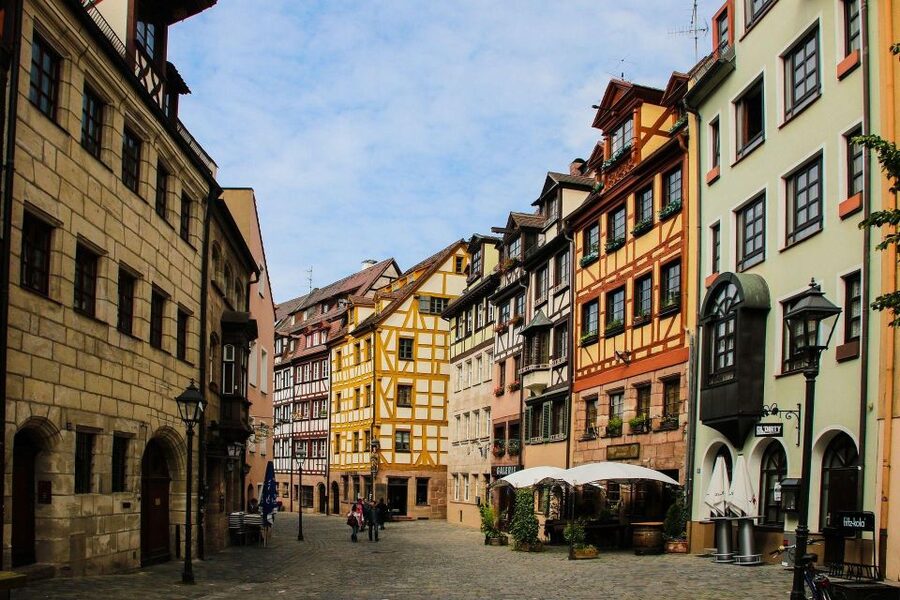
The old town portion brings you through narrow streets, past timbered houses, and along sections of the city walls. These details are easy to pass without comment, but together they show how Nuremberg was built and protected.
I would pay close attention here to the contrast between grand public buildings and smaller residential streets. The walk is not just about major monuments. It also gives you a sense of how the city’s medieval identity survives in its street plan and older structures.
Nuremberg’s medieval past is one of the strongest reasons to book a guide instead of walking alone with a map. You can see the same walls and houses independently, but a local guide can connect them to the city’s political role and tell the legends that make the places easier to remember.
The walking is outdoors and continuous. Wear comfortable shoes, particularly if your group includes children, older relatives, or anyone who dislikes long stretches on historic streets. The supplied details do not promise seating breaks or a fixed route length beyond 90 minutes, so plan for a steady city walk.
Albrecht Dürer and the city’s artists
Nuremberg has a strong artistic chapter, and the tour gives attention to artists who shaped the city’s reputation. Albrecht Dürer is the key name to know. His connection with Nuremberg helps explain why the city was more than a political center.
This part will suit you if you like art but do not want a specialist museum tour. You get the setting and the wider story, rather than a long examination of individual paintings. The guide can place Dürer and other artists within the city’s working life, trade, and public culture.
That broader framing is useful. Medieval and early modern art did not appear in isolation. It grew in cities with money, skilled craftspeople, patrons, and busy commercial links. Nuremberg’s artists belonged to that larger urban story.
If your main goal is to see specific Dürer works, this walk will not replace a museum visit. Entrance fees are not included, and the advertised experience is a guided walk rather than an indoor art tour. For a first look at the city’s artistic importance, though, it adds needed balance to the better-known 20th-century material.
Hauptmarkt, the Frauenkirche, and the moving clock
Hauptmarkt provides some of the tour’s most memorable visual stops. The Frauenkirche, an ornate Gothic church, faces the square, and its clock performs the Little Men Dancing spectacle. Your guide can explain what to watch for and why the display has become part of the square’s identity.
Timing may matter for this feature. The supplied information describes the figures enacting a spectacle, but it does not give a performance schedule. Ask your guide when you meet so you know if the clock will operate during your visit.
The Schöner Brunnen, or Beautiful Fountain, is another highlight. Its golden rings come with a local legend about an apprentice, a blacksmith, and an impossible love. The practical detail is especially fun: your guide tells you which rings to turn and in which direction.
This is the kind of small story I value on a walking tour. You can look at a fountain in a few seconds, take a photograph, and move on. Knowing the legend gives you a reason to pause, and learning the ring tradition turns a static monument into something you can interact with.
The fountain and church also show why a guide can be useful even in a compact area. The buildings are close together, but their stories belong to different parts of Nuremberg’s past. A good guide keeps the connections clear instead of tossing out disconnected dates.
Same city, a completely different kind of day:
- Nuremberg: City Tour with the Bimmelbahn Train
★ 4.4 · 2,475 reviews - Nuremberg: Tunnels and Secret Passages in the City Wall Tour
★ 4.8 · 2,334 reviews - Nuremberg: Medieval Dungeons Guided Tour
★ 4.8 · 1,726 reviews - Medieval Tour in Nuremberg in Spanish
★ 5.0 · 1,374 reviews
Nuremberg Castle and the city’s royal role
Nuremberg Castle is one of the central historical subjects of the walk. The tour focuses on its place in the city’s political past and the secrets connected with its long story.
Because entrance fees are excluded, you should not assume that this experience includes a full indoor castle visit. The supplied information promises guided sightseeing and discussion, not admission to every castle building. If you want interior rooms or exhibitions, confirm the plan with the guide and be ready to pay separately.
Even from the outside, the castle helps explain Nuremberg’s former status. Its position and history connect the city to German kings and the Holy Roman Empire. This is where the tour can shift from attractive streets to questions of power: who controlled the city, why rulers came here, and how Nuremberg became so influential.
I would give the castle section extra attention if this is your first visit. It gives the old town a framework. Without it, the city may seem like a collection of handsome facades. With it, you begin to see how Nuremberg’s political importance shaped the streets around you.
The Third Reich and the Nuremberg Trials
The tour does not avoid Nuremberg’s darkest chapter. It addresses the Third Reich and the Nuremberg Trials, while placing those subjects alongside the city’s much older story.
That balance is important. Nuremberg is often reduced to Nazi rallies, wartime destruction, and postwar trials. Those subjects deserve careful treatment, but they are only part of the city’s identity. This walk connects the 20th century to earlier centuries of royal power, art, commerce, and urban growth.
Expect discussion rather than a specialist museum presentation. A 90-minute old town route cannot provide the same depth as a dedicated visit to the Documentation Center or a full legal history program. The advantage is that you can understand how the city’s public image changed and why Nuremberg remains closely linked to the trials.
If this is your chief reason for visiting, ask the guide to spend more time on it. The private format allows some adjustment, but the available time is limited. A group focused on the trials may need a separate museum visit to examine the evidence and buildings in greater detail.
Beer gardens, sausages, and local tips
Food is part of the experience’s appeal, though the price does not include a meal or drinks. The guide can point you toward local brews, beer gardens, and Nuremberg sausages, all useful subjects when you are deciding where to eat after the walk.
Nuremberg sausages are an obvious local specialty, and a guide’s restaurant advice can save you from choosing a place only because it sits beside a famous square. One guest specifically valued recommendations for distinctive restaurants and bars, and another guide shared local information not easily found in a basic guidebook.
Treat this as advice, not a food tour. You should budget separately for anything you eat or drink, and the supplied details do not promise tastings or a stop at a beer garden. The benefit is knowing what to look for once the formal walk ends.
I would save your restaurant questions for the last part of the tour. Ask where the guide would eat, which local beer to try, and how close the recommended places are to your next stop. Since the walk ends in the old town, this can be a useful bridge into your evening.
What the private format is worth at $294
The price is $294 for a group of up to 15 people. That makes the value depend heavily on your group size. With 15 people, the cost is about $19.60 each. With six people, it is $49 each. For two people, the private format becomes a much more expensive choice.
The benefit is control. You get a guide assigned to your group rather than a large mixed crowd, and the route can be adjusted on the spot. That is valuable if your family has different interests or if one person wants more time on the medieval period while another wants the Nuremberg Trials.
The fee includes a local professional guide, but not entrance fees, food, or drinks. Since the walk lasts 90 minutes, I see it as a focused introduction. It offers good value for a larger group that wants a personal overview, but less value for solo visitors or couples who prefer to spend freely on museums and self-guided material.
The guide quality matters more than usual in a short private tour. Thomas has been praised for explaining local history and sharing information that felt specific to Nuremberg. Justina has also received especially warm feedback. Another guide was praised for excellent English, sustained storytelling, restaurant tips, and even meeting the group at its hotel, though hotel pickup is not listed as a standard inclusion and should not be expected.
Timing, cancellations, and who should book
The activity runs for 90 minutes, with starting times based on availability. English and German are offered. You can cancel up to 24 hours in advance for a full refund, and the reserve now, pay later option lets you hold the booking without paying immediately.
One timing issue deserves attention. An 18:00 departure was canceled six hours before the meeting time because it would be too dark. This appears to be an isolated problem rather than a stated rule, but I would choose a daytime start when possible, especially in late autumn or winter. It gives you better light for the old streets, fountain, church, and castle views.
This tour suits:
- First-time visitors who want a clear introduction to Nuremberg
- Families and private groups that prefer a flexible conversation
- History fans interested in medieval power and the 20th century
- Art lovers who want context about Dürer and Nuremberg’s artists
- Groups that want local suggestions for sausages, beer, restaurants, and bars
It may not suit you if you want a long castle interior visit, a dedicated Nazi-era museum tour, or a food tasting. It is also less economical for a very small group unless privacy and flexibility matter more than price.
Should you book this Nuremberg walk?
Book it if you want the city’s story tied together by a local guide. The best part is the range: royal Nuremberg, medieval streets, Dürer, the castle, Hauptmarkt legends, the Third Reich, and the trials all appear in one compact route.
For the best value, bring a group of several people and choose a daytime departure. Tell the guide at the start which subjects matter most, and ask for current food and drink suggestions before the walk ends. If you want museums or castle interiors, add them separately and budget for admission.
FAQ
Where does the tour meet?
The meeting point is Rathausplatz, at the main entrance of the Historic City Hall, Hauptmarkt 18, 90403 Nürnberg, Germany.
How long does the tour last?
The walking tour lasts 90 minutes.
Is the tour private?
Yes. It is a private group experience for up to 15 people.
Which languages are available?
The live tour is available in English and German.
Are entrance fees included?
No. Entrance fees are not included in the tour price.
Can the route be customized?
The tour allows possible customization with your local guide on the spot. The 90-minute duration limits how much can be added.
What is the cancellation policy?
You can cancel up to 24 hours in advance for a full refund. You can also reserve now and pay later.
Just added in Nuremberg
- Tour en español al Campo Zeppelin★ 5.0 · 8 reviews
- Stein: Public guided tour of the “Old Mine” museum★ 4.5 · 18 reviews
- “Rotes Bier” and “Blaue Zipfel”. A historical-culinary walk★ 4.4 · 190 reviews
- Nuremberg: Old Town Guided Tour By Bus★ 4.4 · 198 reviews
- Nürnberg Bachelor(ette) Party with Night PubCrawl★ 4.2 · 5 reviews
- Nuremberg: Bar and Club Tour with Free Shots and Free Entry★ 3.8 · 23 reviews
- Nuremberg: WWII Tour, Courtroom 600 and 3rd Reich Sites★ 4.6 · 94 reviews
- Nürnberg kennenlernen: Highlights in der Altstadt★ 4.7 · 189 reviews
Walking Tours, compared.




Berlin’s Best: 2 Hour Walking Tour Third Reich and the Cold War
Read our review →


Third Reich Berlin: Hitler and WWII Walking Tour
Read our review →Browse the lists this tour appears in