
Reviewed · HISTORICAL TOURS
Historic Dresden Small-Group Walking Tour in English
Dresden’s old town is a compact lesson in destruction, royal ambition, and careful rebuilding. This two-hour English walking tour links the grand Zwinger, royal palace courtyards, Fürstenzug mural, Brühl’s Terrace, and Frauenkirche into one clear story. I like the way guides such as Laura, Leo, Christina, Doris, and Karen bring both older Saxon history and modern Dresden into the same walk.
I also like the small-group limit of 15, which leaves room for questions and usually keeps the pace manageable. The main drawback is sound: when the group grows, there are no headsets, and it can be hard to hear in busy squares or open courtyards.
Key points at a glance
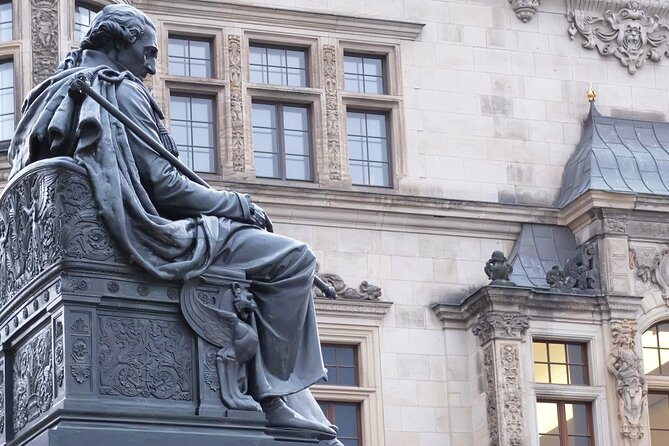
- Augustus the Strong’s grand vision: See how one ruler’s appetite for ceremony shaped the Zwinger and Dresden’s courtly center.
- A strong old-town route: The walk covers the major landmarks without sending you far from the historic core.
- Rebuilding is part of every stop: The Frauenkirche, Neumarkt, royal palace, and other sights carry stories of wartime ruin and renewal.
- Useful museum advice: The guide stays outside the royal palace museums but can help you choose which collections and tickets deserve your time.
- Good access to local orientation: Brühl’s Terrace gives you a clear view toward the Elbe, steam boats, churches, and distant wine slopes.
- A practical group size: Up to 15 people is a sensible limit, though hearing may be harder if an unusually large group gathers.
Why this Dresden walk works as a first introduction
I like city walks that give you a framework rather than a pile of dates. This one does that well. In a short stretch of central Dresden, you see royal display, religious tension, wartime loss, Communist-era memory, and modern restoration.
The guides are licensed members of the German Guides Association and receive continuing training. That matters here because Dresden’s story has several layers. A guide needs to explain not only what a building looks like, but why it was built, destroyed, rebuilt, or altered.
The tone varies by guide. Laura is praised for an animated presentation and personal touches. Christina brings an art-history background and pays attention to small details. Doris and Karen are especially good choices if you want wider context, including Dresden before and after German reunification. Leo is praised for his stories and affection for the city.
You should expect a walk that mixes facts with personal interpretation. One comment found a guide slightly too familiar and chatty, so this is not a silent, strictly academic lecture. For most people, that conversational style will make the complicated history easier to remember.
More History Tours in Dresden
- Elbfloren: Historical city tour
★ 4.8 · 819 reviews - Dresden: Guided Beer Tour of the Historic Old City
★ 4.8 · 95 reviews - Historic Dresden Private Walking Tour
★ 5.0 · 32 reviews
Theaterplatz opens with Dresden at full volume
The tour begins at Schloßplatz, close to Theaterplatz and the main royal sights. Theaterplatz gives you Dresden’s grandest opening view: the Semper Opera House, the Zwinger, the Residenzschloss, and the Dresden Cathedral all gather around one square.
Your guide can point out the Old Masters Gallery from here, an important tip if you plan to return for art. The square also helps you understand Dresden’s style. This is not a single monument surrounded by empty space. It is a carefully staged royal and cultural center, where opera, art, court life, and religion were placed within a few steps of one another.
Allow about 15 minutes here. That sounds brief, but the square is visually dense. The guide’s real value is directing your attention. You will learn which façade matters, where the royal residence fits into the larger plan, and how the buildings relate to one another.
The Zwinger turns royal excess into architecture
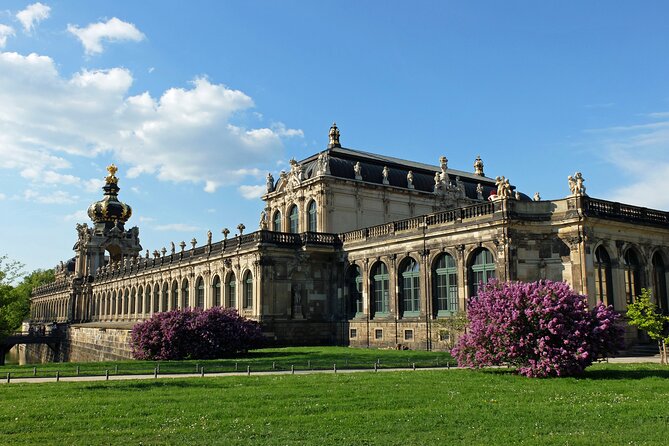
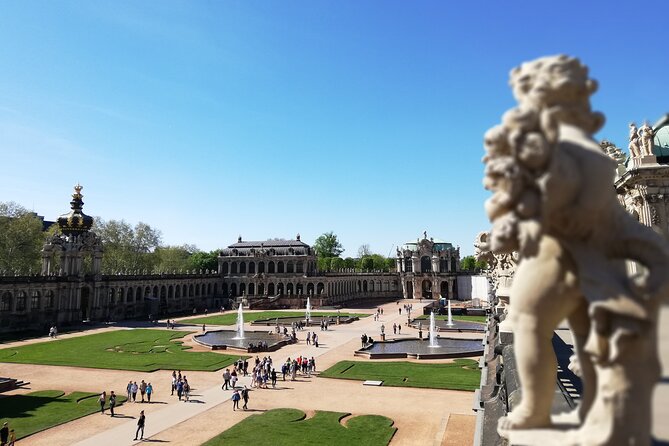
The Zwinger is one of the most memorable stops. It was designed as a single sculptural composition and intended to serve as the grand entrance to a palace that was never built. That unfinished purpose is part of its appeal. You are looking at a stage for court celebrations, not a complete palace complex.
The story centers on Augustus the Strong, the Saxon ruler who commissioned it. His taste for spectacle and beauty appears in the curves, ornament, sculptures, fountains, and carefully framed courtyards. The Zwinger can look decorative at first glance, but the guide helps you read it as a statement about power.
If conditions allow and the area is open, your guide may show you a small open-air grotto tucked away from the usual view. That possibility depends on access, so do not treat it as guaranteed. Still, it is exactly the sort of detail a local guide can add that you would likely miss while walking through on your own.
The stop is free because you are exploring the exterior. If you want to visit the museums later, ask about the Old Masters Gallery and the other collections before you leave. The tour is useful partly because it helps you decide where to spend more of your museum time.
The royal palace explains Dresden’s repeated rebirth

The Residenzschloss, or Royal Palace, is a building shaped by repeated catastrophe. It was built, burned, repaired, extended, damaged again, and rebuilt. Today it guards the story of the Saxon ruling family and houses major collections of royal treasures.
The walk takes you through one of its courtyards rather than into the museums. Look for the Renaissance technique called sgraffito, in which layers of surface material are worked to create detailed designs. This courtyard stop gives you a taste of the palace’s art without committing you to a museum visit.
That is a sensible choice for a two-hour tour. Dresden’s palace collections deserve far more time than the walking route can spare. Instead, ask your guide which exhibitions fit your interests and what type of ticket to buy. You may want to return for the treasures, historic rooms, or other collections, but the right choice depends on how long you have in the city.
More Walking Tours in Dresden
- Dresden: City & Semperoper Guided Walking Tour
★ 4.8 · 2,293 reviews - Dresden: Guided City Walk with a Cup of Coffee
★ 4.7 · 1,568 reviews - Dresden: Complete Walking Tour with Frauenkirche Visit
★ 4.8 · 700 reviews - Dresden: Walking Tour with a Night Watchman and Meal
★ 4.4 · 487 reviews
Stallhof offers a quieter courtly pause
Behind the palace, Stallhof feels more enclosed and less ceremonial than Theaterplatz. This Renaissance courtyard once hosted jousting tournaments and royal festivities. Its arcades and sandstone columns create a useful pause in the route, after the grand scale of the Zwinger and palace.
The stop lasts about five minutes, so expect a quick explanation rather than a long visit. I like it because it shows another side of court life. Dresden’s royal world was not only opera houses and palace façades. It also included staged contests, pageantry, horses, and public displays of chivalry.
The Fürstenzug rewards a slow look
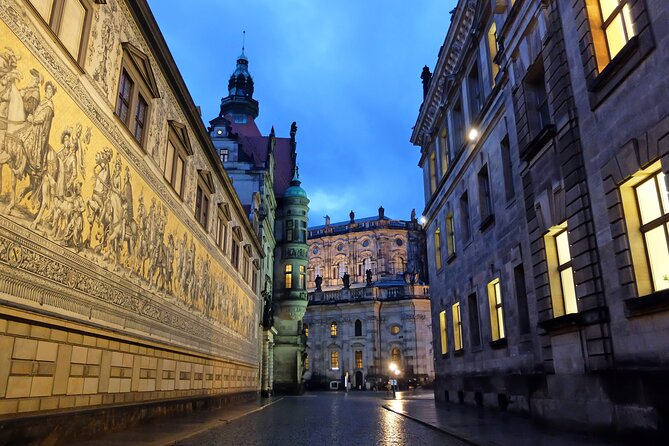
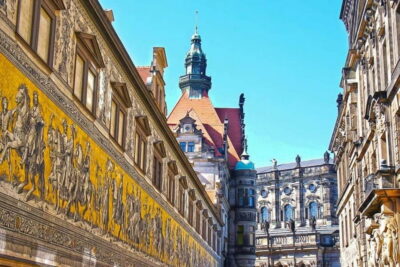
One of the route’s most unusual sights is the Fürstenzug, the Procession of Princes. The outdoor artwork stretches about 100 meters and uses around 24,000 porcelain tiles, making it the longest porcelain mural outdoors.
The important point is not simply its size. Your guide will draw attention to small stories and details hidden in the procession. Take time to scan the figures rather than treating the mural as a background wall. This is a stop where a guide can turn a quick photograph into a much better understanding of Saxon rulers and court identity.
The mural is especially valuable for visual learners. Even if royal succession sounds dry in a book, a long procession of figures gives you a human outline of the past. Ask your guide to help you spot the details that are easiest to miss.
Dresden Cathedral shows a religious contradiction
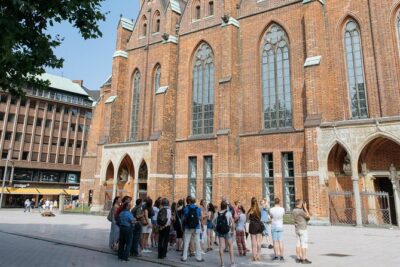
The Royal Cathedral is an unusual building in Protestant Saxony because it was built secretly by a Catholic ruler. Its former court-church role, external appearance, and connection to the royal family make it an important stop even though the tour views it from outside.
The church also contains royal burials, adding another layer to the relationship between religion and monarchy. Your guide will explain why a Catholic court church appeared in this setting and point out features that may otherwise seem ordinary.
This is a short exterior explanation, not an interior visit. If you want to see the church inside, plan that separately.
Brühl’s Terrace opens Dresden toward the Elbe

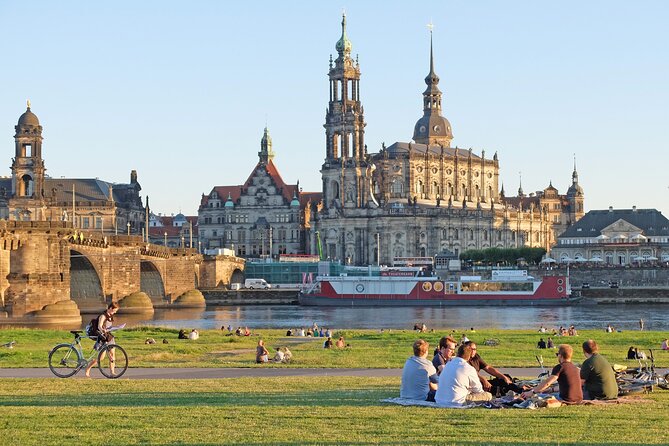
Brühl’s Terrace is often called the Balcony of Europe, and the nickname makes sense once you reach the top of the stairs. The promenade was once reserved for nobility. Today, it gives you a broad view over the Elbe and the city beyond the old center.
Your guide can point out the White Fleet’s historic steam boats, riverside buildings, church steeples, and distant wine slopes. This is one of the best orientation moments on the route because it shows that Dresden is more than its restored center.
The climb includes stairs, but the walk is not especially demanding according to the experience details and direct feedback from older participants. Still, anyone concerned about stairs should take the pace seriously. The guide may spend around 10 minutes here, which is enough for the main view and a few questions, but not a long riverside stroll.
Neumarkt and the Frauenkirche tell the hardest story
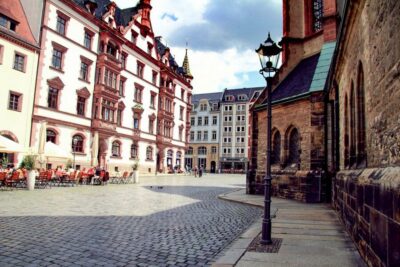
The walk usually wraps up around Neumarkt, the square anchored by the Frauenkirche. Neumarkt was reduced to rubble and later restored in an effort to recover its 18th-century character. Its colorful façades and cafés make it a natural place to stop for food after the tour.
The Frauenkirche is Dresden’s central symbol. Its dome was rebuilt from the ruins after World War II, and the church now represents both reconstruction and reconciliation. The guide explains the destruction, the long gap before rebuilding, and the international effort that brought the baroque church back.
I recommend returning inside on your own if time allows. Sit quietly and look at the pale interior rather than rushing through for a photograph. A small crypt exhibition explains the rebuilding process and adds useful detail to the story you hear outside.
The tour information gives Schloßplatz as both the starting and ending meeting point, while also noting that the walk usually ends at Neumarkt. Since the route is compact, confirm the exact finishing point with your guide on the day.
What the $30.25 price buys you
At $30.25 per person, this is not the cheapest way to walk through Dresden. You can see most of these exteriors without paying an admission fee. The value comes from the guide’s structure, local context, and ability to connect separate buildings into one story.
That value is strongest if Dresden is new to you or if you have only a short stay. Two hours can help you decide which palace rooms, church interiors, galleries, and river views deserve more of your own time.
The price also covers a professional guide in a small group, not museum admission. Tips are not included. Because the walk stays outside the main collections, budget separately if you plan to visit the palace museums or other interiors.
Group size, weather, and hearing clearly
The stated maximum is 15 people. That is a good size for asking questions and staying close to the guide. A few direct accounts describe very small groups, including one walk with only two people, while another unusually large group made it difficult to hear.
Headsets are not provided. In a group of four or fewer, this may not matter much. In a full group, stand near the guide and ask people not to spread too far across the square. Rain and cold do not cancel the historical content, but open courtyards and Brühl’s Terrace can feel exposed, so dress for the weather.
The walk is near public transportation, service animals are allowed, and most people can participate. Confirmation arrives at booking. You can cancel for a full refund up to 24 hours before the start time, but late cancellations and changes are not accepted.
Who should book this walk
I would choose this tour if you want a clear first look at Dresden’s historic center, especially if you enjoy architecture, royal history, or stories of rebuilding. It suits couples, solo visitors, older walkers who prefer a steady pace, and anyone who wants to ask questions instead of following a large crowd.
It is less suitable if you want long interior visits. The Zwinger, Royal Palace, Cathedral, and Frauenkirche are mainly explained from outside, so museum lovers should treat this as orientation and return later.
Should you book the Historic Dresden Small-Group Walking Tour?
Book it if you want Dresden’s major sights placed into a memorable story. The strongest features are the route, the guide quality, and the chance to understand how Dresden moved from royal showpiece to wartime ruin to carefully rebuilt city.
I would be most comfortable booking it early in your stay, especially since it is commonly reserved about three weeks ahead. Ask plenty of questions, stay close enough to hear, and save time afterward for the Frauenkirche and whichever Royal Palace collection catches your interest.
FAQ
How long is the Historic Dresden Small-Group Walking Tour?
The tour lasts approximately two hours.
What language is the tour offered in?
The walking tour is offered in English.
Where does the tour begin?
It begins at Schloßplatz in Dresden’s Altstadt.
What sights are included?
The route includes Theaterplatz, the Zwinger, the Royal Palace courtyard, Stallhof, the Fürstenzug, Dresden Cathedral, Brühl’s Terrace, Neumarkt, and the Frauenkirche.
Does the tour enter the museums?
No. The Royal Palace museums are not included inside the tour, though you can ask the guide for advice about the collections and ticket choices.
How large is the group?
The stated maximum is 15 people.
Are gratuities included?
No. Tips and gratuities are not included in the tour price.
Just added in Dresden
- Test Drive Electric Vehicles from the VW brand (ID. model)★ 4.8 · 190 reviews
- SRF CoBi | City Tour by ConferenceBike★ 4.7 · 38 reviews
- Dresden: Scavenger Hunt to Elbe River & Castles★ 4.7 · 15 reviews
- Dresden: Bike Rental – City Bike with Option Children Seat★ 4.5 · 13 reviews
- Private trip from Prague to Dresden, Moritzburg & Meissen★ 5.0 · 5 reviews
- Moritzburg: Scavenger Hunt Self-Guided Walking Tour★ 4.8 · 12 reviews
- Historical tour of the old town including a Saxon dinner★ 4.7 · 23 reviews
- Climb the mountains together with goats★ 4.8 · 8 reviews
Historical Tours, compared.
City History Canal Sightseeing Tour on a Motorboat
Read our review →


Browse the lists this tour appears in