Reviewed · BERLIN TOURS
Explore Berlin: See All The Iconic Sights & Some Hidden Gems
Berlin reveals its story block by block, and this walk gives you the crucial pieces in one steady route. You’ll move from the Palace of Tears and Museum Island to Checkpoint Charlie, the former crossing between East and West Berlin, then on to the Holocaust Memorial and Hitler’s former bunker site.
I like the way the tour links Nazi and Cold War history instead of treating them as separate topics. I also like the range of guides, from Joseph and Tina to Hannah, Jimmy, Paul, and Rohan, whose clear explanations and willingness to answer questions help make difficult subjects easier to follow. The main drawback is the pace: three hours covers roughly three miles, so older visitors or anyone wanting long photo stops may find it brisk.
Key points to know before you book
- A serious history walk: Expect clear discussion of the Third Reich, the Holocaust, Berlin’s division, and reunification.
- Major sights in one route: Brandenburg Gate, Checkpoint Charlie, the Reichstag, Gendarmenmarkt, Museum Island, and the Wall all feature.
- About three hours on foot: The route is efficient, but it is not a slow sightseeing stroll.
- Strong guide-led experience: Guides including Joseph, Tina, Hannah, Jimmy, Paul, and Rohan are praised for clear delivery, humor, and good answers to questions.
- Small enough to follow, but not private: The maximum group size is 25 people.
- Good first-day value: At $24.07 per person, it gives you a useful city framework before you return to the sights that deserve more time.
Berlin’s difficult story, told on foot
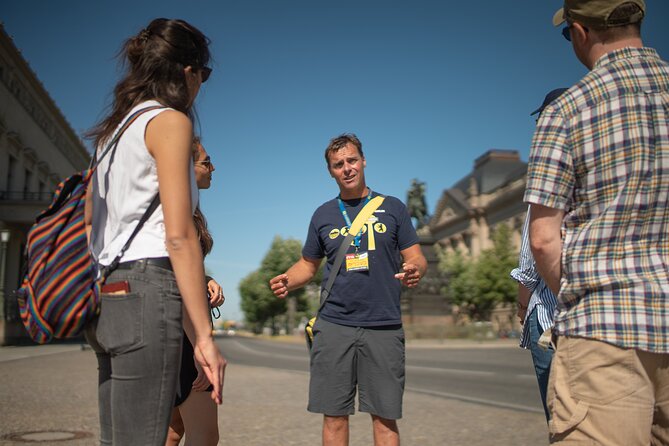
This is not a tour built around grand interiors or long museum visits. It is a walking lesson in how Berlin’s political past shaped the streets you see today.
Your guide begins near Friedrichstrasse Station, at Reichstagufer 17 in central Berlin. The booking details also describe the meeting point as outside Friedrichstrasse train station, so check the exact meeting instructions carefully and arrive 15 minutes early. That small bit of planning matters because one of the few negative experiences reported involved a solo visitor becoming separated from the group.
The tone is serious but not dreary. Guides explain Adolf Hitler, the Nazi Party, the Second World War, the Holocaust, the division of Germany, and the Cold War while you stand at the actual locations where events unfolded. The best guides make complex ideas plain, add personal anecdotes, and keep the walk moving without turning it into a lecture.
The experience is offered in English and includes a local English-speaking guide. Admission to the outdoor stops is free. You are paying for the route, the historical explanation, and the chance to connect places that can seem unrelated when visited alone.
A few more half-days in Berlin worth comparing
- Berlin: Reichstag, Dome and Government District Guided Tour
★ 4.7 · 18,288 reviews - Berlin: 1-Hour City Tour by Boat with Guaranteed Seating
★ 4.3 · 16,993 reviews - Berlin: Boat Tour Along the River Spree
★ 4.4 · 11,252 reviews
From the Palace of Tears to Museum Island
The first stop is the Palace of Tears, or Tränenpalast, near Friedrichstrasse Station. This former Cold War checkpoint handled departures between East and West Berlin. Its name comes from the emotional farewells that took place there, since family members and friends often had to separate after visits across the border.
You then move toward Neue Wache, a national memorial concerned with war and tyranny. It is a useful early stop because it introduces one of the tour’s main ideas: Berlin’s public spaces often carry several layers of memory at once.
Nearby, Humboldt University connects the city’s academic life with figures such as Karl Marx, Friedrich Engels, and Albert Einstein. The stop is brief, but it helps show that Berlin’s story is not only about dictatorship and division. It is also a city of universities, ideas, art, and political change.
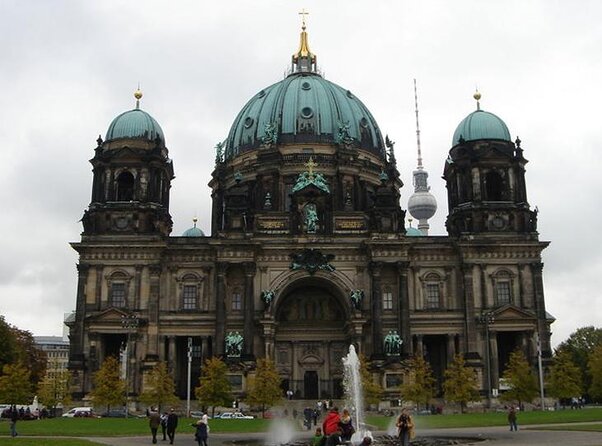
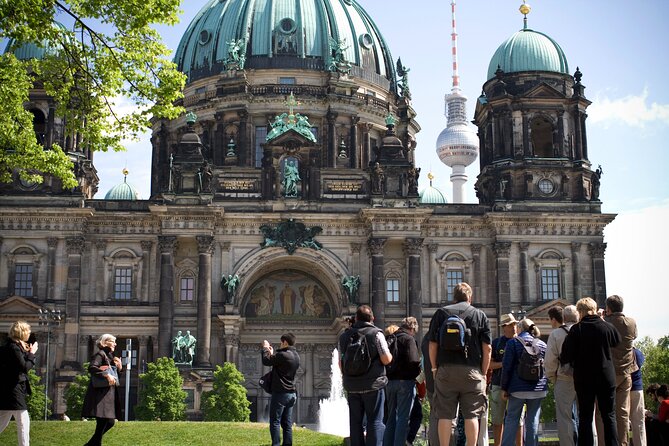
The route continues through Lustgarten, where you see the Berliner Dom, the former City Palace, and the Humboldt Forum. The cathedral is Berlin’s largest church, while the reconstructed palace complex reflects the city’s effort to rebuild and reinterpret its historic center.
You do not tour the interiors of these buildings during the walk. The focus is on orientation and explanation. If the Berliner Dom, Humboldt Forum, or the museums interest you, mark them for a later visit.
Museum Island in five quick stops
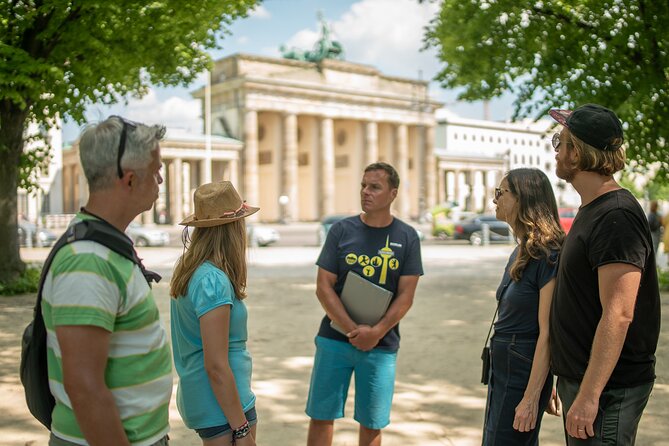
The tour passes the Pergamonmuseum, Neues Museum, and Altes Museum. These are not full museum visits, and admission is not included, but your guide points out what makes each one important.
The Pergamonmuseum is associated with Islamic art, the Ishtar Gate, and the Market Gate of Miletus. The Neues Museum is known for its ancient Egyptian collection and belongs to the UNESCO World Heritage setting of Museum Island. The Altes Museum was Berlin’s first museum and is linked to architect Karl Schinkel.
You also see the reconstructed Stadtschloss, now home to the Humboldt Forum. This area is one of the most visually dense parts of the route, with major buildings close together. The tradeoff is time. Five or ten minutes at each location is enough for context and photographs, but not enough to explore the collections.
I see this portion as a useful preview. If you have only one day in Berlin, the guide helps you decide which museum deserves your limited time. If you already have museum plans, the walk gives the buildings a stronger setting.
Bebelplatz and the memory of book burning
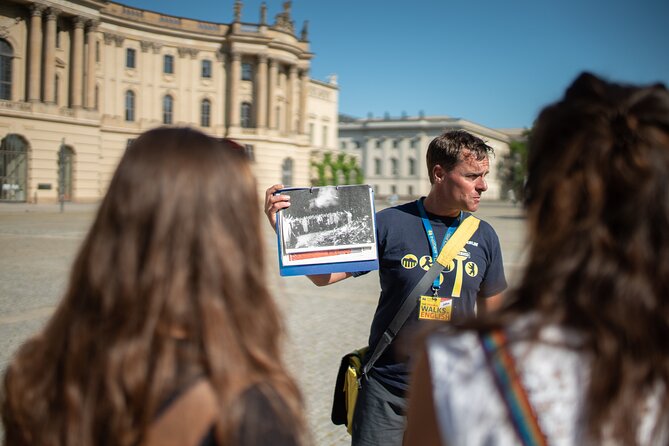
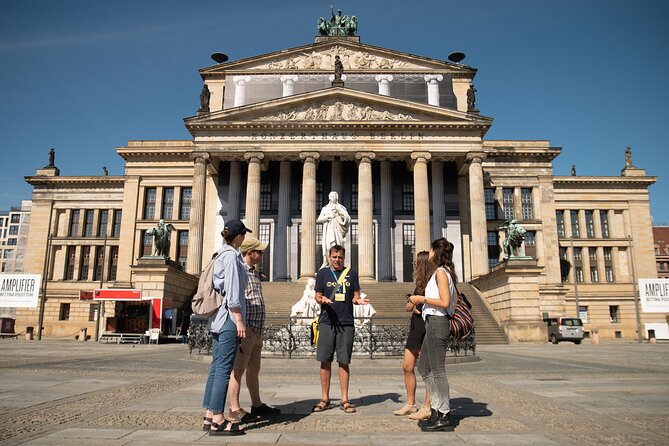
At Bebelplatz, the tour shifts from architecture to the Nazi assault on culture. This elegant eighteenth-century square is surrounded by important buildings, including the Staatsoper and the Konzerthaus.
The Book Burning Memorial marks the site where the Nazis burned tens of thousands of books in 1933. The memorial is easy to miss if you are wandering alone, which is one reason a guide adds real value here. The location shows how the destruction of ideas was staged in the center of the city, not hidden away at some distant site.
The nearby Staatsoper was built under Frederick the Great in 1743. The Konzerthaus, completed in 1821, is another major work linked to Schinkel. Together with Gendarmenmarkt, these stops offer a sharp contrast with the political violence discussed elsewhere.
Gendarmenmarkt reflects a period of religious tolerance and includes the French Cathedral and German Cathedral. The square is one of Berlin’s grandest urban spaces, but the tour keeps moving. Take photographs as you go, and do not expect a long break unless your guide allows one.
Same city, a completely different kind of day:
- Discover Berlin Half-Day Walking Tour
★ 5.0 · 9,624 reviews - Berlin: Hop-on Hop-off Bus Tour with Live Commentary
★ 4.3 · 8,579 reviews - Berlin: Government District around the Reichstag Guided Tour
★ 4.7 · 8,447 reviews - Berlin: Reichstag, Plenary Chamber, Cupola & Government Tour
★ 4.6 · 8,422 reviews
Checkpoint Charlie and the Wall
Checkpoint Charlie is one of Berlin’s best-known Cold War sites. It was a civilian and military crossing between East and West Berlin, and in 1961 it became the scene of a tense tank confrontation between Soviet and American forces.
Today, the setting can feel more commercial than solemn. That is exactly why the guide’s explanation matters. Without context, you see a famous name and a photo opportunity. With context, you understand how this crossing fit into a divided city where movement between neighborhoods could become an international crisis.
The walk continues to the Topography of Terror, where you see a roughly 200-meter section of the Berlin Wall. This part of the route helps correct a common misunderstanding: the Wall was not simply a single barrier cutting through empty land. It ran through an inhabited city, separating streets, homes, workplaces, and families.
You also pass the former Aviation Ministry of Berlin. The building was associated with Hermann Göring’s air force ministry, later served as the East German house of ministers, and now houses the German Finance Ministry. This is a particularly good example of Berlin’s habit of placing different political eras in the same building.
Hitler’s bunker site and the Holocaust Memorial
The tour then reaches the site of Hitler’s former bunker. You stand above the location where he spent the final days of the Second World War. There is no dramatic bunker interior to enter here, and that is part of the point. The site is deliberately understated, with the historical meaning carried by the guide’s explanation rather than by a grand monument.
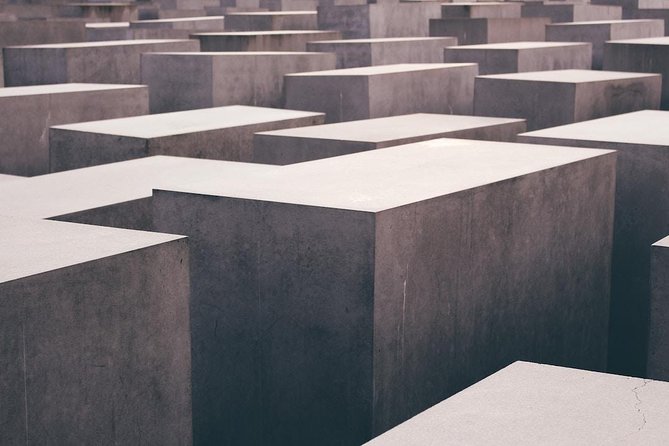
From there, you walk through the Memorial to the Murdered Jews of Europe. Its field of concrete blocks creates a powerful, unsettled space in the middle of Berlin. Your guide discusses the Holocaust with care, and this is one part of the walk where thoughtful presentation matters more than a long list of dates.
Allow yourself enough attention here. The tour schedule gives about ten minutes, but the memorial works best when you pause and form your own response. If you want to read the underground information center, you will need to return separately because this walking tour does not include a full visit.
These stops are emotionally demanding. That is not a reason to avoid them, but you should know what kind of experience you are booking. This is a history tour that asks you to confront state violence and human loss, not a light introduction to Berlin’s architecture.
Brandenburg Gate, Pariser Platz, and the government quarter
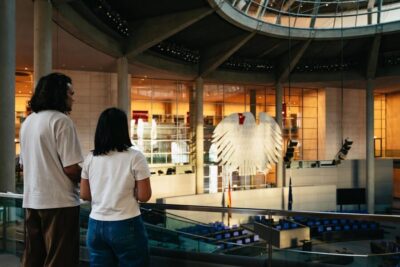
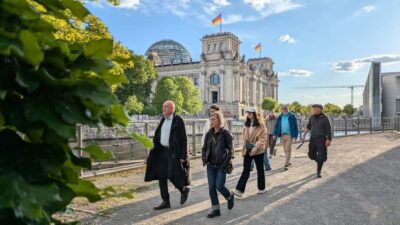
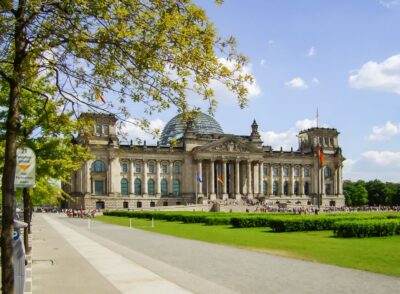
The route reaches Berlin’s government quarter and the Reichstag Building, home of the German Parliament. The Reichstag is viewed from outside during this walk, so do not confuse the tour with a guided visit inside the dome.
The final major sight is Brandenburg Gate. Once associated with division, the gate now serves as a national symbol of peace and unity. Its setting at Pariser Platz includes the American and French embassies, the Hotel Adlon, and the Academy of Fine Arts.
This is a satisfying finish because the gate brings several themes together. It was part of a divided city, it became a symbol of change, and it now frames one of Berlin’s most photographed public spaces.
The supplied route information gives both the Reichstag and Brandenburg Gate as closing points, while the stated end point is Brandenburg Gate at Pariser Platz. Plan on finishing in that area, and confirm the precise end details with the guide if you need to meet a train or reserve a timed entry elsewhere.
How the guides shape the experience
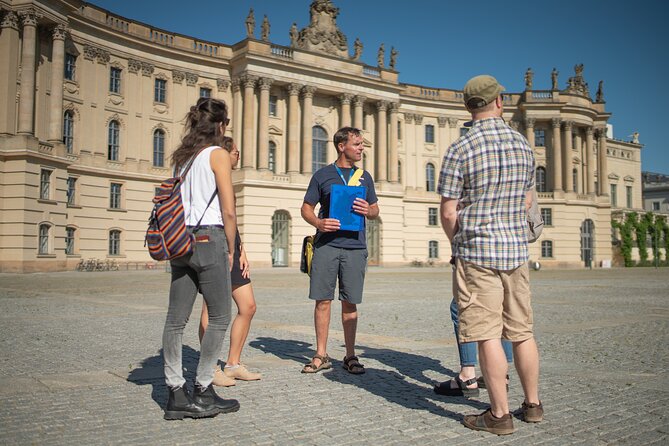
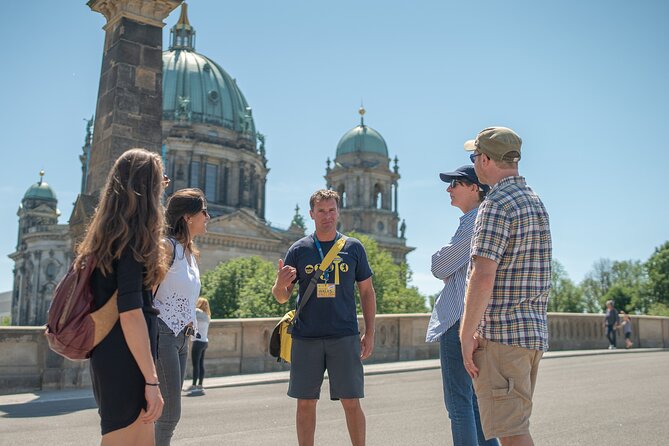
The route is fixed, but the guide can make it feel either rushed or lively. The strongest guide reports describe people such as Joseph, Tina, Hannah, Jimmy, Paul, Rohan, Jef, Tom, Peter, and Brian as clear, friendly, and able to explain difficult history in an accessible way.
Joseph is noted for inviting questions and answering them well. Tina is praised for making several centuries of history understandable while keeping the group on time. Hannah kept a steady pace and included short stops during cold weather. Jimmy is described as friendly, humorous, and especially good at making the three hours pass quickly.
Other guides add their own strengths. Rohan gives engaging explanations, while Jorg uses personal anecdotes to make events feel more relatable. Grayson’s discussion of the Holocaust made a particularly serious impression, and Paul is praised for both major sights and practical recommendations.
A few practical weaknesses are worth noting. One experience became uncomfortable because the guide spoke too softly and began talking before the full group had gathered. Another participant became separated after feeling hurried and not having enough time for photographs. These problems appear to be guide-dependent, but you should still stay close, speak up if you cannot hear, and ask for a short photo pause when needed.
Pace, walking distance, and group size
This is a city walk, not a hop-on, hop-off tour. One person estimates the route at about three miles, and the supplied schedule lists roughly 20 stops across three hours. That means plenty of standing, regular movement, and short explanations at each location.
The maximum group size is 25. That is not private-tour intimacy, but it is manageable when the guide uses a clear voice and keeps the group together. The experience is near public transportation, begins in central Berlin, and ends near Brandenburg Gate, so it fits neatly into a day of sightseeing.
Wear comfortable shoes. In cold weather, expect to appreciate the short warming pauses. If you have limited mobility or tire easily, consider how the distance and standing time will suit you. The information says most people can take part, and service animals are allowed, but the route remains a fairly demanding walk for anyone who needs frequent rests.
Is $24.07 good value?
At $24.07 per person, this is good value if you want an informed first look at central Berlin. You see a remarkable number of major sights without paying separate admission fees, and you get historical links that are difficult to build from a map alone.
The value is less clear if you want to enter museums, the Berliner Dom, the Reichstag, or the Holocaust Memorial information center. Those admissions and visits are outside the walk. Think of this as a guided framework, not a complete sightseeing day.
The tour is also a useful way to plan the rest of your stay. You can note which places deserve a second visit and return later when you have more time. At this price, the route does much of the orientation work for you.
Who should book this Berlin walk?
I would choose this tour for a first visit, especially if you want Berlin’s Nazi and Cold War past explained in one connected story. It suits adults, older children who can handle serious subject matter, and anyone who prefers a local guide to reading plaques alone.
It is also a strong choice at the start of a stay. By the end, you know where the key monuments are, how the historic center fits together, and which locations you want to explore at greater length.
I would think twice if you dislike group walks, need a slow pace, or want extended time at every photograph stop. A private tour or a shorter themed visit may suit you better. Also, arrive early and stay near the guide, since the route covers a lot of ground and the group cannot pause indefinitely for each person.
Cancellation is free up to 24 hours before the start time. Changes or cancellations made later are not refunded.
Should you book it?
Book this walk if you want a well-priced introduction to Berlin’s central sights and the forces that shaped modern Germany. Its greatest strength is the connection between places: the Palace of Tears, Bebelplatz, Checkpoint Charlie, the Wall, the bunker site, the Holocaust Memorial, the Reichstag, and Brandenburg Gate become chapters in one story.
Skip it if you want long museum visits or an unhurried photography tour. For most first-time visitors who can comfortably walk three miles, I would book it early in the trip, arrive 15 minutes ahead, and use the final hour to mark the places you want to revisit.
FAQ
How long is the Berlin walking tour?
The tour lasts approximately three hours.
How much does the tour cost?
The listed price is $24.07 per person.
What language is the tour offered in?
The tour is offered in English with a local English-speaking guide.
Where does the tour begin?
The meeting information gives Reichstagufer 17, 10117 Berlin, and describes the meeting area as outside Friedrichstrasse train station in central Berlin. Check the exact meeting instructions and arrive 15 minutes early.
Where does the tour finish?
The stated end point is Brandenburg Gate at Pariser Platz. The route also includes the Reichstag and Berlin’s government quarter near the end.
Is admission to the museums included?
No. The walking tour passes the Pergamonmuseum, Neues Museum, Altes Museum, Berliner Dom, and Humboldt Forum, but museum and interior admission is not included.
How many people can join the tour?
The maximum group size is 25 people.
Can I cancel for a full refund?
Yes. You can cancel up to 24 hours before the experience starts for a full refund. Cancellations or changes made less than 24 hours before the start time are not refunded.
Just added in Berlin
- Berlin & The Third Reich Private Guided Tour★ 5.0 · 3 reviews
- Third Reich Quest Experience in Berlin★ 4.5 · 7 reviews
- Private Analogue Photography Experience in Berlin★ 5.0 · 3 reviews
- Berlin Urbex Adventure and History Tour★ 5.0 · 9 reviews
- The Beauty of Berlin by Bike: Private Tour★ 5.0 · 59 reviews
- Berlin: Guided Bike tour of the Berlin Wall and Third Reich★ 5.0 · 160 reviews
- Beyond Currywurst: Berlin’s Hidden Street Food & Culture Tour★ 5.0 · 100 reviews
- Berlin Third Reich & Cold War Walking Tour With A Guide★ 5.0 · 7 reviews
Berlin Tours, compared.
Reichstag, Dome and Government District Guided Tour
Read our review →
Reichstag, Plenary Chamber, Cupola & Government Tour
Read our review →