
Reviewed · WALKING TOURS
Berlin Highlights Walking Tour
Berlin’s most difficult history is packed into this two-hour walk. You move from Brandenburg Gate to the Führerbunker site, the Holocaust Memorial, the Topography of Terror, and Checkpoint Charlie, tracing the city’s story from dictatorship and war to Cold War division.
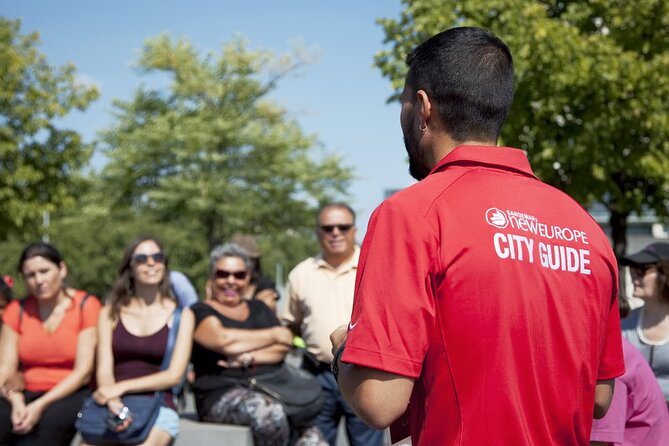
I like the efficient route and the fact that the main sites are free to enter. I also like the practical pace: guide Nir has been praised for offering useful context while keeping the group on schedule. The drawback is clear: five serious stops in two hours leave little time for extended discussion or independent looking.
Key points to know before booking
- Five major sites in two hours: The route covers Berlin’s Nazi and Cold War landmarks in a compact walk.
- A strong first-day orientation: Starting at Brandenburg Gate gives you an immediate sense of central Berlin.
- Somber subject matter: The Führerbunker site, Holocaust Memorial, and Topography of Terror require a thoughtful approach.
- Checkpoint Charlie is the finish: You end at one of Berlin’s best-known Cold War locations, near public transportation.
- Good value at $4.81: With a local English-speaking guide and no separate admission charges, the price is unusually low.
- Small enough to manage: The group can include up to 25 people, a reasonable size for an outdoor walking tour.
Five Berlin landmarks, one focused historical story
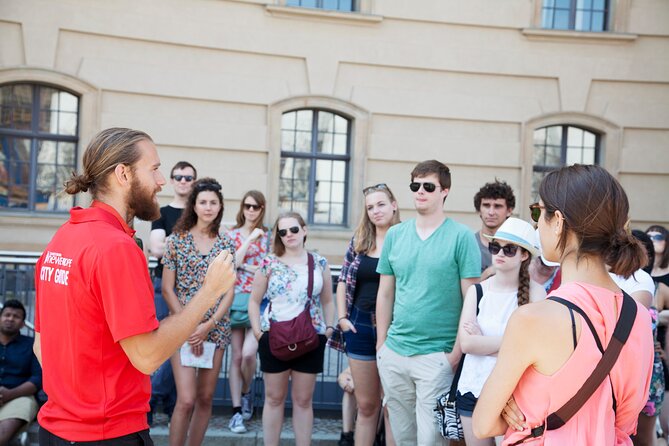
This is not a general tour of Berlin’s food, neighborhoods, museums, or daily life. It concentrates on the city’s 20th-century political history, with each stop adding another chapter.
You begin with Brandenburg Gate, then move to a site connected with the final days of World War II. From there, the route turns toward remembrance of the Holocaust, the machinery of Nazi persecution, and finally the division of Berlin during the Cold War.
That focus makes the walk especially useful if you have limited time. You will not see every side of Berlin, but you will connect several major places that are often visited separately. I would treat it as a historical orientation, not a complete introduction to the city.
The tour is offered in English and includes a local guide. Admission is free at all five listed stops, so the price mainly pays for the guide’s explanations and the convenience of moving between important sites with a clear plan.
More Walking Tours in Berlin
- Discover Berlin Half-Day Walking Tour
★ 5.0 · 9,624 reviews - Berlin: Third Reich and Cold War 2 Hour Walking Tour
★ 4.9 · 6,830 reviews - Berlin: Discover Berlin Walking Tour
★ 4.9 · 5,998 reviews
Brandenburg Gate gives you the right starting point
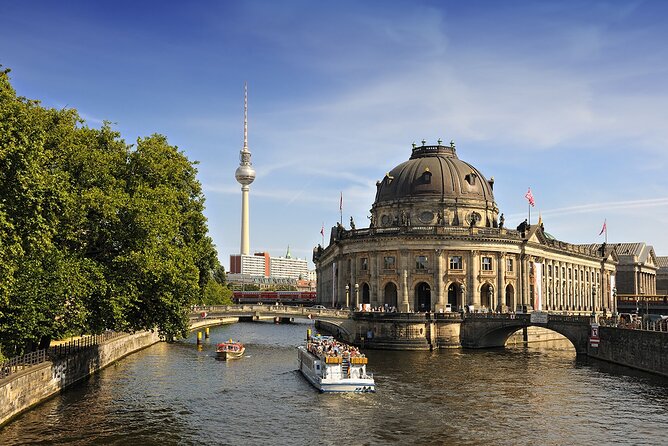
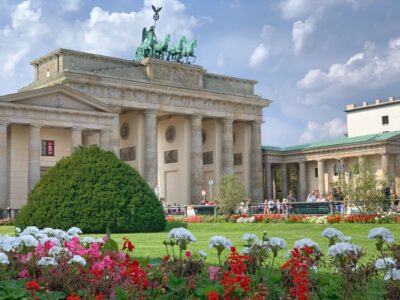
The meeting point is Starbucks at Pariser Platz 4A, beside Brandenburg Gate. This is a practical place to begin because the gate is easy to recognize and already places you in the center of Berlin’s major historical district.
The guide uses the monument to explain its changing role. Built as a grand city entrance, Brandenburg Gate later became tied to major political events and eventually took on meaning as a symbol of division and unity.
You spend about 24 minutes here. That is enough for a focused explanation and some time to look closely at the neoclassical design, but not enough for a long architectural lecture. The value comes from hearing why the gate matters before you move on to more troubling sites.
If you are meeting a group, arrive with the exact address in hand. The meeting point is not described as the gate itself, but as the Starbucks near Pariser Platz. A phone with the mobile ticket available should make the start easier.
The Führerbunker site requires imagination
The next stop is the site of the Führerbunker. The bunker itself is no longer visible, and that fact shapes the experience. You are not entering an intact wartime room or viewing a preserved underground complex. Instead, the guide explains what happened at this location during the final days of World War II.
This stop works best when you understand that the absence of a visible structure is part of the point. Berlin does not present every difficult site as a dramatic monument. Here, the guide’s account supplies the historical information while the ordinary surroundings require you to picture what once happened below ground.
About 24 minutes are assigned to the stop. That should give you a concise account of the bunker’s role without turning the visit into a long, technical study of its construction.
I appreciate that the route includes this location without presenting it as a spectacle. The subject is grim, and a short, factual explanation is likely more useful than a theatrical presentation. If you want detailed military history, you will need extra time elsewhere. For a first look at Berlin’s final wartime days, this stop earns its place.
The Holocaust Memorial changes the pace
The Memorial to the Murdered Jews of Europe is the emotional center of the walk. Its field of concrete slabs creates a physical setting that feels different as you move through it. The tour gives you about 24 minutes here, with the guide explaining the memorial’s design, purpose, and connection to the millions of Jewish people murdered during the Holocaust.
This is a place where you should allow yourself to look and think, not simply collect a photograph. The blocks create narrow paths and changing sight lines, so the memorial is experienced by walking through it rather than viewing it from one fixed point.
The short schedule is the main limitation. Twenty-four minutes gives you an introduction, but you may want to return later if you prefer to spend more time with the memorial or visit its information center independently. The tour does not promise a full museum visit, and the listed stop is focused on the memorial itself.
For me, this stop shows why a guide can be useful. The design is powerful, but its meaning is not automatic. A good explanation helps connect the physical setting with the act of remembrance without reducing the memorial to a quick photo stop.
Same city, a completely different kind of day:
- Berlin: Reichstag, Dome and Government District Guided Tour
★ 4.7 · 18,288 reviews - Berlin: 1-Hour City Tour by Boat with Guaranteed Seating
★ 4.3 · 16,993 reviews - Berlin: Boat Tour Along the River Spree
★ 4.4 · 11,252 reviews - Berlin: Hop-on Hop-off Bus Tour with Live Commentary
★ 4.3 · 8,579 reviews
Topography of Terror adds documented evidence
At the Topography of Terror, the subject shifts from remembrance to the organizations and systems behind Nazi persecution. The permanent exhibition sits on the former site of the Gestapo and SS headquarters and details the rise and fall of the Nazi regime.
This is one of the most substantial stops on the route because it places individual events within the wider structure of government terror. You get a clearer sense of how institutions operated and how persecution was organized.
The itinerary allows about 24 minutes here. That is enough for a guided introduction to the exhibition, but it is not enough to read every display or examine the full collection at your own pace. If this subject is central to your interest, plan to return independently with more time.
The stop is especially valuable after the Holocaust Memorial. The memorial asks you to remember the victims. The Topography of Terror helps explain the organizations and decisions that made the crimes possible. Together, the two locations create a stronger understanding than either one would provide alone.
Checkpoint Charlie closes with Cold War tension
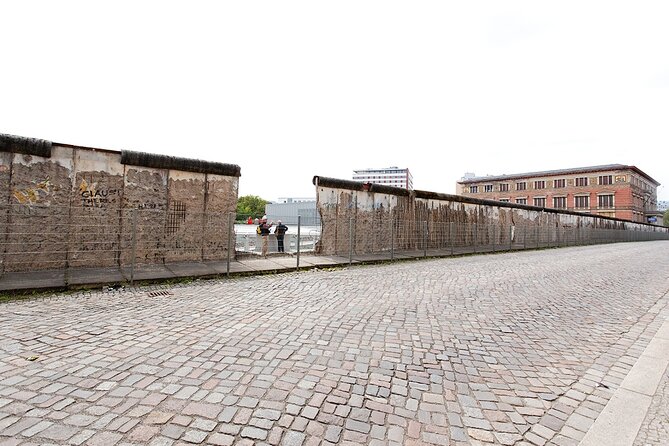
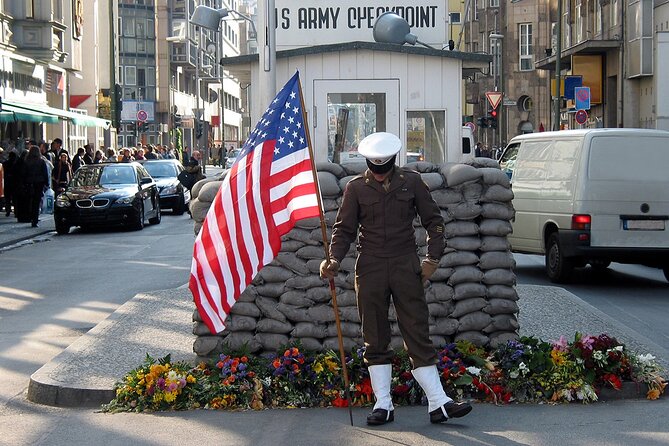
The walk ends at Checkpoint Charlie on Friedrichstraße, at 43 to 45. This former crossing between East and West Berlin is one of the city’s most recognizable Cold War sites.
The guide explains the tense standoffs, border controls, and escape attempts connected with the crossing. After the earlier stops, the story moves from Nazi rule and wartime destruction to the political division that shaped Berlin for decades after 1945.
Ending here is practical. Checkpoint Charlie is near public transportation, so you can continue exploring after the tour. It is also a useful place to pause and decide what you want to see next.
The site itself can feel more symbolic than preserved. The value of the stop comes largely from the explanation of what the crossing represented and how Berlin’s division affected people on both sides. If you expect a fully intact border installation, keep your expectations measured. If you want a clear account of the Cold War’s role in Berlin, the stop fits the route well.
The two-hour schedule favors coverage over depth
Each of the five listed stops receives about 24 minutes, which adds up to the advertised two-hour duration. That tidy structure helps the guide keep the walk moving and lets you cover many landmarks without giving the entire day to one subject.
The tradeoff is depth. You will receive a clear introduction at each location, but you will not have much spare time for extended questions, museum displays, or long personal reflection. The tour is best for getting your bearings and deciding which sites deserve a longer return visit.
One useful detail is that the route covers several locations within a few kilometers of Brandenburg Gate. That keeps the experience compact rather than turning it into an all-day march across Berlin.
Wear comfortable shoes and be ready to spend the full two hours walking and standing. The tour is described as suitable for most people, and service animals are allowed. No special fitness requirement is listed, but the format is still a walking experience, not a seated sightseeing trip.
What $4.81 really buys you
At $4.81 per person, this is unusually inexpensive for a guided experience. The price becomes even easier to justify because the five stops have free admission. You are paying for the local guide, the route, the historical explanations, and the time saved organizing the sequence yourself.
I would not judge the price by expecting a full museum tour or private attention. A group of up to 25 people can include enough people that questions may need to be brief, especially at busy sites. The price is strongest for someone who wants a low-cost introduction rather than a highly personal, in-depth history lesson.
The tour is booked an average of 19 days ahead, so it is sensible to reserve before your Berlin dates are fixed in your daily plan. Confirmation is provided at booking, and the mobile ticket makes the experience easy to carry without printing paperwork.
The free cancellation policy also gives you some flexibility. You can cancel for a full refund up to 24 hours before the start time. Changes or cancellations inside that 24-hour window are not accepted for a refund.
A guide can make or break this format
Because the tour moves quickly and includes serious subjects, the guide’s clarity matters more than fancy presentation. You need someone who can explain the facts, keep the group together, and respect the tone of each site.
Nir is specifically associated with a two-hour tour that stayed on schedule while offering useful and interesting insights. If Nir is leading your departure, that is a helpful sign for anyone who values a well-paced introduction. Guide assignments can vary, so I would not book solely on the promise of one named guide.
The English-language format makes this a straightforward choice for English speakers who want historical context while walking. The group limit of 25 is not intimate, but it is manageable for a city walk if the guide uses a clear meeting point and keeps the explanations focused.
Who will get the most from this walk
I would choose this experience if you are visiting Berlin for a short stay, want a history-heavy introduction, or prefer to see important places before deciding which museums deserve more of your time.
It suits:
- First-time visitors who want a quick central orientation
- History enthusiasts focused on Nazi Germany and the Cold War
- People with a busy schedule who can spare two hours
- Budget-conscious visitors who want a guide without admission costs
- Visitors who prefer a planned route to navigating several sites alone
I would look for a longer or more specialized experience if you want extended museum time, detailed military history, or a broad overview of Berlin’s art, food, neighborhoods, and modern culture.
Families can participate because most people are eligible to join, but the subject matter is serious. The tour is better suited to anyone prepared for frank discussion of war, dictatorship, genocide, and political repression.
Practical details for a smoother visit
Meet at Starbucks, Pariser Platz 4A, 10117 Berlin. The walk ends at Checkpoint Charlie, Friedrichstraße 43 to 45, also in the 10117 postal area.
The mobile ticket is convenient, and the experience is offered in English. Service animals are permitted, and the route is near public transportation. The operator lists a maximum of 25 people, so expect a shared group rather than a private walk.
Since admission is free at the listed stops, you do not need to budget for entrance fees during the tour. You should still plan your day around the fixed two-hour schedule, especially if you have a timed museum booking afterward.
I would leave a little breathing room after the tour. Checkpoint Charlie gives you a logical place to continue, but the historical subjects can make the walk feel fuller than its two-hour length suggests.
Should you book the Berlin Highlights Walking Tour?
Book it if you want an inexpensive, tightly organized introduction to Berlin’s Nazi and Cold War history. The route covers five major sites, the guide adds needed context, and the two-hour length fits neatly into a crowded itinerary.
Skip it if you want long museum visits, a relaxed pace, or a wider look at Berlin beyond its political past. For most first-time visitors with limited time, though, $4.81 is a small price for a clear route through places that are difficult to understand without background.
FAQ
How long does the Berlin Highlights Walking Tour last?
The tour lasts approximately two hours.
Where does the tour begin?
It begins at Starbucks, Pariser Platz 4A, 10117 Berlin, Germany.
Where does the tour end?
The tour ends at Checkpoint Charlie, Friedrichstraße 43 to 45, 10117 Berlin, Germany.
Which landmarks are included?
The route includes Brandenburg Gate, the Führerbunker site, the Memorial to the Murdered Jews of Europe, the Topography of Terror, and Checkpoint Charlie.
Is admission included?
Admission is free at the listed stops. The tour includes a local guide.
What language is the tour offered in?
The tour is offered in English.
How many people can join the tour?
The maximum group size is 25 people.
Just added in Berlin
- Berlin & The Third Reich Private Guided Tour★ 5.0 · 3 reviews
- Third Reich Quest Experience in Berlin★ 4.5 · 7 reviews
- Private Analogue Photography Experience in Berlin★ 5.0 · 3 reviews
- Berlin Urbex Adventure and History Tour★ 5.0 · 9 reviews
- The Beauty of Berlin by Bike: Private Tour★ 5.0 · 59 reviews
- Berlin: Guided Bike tour of the Berlin Wall and Third Reich★ 5.0 · 160 reviews
- Beyond Currywurst: Berlin’s Hidden Street Food & Culture Tour★ 5.0 · 100 reviews
- Berlin Third Reich & Cold War Walking Tour With A Guide★ 5.0 · 7 reviews
Walking Tours, compared.

Berlin’s Best: 2 Hour Walking Tour Third Reich and the Cold War
Read our review →
Third Reich Berlin: Hitler and WWII Walking Tour
Read our review →Browse the lists this tour appears in