
Reviewed · CASTLE TOURS
Berlin: Decolonial Berlin Castle/ Humboldt Forum Guided Tour
Berlin’s Humboldt Forum looks like a palace, but this tour asks you to question what that image represents. From the rebuilt façade and the cross on the roof to objects gathered during colonial rule, you’ll examine the building through an Afrocentric, decolonial lens rather than taking its story at face value.
I like the tour’s focus on the Humboldt brothers and the way it links their scientific legacy to the museum today. I also like that the guide does not rush straight indoors: the outdoor discussion gives you time to understand the palace, missionary activity, and colonial structures before you meet the collections. The main drawback is that roughly half the two-hour tour takes place outside, and some people may find the critical approach direct or challenging.
Key points to know
- Start at the reconstructed Sanchi Gate: Meet near the gate and use the white chairs for the opening discussion.
- Expect about one hour outdoors: Weather-appropriate clothing and comfortable shoes matter.
- Study the cross on the roof: Its symbolic meaning is part of the tour’s examination of power and colonial memory.
- Connect the Humboldt brothers to the museum: Their scientific work is explained alongside the institution’s modern identity.
- View the ethnological collection critically: An audio walk helps you consider how objects were collected, labeled, and presented.
- Allow two hours for a serious discussion: The palace story receives more attention than a standard museum tour usually gives it.
Why this Humboldt Forum tour takes a different route

Many visits to the Humboldt Forum begin with the building itself: a grand reconstruction of Berlin’s former palace in the center of the city. This experience begins with a question. Who gets to tell the story of that palace, and what has been left out?
The tour uses decolonial ideas to examine Berlin’s links to colonialism. You’ll hear about the establishment of colonial structures, the role of missionaries, and the way these forces shaped the collection now presented inside the museum. The point is not simply to add a few missing facts. It is to reconsider how museums create meaning through architecture, names, displays, and labels.
The tour also takes an Afrocentric approach. That means African perspectives and Black historical experiences receive particular attention, rather than being treated as a small side note within a mainly German story. If you want a neutral, traditional palace tour, this may not be the right fit. If you want to question familiar versions of history, the approach gives you plenty to think about.
The tone can be forceful. One low rating objected to the way historical interpretation was presented and felt that alternative readings were defended too strongly. That is useful context: this is not a light sightseeing walk with a few colonial references added for balance. It is a guided argument about how Berlin should remember its past.
More Castle Tours in Berlin
- Berlin: Charlottenburg Palace Entry Ticket
★ 4.4 · 2,076 reviews - Berlin: Guided Palace Tour by the Insider
★ 5.0 · 38 reviews - Berlin: Palace of Köpenick Entrance Ticket
★ 4.3 · 21 reviews
Meeting at the Sanchi Gate

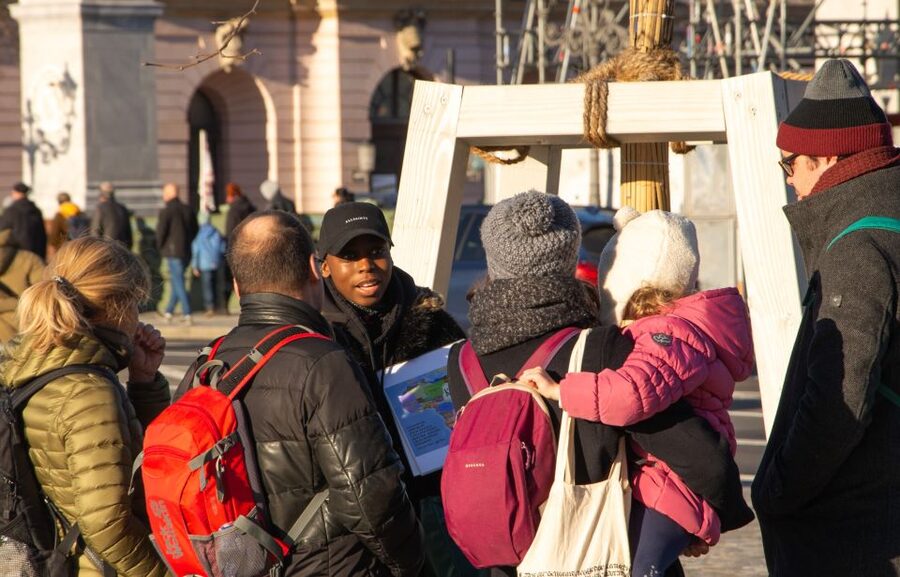
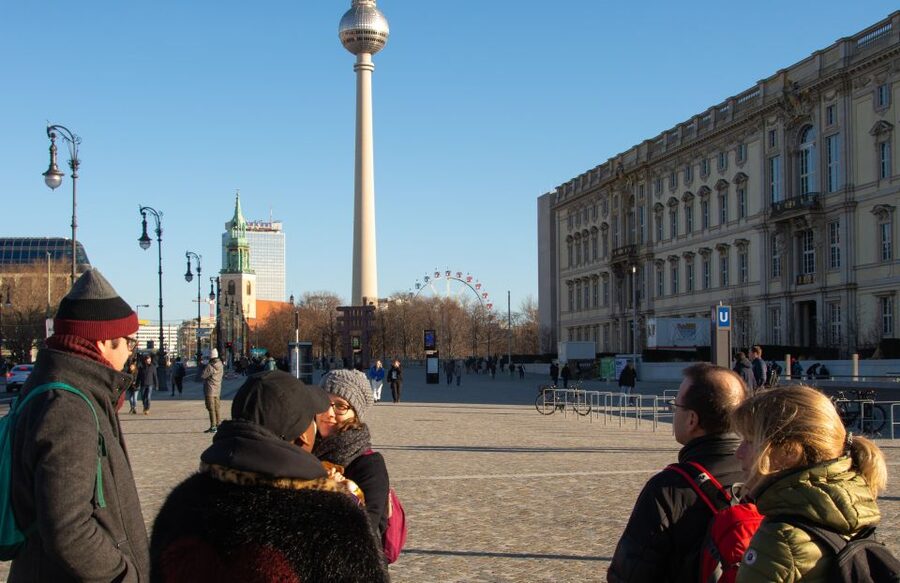
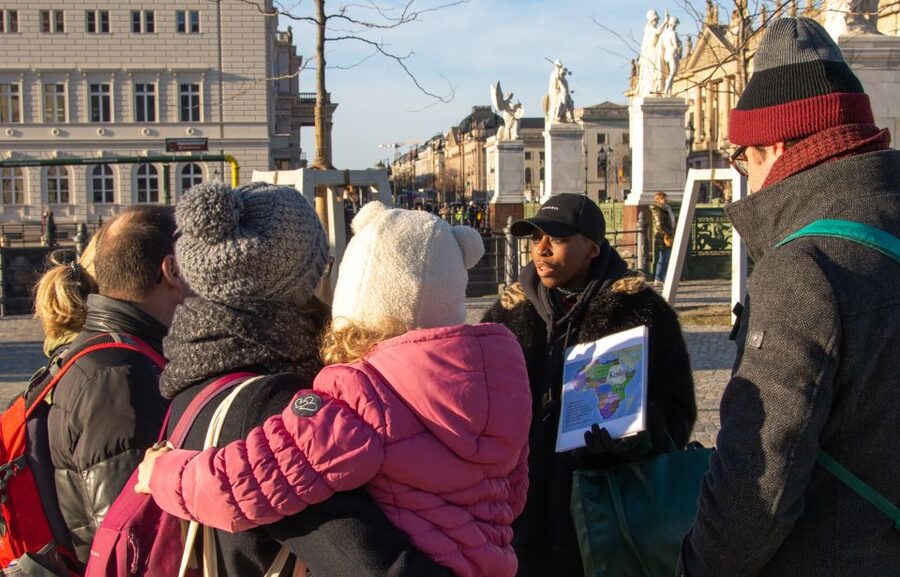
The meeting point is near the reconstructed Sanchi Gate, close to the Humboldt Forum. Look for the white chairs, where the group sits for the first part of the experience.
This unusual starting point helps set up the tour’s wider questions. The gate is connected to India, while the museum around you presents collections from several parts of the world. That makes it a fitting place to begin a conversation about how non-European cultures have been displayed, interpreted, and placed within European institutions.
You should plan to arrive ready to sit outside for about an hour. This is not a quick introduction while standing in a busy entrance hall. The outdoor section forms a major part of the tour, so your comfort depends on the weather. Wear shoes suitable for walking and clothing that suits Berlin’s conditions. There is no mention of food or drinks being allowed, and large bags or luggage are not permitted.
The outdoor format has a clear benefit. You can look at the palace from the outside while discussing its meaning, rather than treating the building as a neutral shell. The tradeoff is simple: on a cold, wet, or very hot day, the opening hour may feel long.
Berlin Palace, rebuilt image, complicated past
The guide introduces the palace’s roughly 500-year history, but the focus is not a standard list of rulers and dates. You’ll consider how the palace became part of Berlin’s political and cultural identity, and how its reconstruction affects the way the past is presented today.
The building is especially important because the Humboldt Forum is not housed in an ordinary modern museum. Its exterior recreates the former Berlin Palace, giving the institution a powerful link to royal and imperial Germany. The tour asks you to notice that symbolism before you step inside to see collections from outside Europe.
One of the most striking subjects is the cross on the museum roof. You’ll learn why it matters and what it can suggest about religion, authority, and the public image of the building. The cross is not treated as a simple architectural decoration. It becomes part of a larger question about which values are placed above a museum that contains objects connected to colonial histories.
That discussion is useful even if you know little about Berlin Palace. You do not need a background in German history to follow the tour, but you should be prepared to think about architecture as an active part of historical storytelling.
The Humboldt brothers and the museum’s name

The tour gives special attention to the Humboldt brothers, important figures in German scientific history. Their names are central to the forum, so understanding their work helps explain why the museum is called the Humboldt Forum.
The brothers are presented as more than names on a building. Their scientific interests, research, and place in German history provide a route into questions about how European knowledge was gathered and organized. The tour connects their legacy with the museum’s present-day purpose, including the way the institution displays cultures from around the world.
This section should appeal to you if you enjoy seeing how a museum’s name shapes its identity. It also helps prevent the visit from becoming only a conversation about the palace. You’ll look at the people behind the institution’s title and consider how their intellectual legacy fits, or fails to fit, with current debates about colonial collections.
The tour does not reduce the Humboldt brothers to heroes or villains. Based on the experience’s stated focus, their importance is examined in relation to science, empire, collecting, and the modern museum. That broader framing is one of the strongest reasons to choose this tour instead of a basic building visit.
Same city, a completely different kind of day:
- Berlin: Reichstag, Dome and Government District Guided Tour
★ 4.7 · 18,288 reviews - Berlin: 1-Hour City Tour by Boat with Guaranteed Seating
★ 4.3 · 16,993 reviews - Berlin: Boat Tour Along the River Spree
★ 4.4 · 11,252 reviews - Discover Berlin Half-Day Walking Tour
★ 5.0 · 9,624 reviews
Missionaries and the machinery of colonial power
Missionaries receive more attention here than they usually do on a standard museum visit. You’ll learn how various missionaries contributed to the establishment of colonial structures and how religious work could connect with wider political and economic systems.
This is an important distinction. Colonialism was not built only by soldiers, officials, or traders. Religious institutions and individuals could also take part in systems that changed local societies, gathered information, claimed authority, and helped European powers extend their influence.
The tour uses this history to question the path objects may have taken before reaching a European collection. An ethnological object can be beautiful, important, or spiritually meaningful, but the circumstances of its removal and presentation also matter. The guide’s role is to help you read that background rather than look only at the object’s surface.
I find this part especially valuable for anyone who has visited museums that display African, Asian, Oceanian, or American objects without much explanation of how they arrived in Europe. The tour encourages you to ask who collected an object, under what conditions, and whose voice is missing from the label.
Entering the ethnological collection
After about an hour outside, you head into the Humboldt Forum and its ethnological collection. Entry to this collection is included in the $41 price, along with the live English-speaking guide.
The indoor portion is not designed as a fast march from one display case to the next. You’ll use an audio walk and examine the collection from a critical perspective. That means looking not only at what is displayed, but also at the language, categories, and assumptions used to organize it.
The audio element gives the visit a second layer. Instead of relying only on a guide’s spoken explanation, you have a way to continue analyzing the collection as you move through it. The exact route and object selection are not specified, so you should not expect a fixed list of famous pieces. The value lies in the method: you are being shown how to question a museum display.
This is also where the tour may feel shorter than you expect. One four-star assessment found that the historical background received so much attention that the actual time inside the forum felt limited. That is a fair tradeoff to consider. You receive more context about the palace and colonial history, but less time for a conventional museum tour.
If your main goal is to see as many objects as possible, book extra time at the Humboldt Forum separately. If your goal is to understand how the collection should be read, the focused indoor section may be enough to change the way you explore the museum afterward.
What the two-hour timing really means
Two hours is enough for a clear introduction, but not enough to cover the palace, the Humboldt brothers, missionaries, colonialism, architecture, and the full ethnological collection in equal depth. The schedule gives priority to discussion and interpretation.
The first hour outdoors is the biggest practical factor. You need to be comfortable listening while seated outside, and you should not plan another time-sensitive activity immediately afterward. The indoor portion then brings the ideas into contact with the objects and displays.
The tour is conducted in English. No guide names are provided, but the strongest praise focuses on guides being competent, informative, and able to keep the subject engaging. That matters here because the topic can become abstract or heavy. A good guide needs to explain difficult ideas without turning the tour into a lecture disconnected from the place.
The current rating is 4.4 out of 5 from 12 ratings, with several top scores praising the guide and the relevance of the subject. There is also one report of a guide failing to appear at the agreed time and place. That appears to be an isolated service problem, but it is worth checking your meeting instructions carefully and keeping confirmation details available.
Is $41 a fair price?
At $41 per person, this is not the cheapest way to see the Humboldt Forum. The price makes more sense if you value guided interpretation, entry to the ethnological collection, and a focused discussion of colonial history.
A standard museum visit gives you freedom to move at your own pace. This tour gives you a framework for seeing the museum differently. You are paying for the guide’s explanation, the organized outdoor discussion, and the connection between the building, its name, its roof, its collections, and Germany’s colonial past.
The value is strongest for first-time visitors who might otherwise walk through the palace-like building without knowing what questions to ask. It is also useful if you have already visited ethnological museums and want to examine how collecting practices and display choices affect what you see.
The price is less attractive if you mainly want architecture, royal history, or a broad introduction to the Humboldt Forum. In that case, the tour may spend too much time on issues you did not plan to study. It is a specialist experience in subject and tone, even though you do not need specialist knowledge to attend.
Who should book this experience?
I would recommend it to you if you enjoy history that challenges official versions of the past. It suits students, museum workers, educators, and curious visitors who want to understand how colonialism remains visible in modern cultural institutions.
It also fits anyone who feels unsure about how to approach the ethnological collection. The guide gives you practical questions to carry through the galleries: who collected this object, how was it acquired, what name is used for it, and whose interpretation is missing?
You should think twice if you want a relaxed, traditional sightseeing tour. The discussion is serious, the outdoor opening is long, and the guide’s approach may feel assertive. It is not designed to leave every interpretation untouched.
Bring comfortable shoes and weather-appropriate clothing. Do not bring food, drinks, luggage, or large bags. The tour is wheelchair accessible, but because about an hour is spent seated outdoors, you may want to confirm that the meeting setup works for your needs before booking.
Should you book the decolonial Humboldt Forum tour?

Book it if you want the Humboldt Forum to raise questions, not simply provide attractive rooms and historic-looking walls. The strongest parts are the explanation of the palace’s symbolism, the attention to missionaries and colonial structures, and the critical reading of the ethnological collection.
Skip it if your priority is a quick museum overview or maximum gallery time. The outdoor discussion takes up about half the tour, and the subject can be demanding.
For the right audience, $41 buys more than entry. It gives you a set of ideas that can shape how you see the Humboldt Forum and other European museums. Just arrive prepared for a serious, openly decolonial conversation rather than a conventional guided tour.
FAQ
Where does the tour meet?
Meet your guide near the reconstructed Sanchi Gate. White chairs are available for the outdoor portion of the tour.
How long does the experience last?
The tour lasts two hours. About one hour is spent seated outside before the group enters the museum.
What language is the tour conducted in?
The tour is conducted in English with a live guide.
Is entry to the ethnological collection included?
Yes. Entry to the ethnological collection is included in the tour price.
Is the tour wheelchair accessible?
Yes, the activity is listed as wheelchair accessible.
What should I bring?
Bring comfortable shoes and clothing suited to the weather, since approximately one hour takes place outdoors.
Can I bring food, drinks, or large luggage?
No. Food and drinks are not allowed, and luggage or large bags are not permitted.
Just added in Berlin
- Berlin & The Third Reich Private Guided Tour★ 5.0 · 3 reviews
- Third Reich Quest Experience in Berlin★ 4.5 · 7 reviews
- Private Analogue Photography Experience in Berlin★ 5.0 · 3 reviews
- The Beauty of Berlin by Bike: Private Tour★ 5.0 · 59 reviews
- Berlin: Guided Bike tour of the Berlin Wall and Third Reich★ 5.0 · 160 reviews
- Berlin Urbex Adventure and History Tour★ 5.0 · 9 reviews
- Beyond Currywurst: Berlin’s Hidden Street Food & Culture Tour★ 5.0 · 100 reviews
- Berlin Third Reich & Cold War Walking Tour With A Guide★ 5.0 · 7 reviews
Castle Tours, compared.

From Munich: Neuschwanstein & Linderhof Castle Full-Day Trip
Read our review →
From Munich: Neuschwanstein Castle Full-Day Trip
Read our review →
Premium Neuschwanstein Castle and Linderhof VIP Tour from Munich
Read our review →

Browse the lists this tour appears in