
Reviewed · WALKING TOURS
Berlin: Sightseeing Walking Tour of the Top 20 Attractions
Berlin reveals itself best on foot, and this three-hour private or small-group walk gives you a fast, useful introduction to the city. You move from the government district to the Brandenburg Gate, the Wall, Nazi-era memorials, and Museum Island, with history explained where it happened rather than from behind a bus window.
I like two things right away. First, the route connects Nazi, Cold War, Prussian, and modern Berlin, so you get a proper sense of how the city changed. Second, the guides add dry Berlin humor and personal stories. Carlos and Carlo are especially good names to look for, while Antonella and Max have also led warm, well-received tours. The main drawback is the pace: six kilometers in three hours is a lot of ground, and several stops receive only a short explanation.
Key points at a glance
- About 6 kilometers on foot: Wear comfortable shoes and expect a brisk walk between major sites.
- History beyond the postcard sights: The route includes Checkpoint Charlie, the Topography of Terror, longer Wall sections, and Bebelplatz.
- A strong first-day orientation: You finish near Friedrichsbrücke, close to Museum Island and central Berlin.
- Personal guiding: Private and small-group options let you ask questions and adjust the focus.
- Good value for a compact overview: At $94 per person, the price makes most sense if you want expert context and local advice in one short session.
- Flexible practical terms: English, Spanish, and German tours are available, with cancellation up to 24 hours before the start.
Why this walk works for a first look at Berlin
Berlin is spread out. Its most important sights are not gathered in one old town square, and the city’s story is split across government buildings, memorials, former border crossings, museums, and grand Prussian avenues.
This route solves that problem by drawing a line through the center. You begin near the Federal Chancellery and the Reichstag, then head toward Potsdamer Platz, Checkpoint Charlie, and the former Gestapo site. From there, the walk turns toward Gendarmenmarkt, Bebelplatz, Unter den Linden, and Museum Island.
That sequence matters. You are not simply ticking off monuments. You are moving through the political center of today’s Germany, the Nazi capital, the divided Cold War city, and the royal heart of Prussia. I like this approach because Berlin’s history makes more sense when you see those periods side by side.
The guide also adapts the talk to your interests. You can ask about politics, architecture, everyday life, food, nightlife, or neighborhoods to visit later. That kind of conversation can be more useful than a fixed script, especially if this is your first stay.
More Walking Tours in Berlin
- Discover Berlin Half-Day Walking Tour
★ 5.0 · 9,624 reviews - Berlin: Third Reich and Cold War 2 Hour Walking Tour
★ 4.9 · 6,830 reviews - Berlin: Discover Berlin Walking Tour
★ 4.9 · 5,998 reviews
Starting at the Paul-Löbe-Haus and the modern government district
Meet your guide in front of the main entrance to the Paul-Löbe-Haus at Konrad-Adenauer-Straße 1, opposite the Federal Chancellery. The meeting point places you directly in Berlin’s present-day government quarter.
The first sights include the Paul-Löbe-Haus, the German Chancellery, and the Reichstag. Your guide explains how the area functions today and how the capital moved through major changes before and after reunification.
The Reichstag is one of Berlin’s essential landmarks, but this experience is a walking tour, not an interior visit. The listed route does not include a guided visit inside the building or a reserved dome entry. If seeing the dome is important to you, treat that as a separate plan.
This opening section is a good reason to choose the 10:00 AM start. You begin with the city’s political center and still have much of the day ahead. The 2:00 PM departure works better if you prefer a later start, but you should expect the same six-kilometer walk to extend into the afternoon.
Brandenburg Gate and the emotional weight of the Holocaust Memorial
The Brandenburg Gate is the tour’s big symbolic moment. Once a royal entrance, it later became a Cold War image of a divided city. Today it is linked with reunification and the modern German capital.
A good guide does more than point at the columns. The useful question is how the meaning of the gate changed over time. The story moves from Prussian power to Nazi spectacle, division, and the fall of the Wall. That shift is exactly the kind of context that makes a familiar photograph worth seeing in person.
The nearby Holocaust Memorial changes the tone. The field of concrete slabs invites quiet time as well as explanation, and the itinerary allows free time here. I appreciate that pause. Berlin’s hardest subjects should not be rushed through with a quick fact and a photograph.
You should also know that the tour covers a lot of ground after this stop. If you need long periods at each memorial, museum, or building, a private version gives you a better chance to adjust the pace. A larger small group may need to keep moving.
Potsdamer Platz and a city rebuilt from the ground up
Potsdamer Platz offers a sharp contrast to the memorials and older monuments. It is a modern commercial district shaped by the division of Berlin and the redevelopment that followed reunification.
The stop helps you understand how much of central Berlin was changed during the twentieth century. Instead of looking only at historic facades, you see how the city rebuilt itself and created a new center after decades of separation.
This is one of the places where a guide’s local observations can add real value. The official story is easy to find, but an experienced Berliner can explain how the area fits into daily city life, transport, shopping, and the modern capital. The tour description promises practical tips for food, nightlife, and neighborhoods, so this is a good point to ask what to do after the walk.
Same city, a completely different kind of day:
- Berlin: Reichstag, Dome and Government District Guided Tour
★ 4.7 · 18,288 reviews - Berlin: 1-Hour City Tour by Boat with Guaranteed Seating
★ 4.3 · 16,993 reviews - Berlin: Boat Tour Along the River Spree
★ 4.4 · 11,252 reviews - Berlin: Hop-on Hop-off Bus Tour with Live Commentary
★ 4.3 · 8,579 reviews
Checkpoint Charlie and the Cold War story
Checkpoint Charlie is one of Berlin’s most famous Cold War sites. The checkpoint building and nearby displays draw plenty of attention, but the important part is the story of a city divided by an armed border.
Your guide explains how Berliners lived with the Wall, how crossing worked, and how the city changed when the border opened. Guides who lived through the Wall’s fall can give this period a personal frame. Carlos, in particular, has been described as bringing firsthand experience of that moment into his explanations.
The area can feel commercial and crowded, and the checkpoint itself is not a quiet memorial. That is worth knowing before you arrive. The tour helps by placing the site in context, then taking you to longer sections of the Wall and the Topography of Terror nearby.
Topography of Terror and the former Gestapo headquarters
The Topography of Terror memorial occupies the grounds of the former Gestapo and SS headquarters. This is one of the most important stops on the route for understanding Nazi rule and state violence.
The outdoor displays and documentation center are more serious and detailed than a quick landmark stop. On a three-hour walk, you will not have time for a full museum visit, but the guide can explain why the site matters and point out the surviving traces of its past.
The inclusion of this location is a major strength. Many short Berlin walks stay with Brandenburg Gate, the Wall, and Checkpoint Charlie. This tour adds a place that deals directly with the machinery of dictatorship.
Martin-Gropius-Bau is also included nearby. Depending on the current exhibition, the building may be hosting a major art or cultural show, but the tour does not include admission. You see it as part of the city’s architectural and historical setting.
Gendarmenmarkt and the royal center of Berlin
Gendarmenmarkt brings a different mood. The square is framed by the French Cathedral, the German Cathedral, and the Konzerthaus, creating one of central Berlin’s most impressive architectural views.
Here, the story shifts toward Prussian power, religious communities, music, and the city’s development as a European capital. It is a welcome change after the difficult subjects at the Holocaust Memorial and Topography of Terror.
The square has also faced restoration and building work at different times, so conditions can change. Your guide can still help you read the layout and understand why this space matters, even if parts of it are not fully open.
Bebelplatz and the story behind the empty library
Bebelplatz is small but powerful. It is known for the Nazi book burning of 1933, commemorated by the underground room of empty bookshelves visible through a glass panel in the square.
This is a stop where a few clear facts matter more than a long speech. The memorial is easy to miss if you walk past without knowing the story. Your guide gives the square its proper weight and links it to the wider history of censorship and dictatorship.
The walk then continues along Unter den Linden, Berlin’s historic boulevard. You see how the avenue connects the royal center with Museum Island and the modern city. This is a good section for questions about Prussian history, architecture, and the way Berlin grew around its institutions.
Lustgarten, Berlin Cathedral, and Museum Island
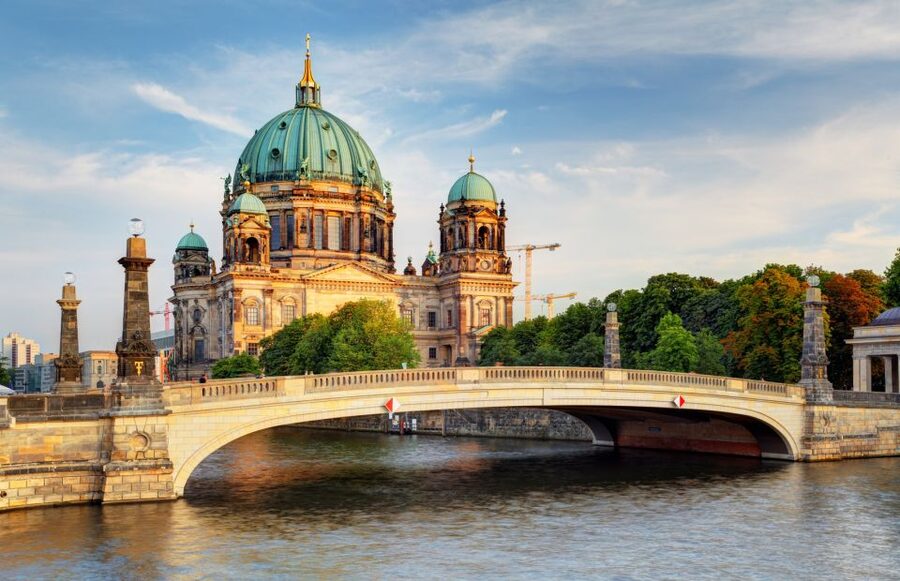
Lustgarten opens the view toward Berlin Cathedral and Museum Island. The cathedral is one of the city’s most recognizable buildings, with a large dome and an imposing riverside position.
The tour does not list interior entry, so plan on seeing the building from outside. That is still worthwhile, especially when the guide explains the role of the cathedral, the square, and the surrounding royal buildings.
Museum Island is the final major historical zone. The island includes several museums and the Alte Nationalgalerie, whose grand exterior forms part of the route. The New City Palace, also called the Humboldt Forum building, is included among the major landmarks.
The finish at Friedrichsbrücke is practical. You are left near the river and Museum Island rather than being returned to the starting point. That makes it easy to continue sightseeing, find a meal, or head toward another central Berlin attraction.
What the guide adds to the walk
The guide is the main reason to choose this experience over a self-guided route. Berlin’s monuments often look clear until you ask what happened there, who used the building, or why the memorial was designed in that particular way.
The guiding style is described as friendly, story-based, and lightly humorous. Carlos and Carlo have been praised for personal Berlin knowledge and for making history feel connected to real life. Antonella is noted for a strong overall experience, while Max is described as warm and friendly.
English, Spanish, and German are offered. The private or small-group format also matters. In a private tour, you can ask about family history, photography, food, politics, or the Wall without worrying about slowing down a large group.
One practical note: guides may run beyond the stated three hours when conversation and questions keep going. That can be a pleasant bonus, but do not schedule a tight appointment immediately afterward.
Is $94 a fair price?
At $94 per person, this is not Berlin’s cheapest walking tour. The value depends on what you want from the morning or afternoon.
You are paying for a certified local guide, a private or small-group setting, three hours of historical explanation, and a route covering far more than the usual postcard sights. If you are visiting Berlin for the first time and want a clear framework for the city, that can be good value.
The price is less attractive if you prefer to wander slowly, enter several museums, or spend a long time photographing each stop. Admission tickets are not presented as part of the tour, and the route is built around outdoor sightseeing. You may still want separate museum visits after the walk.
The strongest value comes from using the tour as your orientation. Take notes on the guide’s suggestions, then return to the sites that interest you most.
Walking comfort, weather, and group choice
The route covers about six kilometers and runs in all weather. You need comfortable walking shoes, water, and clothing suited to the forecast. A camera is useful, but the best preparation is enough time and energy for a steady walk.
The tour is described as suitable for all ages and wheelchair accessible. Still, the distance is significant, and the pace may feel tiring for anyone who has trouble walking for three hours. A private format gives you more control over pauses and questions.
One previous tour group continued for around 30 minutes beyond the planned time, and another stopped for a hot drink during cold, wet weather. Those details suggest a flexible guiding style, but you should still tell the guide about mobility needs or timing concerns at the start.
Who should book this Berlin walk?
I would choose it for a first visit, a short stay, or the first full day in Berlin. It is also useful for couples, families, friends, small teams, and curious local residents who want a connected story rather than isolated facts.
It suits you especially well if you enjoy history, want personal explanations, and can walk six kilometers without needing long rests. It is less suitable if your priority is museum interiors, leisurely photography, or a slow café-centered morning.
Book it when you want to leave the tour with a mental map of Berlin and a clear list of places to explore next. Skip it if you already know the central sights well and would rather spend three hours inside one museum or neighborhood.
FAQ
How long is the Berlin walking tour?
The tour lasts three hours, or 180 minutes. The route covers approximately six kilometers on foot.
What time does the tour start?
Tours are offered daily at 10:00 AM and 2:00 PM.
Where does the tour begin?
Meet in front of the main entrance to the Paul-Löbe-Haus, opposite the Federal Chancellery, at Konrad-Adenauer-Straße 1 in Berlin.
Where does the tour finish?
The walk finishes at Friedrichsbrücke, near Museum Island and Berlin Cathedral.
Which languages are available?
The live guide is available in English, Spanish, or German.
Is the tour private?
Private and small-group options are available. The exact group arrangement depends on the booking selected.
Is the tour wheelchair accessible?
Yes. The activity is listed as wheelchair accessible.
What should I bring?
Bring comfortable walking shoes, a camera, and a water bottle. Tours operate in all weather conditions.
Can I cancel the tour?
You can cancel up to 24 hours in advance for a full refund. Reserve-now, pay-later booking is also available.
Should you book it?
Book this tour if you want Berlin’s major sights tied together by one clear story, with Nazi and Cold War history given proper space. The combination of Brandenburg Gate, Checkpoint Charlie, the Topography of Terror, Bebelplatz, and Museum Island is strong, and the local guides add the personal touch that makes a fast overview useful.
Just plan for a brisk six-kilometer walk and limited time at each stop. At $94 per person, it is best for visitors who value expert guidance, local humor, and a practical first map of Berlin.
Just added in Berlin
- Berlin & The Third Reich Private Guided Tour★ 5.0 · 3 reviews
- Third Reich Quest Experience in Berlin★ 4.5 · 7 reviews
- Private Analogue Photography Experience in Berlin★ 5.0 · 3 reviews
- Berlin Urbex Adventure and History Tour★ 5.0 · 9 reviews
- The Beauty of Berlin by Bike: Private Tour★ 5.0 · 59 reviews
- Berlin: Guided Bike tour of the Berlin Wall and Third Reich★ 5.0 · 160 reviews
- Berlin Third Reich & Cold War Walking Tour With A Guide★ 5.0 · 7 reviews
- Shared Underground Party Tour in Berlin★ 4.5 · 9 reviews
Walking Tours, compared.




Berlin’s Best: 2 Hour Walking Tour Third Reich and the Cold War
Read our review →


Third Reich Berlin: Hitler and WWII Walking Tour
Read our review →Browse the lists this tour appears in