
Reviewed · WALKING TOURS
Berlin Off-the-Beaten-Path Walking Tour: Kreuzberg, Mitte and Friedrichshain
Berlin’s story is not confined to the Brandenburg Gate, the Berlin Wall, or grand government buildings. This four-and-a-half-hour walk follows the city’s less polished side: Turkish markets, guerrilla gardens, alternative art spaces, punk landmarks, street murals, and places shaped by protest. It is a useful way to see how Berlin became the unusual city it is today.
I like the way the tour connects food and daily life with political and artistic change. I also like that it uses a few tram, train, or U-Bahn legs to link distant neighborhoods instead of keeping you in one small patch of town. The main drawback is simple: this is a long outdoor afternoon, and cold or wet weather can make it tiring.
Key points to know before booking
- Berlin beyond the postcard sights: Explore Kreuzberg, Mitte, Friedrichshain, Prenzlauer Berg, and other less-visited corners.
- Counterculture takes center stage: Learn about student protests, the Baader-Meinhof group, punk, the May 1 riots, the Love Parade, and Berlin’s music scene.
- Food is part of the story: Hear how currywurst and Berlin-style döner became local staples, with time for a lunch stop at your own cost.
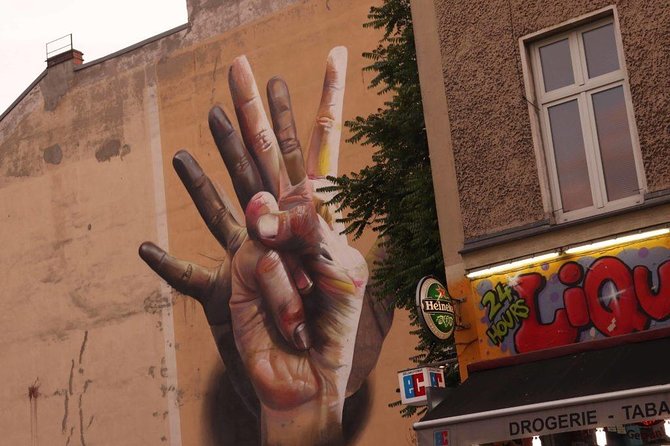
- Street art has context: Murals, alleys, and alternative galleries are explained through Berlin’s social and political changes.
- Public transport widens the route: An AB ticket is required, and a day pass is recommended.
- A guide can shape the experience: Past tours have featured Reese, Jake, Jason, Lee, Antonio, Arnie, and others, with personal stories and strong local character.
Why this walk shows a different Berlin
Many Berlin tours focus on the city’s major political events. Those are important, but they do not fully explain why Berlin feels so experimental, rough-edged, and creative. This tour looks at the people and movements that occupied empty buildings, challenged authority, made art in public spaces, and helped shape neighborhood identity.
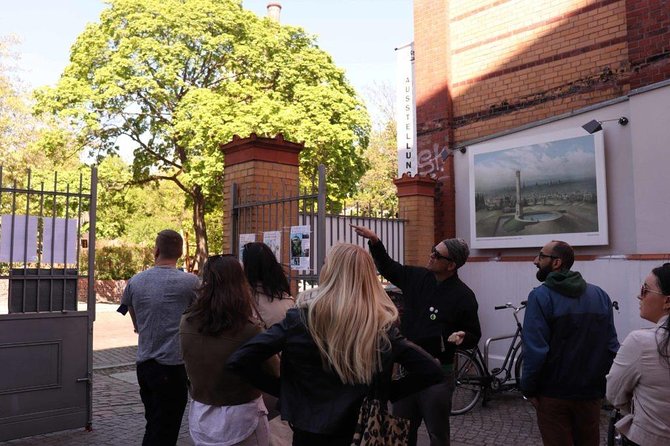
You begin at Vapiano am Alex near Alexanderplatz at noon. From there, the route gradually moves away from central Berlin and into districts where ordinary street life becomes the main attraction. The exact sequence can vary with the guide, but you should expect a mix of walking, public transport, short stops, stories, and neighborhood observation.
The group can include up to 20 people. That is large enough to give the walk energy but still small enough for a guide to answer questions. Since the subject matter is broad, the guide matters a great deal. Strong guides such as Reese, Jake, Jason, Lee, and Arnie have been praised for humor, personal anecdotes, and an ability to explain Berlin without sounding like they are reciting a textbook.
More Walking Tours in Berlin
- Discover Berlin Half-Day Walking Tour
★ 5.0 · 9,624 reviews - Berlin: Third Reich and Cold War 2 Hour Walking Tour
★ 4.9 · 6,830 reviews - Berlin: Discover Berlin Walking Tour
★ 4.9 · 5,998 reviews
Kreuzberg: Turkish Berlin, gardens, and street-level culture
Kreuzberg is one of the main reasons to book this walk. The district brings together Berlin’s Turkish community, alternative artists, organic markets, informal gardens, and layers of political history. You are not simply shown a set of colorful streets. You are given context for how different groups helped make the area what it is.
The Turkish influence is especially important to Berlin’s food culture. You hear about döner kebab, the Turkish-style sandwich that became one of the city’s signature quick meals. Currywurst also enters the story, a fried sausage served with curry-flavored ketchup. Food is not included, so budget for your own snack or lunch if you want to try something along the way.
A break of roughly 20 to 30 minutes may be included, depending on the route and guide. This is useful during a long afternoon, though you should not treat it as a full restaurant meal. If you need a proper sit-down lunch, ask the guide at the start how much time is planned.
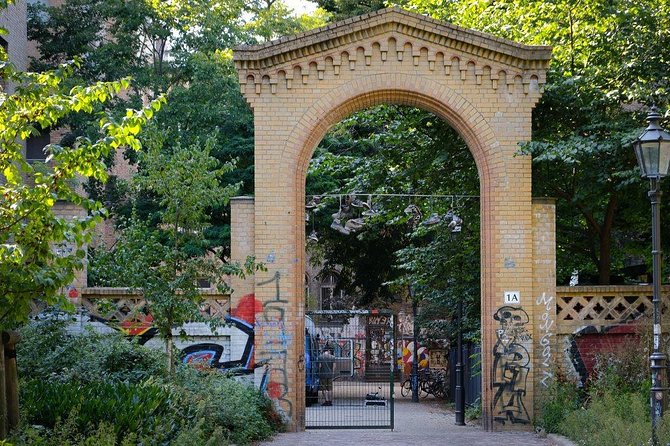
Kreuzberg also gives you a look at Berlin’s do-it-yourself spirit. Urban farms, guerrilla gardens, small art spaces, and changing walls all point to a district where residents have often shaped their surroundings outside formal institutions. That does not mean every corner is picturesque. Part of the value is seeing a real neighborhood in motion, not a preserved museum district.
Mitte and Jewish Berlin beyond the major monuments
The route also touches Mitte and Berlin’s Jewish quarter. This section adds an important layer to the walk because it places present-day street life beside the city’s older communities and difficult past.
You should not expect a full Holocaust or World War II tour. The emphasis here is broader: how neighborhoods changed, how communities were affected by war and dictatorship, and how Berlin’s identity kept shifting afterward. If you have already taken a traditional memorial or Cold War tour, this walk can serve as a useful second chapter.
One of the tour’s strengths is its attention to people rather than only dates and buildings. Stories about artists, activists, residents, and those who resisted oppression help explain how political events affected daily life. That approach is particularly helpful if you find standard Berlin tours too focused on official monuments and government history.
The description of the route has changed somewhat over time, and the exact stops may vary. Think of the advertised districts as the tour’s main areas of interest rather than a fixed checklist of sights. The guide’s ability to connect each place to a larger story is more important than ticking off named landmarks.
Prater Garten and Berlin’s food culture
A stop at Prater Garten adds a lighter note to the afternoon. It is known as Berlin’s oldest beer garden and offers a chance to consider the city’s long social tradition of meeting over food and drink.
Food and beverages are not included in the $30.25 price. That keeps the base cost reasonable, but you should bring extra money if you want currywurst, döner, a drink, or anything during the break. The tour is not a food tour, so the culinary stops are there to explain Berlin’s culture rather than provide a series of tastings.
I like this balance. Berlin’s food culture is easy to overlook when you spend your time at museums and memorials. A quick discussion of sausage, curry ketchup, and döner makes the city feel more lived-in. Just remember that the walk gives you the setting and the explanation, not a prepaid meal.
Same city, a completely different kind of day:
- Berlin: Reichstag, Dome and Government District Guided Tour
★ 4.7 · 18,288 reviews - Berlin: 1-Hour City Tour by Boat with Guaranteed Seating
★ 4.3 · 16,993 reviews - Berlin: Boat Tour Along the River Spree
★ 4.4 · 11,252 reviews - Berlin: Hop-on Hop-off Bus Tour with Live Commentary
★ 4.3 · 8,579 reviews
Protest, punk, and the city’s rebellious side
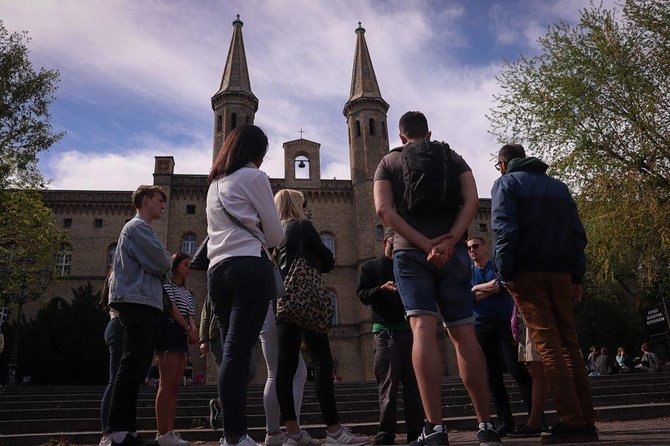
The most distinctive part of the tour is its discussion of Berlin’s counterculture. You hear about the 1960s student protest movement, the Baader-Meinhof group in the 1970s, and punk culture and the May 1 riots in the 1980s.
These topics are not presented as disconnected curiosities. They help explain why Berlin developed a reputation for resistance, experimentation, and social change. The guide may also discuss the Love Parade, once a major electronic dance music event, along with reggae, hip-hop, and rasta culture connected with Yaam Beach.
This material suits you best if you want more than a standard political timeline. The stories focus on how people challenged authority and used music, art, squats, public gatherings, and neighborhood spaces to express themselves. Some of the content can be politically charged, and the tone may include dark humor or a rebellious edge. That is part of the character of the tour, but it will not appeal to everyone.
The walk also addresses Berlin’s divided past by moving through areas associated with both former East and West Berlin. Public transport makes this possible. You can compare how different parts of the city developed after the war and after reunification, rather than treating the former border as a single memorial site.
Street art, alleys, and creative Berlin
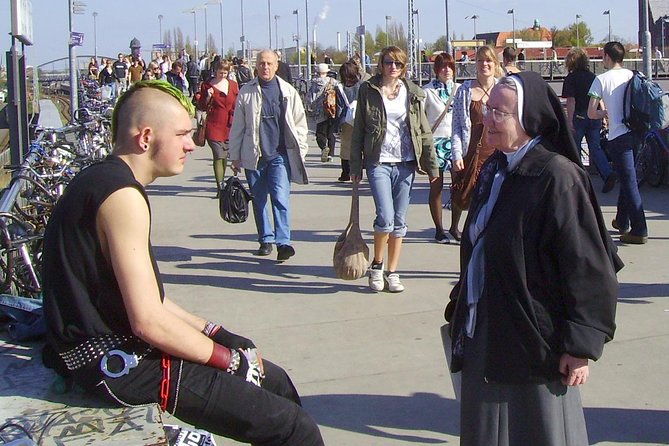
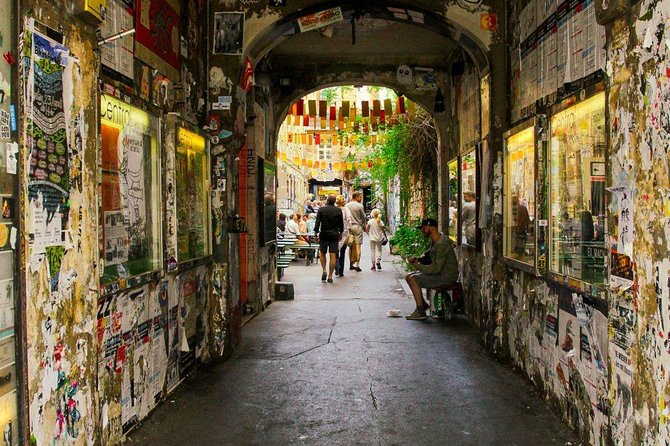
Street art is one of the tour’s visual highlights. You may see murals, graffiti, painted alleys, and alternative art spaces that you would probably pass without understanding on your own.
The guide’s explanation is what makes these places worthwhile. Instead of simply taking photographs of walls, you learn how art relates to protest, identity, neighborhood change, and Berlin’s creative communities. The walk also considers how music and art contributed to the city’s public character.
Do not expect every piece to be treated as a famous work or permanent attraction. Street art changes, disappears, and sometimes gets painted over. That uncertainty is part of the experience. The tour gives you a way to read the city’s walls, even when the exact artwork is different from what you might see in a photo.
One unusual stop described by a past participant involved a playground built largely by children aged 6 to 16, without adult supervision, with part of it burned each year to make room for new construction. It captures the unusual trust in experimentation that can appear in Berlin. Because the route can change, I would treat this as a possible highlight rather than a guaranteed stop.
How the transport and walking work
The tour lasts about 4 hours and 30 minutes, but you are not walking every minute. Several sections may use tram, train, or U-Bahn services, and the time includes a short food break. That makes the distance manageable for many people, but you still need comfortable shoes.
You must arrange your own AB public transport ticket. A day pass is recommended because the route uses more than one ride. This extra cost is easy to overlook when comparing tour prices, but it also lets the guide cover far more ground than a purely local walk.
The starting point is Vapiano am Alex, Rathausstraße 6, near Alexanderplatz. The published finish is Yaam Beach at Stralauer Allee 34 in Berlin. One past participant found that the group finished a little farther into Kreuzberg than expected, so avoid scheduling a tight appointment immediately after the tour.
The route crosses several neighborhoods, and public transport means you should stay close to the group when moving between sections. The pace has been described as relaxed, but the afternoon remains active. If you have mobility concerns, ask before booking because the tour combines city walking with transit connections and extended time outdoors.
The guide makes the biggest difference
This is a guide-led experience in the truest sense. The subjects are broad, and the city does not explain its own counterculture without someone to connect the pieces.
Reese has been praised for passionate storytelling, humor, and a strong sense of Berlin’s alternative scene. Jake is described as energetic, warm, and quick with anecdotes. Jason has been appreciated for personal stories and a friendly manner, while Lee has been associated with strong explanations of street art and local neighborhoods. Arnie received praise for putting Berlin’s political changes into historical perspective, even after a quiet start.
The guide assigned to your date may be different. You should book this tour for the route and subject, not for one particular person. Still, the range of guide styles gives you a useful clue: expect conversation, opinion, and personality rather than a formal lecture.
A good guide can also adjust the emphasis. One afternoon may focus more on art and punk, another on Berlin’s divided past, food, migration, or the lives of residents. That flexibility is a strength, though it means the experience will not be identical every time.
Is $30.25 a fair price?
At $30.25 per person, the tour offers a solid value if you want orientation across several neighborhoods. You are paying for 4.5 hours with an English-speaking local guide, plus the convenience of having someone plan the route and explain what you are seeing.
The price does not include public transport, food, drinks, or hotel pickup. Add the cost of an AB ticket and anything you buy during the break. Even so, the tour can compare well with a short private walk because it covers several districts and includes local context that would take time to assemble on your own.
The value is highest for a first or second visit, especially if you have already seen Berlin’s major historical sights and want to understand present-day neighborhood culture. If you prefer a fixed list of famous monuments, the tour may feel too loose. If you like cities best through their streets, food, music, and residents, it earns its price.
Weather, group size, and who should book
This is an outdoor tour, so check the forecast and dress sensibly. A cold, wet day can make four hours uncomfortable, even with public transport and a break. Comfortable shoes are essential, and a rain layer is sensible.
Most people can participate, and service animals are allowed. The group maximum is 20 people. The tour is offered in English only, so you should be comfortable following a long spoken explanation in English.
I would recommend it to:
- First-time visitors who want more than the usual central sights
- Repeat visitors who have already covered World War II and Cold War landmarks
- People interested in street art, music, migration, protest, and neighborhood change
- Curious walkers who enjoy stories and discussion
- Anyone wanting practical ideas for places to explore after the tour
I would hesitate if you dislike long outdoor activities, want a meal included, or need a tightly timed route with guaranteed stops. The free cancellation policy allows a full refund when you cancel at least 24 hours before the start time, which gives you some flexibility if the weather looks poor.
Should you book this Berlin walking tour?
Book it if you want to see Berlin as a living city rather than a collection of monuments. The strongest parts are the Kreuzberg food and community stories, the discussion of punk and protest, the street art, and the way public transport links former East and West Berlin.
Skip it if your priority is a formal tour of major memorials or a food experience with included tastings. You will spend much of the afternoon outside, pay separately for transit and food, and follow a route that may shift with the guide.
For the right person, this is an excellent second-day activity. After the grand sights have supplied the facts, this walk helps explain Berlin’s habits, humor, arguments, and creative energy.
FAQ
How long does the tour last?
The tour lasts approximately 4 hours and 30 minutes, including walking, public transport sections, and a possible short food break.
Where does the tour begin?
It begins at Vapiano am Alex, Rathausstraße 6, 10178 Berlin, Germany, at 12:00 pm.
Where does the tour end?
The published end point is Yaam Beach at Stralauer Allee 34, 10245 Berlin.
Is public transport included?
No. You need to arrange your own AB public transport ticket. A day pass is recommended for the tram, train, or U-Bahn sections.
Are food and drinks included?
No. Food and drinks are purchased separately. The route may include time to try currywurst or another local meal at your own expense.
What language is the tour offered in?
The tour is offered in English with an English-speaking local guide.
How many people can join?
The activity has a maximum of 20 participants.
Can I cancel for a full refund?
Yes, if you cancel at least 24 hours before the experience start time. Cancellations or changes made less than 24 hours before the start time are not accepted for a refund.
Just added in Berlin
- Berlin & The Third Reich Private Guided Tour★ 5.0 · 3 reviews
- Third Reich Quest Experience in Berlin★ 4.5 · 7 reviews
- Private Analogue Photography Experience in Berlin★ 5.0 · 3 reviews
- Berlin Urbex Adventure and History Tour★ 5.0 · 9 reviews
- The Beauty of Berlin by Bike: Private Tour★ 5.0 · 59 reviews
- Berlin: Guided Bike tour of the Berlin Wall and Third Reich★ 5.0 · 160 reviews
- Beyond Currywurst: Berlin’s Hidden Street Food & Culture Tour★ 5.0 · 100 reviews
- Berlin Third Reich & Cold War Walking Tour With A Guide★ 5.0 · 7 reviews
Walking Tours, compared.


Berlin’s Best: 2 Hour Walking Tour Third Reich and the Cold War
Read our review →
Third Reich Berlin: Hitler and WWII Walking Tour
Read our review →Browse the lists this tour appears in