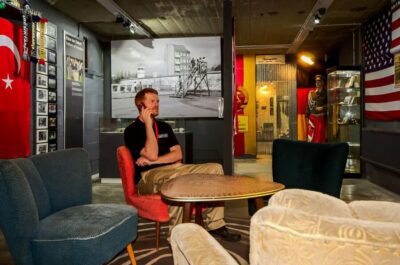
Reviewed · BERLIN TOURS
Berlin Self-Drive Trabi Tour with Guide
Driving a Trabant through Berlin turns a city tour into a moving history lesson, complete with a rattly gearbox, a loud little engine, and pedestrians taking pictures as your convoy passes. You get behind the wheel of an East German classic rather than simply looking at one in a museum.
I like two things here: you drive the car yourself, and the route links major sights with places tied to Berlin’s divided past. The slow pace also helps you see the city from street level. The main caution is simple: the Trabi is not easy for every driver, especially if you are rusty with a manual transmission.
Key points to know before booking
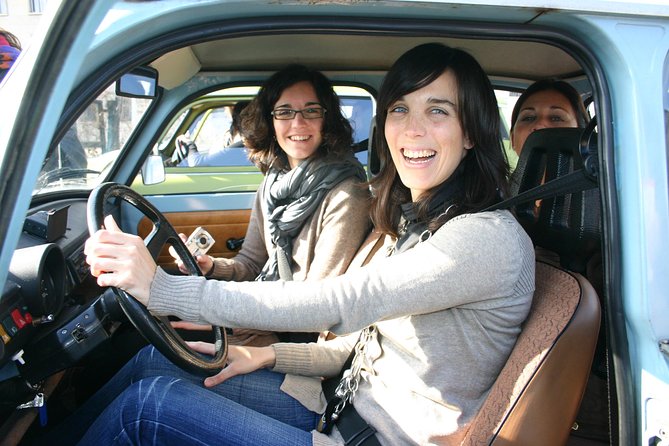
- Drive the Trabi yourself: Every driver needs a license for a manual car, unless an automatic has been arranged in advance.
- See Berlin in convoy: The route passes Potsdamer Platz, the Brandenburg Gate, Unter den Linden, the TV Tower, East Side Gallery, Oberbaum Bridge, and Checkpoint Charlie.
- Expect a noisy ride: Engine noise, vibration, and radio static can make the guide’s commentary hard to catch at times.
- Arrive early: Plan to be at TrabiWorld Berlin about 15 minutes before the 11:30 a.m. start.
- Keep the group small: The maximum is 12 people, with up to four occupants per car and a total vehicle weight limit of 770 pounds.
- Budget for the excess risk: The tour price is $95.58 per person, and an accident carries a required co-payment of EUR 850.
Why a Trabant makes Berlin more memorable
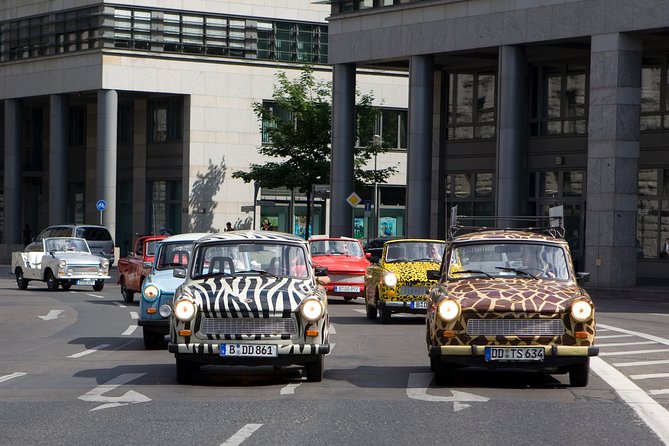
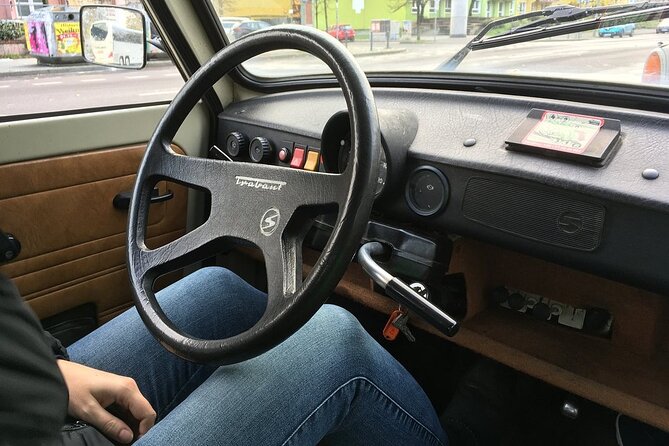
The Trabant, or Trabi, is one of the clearest symbols of former East Germany. It was small, basic, slow, and built for an era when car ownership and consumer choice looked very different from today. On this tour, that story is not confined to a display case. You feel it through the thin controls, the manual gearbox, the vibration, and the distinctive engine note.
That is the appeal. You are not riding in a polished sightseeing bus. You are operating a piece of everyday East German life while moving through a city shaped by the Cold War and reunification.
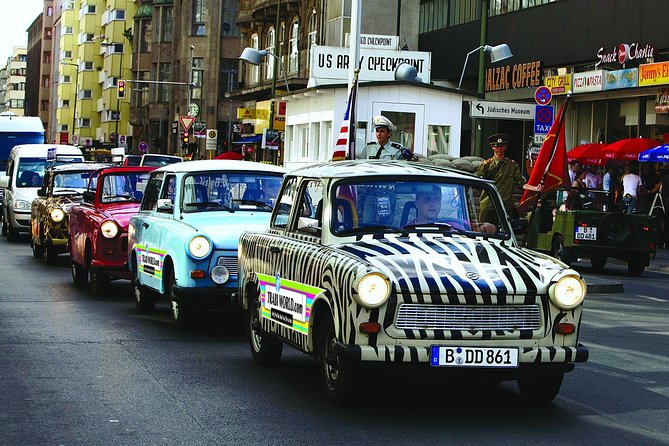
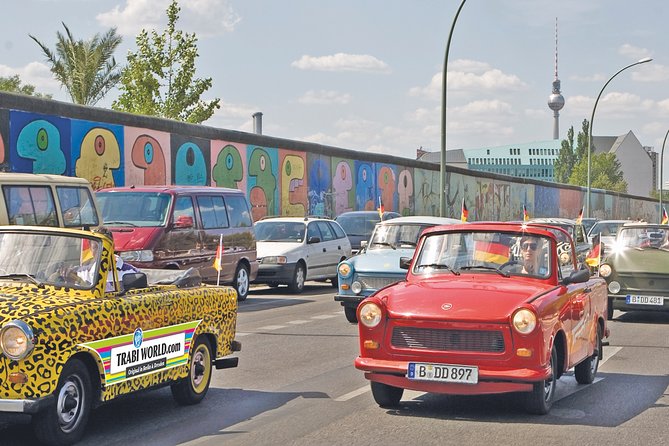
The cars travel together in a bright little line, usually led by the guide. The convoy itself becomes part of the show. People along the street may photograph the cars, and you may find that you are looking at Berlin while Berlin looks back at you.
This is not the most efficient way to cover the city. A bus or walking tour gives you clearer commentary and less work. The Trabi tour offers something different: a quick orientation mixed with hands-on fun.
A few more half-days in Berlin worth comparing
- Berlin: Reichstag, Dome and Government District Guided Tour
★ 4.7 · 18,288 reviews - Berlin: 1-Hour City Tour by Boat with Guaranteed Seating
★ 4.3 · 16,993 reviews - Berlin: Boat Tour Along the River Spree
★ 4.4 · 11,252 reviews
Getting started at TrabiWorld Berlin
The meeting point is TrabiWorld Berlin at Zimmerstraße 97 to 100, 10117 Berlin. It is close to public transportation and within walking distance of several central sights, including Checkpoint Charlie and nearby squares and museums.
The official start time is 11:30 a.m. Arrive early. The briefing takes about 10 minutes, and arriving at the last moment can create trouble. One person who arrived on time by their own watch found that the local expectation was 10 to 15 minutes early, and another late arrival had to be rushed into the car.
Your guide explains the controls and gives you time to understand the gearbox and four-stroke engine. The car uses a standard manual transmission. If you normally drive an automatic, this is not the place to relearn stick shift under pressure.
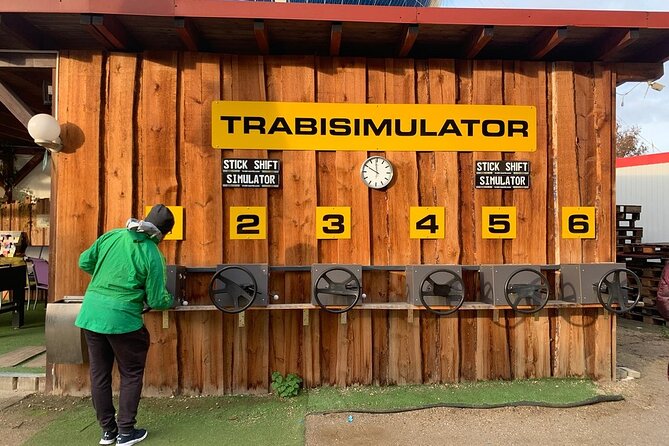
The tour can provide a simulator to help you get the feel of the gear changes before setting off. Still, you need a valid driver’s license for a manual car. An automatic gearbox is available only after prior consultation, so do not assume you can request one on arrival.
The operator limits the activity to 12 people. Each vehicle holds up to four people, and children must be accompanied by an adult. Drivers must be at least 18. Children up to age 17 can join free when accompanied by at least one paying adult, but any required child seat is your responsibility.
What driving the Trabi feels like
The best way to prepare is to forget modern driving comfort. The Trabi is loud, it shakes, and its controls can feel fiddly. That is not a defect in the tour. It is the point, though it can become tiring or distracting.
Some drivers get the hang of it quickly. Others struggle with the clutch and return the car before the tour properly begins. If you drive a manual car regularly, you have a clear advantage. If you have only driven stick shift once or twice, think carefully before paying the non-refundable price.
The guide communicates through a radio system. You can hear instructions and commentary, but you cannot talk back through the system. Engine noise and static may make some of the historical information difficult to catch, especially if you are concentrating on traffic and gear changes.
The guide does keep an eye on the group. If a driver falls behind, the convoy can pull over and wait. There is also a phone number to call if you become separated. That safety net matters, especially for anyone concerned about driving an unfamiliar car in central Berlin.
Guides named in the tour feedback include Thomas, Matthias, George, and Axel. Thomas is praised for calm driving instruction and entertaining commentary, while Matthias is described as patient and reassuring. You should not assume a particular guide will lead your departure, but the repeated praise for calm instruction is useful if you are nervous.
From Potsdamer Platz to the Brandenburg Gate
Once the cars leave TrabiWorld, the route gives you a broad look at central Berlin. Potsdamer Platz is one of the key early sights. It is an important square and traffic junction, and it offers a sharp contrast between Berlin’s old political divisions and its modern redevelopment.
From there, the convoy heads toward the Brandenburg Gate, Berlin’s famous neoclassical monument. You will see it from the road rather than stop for a long visit, so do not treat this tour as a substitute for returning on foot. Still, approaching the gate in a line of Trabants gives the moment a fitting historical twist.
The route continues along Unter den Linden, the grand boulevard leading through the heart of Berlin. This stretch is useful for orientation. You get a sense of how the central district connects the Brandenburg Gate with the older civic and museum areas farther east.
Because you are driving, your attention is divided. You may catch only part of the commentary while changing gears or watching traffic. I would treat the tour’s spoken history as a useful layer, not your only source of information about each monument.
Same city, a completely different kind of day:
- Discover Berlin Half-Day Walking Tour
★ 5.0 · 9,624 reviews - Berlin: Hop-on Hop-off Bus Tour with Live Commentary
★ 4.3 · 8,579 reviews - Berlin: Government District around the Reichstag Guided Tour
★ 4.7 · 8,447 reviews - Berlin: Reichstag, Plenary Chamber, Cupola & Government Tour
★ 4.6 · 8,422 reviews
Berlin Cathedral, the Red Town Hall, and the TV Tower
The tour continues toward Berlin Cathedral, a major landmark on Museum Island. The cathedral’s dome and formal architecture make it easy to spot, but the Trabi route gives you only a passing view. If you want to see the interior or spend time with the museums nearby, return later on foot.
The convoy also passes the Rotes Rathaus, or Red Town Hall, built in the late 19th century. Its red-brick exterior is one of the defining sights in this part of Berlin. Along the way, the Berlin TV Tower rises above Alexanderplatz, providing a strong visual marker and a reminder of the former East Berlin city center.
This section is where the tour works best as an orientation ride. You connect places that can feel scattered when visited separately. Afterward, you will have a better sense of where Alexanderplatz, Museum Island, Unter den Linden, and the Brandenburg Gate sit in relation to one another.
The drawback is that you cannot pull over whenever a building catches your eye. You are following the convoy, listening for instructions, and keeping your car moving. For detailed sightseeing, use the tour to identify places you want to revisit.
East Side Gallery and the Berlin Wall
East Side Gallery is one of the most important stops on the route. It is an open-air gallery painted on a 1,316-meter remnant of the Berlin Wall. The tour allows about five minutes here, which is enough to see the wall art but not enough for a full walk along the section.
That short pause is worth using well. Look closely at the murals, take a few photographs, and remember that this is an actual remaining stretch of the former border barrier, not a reconstructed theme park display.
The East Side Gallery gives the Trabi its strongest historical setting. You are driving a car associated with East Germany beside a preserved piece of the wall that divided the city. The contrast is more powerful than a generic city drive, even if the stop itself is brief.
If the wall art is a major reason for your visit to Berlin, plan a separate visit when you have time to walk farther. The Trabi tour gives you a taste and an excellent route connection, but it cannot cover the full length of the gallery in five minutes.
Oberbaum Bridge and the eastern side of Berlin

The route includes Oberbaum Bridge, the distinctive double-deck bridge over the River Spree. Its brick towers and upper rail line make it one of Berlin’s most recognizable crossings.
Driving across the bridge in a convoy is one of the more photogenic parts of the ride. It also links the East Side Gallery with the neighborhoods on either side of the river, helping you understand the geography of the former East Berlin district.
The convoy then continues through central streets toward Checkpoint Charlie. The slow Trabi pace can be an advantage here. You have time to notice street scenes and architecture that can blur past in a faster vehicle, although you still need to keep your attention on driving.
The route may change when roadworks, ceremonies, or city events affect traffic. On one occasion, diversions were required, but the full route was still completed. That shows the guide may adapt without simply cutting the tour short, though exact streets can vary.
Checkpoint Charlie and the end of the route
Checkpoint Charlie is close to the starting point, making it easy to visit before or after the drive. It was a former border crossing between East and West Berlin and remains one of the city’s most visited Cold War sites.
The Trabi experience adds context to the checkpoint. You have spent the ride in a car closely tied to East Germany, then arrive at a place that once represented the sharp division between the two political systems. The connection is not subtle, but it is effective.
The activity ends back at TrabiWorld Berlin. The entire tour is listed at about 1 hour 15 minutes, including the welcome and briefing. That is long enough for a taste of the city and the car without becoming an all-day commitment.
You may see more than expected because the route covers many central landmarks. Just remember that this is a driving adventure first and a formal sightseeing tour second.
Is $95.58 per person good value?
At $95.58 per person, this costs more than a basic walking tour and more than simply using public transportation between the sights. You are paying for the car, fuel, guide, convoy organization, instruction, and the novelty of driving a historic vehicle through Berlin.
For someone who wants the cheapest way to see monuments, the price is hard to justify. You can see many of the same places with a low-cost public transit ticket and a self-guided walk.
For a car enthusiast, a couple celebrating a special trip, or a repeat visitor seeking a different angle on Berlin, the calculation changes. The car itself is the attraction. You are not only looking at the city, you are part of a small moving display that draws attention from people on the street.
The price also comes with a serious financial condition. If an accident occurs, the local operator requires a co-payment of EUR 850. Read that condition carefully before booking, drive conservatively, and do not treat the old car as a toy.
The booking is non-refundable and cannot be changed for any reason. That makes the manual-driving requirement, the early arrival rule, and the accident co-payment especially important to consider before you commit.
Who should book this Berlin drive?
I would choose this tour if you:
- Drive a manual car with reasonable confidence.
- Want a hands-on activity rather than a passive sightseeing ride.
- Enjoy old cars, engineering quirks, or Cold War history.
- Like seeing major sights in an unusual way.
- Are happy with a short route and passing views rather than long stops.
- Can accept noise, vibration, radio static, and a slower pace.
I would skip it if you:
- Have little or no experience with a clutch.
- Want detailed explanations at every monument.
- Need a quiet, comfortable ride.
- Are uncomfortable with the accident co-payment.
- Need flexible cancellation.
- Have limited mobility that makes entering or operating the car difficult, since the supplied information does not describe vehicle accessibility.
The tour suits adults best, but families can join if the adult driver meets the requirements. Children can ride free with a paying adult, subject to the vehicle limit and any needed child seat.
My take: book it for the car, not just the sights
This is a strong choice for a confident manual driver who wants Berlin with a little noise, smoke, and mechanical stubbornness. The route gives you a useful city orientation, but the real prize is the feeling of piloting an East German Trabi past the Brandenburg Gate, the Wall, the TV Tower, and Oberbaum Bridge.
Book it if you want a memorable story to tell and can accept that the car may be harder to drive than expected. Skip it if your main goal is calm sightseeing or a detailed history lesson. Arrive early, practice the gears, keep your expectations practical, and the tour can become one of the more distinctive hours of your Berlin visit.
FAQ
Where does the Berlin Trabi tour start?
It starts at TrabiWorld Berlin, Zimmerstraße 97 to 100, 10117 Berlin, Germany.
What time does the tour start?
The listed start time is 11:30 a.m. You should arrive about 15 minutes early for check-in and the driving briefing.
How long does the tour last?
The activity lasts approximately 1 hour 15 minutes, including the welcome and briefing.
Do I drive the Trabant myself?
Yes. The tour includes driving your own Trabant with a standard manual gearbox. An automatic gearbox is available only after prior consultation.
Do I need a driver’s license?
Yes. Every driver must provide evidence of a license for a non-automatic car.
What sights does the route include?
The route includes Potsdamer Platz, the Brandenburg Gate, Unter den Linden, Berlin Cathedral, Rotes Rathaus, the Berlin TV Tower, East Side Gallery, Oberbaum Bridge, and Checkpoint Charlie.
Can children join the tour?
Children must be accompanied by an adult. Children up to age 17 are free when accompanied by at least one adult, and any required child seat must be provided by the customer.
What happens if there is an accident?
The local operator requires a co-payment of EUR 850 in the event of an accident. The experience is also non-refundable and cannot be changed after booking.
Just added in Berlin
- Berlin & The Third Reich Private Guided Tour★ 5.0 · 3 reviews
- Third Reich Quest Experience in Berlin★ 4.5 · 7 reviews
- Private Analogue Photography Experience in Berlin★ 5.0 · 3 reviews
- Berlin Urbex Adventure and History Tour★ 5.0 · 9 reviews
- The Beauty of Berlin by Bike: Private Tour★ 5.0 · 59 reviews
- Berlin: Guided Bike tour of the Berlin Wall and Third Reich★ 5.0 · 160 reviews
- Beyond Currywurst: Berlin’s Hidden Street Food & Culture Tour★ 5.0 · 100 reviews
- Berlin Third Reich & Cold War Walking Tour With A Guide★ 5.0 · 7 reviews
Berlin Tours, compared.

Reichstag, Dome and Government District Guided Tour
Read our review →


Reichstag, Plenary Chamber, Cupola & Government Tour
Read our review →