Reviewed · BERLIN TOURS
Private Taxi Tour of Berlin East and West and Neighbourhood approx. 4-6h
Berlin makes more sense when you see its two halves together. This private taxi tour links the Brandenburg Gate, Reichstag, former Wall sites, East Side Gallery, grand West Berlin boulevards, Kreuzberg, and the government quarter while Gunter Bauer explains how war, division, and reunification shaped each street. The city becomes a story you can follow, not just a collection of famous buildings.
I like the door-to-door pickup and the way a taxi covers ground that would take much longer on foot. I also like the short walks built into the ride, especially at Brandenburg Gate, Hackesche Höfe, Humboldt Forum, and the Wall. The main caution is pace: this is a broad sightseeing sweep, not a museum tour, and a small vehicle may feel tight for four people.
Key points to know before booking
- Gunter Bauer provides a history-heavy tour: Expect steady commentary on Berlin’s architecture, Nazi past, Cold War division, and reunification.
- You cover both sides of the former Wall: The route joins East Berlin landmarks with West Berlin icons such as Kurfürstendamm and the Kaiser Wilhelm Memorial Church.
- Short walks make the ride more useful: You can get out at selected sites for photographs and a closer look.
- Pickup inside the S-Bahn ring is included: Hotel or apartment pickup is provided within roughly five kilometers of Brandenburg Gate.
- The route can change with traffic and time: Some stops, including Alexanderplatz, East Side Gallery, Oberbaum Bridge, and Checkpoint Charlie, may be shortened or skipped.
- This suits a first Berlin visit: It is especially helpful if you have limited time, reduced walking ability, or want an overview before exploring museums on your own.
Why a private taxi works well in Berlin
Berlin’s main sights are spread across a very large city. The Reichstag is near the Brandenburg Gate, but East Side Gallery, Kreuzberg, Charlottenburg, and the Kulturforum belong to different parts of the city. Public transport is excellent, yet changing trains and walking between stops can eat up a half-day.
A private car gives you a quick first look at the city’s structure. You can move from the former government center of West Berlin to the grand socialist buildings of Karl-Marx-Allee, then on to the Wall and the modern Potsdamer Platz complex. Gunter also knows where parking is practical, which matters when you have only four to six hours.
This is not a hop-on, hop-off service. You stay with one guide and one vehicle, and the route is shaped by traffic, weather, your interests, and the time available. Gunter contacts you before the tour and asks what you want to see, so send a short priority list rather than assuming every stop will receive equal time.
The taxi includes air conditioning, Wi-Fi, parking fees, and private transport. Pickup within the S-Bahn ring is included, but airport pickup from BER and locations outside the ring cost extra. The vehicle has received praise for comfort from solo visitors and couples, though one four-person party found it too small. If your group has four adults and luggage, ask about vehicle size before booking.
A few more half-days in Berlin worth comparing
- Berlin: Reichstag, Dome and Government District Guided Tour
★ 4.7 · 18,288 reviews - Berlin: 1-Hour City Tour by Boat with Guaranteed Seating
★ 4.3 · 16,993 reviews - Berlin: Boat Tour Along the River Spree
★ 4.4 · 11,252 reviews
The Reichstag and Brandenburg Gate: Berlin’s symbolic center
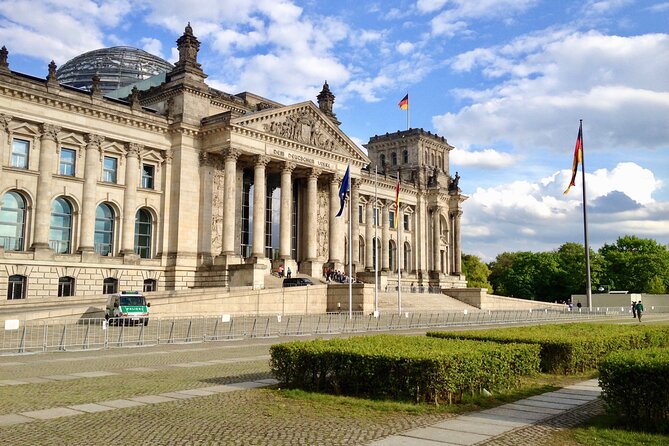
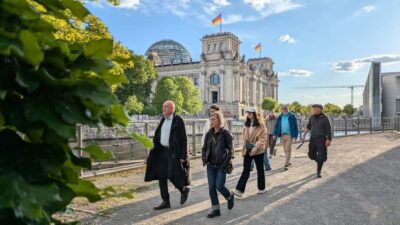
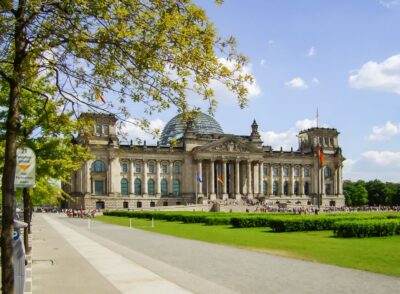
The tour often begins around the government quarter, where the Reichstag tells several chapters of Berlin’s story at once. The grand Wilhelminian building was damaged, criticized, ignored during the Cold War, and later rebuilt for the federal parliament. Its glass dome now signals openness and a new political era.
Gunter’s explanation is useful here because the building’s meaning changed with the city. The famous Soviet flag photograph is often treated as a simple wartime image, but the original scene was later recreated for photographers. The Reichstag also sat just a few meters from the Wall in West Berlin, close enough to be politically awkward and unusable for normal parliamentary sessions during division.
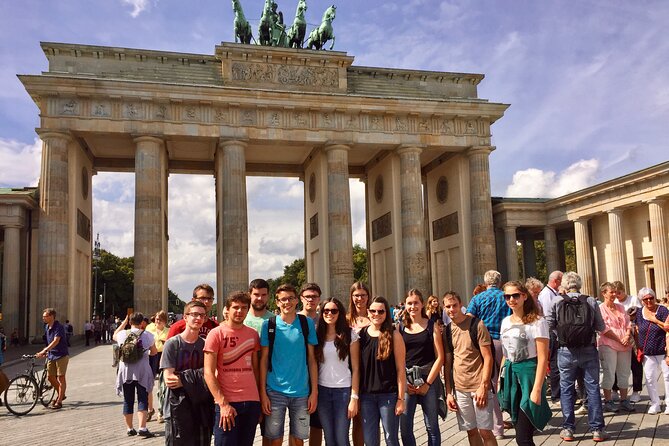
Nearby, the Brandenburg Gate is Berlin’s great public room. Pariser Platz was nearly empty after the war, and the gate once looked isolated, much like the Arc de Triomphe without its surrounding city. The Wall blocked the western side, while East Berlin controlled access from the east.
Today, the square is framed by embassies, the Academy of Arts, the Liebermannhaus, and the rebuilt Hotel Adlon. You usually get out here for a short walk and photographs. Five minutes is listed for the stop, so treat it as an introduction rather than a leisurely visit.
Government buildings and the modern Berlin republic
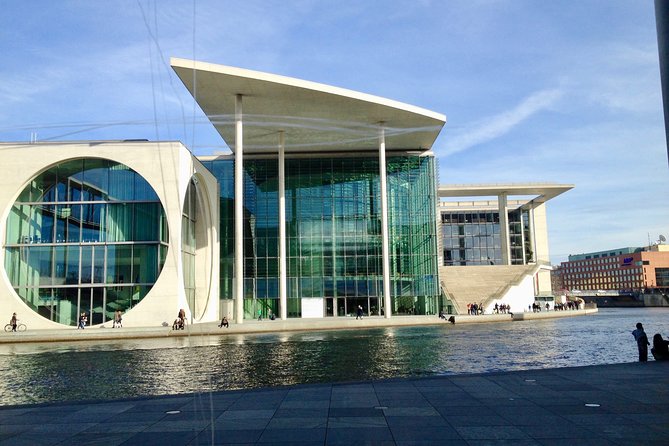
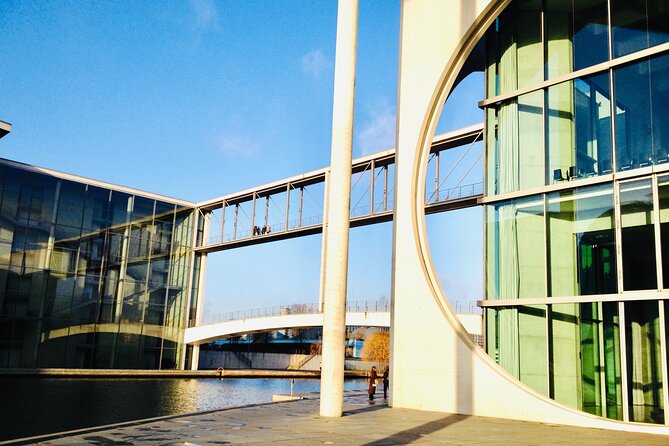
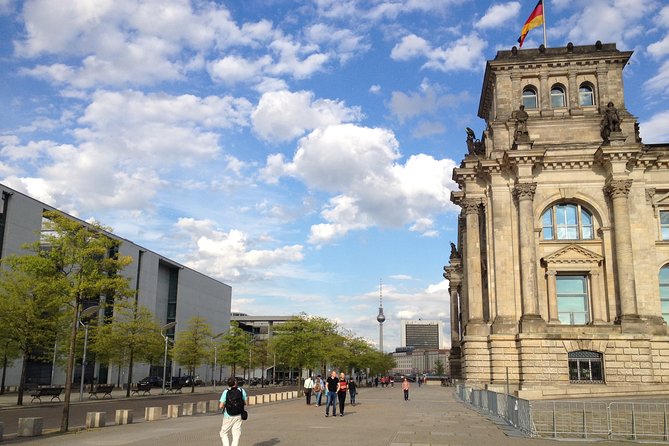
The route continues through Berlin’s newer parliamentary quarter. The Paul-Löbe building is the working engine of parliament, with committee rooms spread through its long, glass-lined structure. The Bundestag chamber is where major speeches and votes take place, but much of the detailed work happens in committees.
Across the Spree, the Federal Chancellery is deliberately oversized. Its scale reflects the power of the office and the image of a reunified capital. The nearby press building, with its large central window, is where journalists question the government during regular press briefings.
These buildings are worth seeing from the car because they explain how the new capital was planned after reunification. You will not tour their interiors on this ride, but Gunter connects the architecture to the workings of government.
Near Invalidenfriedhof, the route crosses the old East-West border again. The harbor was a restricted zone during the Wall years, and Günter Litfin was shot while trying to swim through it. This is the sort of detail that gives the city’s modern streets a human scale.
Berlin Hauptbahnhof follows. It is a huge five-level rail interchange with underground and elevated tracks, shops, and constant movement. The station also shows how reunification changed daily travel. The old Bahnhof Zoo lost its long-distance role, while the new central station drew connections toward the former border zone.
Unter den Linden, Gendarmenmarkt, and the city’s royal core
Unter den Linden began as a route from the Berlin Palace toward the royal hunting grounds. Linden trees eventually replaced the proposed nut trees, giving the boulevard its familiar name. Today, the street passes the State Library, Humboldt University, the State Opera, and other major buildings.
The route includes the former Soviet embassy, built on a scale meant to show who held power in postwar East Berlin. It now serves the successor states of the former Soviet Union. Nearby, the Forum Fridericianum brings together the former Royal Library, St. Hedwig’s Cathedral, the State Opera, and Humboldt University.
A glass panel in Bebelplatz points to an empty library below the square. It marks the Nazi book burning of May 10, 1933. The memorial is easy to miss if you are only passing through, so Gunter’s explanation adds real value.
The Neue Wache, once a guardhouse, is now a memorial to victims of war and tyranny. Inside is Käthe Kollwitz’s enlarged sculpture of a grieving mother holding her dead son. This is one of the tour’s quieter stops, and it gives needed weight to the grand architecture around it.
Gendarmenmarkt is one of Berlin’s most handsome squares, framed by the Concert Hall and the German and French cathedrals. Neither church is technically a cathedral. The French church still holds services in French, while the German cathedral contains an exhibition on German parliamentary history. The square usually receives only a short photo stop, so plan a return visit if you want to go inside.
Same city, a completely different kind of day:
- Discover Berlin Half-Day Walking Tour
★ 5.0 · 9,624 reviews - Berlin: Hop-on Hop-off Bus Tour with Live Commentary
★ 4.3 · 8,579 reviews - Berlin: Government District around the Reichstag Guided Tour
★ 4.7 · 8,447 reviews - Berlin: Reichstag, Plenary Chamber, Cupola & Government Tour
★ 4.6 · 8,422 reviews
Hackesche Höfe, Humboldt Forum, and old Berlin
Hackesche Höfe offers a more intimate side of central Berlin. Built in 1908, the connected courtyards mixed homes, workshops, offices, and small factories. The restored Art Nouveau facades now hold shops, galleries, and small businesses.
You can walk through the courtyards in about ten minutes. Look for the changing colors, decorative tilework, and the way the buildings were designed around shared spaces. Products associated with Königliche Porzellan-Manufaktur and the East Berlin Ampelmännchen add local flavor, though the area is now firmly on the sightseeing circuit.
The Humboldt Forum occupies the former site of the Berlin Palace. The East German government demolished the war-damaged palace despite strong opposition, then later allowed a reconstruction of its exterior. The modern interior houses non-European collections and university material.
The roof terrace is a highlight if it is open and scheduled into your visit. One person specifically praised the city view from the top, and that makes sense: Berlin’s broad spread is easier to understand from above than from street level. Ask Gunter in advance if this is a priority, since opening hours and available time matter.
Nearby, the Red City Hall gets its name from its red brick, not from the political party of the mayor. Nikolaiviertel, reconstructed in the 1980s, offers a carefully made version of old Berlin around the Nikolaikirche. The Knoblauchhaus, with its Biedermeier interiors, gives a closer look at domestic life. This quarter is partly historical reconstruction, so it is best understood as a designed old town rather than an untouched medieval neighborhood.
From the Wall to Potsdamer Platz
The tour’s Cold War section is strongest when it links several small locations instead of treating the Wall as one isolated monument. At Friedrichstrasse station, East Berliners said goodbye to relatives in the area later known as the Palace of Tears. The station was also a controlled crossing point and a place where escape attempts took place.
Checkpoint Charlie is more famous than it is preserved. The guardhouse is a replica, and the surrounding commercial development can feel theatrical. Still, the site matters because American and Soviet tanks faced one another here in October 1961, creating one of the most dangerous moments of the Cold War.
At Niederkirchnerstrasse, you can see a short surviving section of the Wall beside the Topography of Terror. The documentation center occupies the former area of Nazi security offices, where the SS, Gestapo, and police planned and carried out persecution. The open-air displays and excavated cellars make this one of the most serious stops on the route.
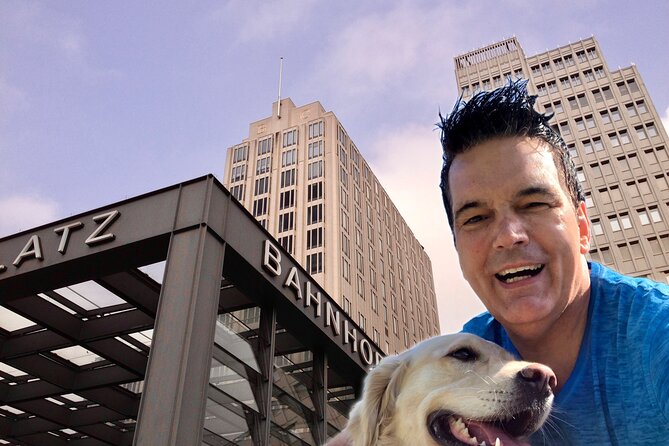
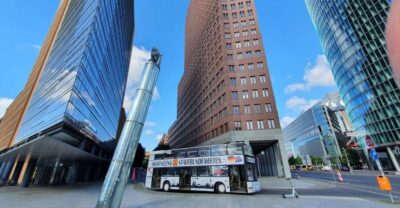
Potsdamer Platz offers the opposite message. Once one of Europe’s busiest intersections, it became a barren zone divided by the Wall. After reunification, major corporations rebuilt it with offices, shops, hotels, and entertainment venues. The Sony Center’s roof is dramatic, though the district can feel more like a new commercial quarter than an old Berlin neighborhood.
East Berlin, the Wall, and Kreuzberg
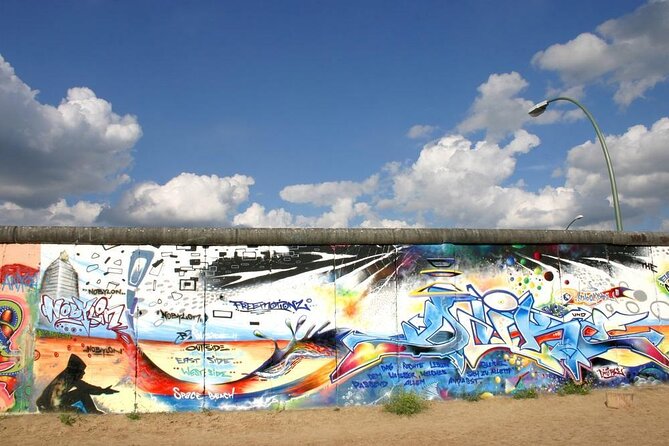
East Side Gallery is usually a short stop, but it is one of the most rewarding places to get out. The surviving section stretches about 1,600 meters and carries murals painted after reunification, including the famous Trabant and Brezhnev-Honecker kiss images.
The artwork is not on the original front wall facing West Berlin. It is on the inner wall along the river, which explains why the section looks different from many photographs of the border. Restoration work and weather have changed the paintings, but the place still brings together art, politics, and a physical piece of the former barrier.
Oberbaum Bridge connects Friedrichshain and Kreuzberg. Its medieval-style towers mark a former city boundary, while the bridge now carries cars, bicycles, pedestrians, and the elevated subway. From here, the tour can move into Kreuzberg, where old apartment buildings, small restaurants, and alternative culture sit alongside rising rents and new development.
The route may also pass Karl-Marx-Allee, lined with monumental workers’ housing built in the Stalinist style. The avenue helps explain East Germany’s public image and its limits. In 1953, workers marched against increased production targets and wage cuts. Soviet tanks crushed the uprising.
These eastern stops are often shortened when traffic is heavy. If the Wall is your main interest, tell Gunter early. If your priority is architecture or daily life in Kreuzberg, say so before the car leaves the center.
West Berlin from the Victory Column to Kurfürstendamm
Tiergarten began as a royal hunting ground before being opened to the public and redesigned as a park. The Victory Column was moved here during the Nazi period and enlarged after Prussian military victories. Its symbolism is complicated, and the story helps explain why the monument looks out of place in the middle of the park.
The route then passes the Nordic embassies, arranged around a shared complex, and Bellevue Palace, the official Berlin residence of the federal president. Bellevue began as a palace for a younger brother of Frederick II and later became the presidential residence after reunification.
Berlin Zoo is another familiar landmark. Its large animal collection and distinctive gates are easy to spot from the car, though this tour does not include a zoo visit. If animals are a priority, plan a separate visit rather than expecting more than an outside view.
At Breitscheidplatz, the Kaiser Wilhelm Memorial Church preserves the damaged tower from the war. The modern blue-glass church beside it is surprisingly calm inside. The glass blocks were made in France, and the double-wall design helps keep out the noise from the busy streets.
Kurfürstendamm and Tauentzien show West Berlin’s commercial face. The long boulevard once recalled the Champs-Élysées, with villas, cinemas, cafes, and nightlife. Today it is mainly a shopping street, leading toward KaDeWe, one of continental Europe’s largest department stores.
Museums, the Kulturforum, and the route’s limits
The Kulturforum was planned as a western counterpart to Museum Island. It includes the Philharmonie, the New State Library, the Picture Gallery, the New National Gallery, and other cultural buildings.
The New National Gallery is an architectural highlight, with a steel roof held by exterior columns and an open upper hall without permanent interior walls. Rotating displays are often placed below ground, while the main hall changes with each exhibition.
The Gropius Bau, near the former Wall, hosts major exhibitions in a restored 19th-century building. These museums are seen from outside unless you arrange extra time, so do not book this taxi tour expecting a museum day.
The tour has a lot of material to cover. Gunter speaks at length, and his energy is a major part of the experience. Several people appreciated his historical detail, smooth driving, punctuality, humor, and habit of taking photographs at stops. One person also noted that English could occasionally require repetition. If you prefer silence and long independent visits, this may feel too full.
Price, timing, and who gets the best value
At about $179.82 per person, the price is easier to justify for a private group than for a solo visitor. You are paying for a car, a guide, parking, pickup, and the ability to see distant sections of Berlin in one outing. The value improves when the group shares the vehicle and uses the tour as a first-day orientation.
The listed duration is four to six hours, but the exact route depends on traffic and the number of walks. Some stops are only five or ten minutes. That is enough for photos and a first explanation, not enough for every museum, memorial, or palace interior.
I would book this early in your stay, ideally near the beginning of a short visit. Gunter can point out places to return to, such as the Humboldt Forum, Topography of Terror, German Historical Museum, or the Kaiser Wilhelm Memorial Church.
The tour is a strong choice if you have limited time, cannot walk for long periods, are visiting with children, or want private transportation. Child seats are available for toddlers and older children, with a baby seat available by request. Service animals are allowed.
Free cancellation is available until 24 hours before the start time. Changes or cancellations inside that window are not refunded.
Should you book this Berlin taxi tour?
Book it if you want a fast, personal introduction to Berlin’s divided past and have more interest in context than in checking off museum interiors. Gunter Bauer’s strength is connecting buildings to politics, war, daily life, and the changing shape of the city.
Before pickup, send three or four must-see places and say which subjects matter most. Ask about the vehicle if you have four adults, and confirm any special stop such as the Humboldt Forum roof terrace. If you want a slow visit to museums or a long walk through one neighborhood, choose a focused tour instead.
For a first visit, a short stay, or limited mobility, this private taxi ride gives you an unusually broad view of Berlin in one sitting. Just remember what it is: a lively, information-packed city survey, with selected walks, rather than a leisurely tour of every attraction.
FAQ
How long does the private Berlin taxi tour last?
The tour lasts approximately four to six hours. Traffic, weather, walking time, and the number of stops can affect the final length.
Where does pickup take place?
Pickup is included from a hotel, apartment, or other requested location within Berlin’s S-Bahn ring, roughly five kilometers around Brandenburg Gate.
Is airport pickup included?
No. Pickup from BER Airport or locations outside the S-Bahn ring costs extra according to the Berlin taxi tariff.
Is the tour offered in English?
Yes. The tour is offered in English, and Gunter Bauer provides the commentary.
Is this a private group tour?
Yes. Only your group participates in the activity.
What is included in the price?
The price includes pickup within the included area, private transportation, an air-conditioned vehicle, parking fees, Wi-Fi on board, and both the taxi ride and city tour charges.
Can children join the tour?
Yes. A toddler seat for children from six months to three years and a booster seat for older children are available. A baby seat can be brought by request.
Can the itinerary be changed?
The route can respond to your interests, traffic, weather, and available time. Tell Gunter your priorities before the tour. Some stops may be shortened or omitted if the schedule does not allow them.
Just added in Berlin
- Berlin & The Third Reich Private Guided Tour★ 5.0 · 3 reviews
- Third Reich Quest Experience in Berlin★ 4.5 · 7 reviews
- Private Analogue Photography Experience in Berlin★ 5.0 · 3 reviews
- Berlin Urbex Adventure and History Tour★ 5.0 · 9 reviews
- The Beauty of Berlin by Bike: Private Tour★ 5.0 · 59 reviews
- Berlin: Guided Bike tour of the Berlin Wall and Third Reich★ 5.0 · 160 reviews
- Beyond Currywurst: Berlin’s Hidden Street Food & Culture Tour★ 5.0 · 100 reviews
- Berlin Third Reich & Cold War Walking Tour With A Guide★ 5.0 · 7 reviews
Berlin Tours, compared.
Reichstag, Dome and Government District Guided Tour
Read our review →
Reichstag, Plenary Chamber, Cupola & Government Tour
Read our review →