Reviewed · BERLIN TOURS
Berlin: Sightseeing Tour in Classic Volkswagen T1 Samba Bus
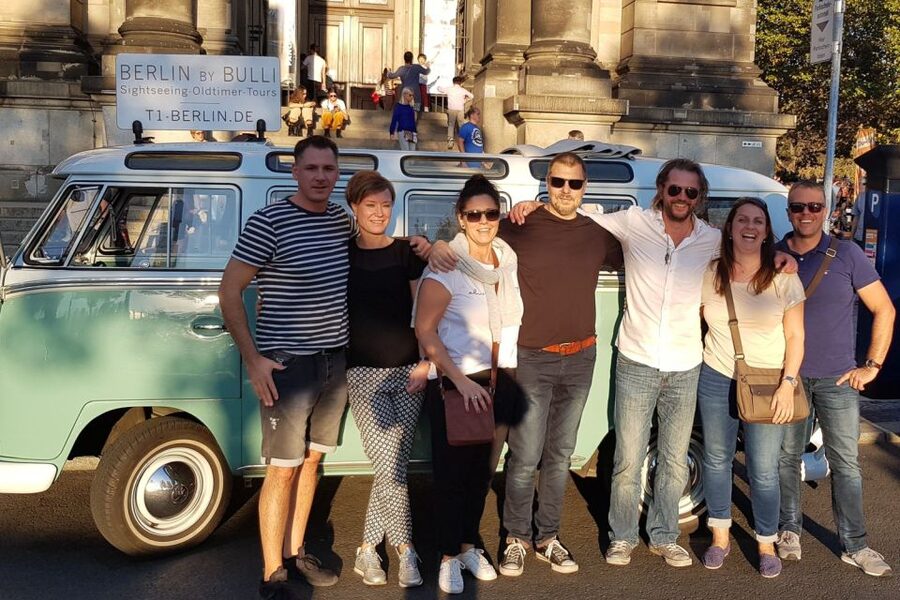
Berlin is best understood from a moving seat, and this tour gives you one of the city’s most memorable ones: a beautifully restored 1965 Volkswagen T1 Samba bus with 21 windows. You pass grand museums, Cold War landmarks, royal buildings, and everyday Berlin streets while the driver explains what you are seeing.
I especially like the small group of up to seven people, which makes it easier to ask questions, and the photo booklet that shows how selected places looked in earlier periods. The main consideration is time: two hours is enough to get your bearings, but every sight is viewed from the bus rather than explored on foot.
- A genuine vintage VW experience: Ride in a carefully maintained 1965 T1 Samba bus that attracts smiles from people along the road.
- Nearly 50 sights in two hours: The route links Museum Island, the Brandenburg Gate, the government quarter, West Berlin, Checkpoint Charlie, and Alexanderplatz.
- Personal guiding: Guides such as Rajko and Michael add local stories, historical context, and answers to questions.
- Old photographs on board: The analog photo booklet helps you picture damaged, divided, and rebuilt Berlin.
- Useful in cold weather: The bus has heating when needed, making it a practical choice in winter or rain.
- A quick city orientation: Take this early in your stay to decide which areas deserve a longer visit later.
Why the 1965 Samba bus changes the tour
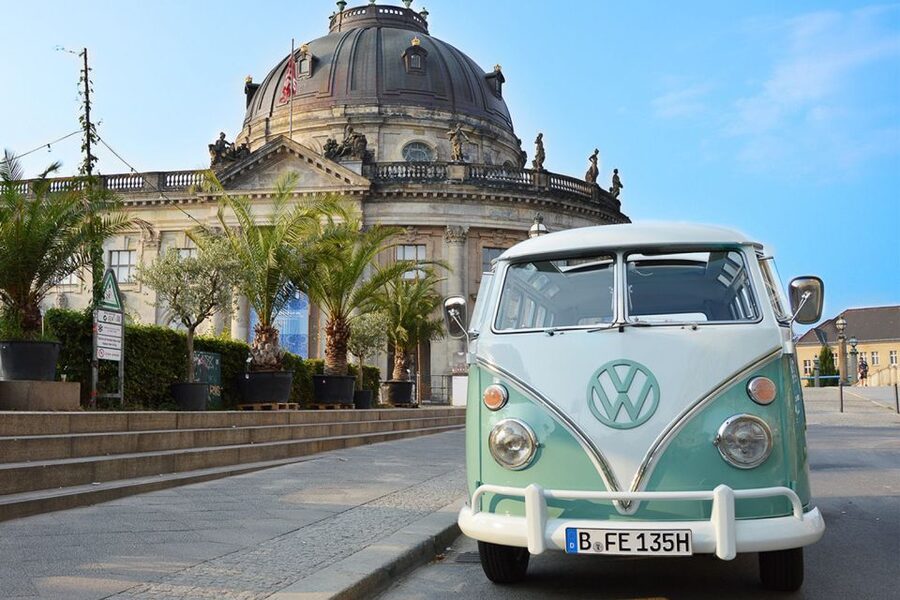
The bus is not just transport. It is the central part of the experience.
A standard sightseeing coach can show you Berlin’s major buildings, but a classic T1 makes the ride feel more personal. You sit close to the street, look through a line of windows, and see the city at a slower, more human pace. The restored vehicle is also a local attraction in its own right. People look over as it passes, which adds a light, cheerful note to a city often associated with serious twentieth-century events.
The bus has heating when necessary, a useful feature in Berlin’s cold months. Several tour accounts describe the vehicle as comfortable even in winter rain and cold. One older account did mention excessive heat on a warm day, so comfort can depend on the weather and ventilation. That is worth keeping in mind if you dislike confined spaces or are sensitive to temperature.
The vehicle holds only seven participants. That is a major advantage over a large coach. You can hear the driver more clearly, ask a follow-up question, and feel less like you are being moved along an assembly line. The compact size also lets the driver use smaller streets and side roads that a full-size sightseeing bus cannot manage.
Starting at Berlin Cathedral and Museum Island
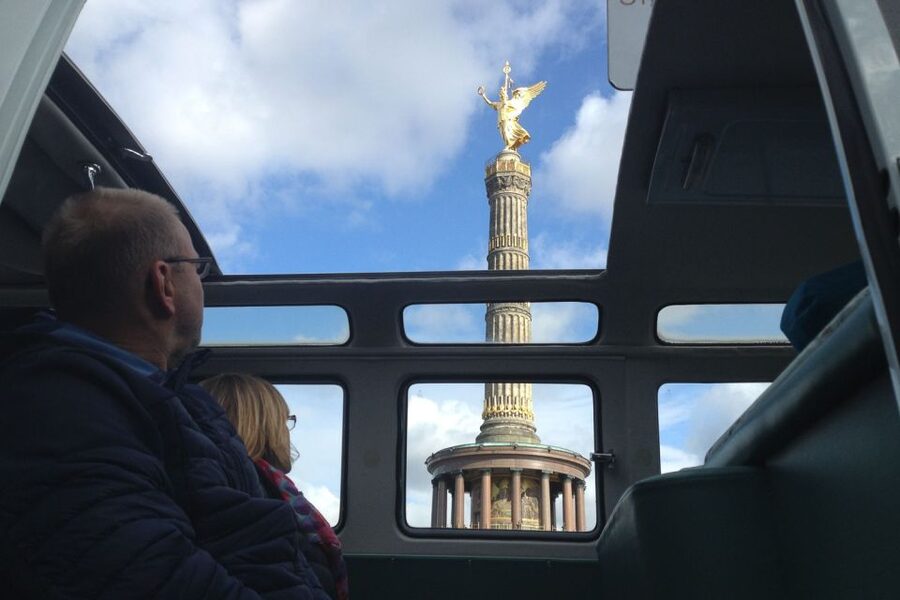
The tour begins at Berlin Cathedral, a useful starting point beside the Spree and Museum Island. From here, you pass Lustgarten and the major museums: the Alte Nationalgalerie, Neues Museum, Pergamon Museum, and Bode Museum.
You should not expect to enter any of these buildings. They are visual stops from the road, with commentary rather than museum admission. Still, this opening section gives you a quick map of Berlin’s cultural center. You see how the cathedral, open square, grand museum facades, and riverfront fit together.
The route continues past the German Historical Museum and Neue Wache, a solemn memorial on Unter den Linden. You then pass the former Crown Prince’s Palace, Humboldt University, the Berlin State Opera, Bebelplatz, and nearby palaces. This is one of the most concentrated sections of the ride, with imperial, academic, artistic, and political Berlin appearing within a short stretch.
Bebelplatz is especially important because it connects the elegant boulevard with the darker record of Nazi rule. The guide’s live explanation matters here. From the bus, you get only a brief look, so the quality of the narration makes the difference between simply passing a square and understanding why it matters.
A few more half-days in Berlin worth comparing
- Berlin: Reichstag, Dome and Government District Guided Tour
★ 4.7 · 18,288 reviews - Berlin: 1-Hour City Tour by Boat with Guaranteed Seating
★ 4.3 · 16,993 reviews - Berlin: Boat Tour Along the River Spree
★ 4.4 · 11,252 reviews
Unter den Linden, the Brandenburg Gate, and the government quarter
Unter den Linden leads you toward Pariser Platz and the Brandenburg Gate, Berlin’s best-known landmark. The gate once marked the edge of the city, later became a symbol of division, and now represents reunification. You pass it rather than stopping for a long photo session, so plan a separate visit if you want time beneath the columns.
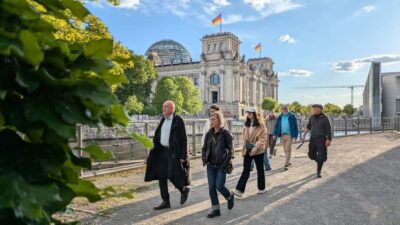
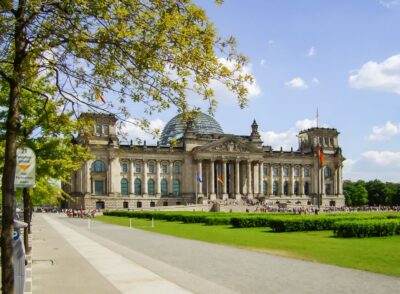
The bus then continues to the Reichstag, the government district, the Federal Chancellery, and Berlin Central Station. This is modern Berlin beside historic Berlin: nineteenth-century ceremonial buildings give way to glass, steel, and large civic spaces.
The route crosses or passes the Moltke Bridge and continues toward Bellevue Palace and the Victory Column. You get a useful sense of how the government quarter relates to the broad parks and avenues around it. The tour is strongest here as an orientation ride. You see the main pieces in sequence, then can return later by train, tram, or on foot.
The commentary also helps explain how the city changed after reunification. Berlin is not laid out as one tidy historic center. Its story is split between old royal avenues, wartime destruction, Cold War borders, and new government buildings. A live guide can connect those pieces as you move through them.
West Berlin from the Victory Column to Kurfürstendamm

After the Victory Column, the bus passes the Zoologischer Garten area, Theater des Westens, Savignyplatz, Kurfürstendamm, and the Kaiser Wilhelm Memorial Church.
This part of the route introduces the character of former West Berlin. Kurfürstendamm is a major shopping boulevard, while the memorial church remains a stark reminder of wartime destruction. You also pass Tauentzienstraße and KaDeWe, one of the city’s famous department stores.
The contrast with Museum Island is useful. Instead of seeing Berlin as one historical center, you see two former halves with different styles and priorities. West Berlin’s commercial streets, theaters, embassies, and postwar buildings tell a different story from the royal axis of Unter den Linden.
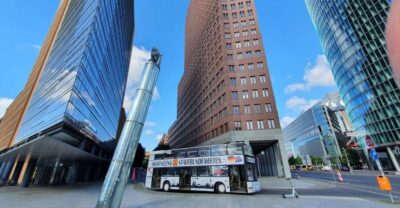
You continue past the embassy district, the Berliner Philharmonie, Kulturforum, and Potsdamer Platz. The Philharmonie and Kulturforum offer a look at postwar cultural planning, while Potsdamer Platz shows how dramatically a once-divided zone was rebuilt. Again, the bus provides the framework, not a full architectural study. If modern design interests you, note the places you want to revisit.
The Wall, Checkpoint Charlie, and Berlin’s difficult twentieth century
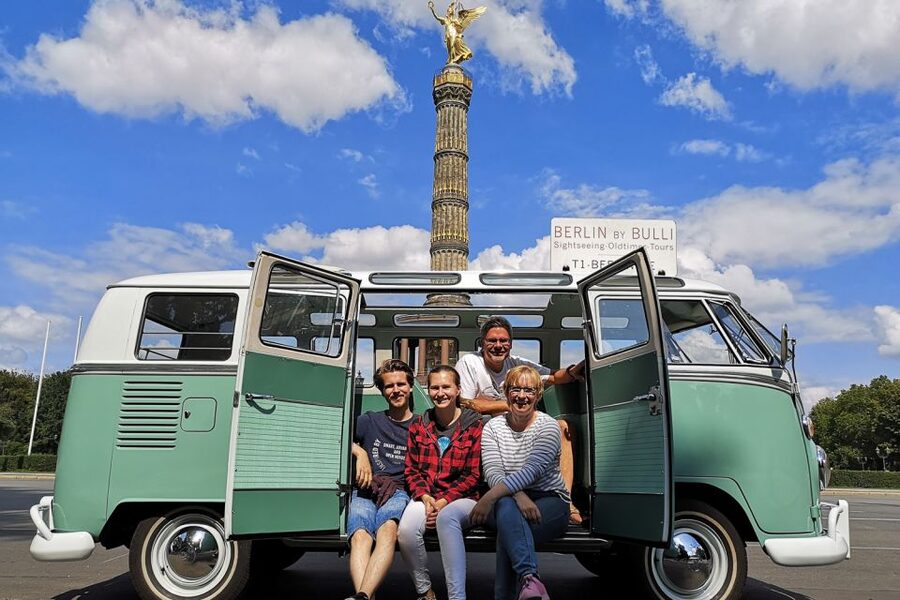
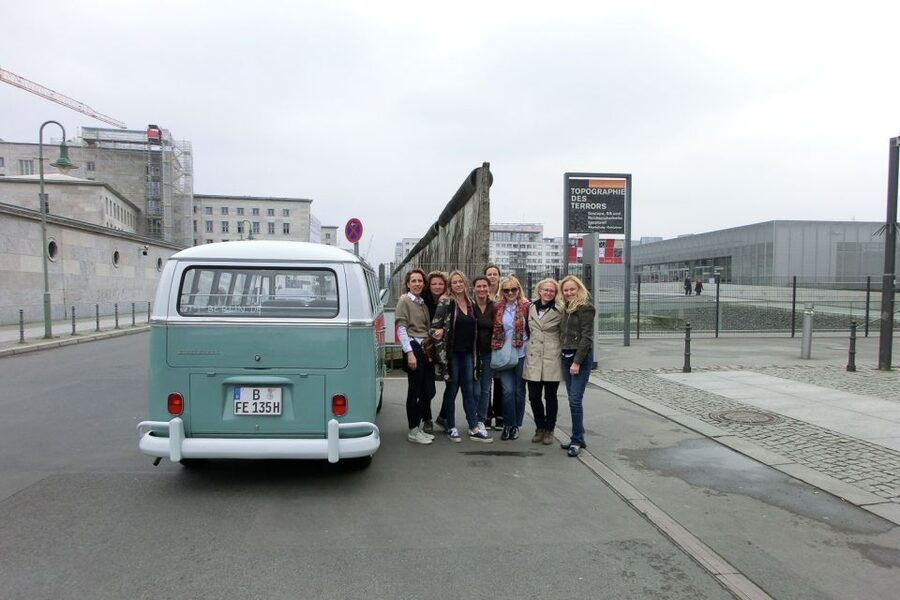
The tour then turns to some of Berlin’s most important political sites: the Berlin Wall, Niederkirchnerstraße, Anhalter Bahnhof, the Holocaust Memorial, the former Führer Bunker site, the former Reich Chancellery area, Friedrichstraße, and Checkpoint Charlie.
This section is dense with meaning. At Niederkirchnerstraße, you are near the Topography of Terror area and remnants connected with Nazi-era institutions. Anhalter Bahnhof recalls the scale of Berlin’s former railway network and the damage caused by war. The Holocaust Memorial sits near the Brandenburg Gate, but its stark blocks are easy to miss if you only pass quickly.
The former Führer Bunker site and the Reich Chancellery area are not conventional attractions. Their importance comes from what happened there and from the way the city treats difficult historical ground today. The photo booklet is particularly useful in this section, allowing you to compare the present streets with earlier images.
Checkpoint Charlie is another quick pass-by rather than a full museum visit. Its famous name can make it feel like a complete attraction, but the surrounding area has changed greatly. Use this tour to understand its place in the divided city, then visit a nearby museum or memorial if you want more detail.
The guide’s tone matters here. The best parts of the tour are not just dates and buildings, but the connections between them. Rajko is praised for combining personal warmth, humor, and strong knowledge of Berlin, while Michael is described as organized, friendly, and very informed. Because the group is small, these explanations can feel more like a conversation than a recording.
Same city, a completely different kind of day:
- Discover Berlin Half-Day Walking Tour
★ 5.0 · 9,624 reviews - Berlin: Hop-on Hop-off Bus Tour with Live Commentary
★ 4.3 · 8,579 reviews - Berlin: Government District around the Reichstag Guided Tour
★ 4.7 · 8,447 reviews - Berlin: Reichstag, Plenary Chamber, Cupola & Government Tour
★ 4.6 · 8,422 reviews
Gendarmenmarkt, the old city, and Alexanderplatz
From Friedrichstraße, the bus continues to Gendarmenmarkt, one of Berlin’s most handsome squares. You pass the Berlin Palace area, Jungfern Bridge, Galgenhaus, the Red Town Hall, Neptune Fountain, and St. Mary’s Church before returning toward the cathedral.
This final stretch brings you back to Berlin’s older center. Gendarmenmarkt offers grand architecture and a formal urban setting, while the Berlin Palace area reflects the city’s changing approach to reconstruction and memory. Jungfern Bridge and Galgenhaus add smaller, less obvious points of interest to the route.
The Red Town Hall, Neptune Fountain, and St. Mary’s Church place you near Alexanderplatz and the TV Tower. The tower is one of the clearest visual markers in Berlin, especially when you are trying to understand the former East Berlin center. Seeing it from the road helps you connect the medieval and modern parts of the city.
The complete route covers around 45 named sights and close to 50 points of interest, depending on how the stops are counted. You will not study each one in equal detail. Instead, the tour gives you a broad map of Berlin’s past and present, with enough pointers to plan the rest of your visit.
The photo booklet is more useful than it sounds
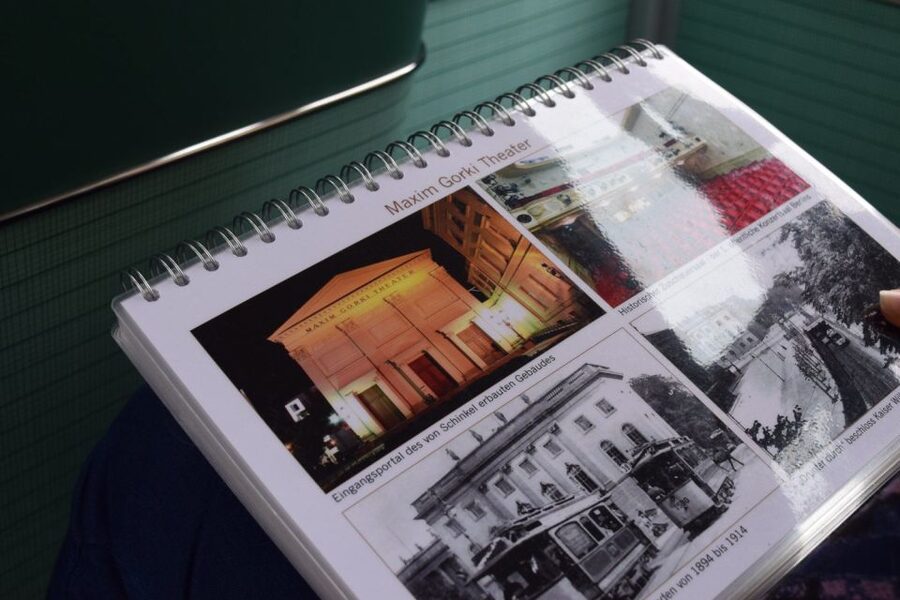
The supplied booklet, described by the operator as an analog iPad, contains old images matched to locations along the route. This is one of the tour’s most practical features.
Berlin can look deceptively ordinary at street level. A modern office, open square, or empty lot may hide a destroyed building, a vanished border, or a former political center. Showing an earlier image while you are looking at the same place helps you make that connection quickly.
I would pay special attention to the booklet around the Wall, the government quarter, the former Reich Chancellery area, Anhalter Bahnhof, and Potsdamer Platz. These locations changed heavily through war, division, and rebuilding. The pictures give the commentary something concrete to point toward.
You should not expect a booklet to replace a museum visit. Its value is speed and context. It helps you understand the city while the bus is moving, then gives you a reason to return to selected places on foot.
What the two-hour format does well, and what it cannot do
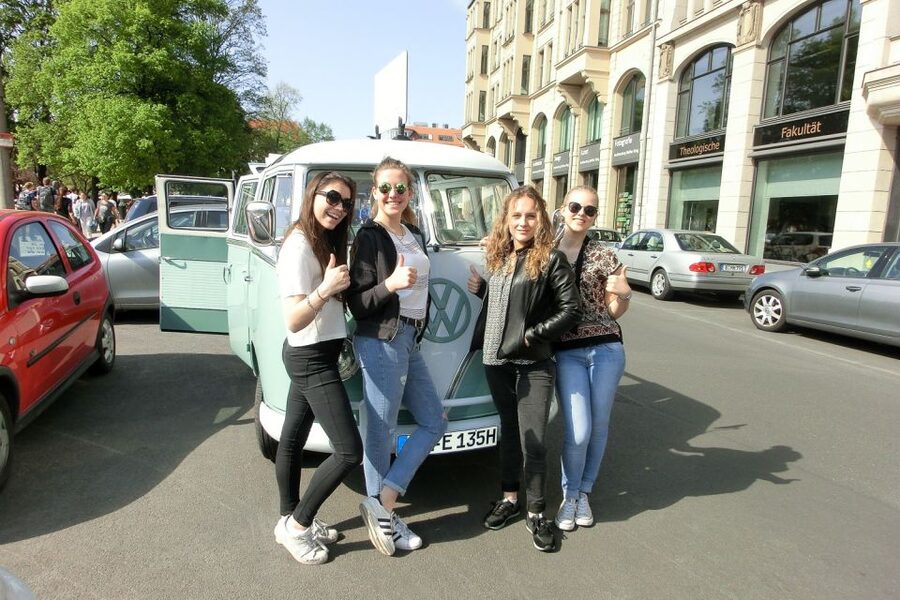
Two hours is a smart length for a first look at Berlin. The city is spread out, and walking between the cathedral, Brandenburg Gate, Kurfürstendamm, the Wall, and Alexanderplatz would take far longer. The bus lets you cover ground without spending your first day figuring out the transport system.
The tradeoff is depth. Nearly every location is a pass-by. You may have time for a photograph from your seat, but not a long stop, museum entry, or detailed walk around a memorial. If your main goal is to visit the Reichstag dome, enter the cathedral, or spend an hour at the Wall Memorial, this tour cannot replace those visits.
I would book it near the start of your Berlin stay. It gives you a mental map and helps you sort the city into areas: Museum Island, the central boulevard, the government quarter, former West Berlin, Potsdamer Platz, the Wall zone, and Alexanderplatz. You can then return to the places that caught your interest.
The tour can also work at the end of a stay. In that case, the guide’s explanations may connect sights you have already seen, while the side streets reveal places you missed. Several people have enjoyed it as a final overview for exactly that reason.
Price, group size, and practical fit
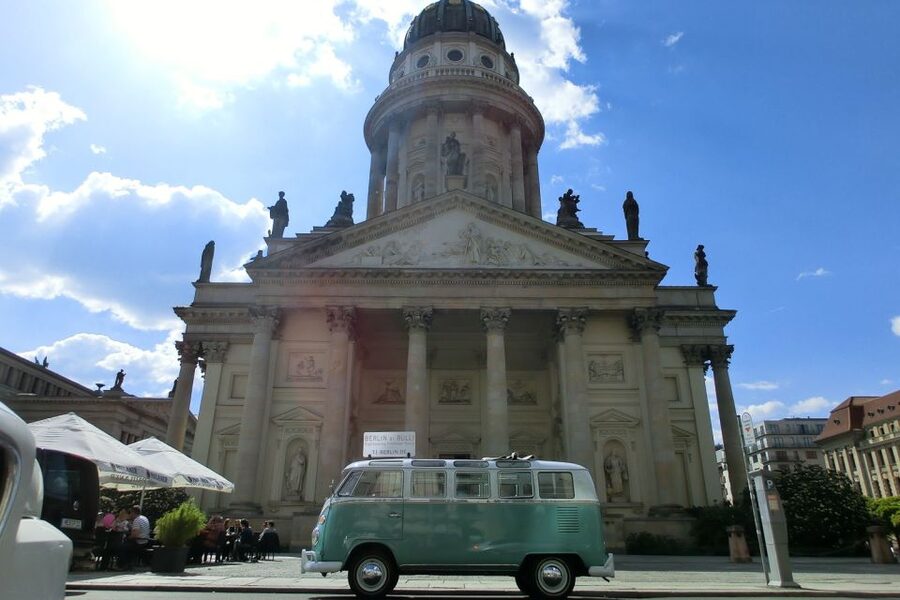
At $51 per person, the tour is not the cheapest way to move around Berlin. A day ticket on public transport costs less, and a self-guided route costs almost nothing beyond your time.
The comparison is not quite fair, though. You are paying for a small group, a dedicated driver-guide, live explanations in English or German, the restored vintage bus, and a route that links distant parts of the city in two hours. For a first-time visit, I consider that fair value if you care about history and want a personal introduction rather than simple transport.
The tour is wheelchair accessible, but non-folding wheelchairs are not allowed. Glass objects and intoxication are not permitted. It is not suitable for people with epilepsy, a cold, or a body weight over 275 pounds, or 125 kilograms.
The tour may use more than one language. If English and German are both spoken on your departure, explanations may take longer. One account specifically noted a delay caused by two languages, though the guide handled it well. If you need every minute of commentary in one language, check the language arrangement before booking.
The bus returns to Berlin Cathedral. Cancellation is free up to 24 hours before departure, and you can reserve now and pay later, which helps if your Berlin plans are still shifting.
Who should book the VW T1 tour?
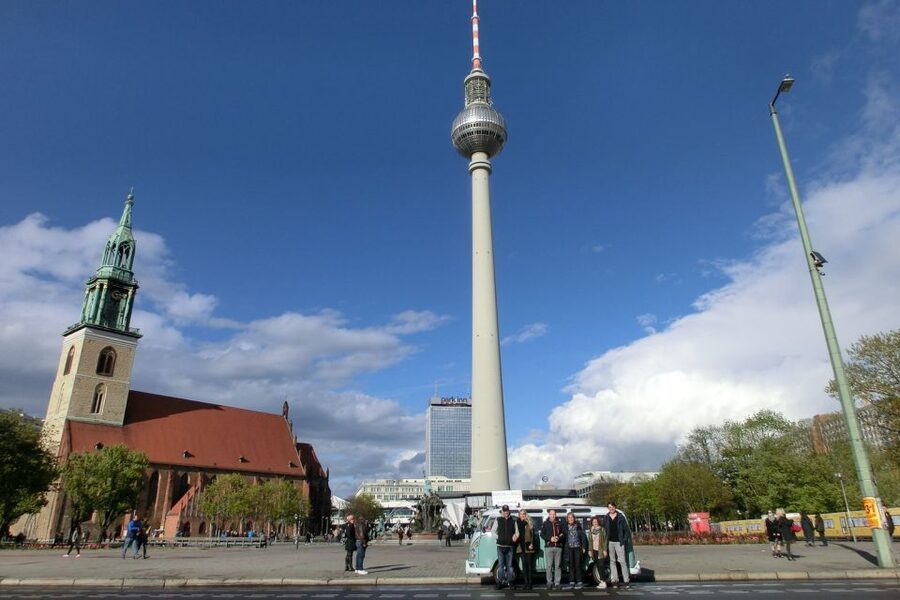
I would recommend this tour to first-time visitors who want a clear overview, couples and families who like unusual transport, and anyone interested in Berlin’s twentieth-century story. It also suits people who have already seen the central sights but want better links between them.
The small capacity makes it a good choice for a family group. One family of six had the entire bus to themselves, which is close to the best possible setup. It is also useful in winter, when the heated bus protects you from a cold or rainy morning.
I would hesitate if you want long stops, museum interiors, or a strictly scheduled sightseeing route with lots of time for photographs. I would also think twice if you dislike vintage vehicles, have trouble with enclosed seating, or fall into one of the listed health and weight restrictions.
Should you book it?
Yes, if you want a compact, personal introduction to Berlin and like the idea of seeing the city from a lovingly maintained 1965 Samba bus. The guide, not just the vehicle, makes the experience worthwhile. Rajko and Michael are among the guides associated with the tour, and the strongest accounts describe warm delivery, strong local knowledge, and plenty of useful detail.
Book it early in your stay if you want help planning the rest of Berlin. Choose it later if you want a fresh explanation of places you have already passed. At $51, it is best viewed as a guided city orientation with character, not as a substitute for visiting Berlin’s museums and memorials.
FAQ
Where does the Berlin VW T1 Samba bus tour start?
The tour starts at Berlin Cathedral and returns there after the two-hour circuit.
How long does the tour last?
The tour lasts two hours.
How many people can join the tour?
The group is limited to seven participants.
What languages are available?
The live guide speaks English and German. The tour may be conducted in more than one language.
Is the tour wheelchair accessible?
The tour is wheelchair accessible, but non-folding wheelchairs are not allowed.
Is the bus heated?
Heating is provided when necessary.
Does the tour enter the museums and landmarks?
No. The listed museums, monuments, memorials, and landmarks are viewed from the bus as the vehicle passes them.
What is included in the price?
Transportation in the Volkswagen T1 Samba bus, a driver-guide, live commentary, a photo booklet, and heating when necessary are included.
Can I cancel the booking?
You can cancel up to 24 hours in advance for a full refund. Reserve now and pay later is also available.
Just added in Berlin
- Berlin & The Third Reich Private Guided Tour★ 5.0 · 3 reviews
- Third Reich Quest Experience in Berlin★ 4.5 · 7 reviews
- Private Analogue Photography Experience in Berlin★ 5.0 · 3 reviews
- Berlin Urbex Adventure and History Tour★ 5.0 · 9 reviews
- The Beauty of Berlin by Bike: Private Tour★ 5.0 · 59 reviews
- Berlin: Guided Bike tour of the Berlin Wall and Third Reich★ 5.0 · 160 reviews
- Shared Underground Party Tour in Berlin★ 4.5 · 9 reviews
- Beyond Currywurst: Berlin’s Hidden Street Food & Culture Tour★ 5.0 · 100 reviews
Berlin Tours, compared.
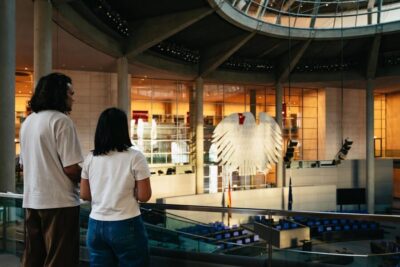
Reichstag, Dome and Government District Guided Tour
Read our review →
Reichstag, Plenary Chamber, Cupola & Government Tour
Read our review →