
Reviewed · WALKING TOURS
Frankfurt: Private or Shared Walking Tour
Frankfurt’s story comes into focus when you walk from the Eiserner Steg to the Römer and Paulskirche, then compare those historic sights with the city’s modern skyscrapers. This tour is less about checking off monuments and more about seeing how Frankfurt rebuilt, changed, and kept its older identity.
I like the clear route, which begins at the Justitia-Brunnen and returns there, and I like the mix of major landmarks with useful historical context. The private option also gives you more flexibility, as one guide, Sanel, adjusted the timing for a private group and still offered detailed information during a shorter visit.
The main consideration is language: the live tour is listed in German. At 1.5 hours, it is also a brisk introduction rather than a full city tour, so you will get the main story but not extended time at each sight.
Key points at a glance
- The Eiserner Steg begins the historical comparison: See Frankfurt’s 1868 iron footbridge and hear how war damage changed the city.
- The Neue Altstadt shows Frankfurt rebuilding its older face: Explore the city’s newer old town project and its connection to the traditional Altstadt.
- Paulskirche marks a major political moment: Visit the place where the first German national assembly took place.
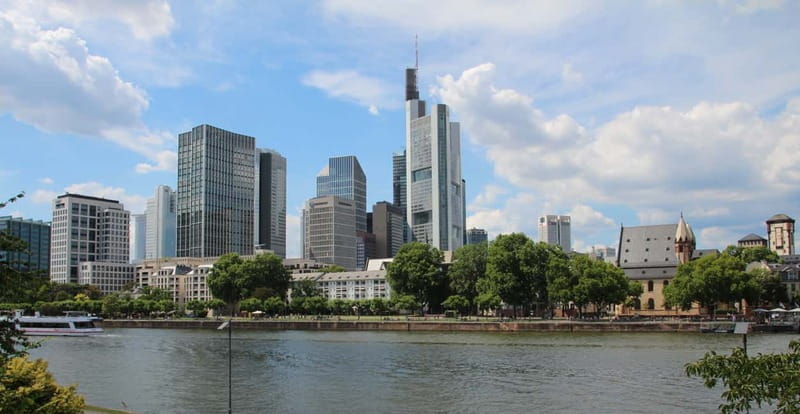
- The route links old and new Frankfurt: Historic buildings and modern skyscrapers appear within the same compact walk.
- A private option offers more flexibility: Shared and private formats are available, with the private group option useful for families or small parties.
- The tour is conducted in German: This matters if you need an English-language guide.
Frankfurt in 90 minutes: what this walk actually does
This Frankfurt walking tour gives you a tight introduction to the city’s central sights. You meet at the Justitia-Brunnen on Römerberg, then walk through the Altstadt, the Neue Altstadt, and nearby landmark areas before returning to the same meeting point.
That fixed start and finish makes the tour easy to fit into a short visit. You do not need to arrange transport between stops, and you finish where you began. For a first look at Frankfurt, this is useful because you can continue exploring independently from Römerberg afterward.
The tour’s main idea is contrast. Frankfurt is often known for its tall office buildings and modern city center, but its historic core tells another story. The walk places both sides of the city in the same route: the older public squares and churches, the rebuilt old town, and the newer skyline.
You should think of this as an orientation walk with history, not as a museum visit. The guide provides information at each attraction, but the tour does not include admission to an indoor site. Much of the value comes from understanding what you are looking at and why the city looks the way it does.
More Walking Tours in Frankfurt
- Frankfurt Highlights English Walking Tour
★ 5.0 · 1,203 reviews - Frankfurt on Foot Daily Walking Tour in English
★ 4.9 · 323 reviews - Frankfurt Self-Guided Historical Walking Tour
★ 4.0 · 58 reviews
Starting at the Justitia-Brunnen on Römerberg
The Justitia-Brunnen is a practical meeting point because it sits on Römerberg, one of the central historic areas of Frankfurt. Find the guide there at the booked starting time. The activity ends back at this same point, which keeps the route simple.
Beginning at Römerberg also puts you close to several of the tour’s key sights. You do not spend the opening part of the walk getting from a distant neighborhood to the historic center. Instead, the setting gives you an immediate sense of Frankfurt’s traditional side.
The meeting point is worth noting carefully if you are coming from a hotel, railway station, or another part of town. The supplied details identify the Justitia-Brunnen specifically, not simply Römerberg in general. Give yourself enough time to locate the statue before the tour starts.
Because the tour is guided in German, listen for the guide and confirm the meeting point when you arrive. If you choose the private option, the guide can offer a more tailored pace. Sanel, named in one of the tour’s comments, was flexible with timing for a private group and provided detailed information even when the available time was shortened.
Crossing the Eiserner Steg, built in 1868
One of the first major stops is the Eiserner Steg, an iron footbridge built in 1868. It gives the tour a strong early image of Frankfurt as a city shaped by both engineering and history.
A footbridge may sound like a quick photo stop, but here it helps connect the old town to the wider city. From this point, the guide can explain how Frankfurt’s appearance changed over time and how the city’s older buildings relate to its modern form.
The bridge is also an easy place to understand the tour’s central comparison. Traditional structures and newer high-rise buildings belong to the same city, even when they seem to tell very different stories. You get a physical sense of that contrast as you walk through the central area.
The guide also discusses the destruction of many grand buildings during World War II. This context matters because Frankfurt’s historic center is not simply an untouched medieval quarter. Some buildings survived, some were lost, and later work changed the appearance of the old town.
You will hear about the major renovation of 2008 and 2009 as part of that story. The details help explain why the Altstadt includes both older remains and newer reconstruction. Without that background, it is easy to assume every traditional-looking building has been standing in its current form for centuries.
The Römer and Frankfurt’s traditional center
The Römer is one of Frankfurt’s key historic sights and an important stop on the route. Your guide explains its place in the city’s past and gives you useful information about what you are seeing.
This is where the tour moves from broad city history to the familiar symbols of Frankfurt’s old center. The Römer helps anchor the walking route, giving you a clear reference point for the Altstadt and the nearby new old town.
The benefit of having a guide here is not simply learning a date or a name. You can ask how the Römer fits into the larger story of the city, including the damage caused during World War II and the work that followed. The tour is designed to connect individual sights rather than treat each one as an isolated photo stop.
Do not expect a long indoor visit or a detailed architectural study. The walk stays focused on the city’s main story, so the explanation at the Römer is part of a larger sequence. If you want extensive time for photographs or close inspection, you may need to return after the tour.
Same city, a completely different kind of day:
- Frankfurt: River Main Sightseeing Cruise with Commentary
★ 4.3 · 5,127 reviews - Frankfurt: Hop-On, Hop-Off Grand or Express Bus Ticket
★ 3.9 · 2,088 reviews - Frankfurt: 1-Hour Panorama Boat Cruise on the river Main
★ 4.4 · 1,822 reviews - Frankfurt: New Old Town and Highlights German-Language Tour
★ 4.7 · 1,316 reviews
Paulskirche and the first German national assembly
Paulskirche is another major stop, and its importance is political as well as architectural. This is where the first German national assembly took place, giving the building a direct connection to German national history.
That one fact gives the tour a useful change of pace. Frankfurt’s history is not only about old buildings and wartime destruction. It also includes major events in the development of German public and political life.
Your guide puts the church into the wider route, so you can see how Paulskirche relates to the Römer and the surrounding Altstadt. The walk helps you build a mental map of central Frankfurt while adding meaning to places you might otherwise pass quickly.
As with the other stops, the visit is viewed from the walking-tour format. The supplied details do not promise an interior visit or a long stop inside Paulskirche. Plan on learning about the site from the guide rather than treating this as a church tour.
For anyone interested in German history, this is one of the most valuable stops. It gives the tour a clear historical purpose and makes the walk more than a general sightseeing loop.
Exploring the Neue Altstadt
The Neue Altstadt, or new old town, is the most distinctive part of the itinerary. It is Frankfurt’s latest major old-town project and shows how the city has chosen to present its historic center in a newer period.
The name itself captures the tension. This is an old town that is new, so you should expect a mixture of restored or rebuilt traditional forms and recent urban planning. The guide explains how this area fits into the city’s long rebuilding process.
This stop is especially useful after hearing about the World War II destruction and the 2008 to 2009 renovation. You can begin to see the old town not as a single untouched block, but as a place shaped by loss, reconstruction, and modern choices.
I like this part of the route because it gives you something to think about after the tour. The Neue Altstadt raises practical questions about how cities preserve identity. What should be rebuilt? What should be modern? How much of an old town needs to be old to feel historic? The guide’s explanation helps you look at the area with more care.
Still, expectations matter. The Neue Altstadt is a project to explore on foot, not a preserved quarter where every wall carries centuries of original fabric. If you want a purely ancient setting, this may feel more reconstructed than expected. If you want to understand present-day Frankfurt, it is one of the most relevant stops.
Seeing old buildings beside modern skyscrapers
Frankfurt’s appeal on this tour comes from its sharp visual contrasts. The route places traditional landmarks and newer towers within the same city center, allowing you to compare them without a separate excursion.
The modern buildings are not just background scenery. They help explain Frankfurt’s current identity and why the city can feel different from other German destinations with more continuous historic centers. The tour makes room for both the old and the modern rather than pretending one side does not exist.
You may find this especially helpful if Frankfurt is a short stop on a larger German trip. A 1.5-hour walk gives you a quick way to understand what makes the city distinctive. You see the historic core, hear about the damage and renovation, and get a sense of the newer urban character.
The drawback is that the city’s contrasts can feel compressed into a short route. You will not explore every part of Frankfurt’s center, and the tour does not promise a detailed examination of the skyscraper district. Think of the modern buildings as part of the comparison, not as a separate architecture tour.
Shared or private: which format suits you?
The shared option is likely the better value if you want a low-cost introduction and are comfortable following a set group pace. At $17 per person, the price is modest for a guided 1.5-hour walk through several of Frankfurt’s best-known historic areas.
The private option makes more sense if you want greater control over timing or prefer a group made up only of your own party. The information provided confirms that private groups are available, but it does not give a separate private price, group-size limit, or exact pacing policy. Check those details before booking.
A private tour can be useful for a family, a small group of friends, or anyone who wants to ask more questions about particular sights. Sanel’s flexibility with a private group shows the possible benefit, though you should not assume every departure will have the same arrangements.
The language is the biggest practical issue. The live guide is listed as German, and German is the only language specified. If you need English, ask before booking rather than relying on the low price or the private format to solve the language question.
Value, pace, and practical planning
At $17 per person, this is good value if you want a compact introduction to Frankfurt’s historic center. You are paying for a guide who links the Eiserner Steg, Römer, Paulskirche, Neue Altstadt, wartime destruction, renovation, and modern cityscape into one story.
The value is lower if you only want to photograph the main sights. You can see several of them independently, but the point of the tour is the explanation between stops. If you do not understand German well enough to follow the guide, the experience will lose much of its purpose.
The 1.5-hour duration is manageable for most sightseeing days. It is long enough to cover the stated highlights without taking over your afternoon, but short enough that you can add another activity before or afterward. Wear comfortable shoes and expect to remain outdoors for most of the route.
The tour offers free cancellation up to 24 hours before the start for a full refund. You can also reserve now and pay later, which helps if your schedule is still shifting. Starting times vary, so check availability when choosing a date.
The tour returns to the Justitia-Brunnen. That is handy for planning lunch, further sightseeing, or a return to your accommodation, though no restaurant or transport recommendation is included with the activity.
Who should book this Frankfurt walking tour?
I would choose this tour if you have limited time in Frankfurt and want the basic story of the center in one guided walk. It suits first-time visitors who want context for the old town, the newer reconstruction, and the city’s modern buildings.
It is also a good fit for anyone interested in German political history, since Paulskirche and the first national assembly are central parts of the route. The explanation of World War II destruction and the 2008 to 2009 renovation adds useful context to the city’s rebuilt appearance.
You may want something else if you need an English-language guide, a long museum-style tour, or a detailed visit inside the major buildings. The route is short, the language is German, and the focus is on outdoor sightseeing and explanation.
Should you book it?
Book this Frankfurt walking tour if you want a reasonably priced, focused introduction to the Altstadt and Neue Altstadt, and you can follow a German-language guide. The best reasons to choose it are the compact route, the clear old-versus-modern comparison, and the historical explanation of wartime destruction and rebuilding.
Choose the private format if timing and personal attention matter more than the lowest price. Choose the shared tour if you mainly want an efficient orientation at $17 per person.
Before paying, confirm the German-language format and starting time. If those work for you, this is a practical way to get your bearings in central Frankfurt while learning why its historic center looks both familiar and newly made.
FAQ
How long is the Frankfurt walking tour?
The tour lasts 1.5 hours. Starting times vary, so check availability for your chosen date.
Where does the tour begin?
You meet your guide at the Justitia-Brunnen on Römerberg.
Where does the tour end?
The activity ends back at the Justitia-Brunnen, the same place where it begins.
Is the tour shared or private?
You can select a shared walking tour or a private group, depending on the option available when you book.
What language is the live tour guide?
The live tour guide is listed as German. German is the only language specified for this activity.
What sights are included?
The route includes the Eiserner Steg, the Römer, Paulskirche, and the Neue Altstadt. It also covers Frankfurt’s modern buildings, World War II destruction, and the 2008 to 2009 renovation.
Is a guide included?
Yes. The selected option includes a Frankfurt walking tour and a guide.
How much does the tour cost?
The listed price is $17 per person. Private options may have different pricing, so check the available option when booking.
Can I cancel for a full refund?
Yes. You can cancel up to 24 hours in advance for a full refund.
Can I reserve now and pay later?
Yes. The activity allows you to reserve your spot and pay later.
Just added in Frankfurt
- Private Tour with Native English speaking Local★ 4.9 · 60 reviews
- Hohenzollern Castle: Full-Day Tour from Frankfurt★ 4.3 · 11 reviews
- Heusenstamm:tour of the Depot of the museum of communication★ 4.8 · 54 reviews
- Frankfurt: Guided walk between palm trees and skyline★ 4.8 · 9 reviews
- Frankfurter Kunstverein: Admission ticket★ 3.7 · 54 reviews
- Frankfurt: Verbrecherjagd und gefährlich leckeres Schnitzel★ 4.4 · 22 reviews
- Frankfurt: Walking Tour – discover the city with VR glasses★ 4.2 · 12 reviews
- Welcome to Frankfurt: Private Tour with a Local★ 4.7 · 81 reviews
Walking Tours, compared.




Berlin’s Best: 2 Hour Walking Tour Third Reich and the Cold War
Read our review →


Third Reich Berlin: Hitler and WWII Walking Tour
Read our review →Browse the lists this tour appears in