
Reviewed · WALKING TOURS
Frankfurt: Walking Tour – discover the city with VR glasses
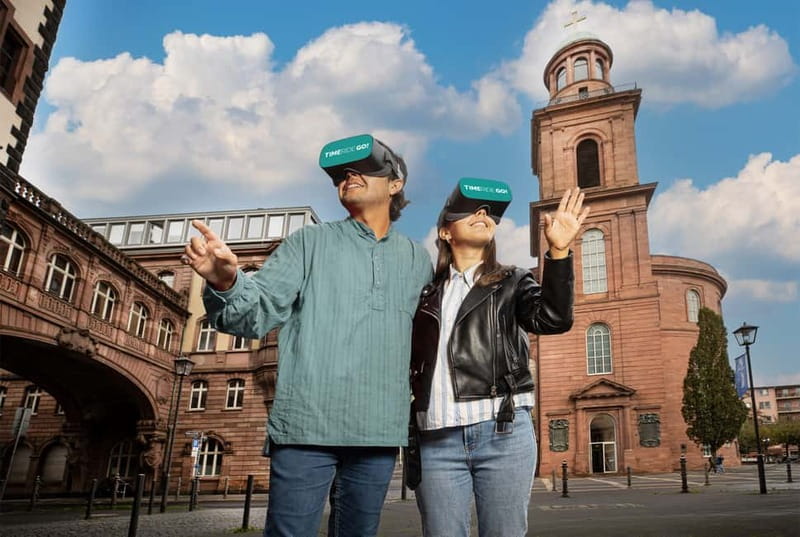
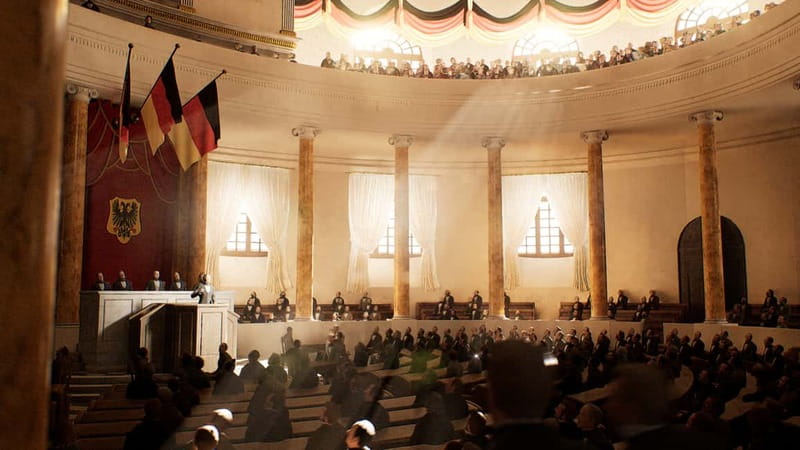
Frankfurt’s old center becomes a time machine on this short walking tour. At Paulsplatz and Römerberg, you use mobile VR glasses to compare the streets in front of you with scenes from earlier centuries. The strongest moment comes inside St. Paul’s Church, where virtual 360-degree images recreate the first German National Assembly in 1848.
I like the direct past-and-present comparison: you are not only told what Frankfurt once looked like, you can look at today’s setting and then see a reconstruction in the same place. I also like the compact route and the live German-speaking guide, who adds the human details that a headset alone cannot provide.
The main limitation is language. The tour is offered in German, and 45 minutes leaves little room for a long look at each stop. You also receive VR equipment and guiding, not admission to the separate TimeRide Frankfurt 1891 exhibition.
Key points to know before you book
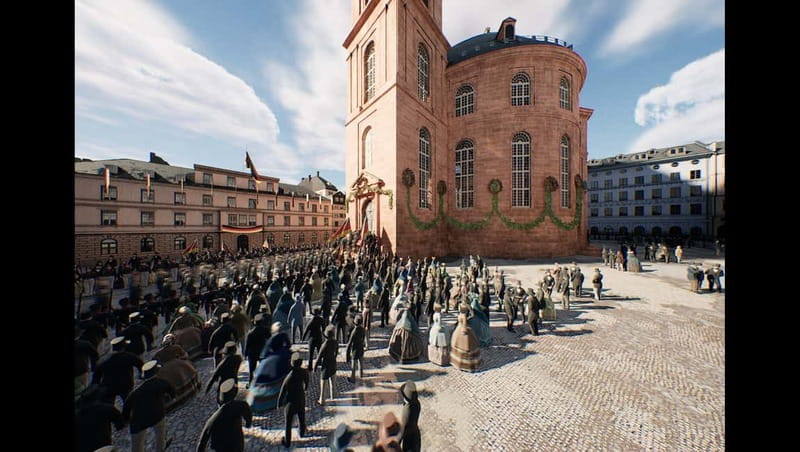
- The 1848 National Assembly is the heart of the tour: Virtual scenes recreate the opening session and the heated debates inside Paulskirche.
- You compare the same places across time: Paulsplatz and Römerberg are viewed first as they are today, then through historical VR scenes.
- The story reaches beyond Frankfurt: The route links the Romans at the Limes, German democracy, and the fall of the Berlin Wall.
- It is a genuine walking tour with a digital tool: The VR glasses are mobile, so the route remains outdoors and place-based.
- The tour is short and easy to fit into a day: It lasts 45 minutes and begins and ends at TimeRide.
- German is the tour language: This matters if you need explanations in another language.
How the VR tour turns Frankfurt into a history lesson
This is not a conventional city walk with a guide pointing at façades while you take notes. It is a guided comparison between the Frankfurt you see now and selected moments from the city’s past.
TimeRide Go! uses mobile VR glasses to show moving historical scenes. The idea is simple but effective: stand in a real Frankfurt square, look through the headset, and see a virtual version of that place at another point in time. Then remove the glasses and compare the reconstruction with the modern view.
That format gives the tour a clear purpose. You are not wearing VR for its own sake. The technology helps explain how political events and changing architecture affected the city around you. The guide supplies the setting, explains the images, and keeps you oriented while the headset is in use.
The story covers a broad span of German history, from Roman control at the Limes to the fall of the Berlin Wall. That is a lot to cover in 45 minutes, so do not expect a full course in German history. Think of it as a brisk introduction built around a few places in central Frankfurt.
The main thread is Frankfurt’s role in German democracy. The focus on 1848 gives the tour a strong center, while the later reference to the Berlin Wall connects that early push for representative government with a much later democratic victory.
More Walking Tours in Frankfurt
- Frankfurt Highlights English Walking Tour
★ 5.0 · 1,203 reviews - Frankfurt on Foot Daily Walking Tour in English
★ 4.9 · 323 reviews - Frankfurt: Private or Shared Walking Tour
★ 4.8 · 156 reviews
Starting at TimeRide Frankfurt
You begin at TimeRide in Frankfurt. Arrive ready to start on time, since the route is short and each stop has a planned place in the story.
The starting point is also where the tour ends. That makes the outing easy to combine with other plans in the central city. You do not need to arrange transport between the beginning and the final stop, and the compact route avoids the time and effort of a longer cross-town walk.
At the start, the guide introduces the equipment and the idea behind the tour. The VR glasses are mobile rather than part of a fixed indoor display. That distinction matters: this is an outdoor walk supported by virtual scenes, not a visit to a VR theater.
The equipment is included in the price. You do not need to arrange a separate headset or purchase an additional tour ticket for the walking experience. The separate TimeRide Frankfurt 1891 exhibition is not included, however, so do not assume that booking this route gives you entry to that display.
Paulsplatz and the first look at Frankfurt’s past
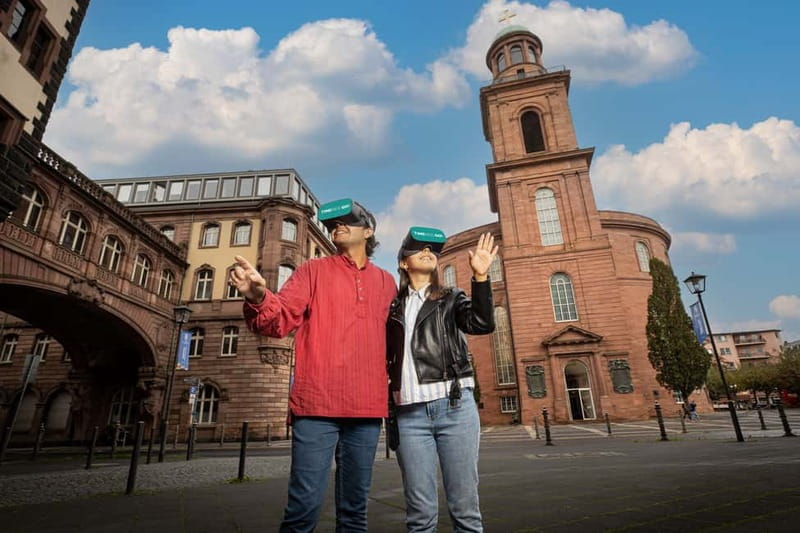
The route continues to Paulsplatz, where the city’s political story comes into focus. This square is closely tied to Paulskirche, the building at the center of the 1848 National Assembly.
Here, the VR scenes help you picture Frankfurt during a very different period. Instead of only hearing that the city played a role in German democracy, you see a virtual version of the setting and compare it with the square in front of you.
This is one of the better uses of the format because the location itself remains part of the lesson. You are not separated from the real city by a screen. The square under your feet provides the reference point, while the headset supplies the missing layers of time.
The guide also explains the role of important figures connected with the National Assembly. Since the route is conducted in German, you will get the most from this stop if you can follow spoken German or are comfortable taking in the visual scenes with only partial verbal understanding.
The stop is listed as about 10 minutes. That is enough for a focused explanation and a short VR sequence, but not enough for every political detail. If you want an extended discussion of 1848, you will need a museum or a longer history tour afterward.
Inside St. Paul’s Church and the 18 May 1848 session
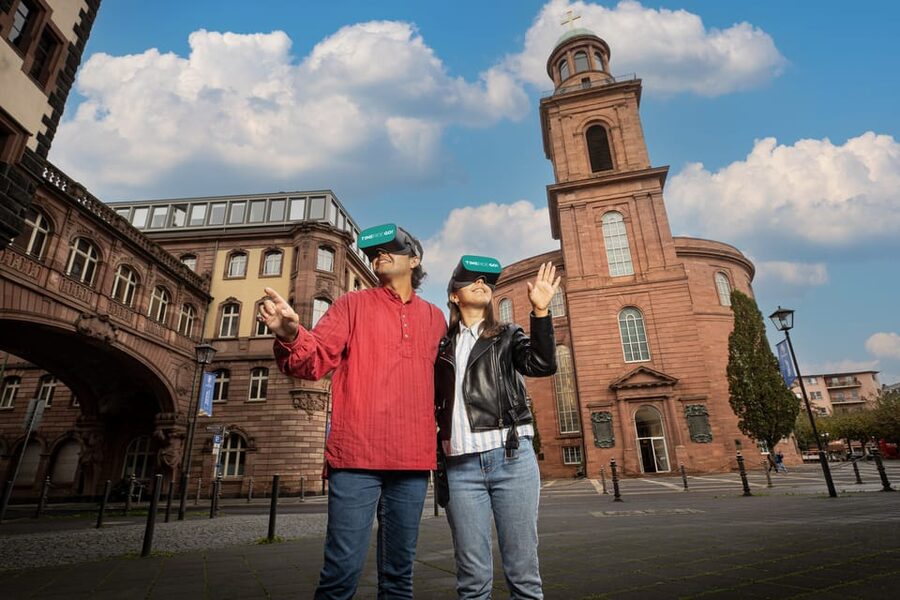
St. Paul’s Church is the emotional center of the experience. The building hosted the first National Assembly, and the tour uses virtual 360-degree scenes to recreate parts of the session that began on 18 May 1848.
The VR reconstruction shows the ceremonial entry and the early debates. Rather than treating the National Assembly as a dry date in a textbook, the scene presents it as a gathering of people facing difficult political choices. The virtual view also illustrates how Paulskirche looked and how the assembly used the building.
I like this stop because the technology has a clear job. It fills in what the building cannot show on its own. Modern visitors can admire the architecture, but the headset adds a sense of how the church functioned as a political meeting place during a tense moment in German history.
The church also gives the tour a visual pause from the open square. The route description specifically draws attention to its architectural beauty, so take a moment to look up and around when you are not using the glasses. The VR sequence is the main feature, but the building itself deserves attention.
The stop lasts about 15 minutes, making it the longest part of the route. That tells you where the tour places its weight. Frankfurt’s wider story matters, but the National Assembly and the roots of German democracy are the central subject.
One practical point is worth keeping in mind. You may need to alternate between watching the virtual scene and listening to the guide. Pay attention to the guide’s instructions, especially if you want to keep track of the real building while the historical sequence is playing.
Same city, a completely different kind of day:
- Frankfurt: River Main Sightseeing Cruise with Commentary
★ 4.3 · 5,127 reviews - Frankfurt: Hop-On, Hop-Off Grand or Express Bus Ticket
★ 3.9 · 2,088 reviews - Frankfurt: 1-Hour Panorama Boat Cruise on the river Main
★ 4.4 · 1,822 reviews - Frankfurt: New Old Town and Highlights German-Language Tour
★ 4.7 · 1,316 reviews
Römerberg and the city of the Gründerzeit
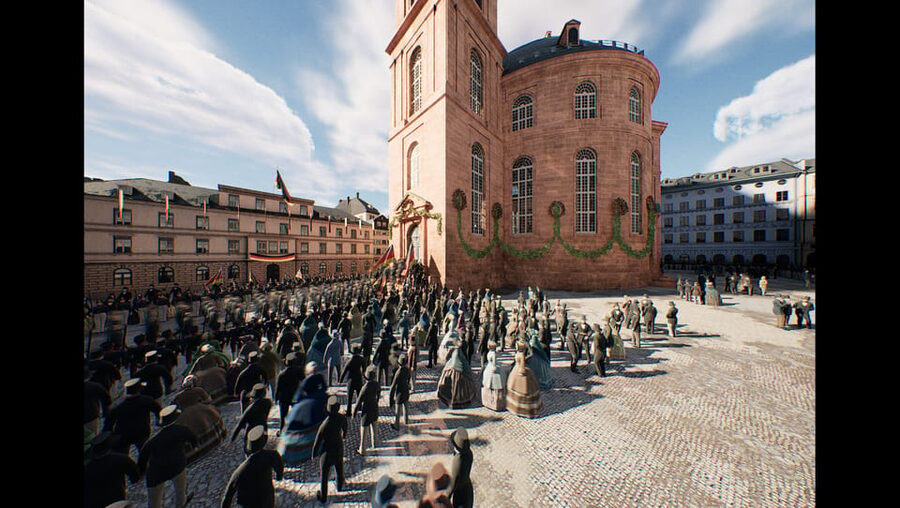
From Paulskirche, the route goes to Römerberg. This square offers a second major comparison between modern Frankfurt and an earlier city.
The VR view focuses on the Gründerzeit in the 19th century, a period associated with major economic growth and urban change. The virtual cityscape gives you a sense of how the area appeared at that time, then lets you compare it with the present-day square.
This stop complements Paulskirche well. At the church, the emphasis is political and constitutional. At Römerberg, the focus shifts toward the shape and appearance of the city itself. You get two different ways to think about the past: one through an important national event, the other through changing streets and buildings.
The stop is planned for about 10 minutes. Again, expect a sharp visual comparison rather than a long architectural lecture. The value lies in seeing the same central area in two forms, not in covering every detail of Frankfurt’s urban development.
From Römerberg, the guide connects the city’s 19th-century changes with later turning points in German history. The route eventually reaches the fall of the Berlin Wall, described here as a symbolic triumph of democracy. The connection is not that all these events happened in Frankfurt, but that the tour uses Frankfurt’s 1848 assembly as an early reference point for a much longer democratic story.
From Roman times to the fall of the Berlin Wall
The historical range is ambitious for such a short tour. The experience touches on the Romans at the Limes, moves through Frankfurt’s role in the National Assembly, and ends with the Berlin Wall’s fall.
This broad sweep works best as a framework. You will not receive equal detail on every period. Instead, the guide uses a few major points to show how local events fit into German history.
For someone new to Frankfurt, that is useful. The city can seem dominated by its financial district and modern skyline, but this route directs your attention to the political importance of its old center. It explains why Frankfurt matters not only as a commercial city, but also as a place linked to German constitutional history.
The final connection to 1989 gives the tour a satisfying endpoint. The story begins with an early attempt to create a representative German government and finishes with the collapse of a barrier that had divided Germany. It is a quick path through history, but the democratic theme gives it unity.
If you already know German history well, you may find the overview too brief. If you want a clear first orientation before visiting museums or historic buildings, the structure is more useful.
What the 45-minute timing means
Forty-five minutes is a real advantage if you have only part of a day in Frankfurt. The route includes the main stops without demanding a half-day commitment, and it returns you to TimeRide at the end.
The short length also creates limits. You will walk, listen, use the headset, and move between locations in a tightly timed sequence. There is not much room for lingering, photography, or long questions at each stop.
I would treat this as an introductory experience rather than a complete city tour. It works well at the start of a Frankfurt visit, when you want context for Paulsplatz, Paulskirche, and Römerberg. Afterward, you can return to the places that caught your attention and look at them at your own pace.
The tour takes place rain or shine. Dress for the weather and be prepared for the outdoor sections even if the forecast looks uncertain. The fixed duration makes planning simple, but poor weather could affect how pleasant the walking portions feel.
The route is listed as wheelchair accessible. One direct experience specifically notes that using a wheelchair was manageable and that the guide paid close attention while the headset was in use. That is useful reassurance, though you should still contact the provider if you have particular mobility needs that are not covered by the general accessibility statement.
The German-language guide and the role of the headset
A live guide leads the tour in German. That live presence is important because VR scenes can show a lot but cannot answer questions or explain why a particular moment matters.
The guide also helps you use the equipment safely while you are looking through the glasses. One practical account describes a guide paying attention to the participant during the VR portions, which is especially helpful when you are moving from one real location to another.
There are no guide names provided for this experience, so you should not expect to book a particular individual. The quality of the outing may depend partly on how clearly the guide handles the German explanations and the transitions between real views and virtual scenes.
The VR glasses are not a replacement for the city itself. They can narrow your view while in use, so give the guide your attention and follow directions about when to look through them. The best parts come from switching between the virtual reconstruction and the real building or square.
Price, value, and who should book
At $26 per person, this is reasonably priced for a 45-minute guided experience with equipment included. The value is strongest if you are curious about VR and want a quick historical introduction without committing to a longer tour.
You are paying for three things: a live German-speaking guide, the mobile VR headset, and a structured route through some of central Frankfurt’s most important historic places. You are not paying for entry to the separate TimeRide Frankfurt 1891 exhibition, so factor that in if you were hoping for a larger indoor attraction.
I would recommend it most to:
- First-time visitors who want a quick introduction to Frankfurt’s political past
- People interested in how VR can support a real-world walking tour
- Families with children aged six or older who can follow a German-language tour
- Visitors with a short stop in the city
- Anyone who wants to see Paulskirche and Römerberg with more historical context
I would be more cautious if you need an English-language tour, want a long architectural visit, or prefer to explore entirely at your own pace. Children under six cannot take part, and the German-only format may be a serious barrier for some families.
The free cancellation policy allows cancellation up to 24 hours before the tour for a full refund. You can also reserve now and pay later, which is useful when your Frankfurt schedule is still changing.
Final verdict: book it for the comparison, not a full city tour
Book this experience if the idea of looking at Frankfurt today and then seeing the same places through virtual historical scenes appeals to you. The strongest section is the 1848 story at Paulskirche, where the VR reconstruction gives real weight to the National Assembly and its opening session.
Do not book it expecting a full museum visit or a detailed survey of every period in German history. This is a brisk, focused route with a German-speaking guide, a few carefully chosen stops, and a clear democratic theme.
For $26, it is a fair choice for a short orientation, especially if you are already planning to visit Paulsplatz, St. Paul’s Church, and Römerberg. Go in prepared for rain, keep your expectations focused, and you will understand exactly what the tour is designed to do.
FAQ
Where does the tour start?
The tour starts at TimeRide Frankfurt.
Where does the tour end?
The activity ends back at the TimeRide meeting point.
How long does the tour last?
The tour lasts 45 minutes.
What language is the tour in?
The live guided tour is conducted in German.
Is the VR headset included?
Yes. A VR headset and tour guide are included.
Does the tour include entry to the TimeRide Frankfurt 1891 exhibition?
No. Entry to the TimeRide Frankfurt 1891 exhibition is not included.
Is the tour wheelchair accessible?
Yes, the activity is listed as wheelchair accessible.
Can children join the tour?
Children under six years old are not permitted to take part.
What is the cancellation policy?
You can cancel up to 24 hours in advance for a full refund.
Just added in Frankfurt
- Private Tour with Native English speaking Local★ 4.9 · 60 reviews
- Hohenzollern Castle: Full-Day Tour from Frankfurt★ 4.3 · 11 reviews
- Heusenstamm:tour of the Depot of the museum of communication★ 4.8 · 54 reviews
- Frankfurt: Guided walk between palm trees and skyline★ 4.8 · 9 reviews
- Frankfurter Kunstverein: Admission ticket★ 3.7 · 54 reviews
- Frankfurt: Verbrecherjagd und gefährlich leckeres Schnitzel★ 4.4 · 22 reviews
- Welcome to Frankfurt: Private Tour with a Local★ 4.7 · 81 reviews
- Frankfurt: The Black Death Tour★ 4.3 · 50 reviews
Walking Tours, compared.


Berlin’s Best: 2 Hour Walking Tour Third Reich and the Cold War
Read our review →
Third Reich Berlin: Hitler and WWII Walking Tour
Read our review →Browse the lists this tour appears in