
Reviewed · OLD TOWN TOURS
Premiumstadtführung (historische Altstadt und Schlossberg)
Quedlinburg’s story comes alive in its medieval lanes and half-timbered houses, then rises to a dramatic finish on the Schlossberg beside St. Servatii. I like that this two-hour walk combines the town’s everyday streets with its grandest historic site, and I like the practical food recommendations along the way. The main catch is that the tour is in German, and the Schlossberg section includes cobbles and a steeper climb.
The meeting point is easy to find at the green Quedlinburg city information sign on the market square. The tour earns a strong 4.4 rating from 627 bookings, with particular praise for detailed explanations, a friendly guide, sensible group sizes, and plenty of time for questions. In winter, though, icy conditions can lead to cancellation or a change of plan.
Key points to know
- Two different sides of Quedlinburg: Walk from the market square and town hall into small medieval streets, then up to the Schlossberg and collegiate church.
- A close look at half-timbered design: The route includes the Schuhhof, Hölle, and other lanes where Quedlinburg’s building traditions are the main attraction.
- A 1,100-year story: The guide connects churches, notable local people, civic buildings, and the former religious center on the hill.
- Useful food advice: You receive recommendations for culinary spots, handy if you want lunch or dinner after the walk.
- Free for children through age 16: This makes the tour a particularly good-value choice for families.
- Plan for the surface: Cobblestones and a steeper Schlossberg section require sensible shoes and extra care in wet or icy weather.
Start at Quedlinburg’s market square
The tour begins directly outside the Quedlinburg city information office on the market square. Look for the green sign, and arrive with your ticket ready to show the guide. This is a much better starting point than meeting at a hotel or an outlying attraction because you begin in the town’s civic heart.
The market square gives you an immediate sense of Quedlinburg’s scale and character. From here, the walk moves toward the town hall and the market church of St. Benedikti. These first stops help place the town’s public life in context before the route turns into narrower streets.
I like this opening because you are not spending the first part of the tour on a long transfer. The sights begin almost at once. It also makes the experience easy to fit into a day of independent sightseeing. After the tour, you are already in the center, close to places to eat and other parts of the old town.
The guide speaks German, and no other language is listed. If your German is limited, you should consider this before booking. The value of the tour depends heavily on the explanations, not just on seeing buildings from the outside.
More Old Town Tours in Germany:
- Dresden: Semperoper and Old Town Tour
★ 4.8 · 5,735 reviews - Nuremberg: Old Town Guided Walking Tour
★ 4.6 · 2,416 reviews - Munich: Old Town & Viktualienmarkt City Walk in German
★ 4.7 · 2,304 reviews
From St. Benedikti to the half-timbered lanes
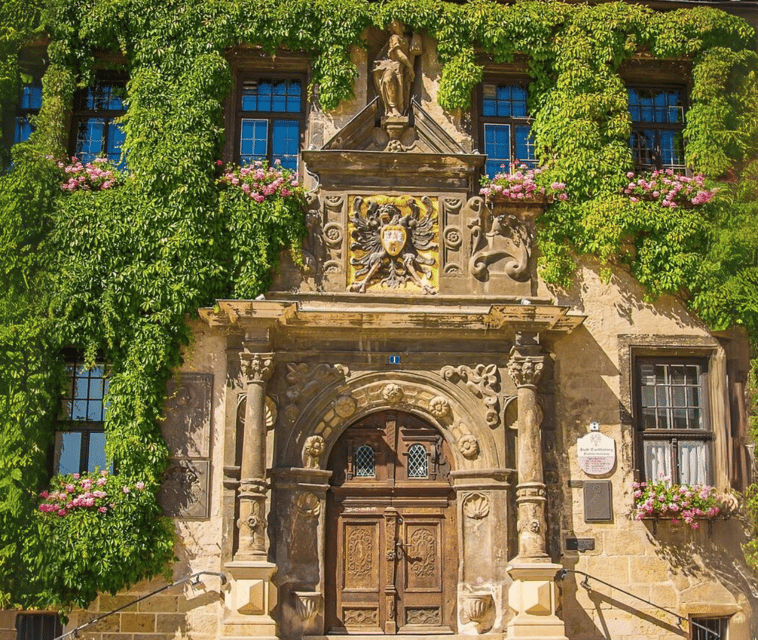
The old town section includes the market church of St. Benedikti, the Schuhhof, Hölle, Blasii Church, and the Half-Timbered Museum. The names alone hint at the pleasure of this walk: it is not only about major monuments, but also about the small streets and unusual corners that give Quedlinburg its personality.
The Schuhhof and Hölle are especially useful stops for understanding how the old town feels at street level. Here, the half-timbered houses are close together, and the route shows the variety of their designs. I would pay attention to the frames, upper stories, entrances, and changing shapes rather than simply photographing the buildings as a group.
Quedlinburg is known for its broad collection of half-timbered architecture, and this tour gives you a guided introduction rather than leaving you to guess what you are looking at. The point is not just that the houses are old. Their timber patterns and street arrangement tell you something about building traditions and the way the town developed.
The Half-Timbered Museum adds another layer. It is included in the route, but the available information does not specify how much time is spent inside or whether every exhibition area is visited. Think of it as one stop within a walking tour, not a standalone museum visit.
Blasii Church adds a religious landmark to the route. Along with St. Benedikti, it shows that Quedlinburg’s story is not limited to attractive houses. Churches, civic buildings, and private homes all sit close together, creating the layered townscape you are here to see.
Quedlinburg’s people and long timeline
The guide’s job is to connect the places you see with more than 1,100 years of local history. That broad time span matters because Quedlinburg is not presented as a frozen medieval set. The tour points you toward famous personalities from the town and includes the Klopstock-Haus on the Schlossberg route.
The information provided does not name the individual guides, so you should not expect a particular guide by name. What you can expect is a live German-speaking guide who explains the town directly and answers questions. A recent booking described the presentation as detailed, friendly, and well suited to questions, with a group size that felt comfortable.
That last point is important. In a historic town, a large group can make narrow alleys awkward and make it hard to hear. The available rating information suggests that group sizes are often manageable, but the exact maximum is not stated. I would still treat the experience as a standard guided walk rather than a guaranteed private tour.
The route also introduces famous people connected with Quedlinburg. For many visitors, this is what turns a collection of old buildings into a place with human scale. You hear who lived here, worked here, or helped shape the town’s identity, rather than receiving only dates and architectural labels.
Climbing the Schlossberg
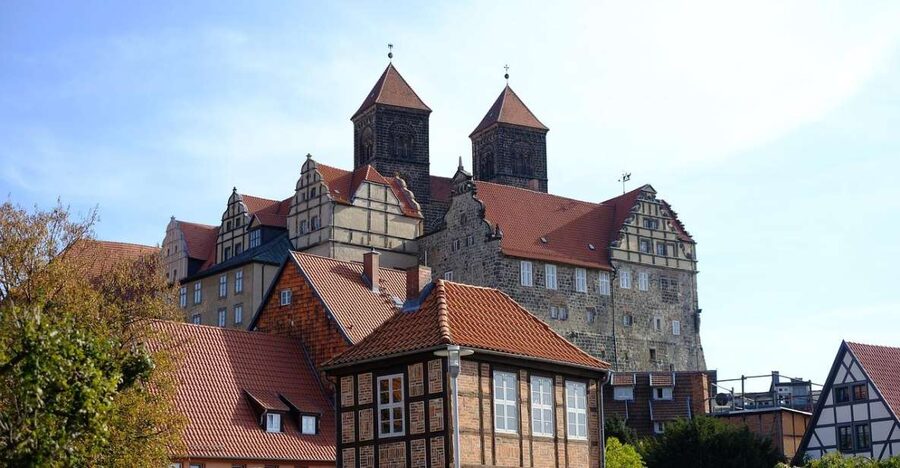
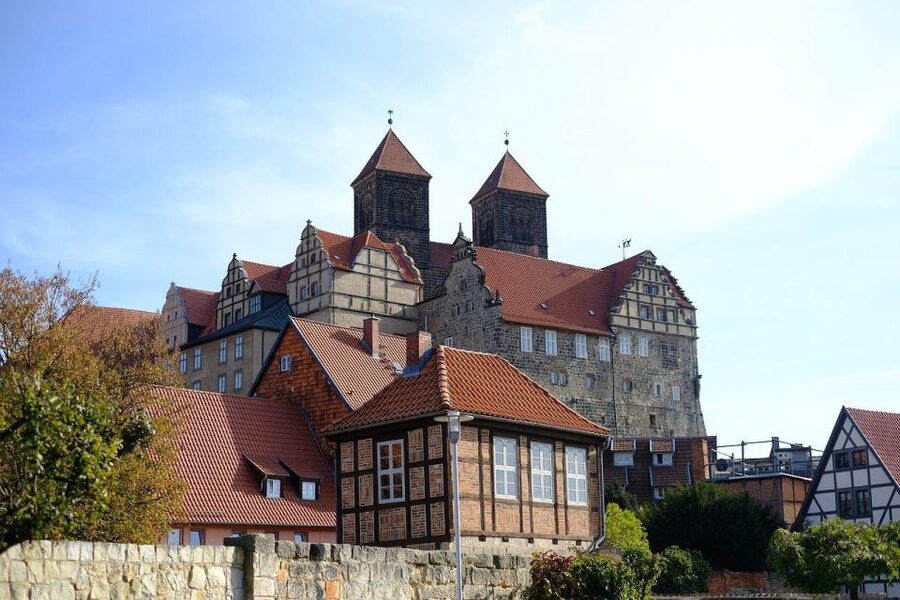
The tour’s main physical change comes when it leaves the flatter old town and heads toward the Schlossberg. This hill is the setting for the most imposing part of Quedlinburg, including the collegiate church of St. Servatii and the surrounding castle area.
You should expect a steeper section. The route also uses cobblestone paths, so good footwear matters even on a dry day. Rain can make the stones slick, and winter weather deserves special caution. One January booking was cancelled because the Schlossberg was considered too icy. The company offered a later date and issued a partial refund, but the experience shows that the hill is not a minor detail.
I like the Schlossberg section because it changes the rhythm of the walk. After the close streets and detailed house fronts, you reach a place with a larger sense of scale. The hill also gives the tour a clear climax, rather than ending with one more church in the center.
The route includes Klopstock-Haus, the Museum Lyonel-Feininger, and the Schlossgarten before reaching St. Servatii. The information does not say that admission to either museum is included, so you should not assume you will have extended indoor visits. The focus is a guided walk around the area and an introduction to its landmarks.
The Schlossgarten provides a quieter section of the route, while St. Servatii anchors the hill with its historic importance. The church is included from the outside, but interior entry is not included. If seeing the inside is a priority, ask separately about opening hours and admission arrangements.
Same city, a completely different kind of day:
- Berlin: Reichstag, Dome and Government District Guided Tour
★ 4.7 · 18,288 reviews - Berlin: 1-Hour City Tour by Boat with Guaranteed Seating
★ 4.3 · 16,993 reviews - Hamburg: Sex and Crime in St. Pauli Tour for Ages 18+
★ 4.7 · 15,447 reviews - Hamburg: 1.5-Hour Harbor and Speicherstadt Day Cruise
★ 4.6 · 14,200 reviews
St. Servatii and the missing indoor visit
St. Servatii is the highlight of the tour, but the experience does not include a visit inside the collegiate church. This distinction is easy to miss when planning. You will reach the church and learn about its role, but the listed tour ends without an interior church visit.
That is not necessarily a weakness. A two-hour route already covers the market square, several churches, old lanes, museums or museum sites, the garden, and the hill. Keeping the church interior outside the schedule may help the guide maintain a steady walking pace.
Still, you should book with the right expectation. If you want an architectural explanation of the exterior and the Schlossberg setting, this tour fits. If you mainly want to see the church’s interior, you will need separate time and possibly a separate ticket.
The hill also affects the tour’s accessibility. The information specifically warns about cobblestones and a steep section, but it does not provide detailed wheelchair or mobility guidance. If you have difficulty with uneven surfaces or inclines, contact the provider before booking rather than assuming the full route will be comfortable.
Food advice after the walking tour
The tour includes a presentation of culinary spots and recommendations. This is a small feature, but I find it useful because a two-hour walk usually leaves you ready for a meal, coffee, or a snack. You get local orientation at the same time as the historical tour.
The advice may be especially helpful in quieter seasons. One January booking described Quedlinburg as unusually quiet, with many restaurants closed at the same time and limited lunch options. That is a seasonal warning, not a reason to reject the tour, but it does mean you should check dining hours if you visit in January.
The tour does not include food or drinks, and no restaurant meal is promised. Treat the culinary section as recommendations, not a tasting experience. Its value is practical: you can ask the guide where to eat after you finish rather than wandering around hungry.
Because the tour begins and ends in the central historic area, you can use the recommendations immediately. The provided details do not specify the exact ending point, so I would plan for the walk to finish somewhere around the old town or Schlossberg area rather than count on a precise restaurant doorstep.
Is $10 good value?
At the stated price of $10 per person, the tour offers strong value if you want context instead of a self-guided stroll. Two hours with a live guide covers the market square, town hall, churches, half-timbered streets, museum sites, Schlossgarten, and Schlossberg. You also receive food suggestions and historical background.
The value is even better for families because children and adolescents up to age 16 are free. A family can see the core old town and hill without paying a full adult price for every member.
You are paying for access to interpretation, not for museum admission or a church interior visit. The tour is also in German only. If you cannot follow German, the low price may not translate into good value because much of what you are buying is the explanation.
The rating of 4.4 from 627 bookings points to a generally dependable experience, while the written comments highlight the friendly delivery, detailed content, and opportunity to ask questions. The one serious issue in the supplied feedback concerns a winter cancellation and confusion over the refund amount. I would keep the booking terms and payment record, especially if poor weather is forecast.
Free cancellation is available up to 24 hours before the start for a full refund, and you can reserve now and pay later. Those options help if your schedule is unsettled, but they do not remove the risk of a same-day weather problem on an icy Schlossberg.
Who should book this Quedlinburg walk?
I would choose this tour if you are visiting Quedlinburg for the first time and want a clear introduction before exploring alone. It suits anyone who enjoys architecture, local stories, old churches, and historic streets, especially if half-timbered buildings are a main reason for your visit.
Families get excellent value from the free admission for children through age 16. The two-hour length is also easier to fit around meals and other sightseeing than a longer walking program.
This is a good match for visitors who can follow German and are comfortable walking on uneven stone surfaces. You should be ready for an uphill section and for the tour to continue in rain or sunshine.
I would hesitate if you need a fully accessible route, want to see St. Servatii from inside, or require an English-language guide. I would also check the weather carefully in winter. The route can be cancelled if the Schlossberg becomes unsafe, and the hill is central to the experience.
Should you book it?
Book this tour if you want a low-cost, well-rounded introduction to Quedlinburg, with equal attention to half-timbered lanes, public buildings, historic churches, local personalities, and the Schlossberg. The detailed explanations, question-friendly format, free child places, and food recommendations make it more useful than simply wandering with a map.
Before paying, confirm that German is suitable for you and that the uphill cobblestone route fits your ability. Do not book it mainly for the interior of St. Servatii, since that is not included. If those limits work for you, this is a sensible two-hour orientation and a strong way to get your bearings in one of Germany’s most distinctive old towns.
FAQ
Where does the tour begin?
It begins at the Quedlinburg city information office on Quedlinburger Marktplatz. Look for the green city information sign and show your ticket to the guide.
How long does the tour last?
The walking tour lasts two hours.
What language is the tour in?
The live tour guide speaks German. No other tour language is listed.
What places are included in the old town section?
The old town route includes the town hall, market church of St. Benedikti, Schuhhof, Hölle, Blasii Church, and the Half-Timbered Museum.
What places are included on the Schlossberg?
The Schlossberg section includes Klopstock-Haus, the Museum Lyonel-Feininger, Schlossgarten, and St. Servatii collegiate church.
Can I go inside St. Servatii during the tour?
No. The interior of St. Servatii collegiate church is not included.
Are children charged for the tour?
Children and adolescents up to age 16 join free.
Does the tour run in bad weather?
Yes. The tour takes place in rain or sunshine, although unsafe conditions on the Schlossberg can affect the schedule.
Is the route suitable for everyone?
The route includes cobblestone paths and a steeper section on the Schlossberg. The available information does not give more detailed accessibility guidance.
Can I cancel the booking?
You can cancel up to 24 hours before the tour for a full refund. You can also reserve the tour and pay later.
Just added in Germany
- Berlin & The Third Reich Private Guided Tour★ 5.0 · 3 reviews
- Third Reich Quest Experience in Berlin★ 4.5 · 7 reviews
- Private Analogue Photography Experience in Berlin★ 5.0 · 3 reviews
- Berlin Urbex Adventure and History Tour★ 5.0 · 9 reviews
- The Beauty of Berlin by Bike: Private Tour★ 5.0 · 59 reviews
- Berlin: Guided Bike tour of the Berlin Wall and Third Reich★ 5.0 · 160 reviews
- Beyond Currywurst: Berlin’s Hidden Street Food & Culture Tour★ 5.0 · 100 reviews
- Berlin Third Reich & Cold War Walking Tour With A Guide★ 5.0 · 7 reviews
Old Town Tours, compared.

Old Town & Viktualienmarkt City Walk in German
Read our review →
The Night Watchman Old Town Walking Tour in German
Read our review →
New Old Town and Highlights German-Language Tour
Read our review →Browse the lists this tour appears in