
Reviewed · NIGHT WATCHMAN TOURS
Munich: Middle Ages Tour with Night Watchman
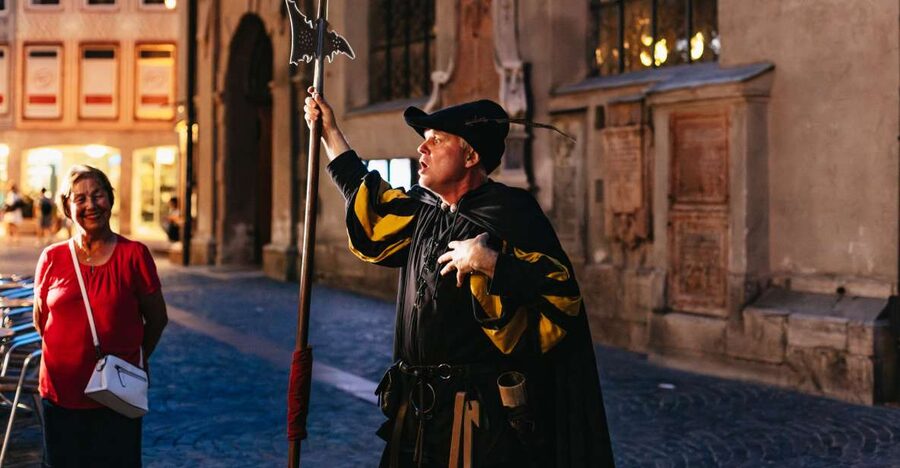
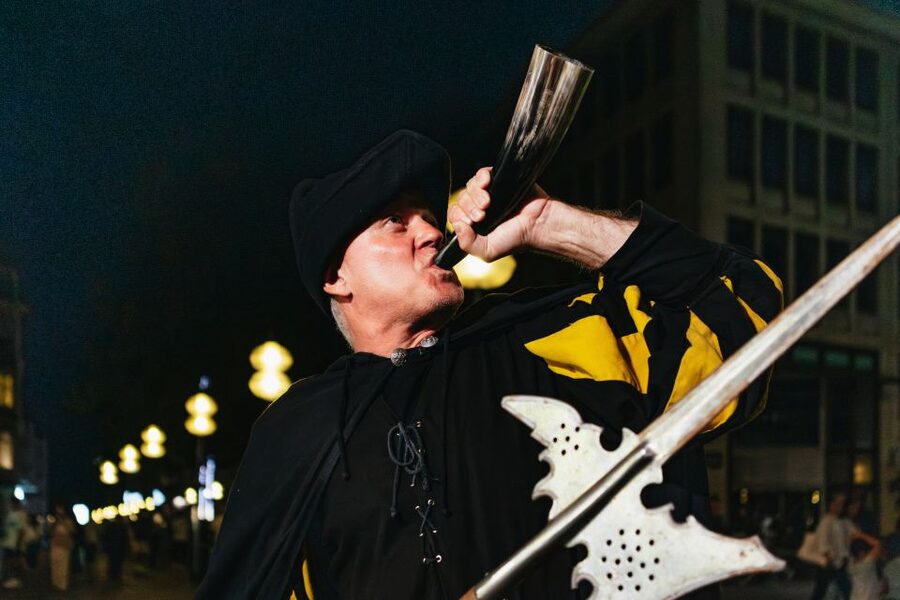
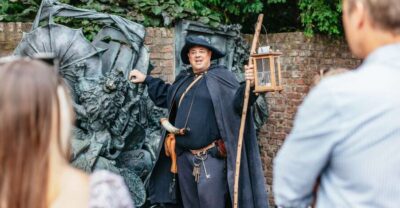
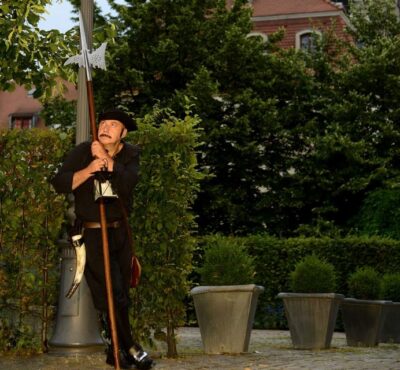
Medieval Munich comes alive through Wolfram the night watchman, who carries a lantern, halberd, and horn as he leads you from Marienplatz into stories of executions, punishments, church rites, and guarded gates. This is history with a sharp edge, not a polite parade of old buildings.
I like the way the tour uses real city landmarks, especially the remains of the 12th-century wall and the old gates. I also like its lively presentation. Wolfram answers questions and keeps the 90 minutes moving, according to the supplied guest feedback. The main limitation is that the tour is in German only, and the grim subject matter will not suit young children or anyone looking for a gentle city walk.
Key points at a glance
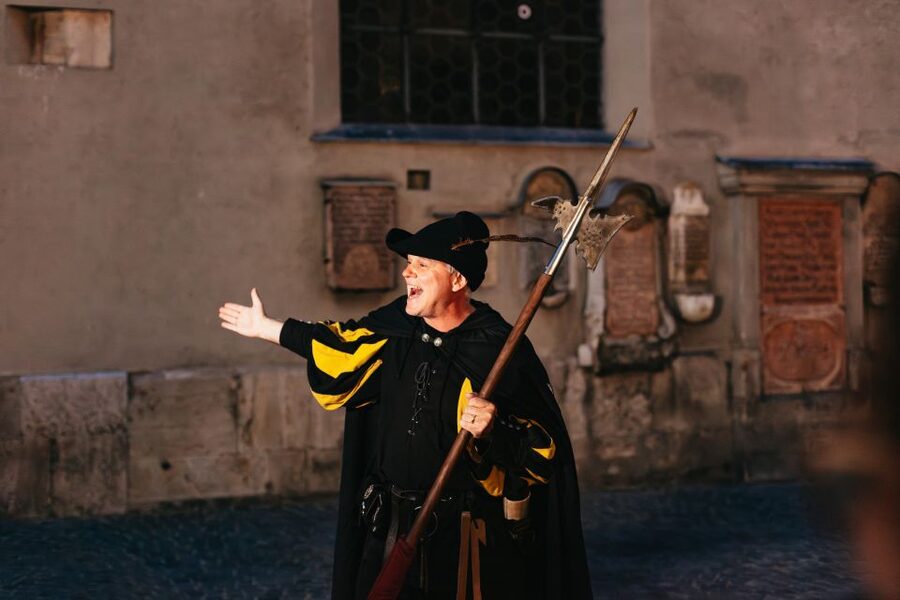
- Wolfram’s medieval costume and weapons: A lantern, halberd, and horn give the walk a theatrical frame without needing special effects.
- Grim but useful history: Learn how medieval Munich handled executions, torture, prison discipline, and punishment for bad bakers.
- Historic route through the old center: The walk links St. Peter’s Church, Viktualienmarkt, the Old Town Hall, Alter Hof, Marienhof, Frauenkirche, and former city gates.
- Strong value at $21: For 90 minutes with a live guide and a private-group option, the price is modest for central Munich.
- German-language storytelling: You’ll get the full experience only if you can follow spoken German.
- Rain-or-shine planning: Wear shoes and clothing suited to weather, since the tour goes ahead outdoors in poor conditions.
Meeting Wolfram at Marienplatz
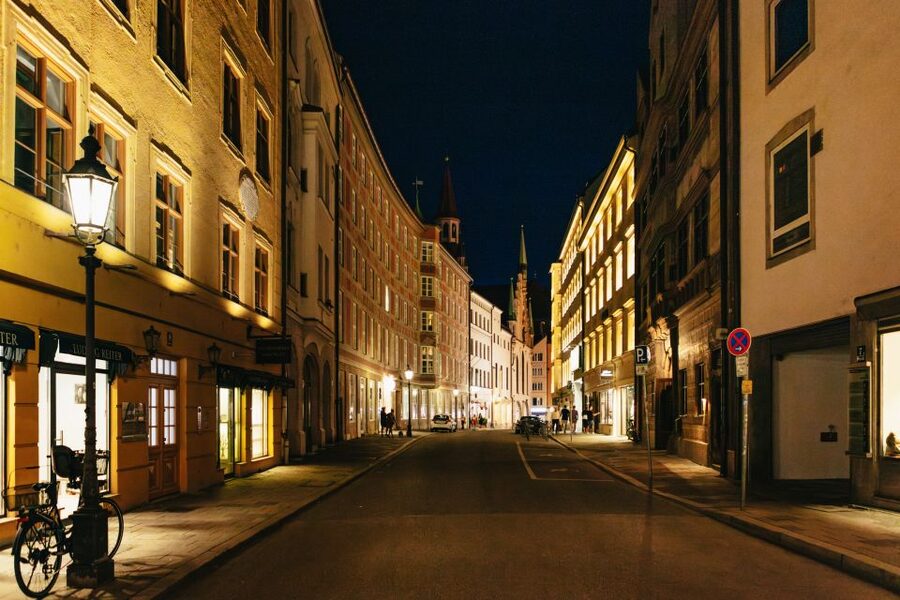
Your meeting point is in front of Rathaus Apotheke at Marienplatz, about 25 meters to the left of number 8. The listed GPS position is 48.13737, 11.57588. Look for a guide in typical medieval clothing rather than for a large tour sign.
This is a busy central square, so give yourself a few minutes to get oriented. Marienplatz has several prominent buildings and entrances, and the pharmacy reference is more useful than simply searching for a person in costume among the crowds.
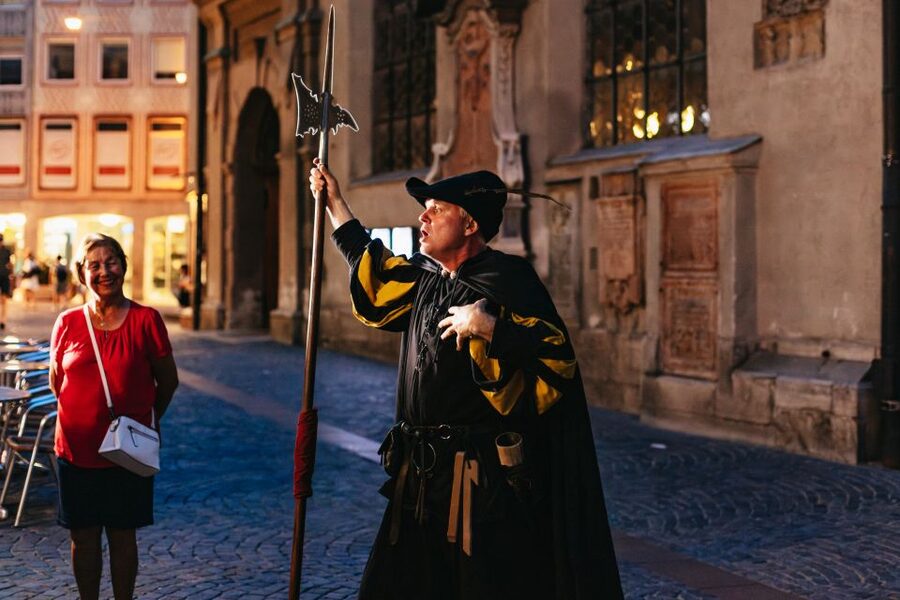
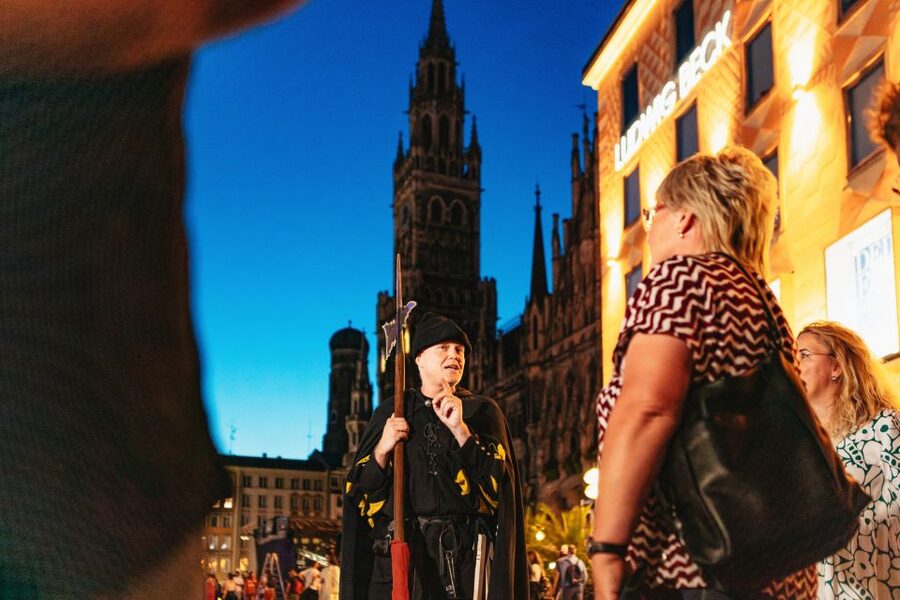
Wolfram’s outfit is part of the experience. The lantern, halberd, and horn help establish the role of a watchman, a figure whose work once involved guarding streets, gates, and public order. You are not just walking behind a guide with a microphone. The costume gives the stories a clear point of view.
The name night watchman can be slightly misleading if you are expecting a tour that always takes place after dark. Starting times vary, so check the available departure when booking. The character and subject matter remain medieval even if your walk begins before sunset.
More Night Watchman Tours in Munich
- Munich: Night Watchman Walking Tour
★ 4.7 · 2,092 reviews - Munich: Night Watchman Torch Tour in German
★ 4.8 · 1,280 reviews - München: Der Nachtwächter für Kinder – Führung auf Deutsch
★ 5.0 · 322 reviews
St. Peter’s Church and the smell of old ritual
The first major stop is St. Peter’s Church, Munich’s historic parish church. The visit includes about ten minutes of guided attention, and the focus is not simply on architecture. You hear about religious life, death, and the way church spaces shaped daily life in medieval Munich.
The tour also refers to the ancient remains of the church and the incense associated with worship. That detail matters because medieval history was not lived only in town halls and fortifications. It was felt through bells, burial places, religious ceremony, and the strong presence of the church.
The schedule allows two ten-minute portions at St. Peter’s. In practical terms, expect the church to receive more attention than a quick passing glance, though the precise flow may depend on the guide and conditions at the site.
This stop also sets the tone. The walk is interested in the uncomfortable parts of the past, including cemeteries and death. If you prefer your sightseeing cheerful and light, you may find the material heavy. If you want to understand how punishment and religion fit together in medieval life, this is a useful beginning.
Viktualienmarkt and the punishment of bad bakers
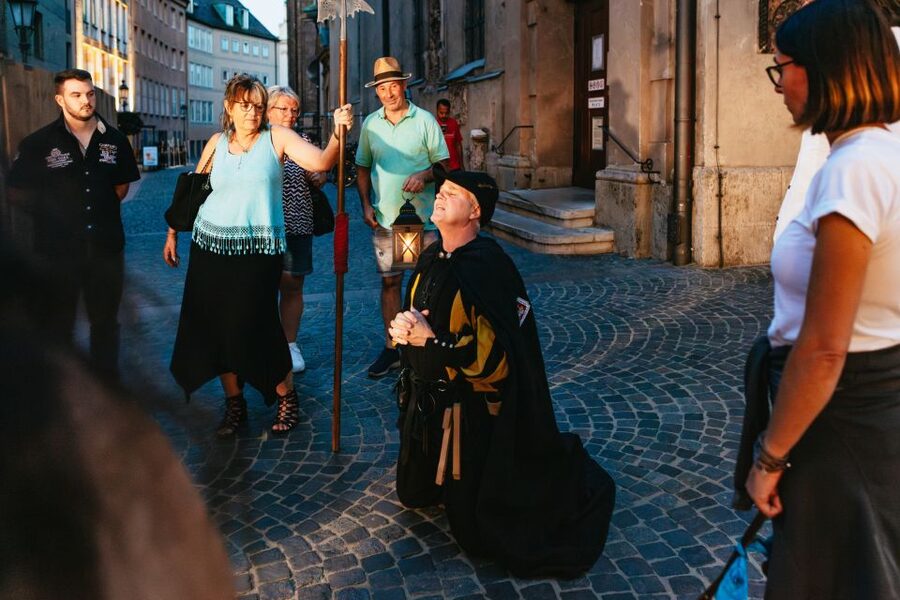
From St. Peter’s, the route continues to Viktualienmarkt. Today, the market is one of Munich’s best-known central food areas, but the tour uses the location to explain older trade rules and public punishment.
One memorable story concerns bad bakers. Medieval authorities watched food production closely, and a baker who supplied poor bread could face punishment. The subject gives you a direct link between city government and ordinary meals. Bread was not a luxury item. It was a basic part of life, so dishonest or careless baking could become a public matter.
This is one of the tour’s better choices because it moves beyond kings, walls, and battles. You get a glimpse of how the city dealt with working people, merchants, and tradesmen. The mention of silver pennies adds another everyday detail, showing how money, trade, and regulation formed part of the medieval street scene.
Viktualienmarkt is also a sensible place to notice the contrast between modern Munich and the old city. You are surrounded by contemporary commerce, yet the guide points to earlier systems of work and punishment beneath the familiar center.
The Old Town Hall and public authority
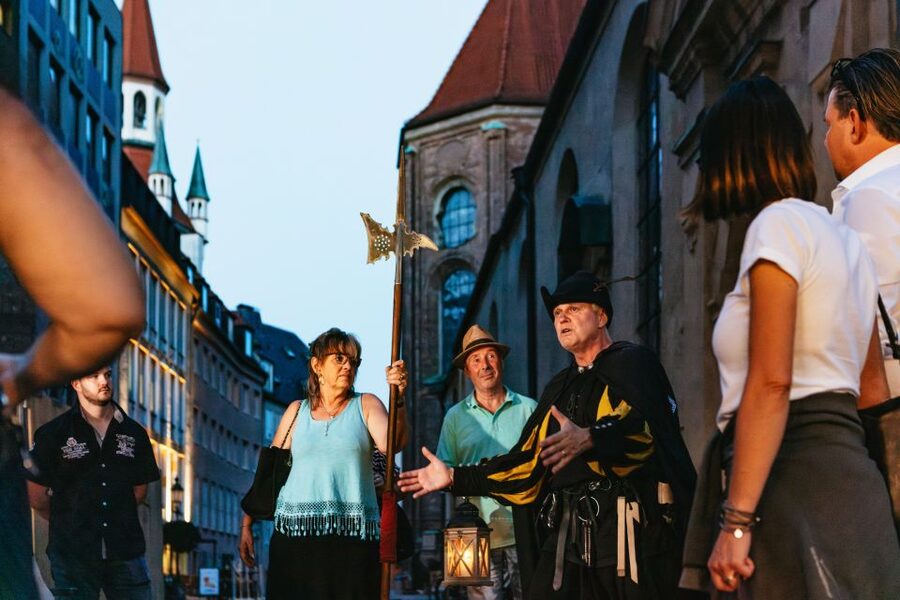
The route then reaches the Old Town Hall. Here, the stories shift toward civic power and public order. Munich’s leaders needed rules, guards, courts, and visible punishment to control a growing town.
You hear about interrogations and executions, subjects that show how authorities dealt with crime before modern policing and courts. The tour does not treat medieval punishment as a quaint curiosity. It presents a society where justice could be public, physical, and frightening.
The Old Town Hall is a good place for this part of the story because it represents government in the middle of the city. Medieval authority was not distant. It worked through visible buildings, officials, gates, markets, and ceremonies.
You should expect storytelling rather than a museum-style display of objects. The tour includes references to ancient artifacts, silver pennies, and old practices, but it is primarily a walking performance led by Wolfram. That makes the pace lively, though anyone hoping to spend a long time examining individual objects may want a separate museum visit.
Same city, a completely different kind of day:
- Munich: Third Reich & WWII Walking Tour
★ 4.6 · 6,181 reviews - Dachau Concentration Camp Memorial Site Tour from Munich by Train
★ 4.5 · 5,637 reviews - Third Reich Walking Tour Munich
★ 4.5 · 4,291 reviews - Munich Hop-On Hop-Off Tour: 1-Day or 2-Day Ticket
★ 4.3 · 4,161 reviews
Alter Hof and the old seat of power
At Alter Hof, the route turns to Munich’s former castle area. The name means Old Court, and the location helps connect the city’s civic life with the rulers who shaped it.
This stop gives Wolfram room to discuss the castle and the relationship between the town and its ruling authority. Medieval Munich was not simply a collection of craftsmen and market stalls. It was also a defended settlement tied to political power.
The castle material adds variety after the darker discussion of punishments. You still hear about control and danger, but the focus broadens to the structure of the city itself. A watchman’s world included walls and weapons, yet it also depended on the court and the people who governed.
The route is central and compact, which helps explain how the tour covers so much in 90 minutes. You do not spend a long time at any one attraction. Instead, Wolfram uses several nearby places as chapters in one story.
Marienhof, city walls, and the guarded gates
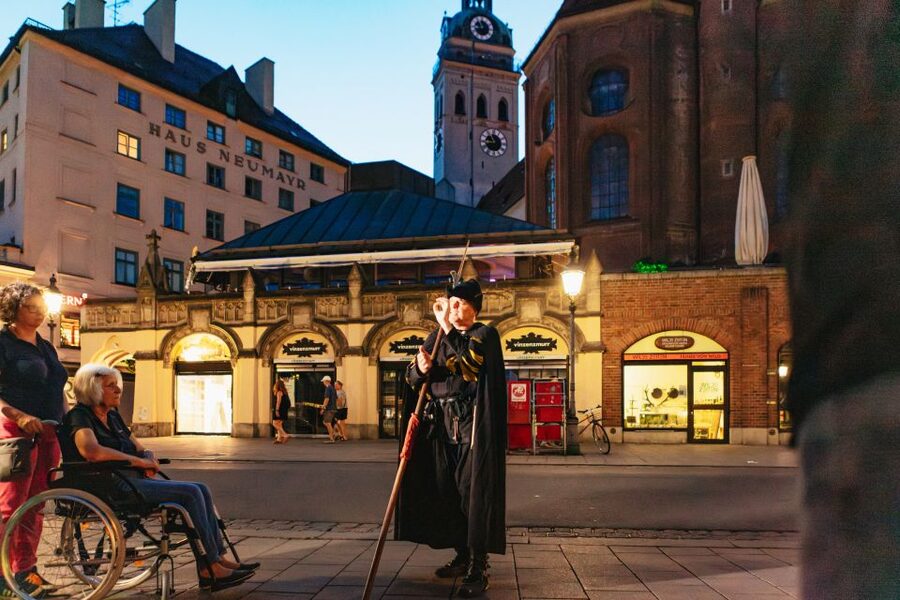
Marienhof brings the story back to Munich’s defenses and open civic spaces. The tour includes the 12th-century city wall, one of the most important physical clues to the medieval town.
Walls are easy to overlook in a modern city. Buildings change, streets widen, and old defensive lines fade into ordinary urban space. Wolfram helps you picture Munich as a smaller settlement with controlled entrances, watchmen, and a clear boundary between inside and outside.
The route also covers Talburg Gate, including the closing of the gate and a staged fight with a halberd. This is one of the most theatrical moments. The halberd was not just a prop in the watchman’s hand. It signals the kind of weapon associated with guarding and close combat.
You should view this as historical interpretation with a performance element, not a full combat demonstration. The short scene helps make the gate’s function clear, while the surrounding explanation gives it context.
The tour also refers to the Schwabinger Gate. Hearing about more than one entrance helps you understand that medieval Munich had a network of controlled approaches rather than a single dramatic doorway. Gates regulated movement, protected the town, and could be closed at night.
Torture, prison life, and the darker side of the walk
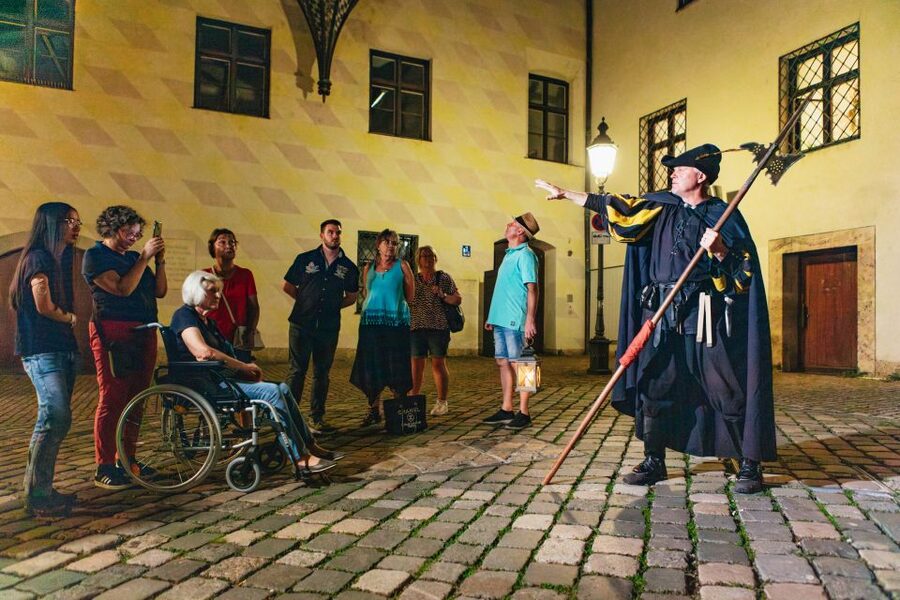
The most intense part of the tour concerns medieval prisons and torture techniques. The subject is presented as part of the city’s legal history, not as a separate horror show.
You will hear about interrogation methods and the punishments used against people accused of wrongdoing. The stories can be disturbing, especially when combined with executions and beheadings. This is why the age limit of 12 is worth taking seriously.
I appreciate the fact that the tour does not hide the unpleasant side of medieval life. Many city walks mention walls and churches but skip the way authority was enforced. Here, punishment is part of the explanation of how the city worked.
Still, you should choose this walk for its subject, not merely for the costume. If your interest is mainly scenic photography, shopping, or church interiors, another Munich tour may suit you better. Flash photography and video recording are not allowed, so you should plan to listen rather than document every moment.
Frauenkirche and the final stretch
The route includes Munich Frauenkirche, one of the city center’s most recognizable churches. This stop brings the walk back to religious architecture and the public face of medieval Munich.
After hearing about cemeteries, executions, and church ritual, the Frauenkirche helps round out the picture. Medieval religion was tied to public life, authority, death, and community identity. The church was not simply a monument to admire. It was part of the mental and social center of the city.
The tour finishes back at Rathaus Apotheke am Marienplatz. That circular route is convenient. You end where you began, with no need to arrange transport from an unfamiliar neighborhood.
The schedule gives roughly ten minutes at each named stop. That is enough for a focused explanation, but not enough for a full interior tour of every church or a detailed architectural study of each building. Think of the walk as a connected story across Munich’s old center.
What $21 buys you
At $21 per person, this is a reasonably priced way to spend 90 minutes in central Munich. You are paying for a live guide, a themed performance, and a route that links several historic locations. You are not paying for food, drinks, museum entry, or a long formal visit inside each attraction.
The value depends heavily on your language skills. The guide speaks German, and the stories are the main product. If you understand German well, the price is attractive because the costume, props, and character give the walk more shape than a basic orientation stroll.
A private group is available, which may make the experience more appealing for families with older children, friends, or a small group that wants a more personal pace. The standard details do not specify the private-group price, so check that before choosing it.
The 4.9 rating from 652 reviews suggests a consistently well-received experience, and the strongest praise centers on Wolfram’s lively, entertaining, and well-informed presentation. One German guest specifically described the walk as both interesting and pleasantly fast-moving. Another noted that Wolfram gave well-grounded answers to questions.
That is important. A costume alone can become a gimmick. Here, the value lies in the combination of character and substance. You get a guide who can entertain while still answering questions with detail.
Who should book this walk
I would recommend it to adults and older children who enjoy local history with a dark edge. It suits you if you like hearing how ordinary rules, punishments, religious customs, and city defenses shaped daily life.
It is also a good choice for someone who has already seen Marienplatz and wants to look at familiar Munich landmarks differently. The route does not take you far from the center, but it changes what you notice in that center.
German speakers will get the most from it. Because there is no English-language option listed, you should not book it hoping to follow through gestures and scenery alone.
The tour is wheelchair accessible, which is useful for a central walking experience. Even so, the walk takes place outdoors and continues rain or shine. Choose practical clothing and footwear. The duration is only 90 minutes, but weather can affect your comfort quickly.
Children under 12 are not suitable for this activity. The age rule makes sense given the treatment of beheadings, torture, executions, and prison punishment.
Helpful planning details before you go
Meet in front of Rathaus Apotheke, roughly 25 meters left of number 8, and look for medieval clothing. Enter the GPS coordinates into Google Maps if the square feels confusing.
Check the departure time carefully. The title uses the night watchman tradition, but the available start time determines how much darkness, evening atmosphere, or daylight you actually get.
Food and drinks are not included. You can plan a snack or meal separately, but do not expect the tour itself to pause for refreshments.
You can cancel up to 24 hours in advance for a full refund, and reserve now while paying later. Those terms are useful if your Munich plans are still shifting.
No flash photography or video recording is allowed. A phone or camera may be useful for quiet, permitted photographs, but the walk asks you to give your attention to the guide and the streets around you.
Should you book the Munich Middle Ages Tour?
Book it if you want a short, vivid look at medieval Munich that includes the city’s uncomfortable subjects. Wolfram’s costume, lantern, halberd, and horn create a strong frame, while the route gives you church remains, walls, gates, markets, castle grounds, and public buildings in one compact walk.
Skip it if you need English commentary, want a calm architectural tour, or dislike stories about torture and executions. Also skip it if you expect a full museum visit or long time inside every church.
For German-speaking history fans, the $21 price is easy to justify. You get a central route, a memorable guide character, and a clear explanation of how medieval Munich protected itself, worshipped, traded, judged, and punished. That is a good deal for 90 minutes, especially when you want history with a little theatrical bite.
FAQ
Where does the tour begin?
Meet in front of Rathaus Apotheke at Marienplatz, about 25 meters left of number 8. The GPS coordinates are 48.13737, 11.57588.
How long does the tour last?
The walking tour lasts 1.5 hours, or 90 minutes.
Who leads the experience?
Wolfram leads the tour as a medieval night watchman. He wears medieval clothing and carries a lantern, halberd, and horn.
What language is the tour in?
The live tour guide speaks German. No other guide language is listed.
Is the tour suitable for children?
Children under 12 are not suitable for this activity. The tour includes executions, beheadings, torture, interrogations, and medieval punishments.
Is the tour wheelchair accessible?
Yes, the activity is listed as wheelchair accessible.
What happens if it rains?
The tour takes place rain or shine, so dress for the weather.
Are food and drinks included?
No. Food and drinks are not included in the price.
Can I take photographs or record video?
Flash photography and video recording are not allowed.
Can I cancel the booking?
Yes. You can cancel up to 24 hours in advance for a full refund. You can also reserve now and pay later.
Just added in Munich
- Private transfer: Vilshofen to Munich with 2h sightseeing stop★ 5.0 · 6 reviews
- Pub crawl incl. Oktoberfest museum guided tour with beer tasting (private)★ 5.0 · 5 reviews
- South Tyrolean specialties and wine tasting★ 5.0 · 5 reviews
- Size Matters Beer Tour Munich★ 4.6 · 105 reviews
- Short & sweet: Tasting the Viktualienmarkt★ 4.8 · 37 reviews
- Secret Food Tours Munich★ 4.8 · 5 reviews
- Munich: Romantic Wine Experience for Two at Viktualienmarkt★ 4.2 · 14 reviews
- Munich: Resistance against Hitler – Historical Walking Tour★ 5.0 · 5 reviews
Night Watchman Tours, compared.
The Original Night Watchman Tour in Lantern Light
Read our review →
The Night Watchman Old Town Walking Tour in German
Read our review →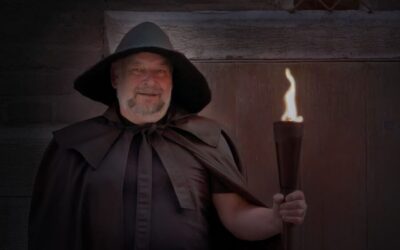
Tour of the Baroque Quarter with a Night Watchman
Read our review →
Browse the lists this tour appears in