
Reviewed · OLD TOWN TOURS
Frankfurt: Highlights and New Old Town English-Language Tour
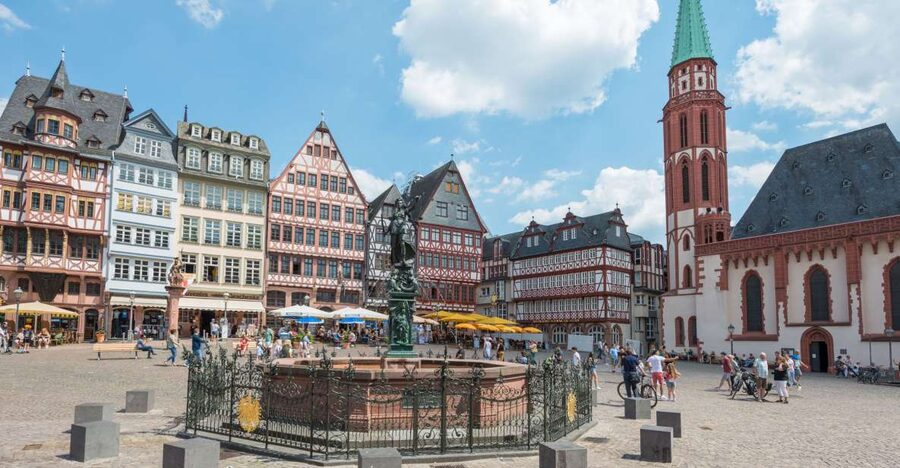
Frankfurt’s New Old Town is the star here: a compact district of reconstructed half-timbered houses, narrow lanes, and historic-looking squares beside the modern banking center. The tour also brings you to the Römer, St. Paul’s Church, the Eiserner Steg footbridge, and views toward the Museum Embankment.
I like the 90-minute length, which gives you a useful first look without taking half a day. I also like the mix of visual stops and clear historical explanation. Guides such as Alexander, Lili, Lutz, and Gabriella have been praised for keeping the talk lively, with humor and stories that work for teenagers as well as adults.
The main thing to keep in mind is the title. This is centered on the reconstructed old town, not an all-encompassing tour of every major Frankfurt sight. On a very hot day, the mostly outdoor route can also feel tiring, especially if the group is large.
Key points to know before booking
- The reconstructed New Old Town takes center stage: See half-timbered buildings and winding lanes rebuilt to recall Frankfurt’s historic center.
- The Römer is both meeting point and major sight: Start in front of Frankfurt’s city hall on the 700-year-old Römerberg.
- The history is delivered at an easy pace: The route includes walking and standing, with time for questions and photographs.
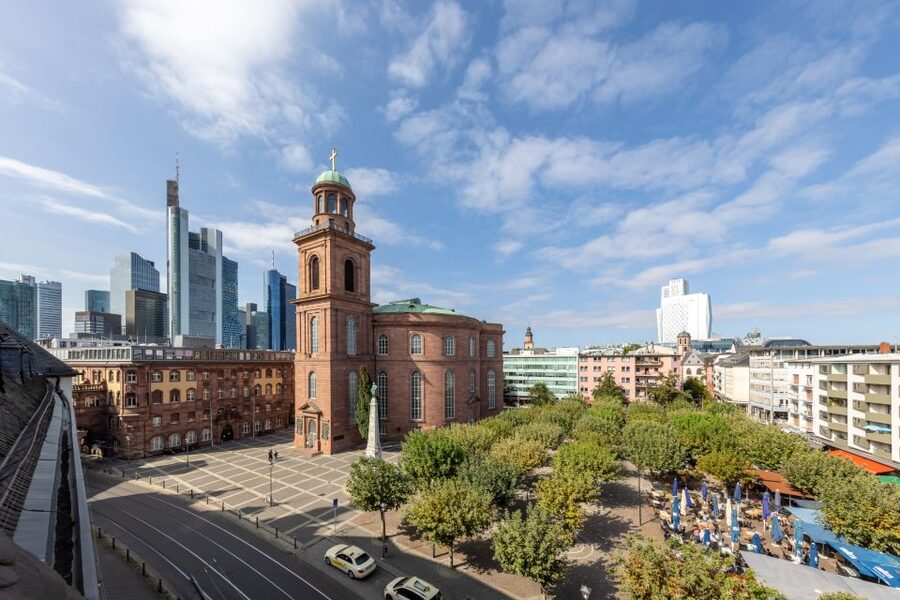
- St. Paul’s Church adds political context: Learn why this church matters to the development of democracy in Germany.
- Eiserner Steg gives you a classic photo stop: The distinctive iron footbridge offers views toward the river and Frankfurt’s skyline.
- The tour costs $21 per person: That is fair value for a certified English-speaking guide and a focused introduction to central Frankfurt.
Starting at the Römer and the 700-year-old Römerberg
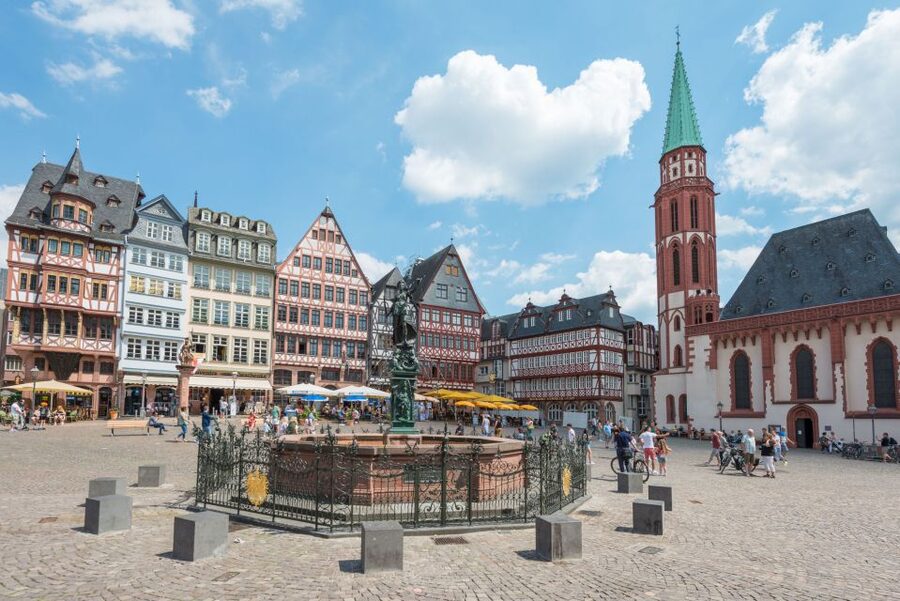
Meet your English-speaking guide in front of the Tourist Information Office Römer, directly by Frankfurt’s city hall. This is a sensible starting point because the Römerberg gives you an immediate sense of how old Frankfurt and modern Frankfurt sit side by side.
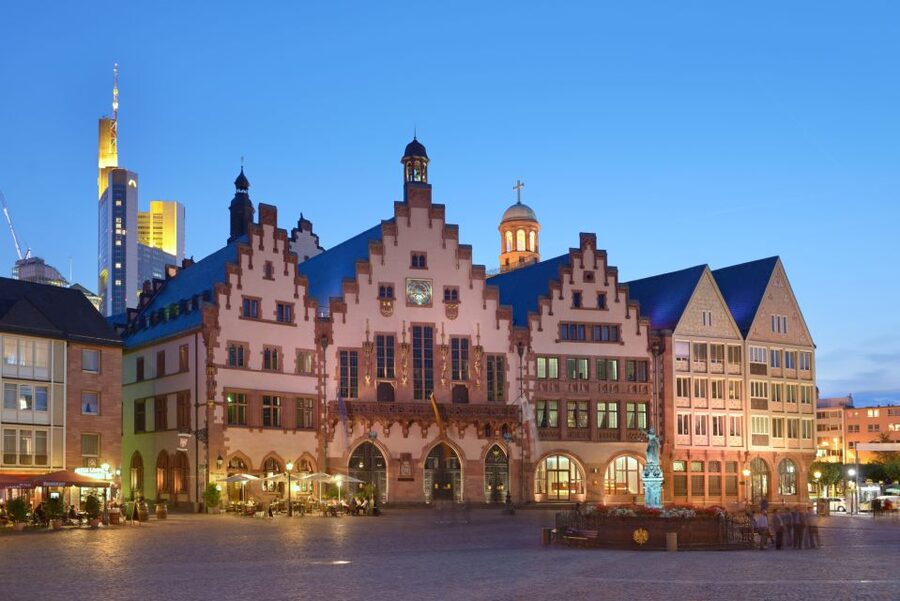
The Römer is one of the city’s best-known buildings. Its stepped front and central position make it easy to recognize, and its setting on Römerberg gives the opening minutes some drama. The square itself has been tied to Frankfurt’s public life for centuries, though much of the surrounding area was rebuilt after wartime destruction.
You will not simply be looking at a pretty façade. The guide uses the square to explain how Frankfurt developed, how the center changed over time, and why the city has chosen to rebuild parts of its former appearance. That background helps you understand the New Old Town instead of seeing it as a collection of attractive buildings with no context.
The meeting point is central and easy to identify, but arrive with enough time to find the Tourist Information Office. The tour begins in a busy part of Frankfurt, and a few extra minutes will make the start less rushed.
More Old Town Tours in Frankfurt
- Frankfurt: New Old Town and Highlights German-Language Tour
★ 4.7 · 1,316 reviews - Guided Axe Throwing Experience in Frankfurt Altstadt
★ 5.0 · 93 reviews - Frankfurt: Old Town Highlights Private Walking Tour
★ 5.0 · 44 reviews
Walking into Frankfurt’s reconstructed New Old Town
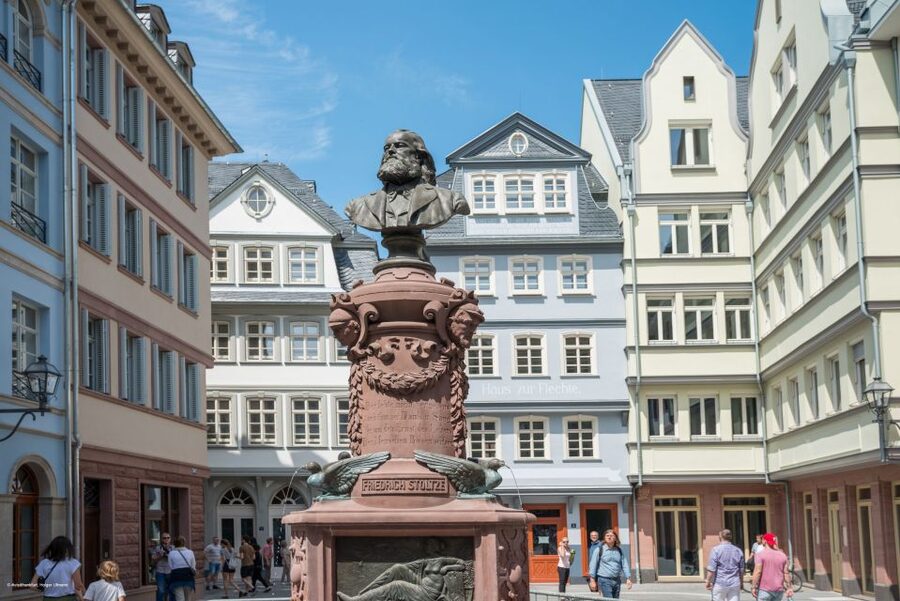
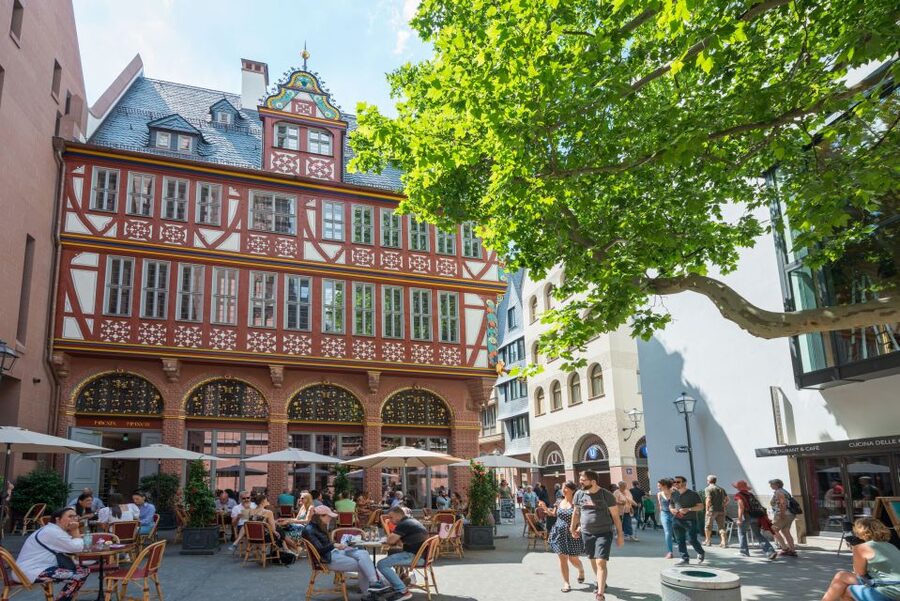
From Römerberg, the tour moves into the New Old Town, the rebuilt district at the heart of the experience. Here you see half-timbered façades, small lanes, courtyards, and buildings designed to recall Frankfurt’s prewar center.
The important point is that this is a modern reconstruction, not an untouched medieval quarter. That makes the area interesting in a different way. You are looking at a city making a deliberate choice about how to remember its past while still functioning as a present-day city.
A good guide can make this distinction clear, and the best departures appear to do so through old photographs and before-and-after comparisons. Those images are especially useful because they let you compare what you see with the streets and buildings that once occupied the same space.
The lanes make a pleasant change from Frankfurt’s broad commercial streets and office blocks. You get a closer look at decorative details, rooflines, and the way the buildings frame public spaces. The route is not built around a long march. It includes regular pauses for explanation, which helps you stay with the story.
One past guide, Alexander, was praised for finding a good balance between fun facts and serious history. That balance matters here. A talk that focuses only on dates can make rebuilt architecture feel flat, while a tour that treats the area as a fairy-tale set misses the complicated story behind it.
Frankfurt Cathedral and the layers of the old center
The route also takes in Frankfurt Cathedral, one of the major landmarks near the New Old Town. The cathedral adds scale to the tour after the smaller houses and narrow lanes.
The stop helps connect the city’s religious, civic, and commercial sides. You see how closely the main parts of the old center sit together, with the cathedral, Römerberg, and reconstructed streets all within a compact walking area.
The tour does not include an advertised interior visit or a long guided examination of the cathedral. Think of it as an exterior highlight and part of the wider walk. If you want a detailed visit inside, you should plan separate time around the tour.
This is one reason the experience works well on a first day in Frankfurt. It gives you a map in your head. Afterward, you can return to the places that caught your attention and spend more time inside the cathedral or among the old-town buildings.
St. Paul’s Church and the story of German democracy
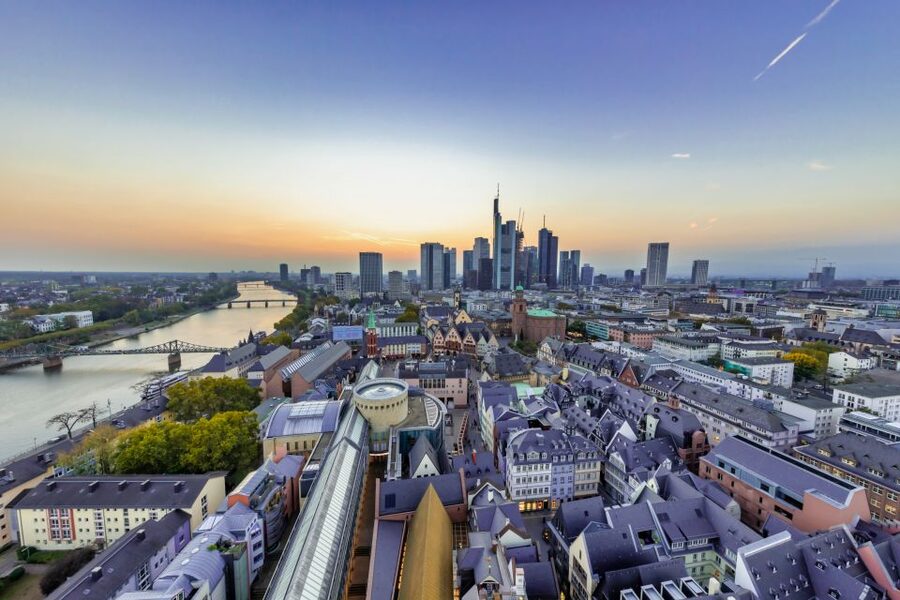
St. Paul’s Church brings a different kind of history to the route. The guide explains its connection with the beginnings of democracy in Germany, giving the tour a political dimension beyond architecture and city planning.
That context makes the stop valuable even if you are not especially interested in churches. St. Paul’s is presented as a place linked to public debate and national political development, not only as a religious building.
The short format means you should expect a clear introduction rather than a full seminar on German constitutional history. Still, this is the sort of stop that can change how you see the city. Frankfurt is often introduced through finance, trade fairs, and its airport, but this part of the tour points to its role in civic life.
Guides have been praised for answering questions and adding stories rather than reciting a script. Lutz, for example, was noted for giving a lively narrative. That style is useful at St. Paul’s, where the significance depends more on explanation than on visual spectacle.
Same city, a completely different kind of day:
- Frankfurt: River Main Sightseeing Cruise with Commentary
★ 4.3 · 5,127 reviews - Frankfurt: Hop-On, Hop-Off Grand or Express Bus Ticket
★ 3.9 · 2,088 reviews - Frankfurt: 1-Hour Panorama Boat Cruise on the river Main
★ 4.4 · 1,822 reviews - Frankfurt Highlights English Walking Tour
★ 5.0 · 1,203 reviews
Crossing the Eiserner Steg for skyline views
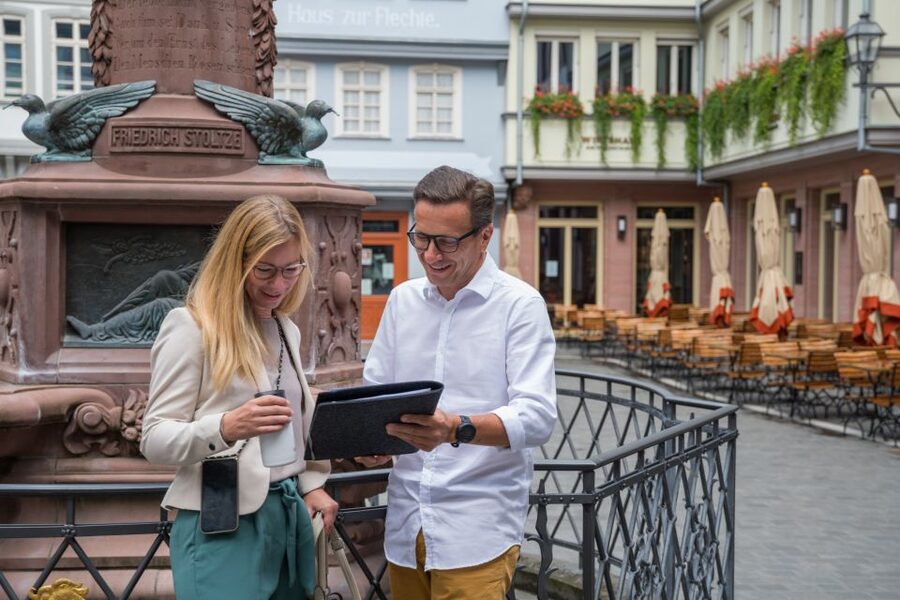
The Eiserner Steg is one of the tour’s most recognizable photo stops. This iron footbridge crosses the Main and is popular for its distinctive structure and views back toward the city.
From the bridge, you can look toward Frankfurt’s skyline, including the contrast between the old center and the tall modern buildings farther away. It is a simple but effective visual summary of Frankfurt: reconstructed historic streets on one side, a major business city on the other.
The bridge also gives the walk a change of rhythm. Instead of pausing in a square or beside a building, you are moving through an open space with river views. Bring a camera or phone, but keep in mind that the bridge is popular and may feel busy at the photo points.
The route includes the bridge as part of the walking tour, not as a long riverside outing. You should expect a brief stop for views and explanation rather than an extended walk along the Main.
A glimpse of the Museum Embankment
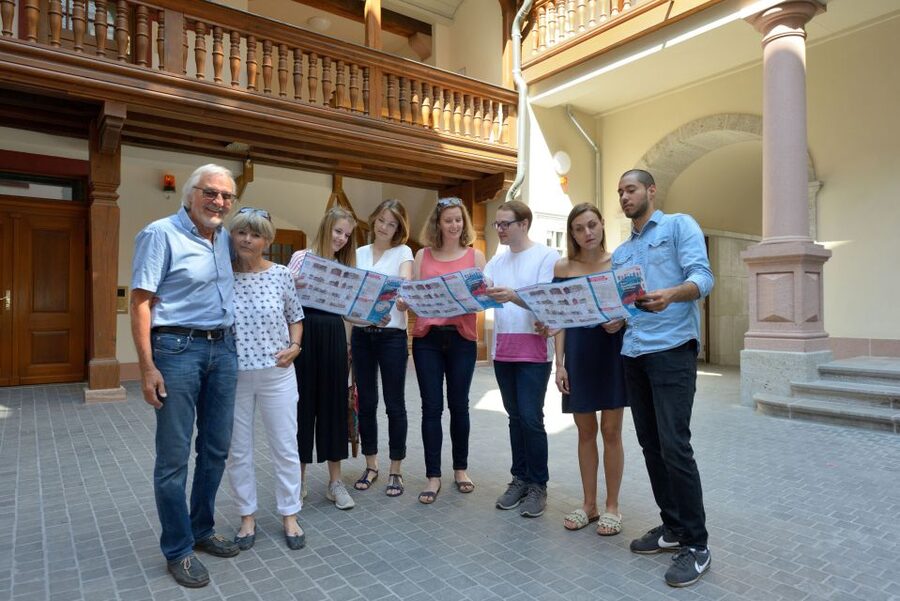
The tour includes views toward the Museum Embankment, an area associated with 39 museums along the Main. This gives you a useful sense of Frankfurt’s cultural side and points you toward a part of the city worth exploring after the walk.
The tour does not include entry to the museums. That is a limitation if you want an art-focused experience, but it also keeps the price and timing under control. You get an introduction and a visual orientation, then you can choose which museums fit your interests.
For many visitors, this is a helpful planning stop. You might see the riverfront and museum area during the walk, then return later for a longer visit. The tour’s job is to connect the major pieces of central Frankfurt, not to spend an hour inside one institution.
How the 90-minute pace feels
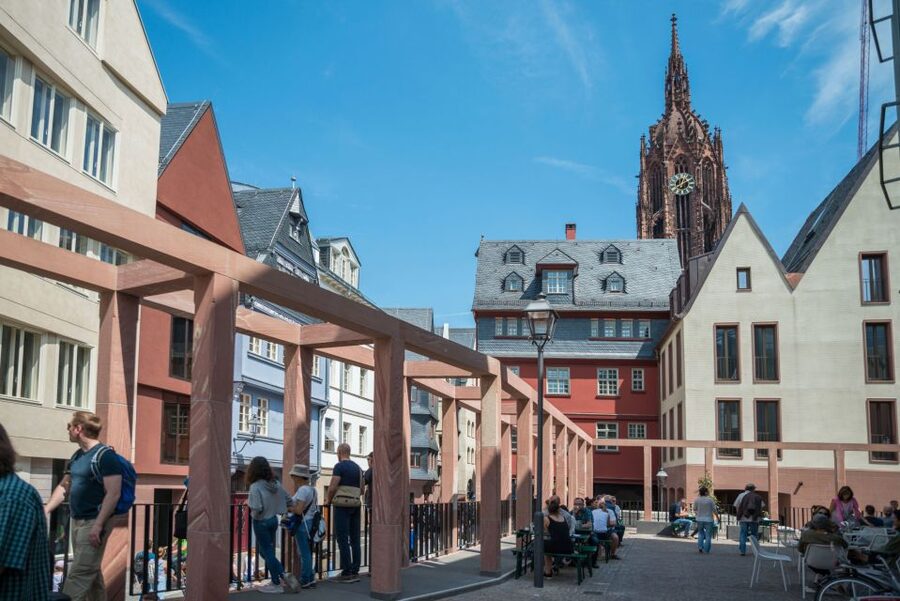
The advertised duration is 1.5 hours, and that is one of the strongest features. You can fit it into a short stay, a stopover, or the first afternoon of a longer visit.
The walk includes both movement and standing. One guide was praised for finding a good balance between the two, which is important when you are listening in a public square or on a busy street. You get enough time to hear the story without turning the experience into a slow march from one lecture point to another.
Past departures have handled both regular groups and at least one larger-than-usual group. A guide was specifically praised for speaking clearly enough for everyone to hear. Still, group size can affect how easily you ask questions or take photographs, so do not expect the intimacy of a private tour.
Weather matters. A departure in 30-degree heat was still considered a reasonable length, but another hot-day experience was less engaging for children. Wear comfortable shoes, carry water, and remember that the route is outdoors. The tour is wheelchair accessible, though the practical ease of any historic-center walk can depend on the conditions of the streets and public spaces on the day.
The guides and the tone of the tour
The guide is central to the value of this experience. You are not paying for admission to a museum or a special attraction. You are paying for a well-organized walk and someone who can connect the buildings with Frankfurt’s past.
The strongest guide comments point to three qualities: clear English, solid local information, and an upbeat delivery. Lili was praised for making the experience enjoyable, while Alexander was noted for keeping teenagers interested. Gabriella was described as excellent and engaging, and other departures were led by Frank, David, Robert, and Lutz.
That does not mean every departure will have the same personality. A city tour is partly shaped by the guide on duty and by the group. The useful expectation is a live, English-language explanation with room for questions, not a guaranteed performance by a specific named guide.
The tone appears to suit mixed-age groups. Families with older children and teenagers may appreciate the short route and humor. If you prefer silent sightseeing or detailed architectural analysis, the group format may feel less tailored to your taste.
Is $21 a fair price?
At $21 per person, I consider this good value for a 90-minute guided introduction to central Frankfurt. The price is low enough to fit into most sightseeing budgets, yet the route covers several of the city’s most important landmarks.
You are getting a certified guide, an English-language tour, and a focused route through the New Old Town, rather than paying for transport or a lengthy package with attractions you may not want. The value is strongest if Frankfurt is new to you and you want the city’s basic story before exploring alone.
The price is less compelling if you already know the Römerberg, cathedral, St. Paul’s Church, and Eiserner Steg well. It is also not the right purchase if you expect museum admission, a cathedral interior tour, or a full survey of Frankfurt beyond the center.
A 4.7 rating from 96 reviews supports the idea that the tour usually delivers what it promises. The recurring strengths are the guides, the clear historical talk, the reasonable pace, and the short duration. The main caution is the limited focus on the rebuilt old town and the possibility that children may lose interest on a very hot day.
Who should book this Frankfurt walk?
I would choose this tour if you have one to two days in Frankfurt, are visiting for the first time, or want a quick introduction before exploring independently. It is also a good fit for a family with teenagers, provided the weather is comfortable.
You should book it if you enjoy learning why a place looks the way it does. The rebuilt houses are attractive, but the explanation of reconstruction, wartime change, civic life, and modern Frankfurt gives the walk its real value.
You might skip it if your priority is an in-depth museum visit, a private guide, or a broad tour covering distant parts of the city. The title may suggest a larger highlights circuit than the route provides. In practice, the experience concentrates on the New Old Town and nearby central sights.
Flexible booking helps if your schedule may change: you can cancel up to 24 hours before the start for a full refund, and you can reserve now and pay later. English is the listed tour language, and wheelchair accessibility is provided.
Should you book it?
Book this walking tour if you want a short, affordable orientation to Frankfurt’s center with a guide who can explain both the old buildings and the city’s modern identity. The New Old Town, Römerberg, St. Paul’s Church, Eiserner Steg, and Museum Embankment make a sensible first route.
Just set your expectations correctly. This is not a complete tour of Frankfurt, and the reconstructed district is the main subject. For $21 and 90 minutes, that focused approach is a strength, especially when you want useful context without giving up the rest of your day.
FAQ
How long does the Frankfurt tour last?
The tour lasts 1.5 hours, or 90 minutes.
What language is the tour conducted in?
The tour is conducted in English by a live English-speaking guide.
Where does the tour meet?
Meet in front of the Tourist Information Office Römer, beside Frankfurt’s city hall at Römerberg.
What sights are included?
The route includes the New Old Town, Römer and Römerberg, Frankfurt Cathedral, St. Paul’s Church, Eiserner Steg, and views toward the Museum Embankment and city skyline.
Is the tour wheelchair accessible?
Yes, the activity is listed as wheelchair accessible.
Does the tour include museum admission?
No museum admission is included. The tour provides a glimpse of the Museum Embankment and its 39 museums.
How much does the tour cost?
The listed price is $21 per person.
Can I cancel the booking?
Yes. You can cancel up to 24 hours in advance for a full refund. You can also reserve your place and pay later.
Just added in Frankfurt
- Private Tour with Native English speaking Local★ 4.9 · 60 reviews
- Hohenzollern Castle: Full-Day Tour from Frankfurt★ 4.3 · 11 reviews
- Heusenstamm:tour of the Depot of the museum of communication★ 4.8 · 54 reviews
- Frankfurt: Guided walk between palm trees and skyline★ 4.8 · 9 reviews
- Frankfurter Kunstverein: Admission ticket★ 3.7 · 54 reviews
- Frankfurt: Verbrecherjagd und gefährlich leckeres Schnitzel★ 4.4 · 22 reviews
- Frankfurt: Walking Tour – discover the city with VR glasses★ 4.2 · 12 reviews
- Welcome to Frankfurt: Private Tour with a Local★ 4.7 · 81 reviews
Old Town Tours, compared.

Old Town & Viktualienmarkt City Walk in German
Read our review →
The Night Watchman Old Town Walking Tour in German
Read our review →
New Old Town and Highlights German-Language Tour
Read our review →Browse the lists this tour appears in