
Reviewed · WALKING TOURS
Dresden: Sightseeing Walking Tour in English
Dresden’s old town is a compact lesson in power, faith, war, and rebuilding. In 90 minutes, this small-group walk links the Frauenkirche, Zwinger Palace, Royal Castle, Semper Opera House, and the riverfront instead of treating them as isolated photo stops.
I like the personal touch. Guides such as Franceska and Franziska explain not only the official story, but also what it was like to grow up in Dresden after World War II. I also like the useful local advice on restaurants, shopping, nightlife, and events.
The main limitation is time. Ninety minutes is enough for orientation and outside views, but not for a full museum visit or a slow look inside every building. You will need a separate plan if you want to explore Dresden’s collections in depth.
Key points to know before you go
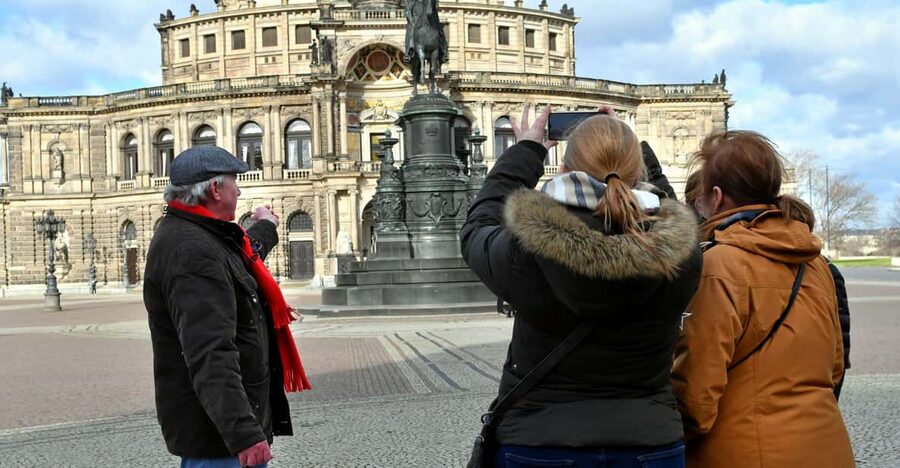
- A compact route through Dresden’s grandest sights: See the Frauenkirche, Royal Castle, Semper Opera House, Zwinger Palace, and Augustus Bridge in one walk.
- History beyond Baroque splendor: The guide covers the Middle Ages, the Reformation, the destruction of Dresden, and the peaceful revolution of 1989.
- A genuinely small-group format: A smaller party makes it easier to ask questions and follow the guide through busy public spaces.
- A local view of postwar Dresden: Guides can add personal insight about life in the city after World War II.
- A useful Nyphembad visit: The route includes the mysterious Nyphembad in the Zwinger Palace, an unusual detail many quick city walks skip.
- Low-cost, low-risk planning: At $15 per person, with free cancellation up to 24 hours ahead and reserve-now, pay-later booking, it is an easy first activity in Dresden.
Starting beneath the QF Passage
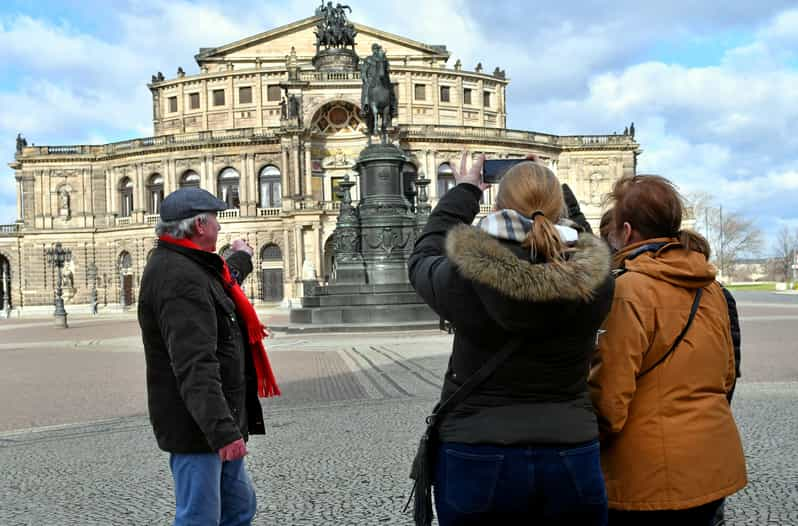
You meet the guide at the seating area of the Tourist Information in the basement of QF Passage. That meeting point matters because Dresden’s old town has several grand squares and landmarks close together, yet the entrances and streets can feel confusing on a first visit.
I would arrive a little early and use the seating area to get settled. The tour is conducted in English, and it is led by a licensed local guide. Since the walk lasts only 1.5 hours, a prompt start gives you the full route rather than a rushed final stop.
The group size is limited enough to keep the conversation practical. You can ask about a building, clarify a historical date, or request a restaurant suggestion without trying to speak over a large crowd. This is especially useful in Dresden, where the visual story is easy to admire but harder to understand without context.
The walk is wheelchair accessible. You should still remember that this is an urban walking route, with public squares and streets rather than a private, controlled attraction. The provided information does not specify the exact route surface or rest intervals, so anyone needing detailed mobility planning should confirm those points before booking.
More Walking Tours in Dresden
- Dresden: City & Semperoper Guided Walking Tour
★ 4.8 · 2,293 reviews - Dresden: Guided City Walk with a Cup of Coffee
★ 4.7 · 1,568 reviews - Dresden: Complete Walking Tour with Frauenkirche Visit
★ 4.8 · 700 reviews
Neumarkt and the Frauenkirche
The route moves into the historic center and the atmosphere of Neumarkt, or Newmarket Square. This is the natural place to begin understanding Dresden’s public face: grand facades, broad open space, and the Church of Our Lady, better known as the Frauenkirche.
The church is one of Dresden’s essential sights, but the value of seeing it with a guide is not only architectural. Its story connects the city’s Baroque glory with its wartime destruction and later rebuilding. The tour gives you a way to read the building as part of Dresden’s larger story rather than as a single impressive church.
You will want to look upward here. The surrounding Baroque buildings create a strong sense of ceremony, and the square makes it easier to appreciate how Dresden presented itself as a royal and cultural center. The guide can also point out details that are easy to miss when you are busy taking photographs.
The drawback is that this is primarily a sightseeing walk, not a dedicated interior tour of the Frauenkirche. If entering the church is your main goal, allow time before or after the walk for that separately.
From the Palace Stables to the Procession of Princes
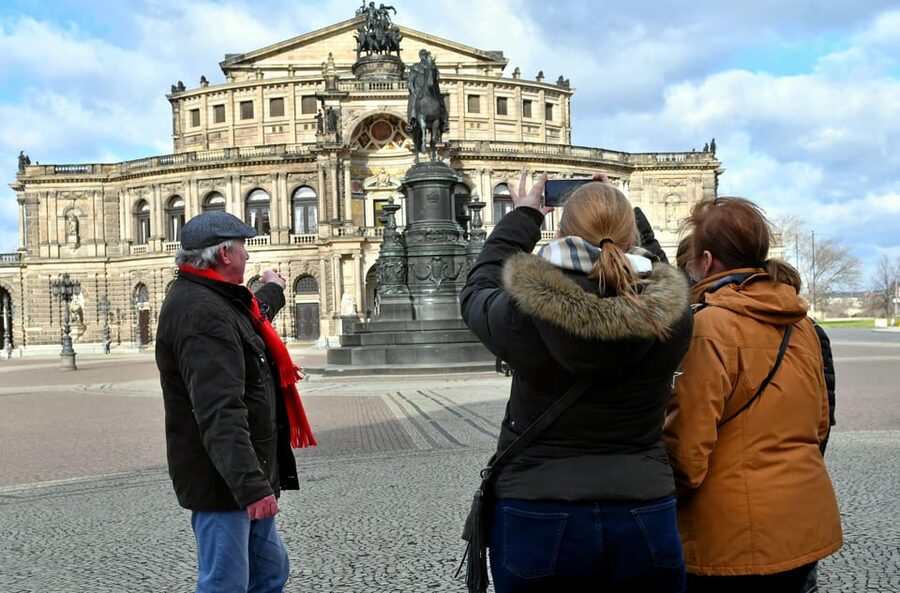
The next part of the route brings Dresden’s royal image into focus. The Palace Stables and the Procession of Princes show how rulers used art and architecture to put power on display.
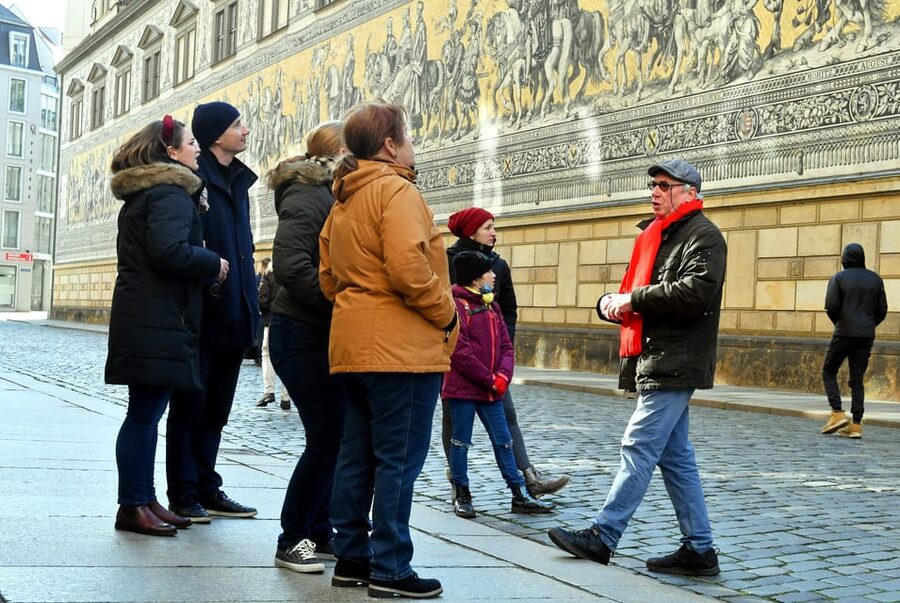
The Procession of Princes is one of the city’s most memorable outdoor works. It turns a long wall into a visual record of Saxon rulers, making it especially useful for visitors who want history tied to something they can see directly. You do not need to memorize every figure. The guide’s job is to help you understand what the scene says about monarchy, ceremony, and Dresden’s place in Saxony.
The Palace Stables add another piece to that picture. Along with the Royal Castle and Taschenbergpalais, they remind you that this part of town was built for court life, not ordinary daily commerce. I find that this is where the route begins to feel like a connected story of a royal capital.
The walk also addresses the city’s earlier centuries. You hear about the Middle Ages and the Reformation before moving into the later Baroque period. That chronological sweep is helpful because Dresden can otherwise appear to be an almost perfectly preserved Baroque city, with the difficult parts of its past hidden behind handsome facades.
The Zwinger Palace and its unusual Nyphembad
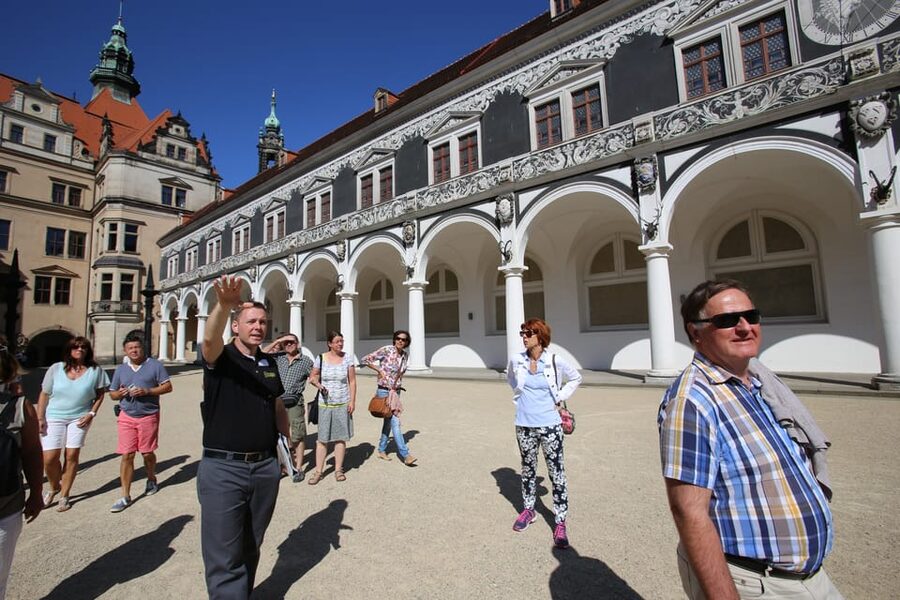
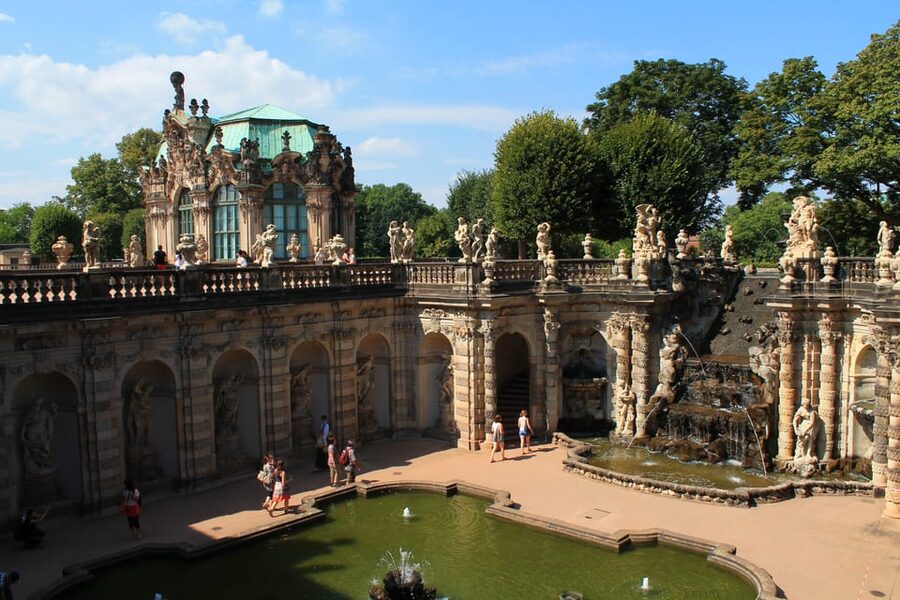
Zwinger Palace is one of Dresden’s most rewarding architectural stops. Its courtyards, sculptural decoration, and formal design show the confidence of the Baroque age. Even if you are not planning to enter its museums, the exterior spaces give you a clear sense of how much theater was built into court architecture.
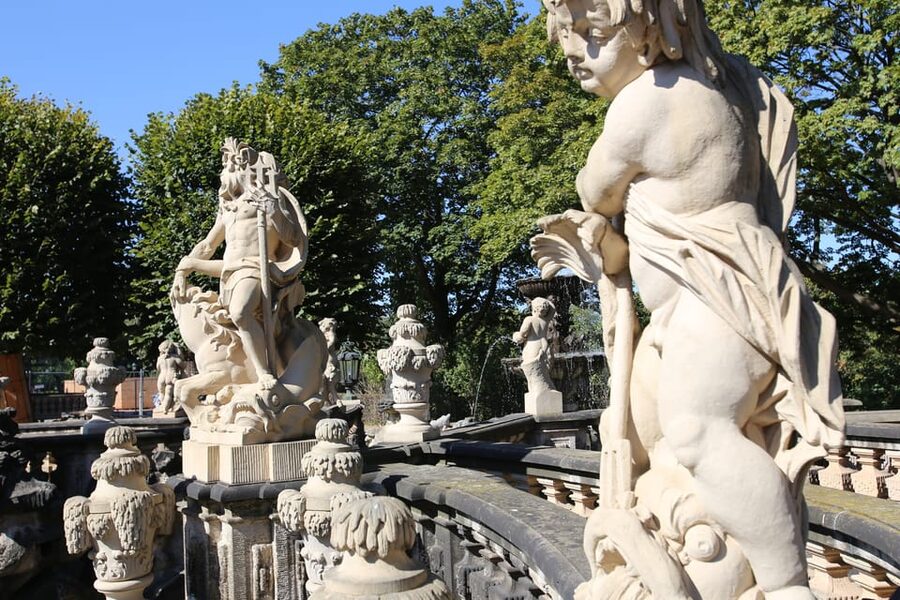
A particularly unusual part of the tour is the visit to the mysterious Nyphembad in the Zwinger Palace. This detail gives the route something beyond the standard list of Dresden landmarks. You get a closer look at a place many visitors might pass without understanding its purpose or character.
The Zwinger is also a good test of the tour’s format. The palace deserves far longer than a quick stop if you want to study its sculpture, courtyards, and museum collections. On this walk, you should expect an introduction and explanation, not a full palace visit.
I would treat the Zwinger stop as a prompt for later exploration. If Dresden is your base for more than a day, return when you can move at your own pace. The walking tour helps you decide which buildings deserve that extra time.
Same city, a completely different kind of day:
- Dresden: Semperoper Tickets and Guided Tour
★ 4.7 · 12,102 reviews - Dresden: The Original Night Watchman Tour in Lantern Light
★ 4.6 · 6,653 reviews - Dresden: Semperoper and Old Town Tour
★ 4.8 · 5,735 reviews - Dresden: River Sightseeing Boat Cruise
★ 4.3 · 5,323 reviews
Semper Opera House and the Catholic Cathedral
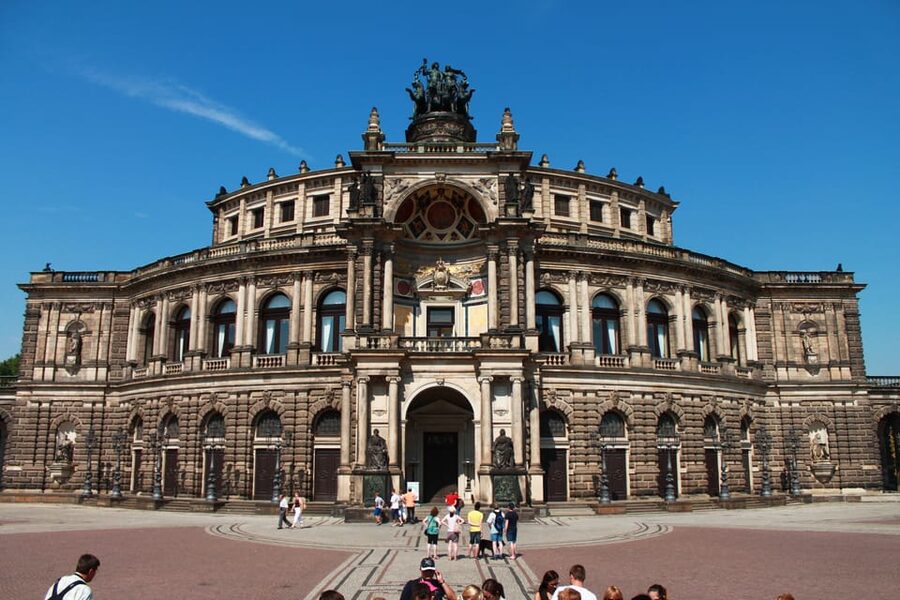
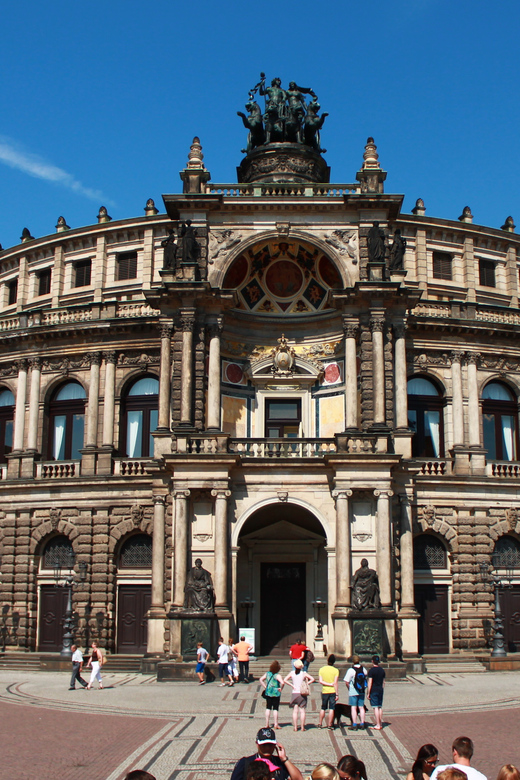
The Semper Opera House brings music and performance into the story. Dresden was not only a seat of government. It was also a city that invested heavily in court culture and the arts.
The building’s elaborate presence makes it a natural photo stop, but the guide helps place it among the surrounding royal buildings. Seeing the opera house together with the Royal Palace, Taschenbergpalais, and the Catholic Cathedral shows how tightly packed Dresden’s political, religious, and cultural centers are.
The Catholic Cathedral adds a useful contrast to the Frauenkirche. The two churches belong to different traditions, and their presence in the same historic center reflects the religious and political changes that shaped Saxony. The tour’s discussion of the Reformation gives that contrast more meaning than a simple list of architectural styles.
You should expect to see these sights from the outside unless the guide specifically says otherwise. That is not a flaw for a first walk. It keeps the group moving and lets you cover more of central Dresden, but it means you should not book this as a substitute for a church or opera-house interior visit.
Brühl Terrace and the Augustus Bridge
Brühl Terrace offers a change of mood. After the formal squares and court buildings, the route reaches the riverfront and opens toward the Elbe. This is a good place to pause, take in the city’s setting, and understand why Dresden has long been associated with grand views and monumental architecture.
The Augustus Bridge carries the route toward another classic Dresden view. From here, the relationship between the old town and the river becomes easier to read. You get a sense of how the city’s public buildings gather near the water rather than spreading evenly across a wide area.
I like this part because it gives the walk some breathing room. The tour is not only a march from one famous facade to the next. The riverfront helps connect the city’s architecture to its setting.
The bridge and terrace can also be busy public spaces, depending on the time of day. A small group helps, but you should stay close to the guide and listen for meeting instructions. The route is short enough that losing sight of the group would be an unnecessary nuisance.
Dresden’s destruction and the postwar story
One of the most important reasons to take this walk is the treatment of Dresden’s destruction. The city’s Baroque center can look polished and complete, but the guide explains the damage that reshaped Dresden and the difficult process that followed.
This subject needs care. A useful city tour should not turn wartime destruction into a dramatic backdrop for photographs, nor should it pretend that rebuilding erased the past. The walk includes untold stories about the destruction of Dresden, giving you a fuller picture of what the city lost and what later generations chose to restore.
The personal angle can make this section particularly meaningful. A local guide who grew up in Dresden after World War II can explain aspects of postwar life that a museum label may not cover. That does not replace formal historical study, but it gives the city a human scale.
You should also expect the guide to connect the old town with the peaceful revolution of 1989. This takes the story beyond kings, churches, and war. You learn about the events and ideas that helped change the course of modern German history, with Dresden presented as a living city rather than a preserved monument.
Local advice that can shape the rest of your stay
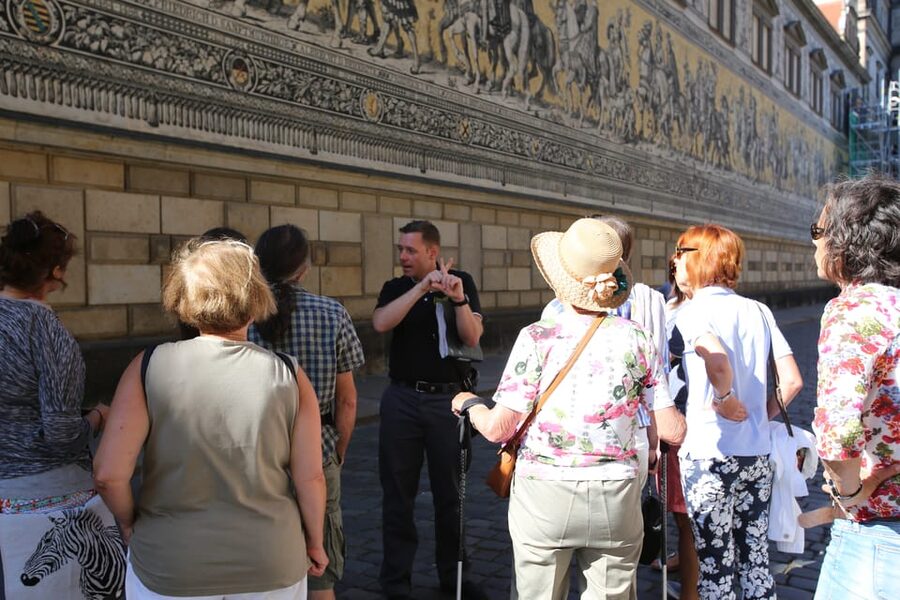
The tour includes tips on restaurants, shopping, nightlife, and events. I consider this one of the better uses of a city walk, especially when the advice comes from someone who lives locally and knows how the center feels beyond its major sights.
Ask specific questions. You might want a restaurant recommendation near your hotel, a quieter place for an evening drink, or advice on where to shop. The guide is also a useful person to ask about current events and local trends, though the tour itself does not promise a detailed food tasting or a dedicated nightlife crawl.
These tips are most valuable when you take the walk near the start of your stay. You can use the advice over the following days instead of collecting it after your schedule is already full. If you take the tour on your final afternoon, the information may still help with dinner, but you will have less time to act on it.
The guide’s local connection is also useful for questions about Dresden’s recent past. The city’s story is not finished at the Baroque period, and a conversation with someone from Dresden can help you notice the difference between restored old-town display and present-day city life.
Is $15 a fair price for 90 minutes?
At $15 per person, this is a strong-value introduction to Dresden. You are paying less than the cost of many major museum admissions, while covering several of the city’s most important outdoor sights with a live English-speaking guide.
The value comes from the connections between the stops. You could walk past the Frauenkirche, Procession of Princes, Royal Castle, and Semper Opera House on your own, but you would need to research the medieval period, Reformation, Baroque court, wartime destruction, and 1989 revolution separately.
There are limits. The tour does not include a full museum visit, a long interior exploration, or transportation to sights outside the central route. If you already know Dresden well, the standard landmarks may feel familiar. In that case, the local stories and personal postwar perspective become the main reason to join.
The reserve-now, pay-later option makes it easier to fit the walk into a changing schedule. You can cancel for a full refund up to 24 hours in advance. Those terms are useful if your Dresden plans depend on weather, train timing, or another fixed appointment.
Who will get the most from this walk?
I would choose this tour for a first visit to Dresden, especially if you want a clear introduction before deciding which buildings to revisit. It suits couples, solo visitors, families, and anyone who prefers a live explanation to reading a guidebook while walking.
It is also a good match for history-minded visitors who want the modern story included. The discussion of 1989 and the guide’s possible personal memories of postwar Dresden add depth that a purely Baroque architecture tour would miss.
Families should note the booking rule: no more than four children’s tickets can be booked per adult. The wheelchair-accessible format makes the tour more broadly usable, though anyone requiring precise route details should check them before reserving.
I would skip it only if you want extensive interiors, museum time, or a specialist architecture lecture. For those needs, the walk will feel like an introduction rather than a complete visit.
Should you book the Dresden walking tour?
Book it if you want an affordable first look at Dresden’s old town, a small group, and a guide who can link grand buildings with war, division, rebuilding, and the peaceful revolution of 1989. The strongest feature is the human explanation of the city, especially when Franceska or Franziska adds local insight to the usual landmarks.
Keep your expectations practical. You will see many important places, but you will not have time to explore each one in detail. At $15, that tradeoff is easy to accept. Take the walk early in your stay, keep a little time afterward for the Frauenkirche or Zwinger, and use the guide’s restaurant and event tips to shape the rest of your visit.
FAQ
How long does the Dresden walking tour last?
The tour lasts 1.5 hours.
What language is the tour conducted in?
The tour is conducted in English by a live guide.
How much does the tour cost?
The listed price is $15 per person.
Where is the meeting point?
Meet at the seating area of the Tourist Information in the basement of QF Passage.
Which major sights are included?
The route includes the Frauenkirche, Palace Stables, Procession of Princes, Brühl Terrace, Catholic Cathedral, Royal Palace, Semper Opera House, Taschenbergpalais, Augustus Bridge, and Zwinger Palace.
Does the tour include the Zwinger Palace?
Yes. The experience includes a visit to the Nyphembad in the Zwinger Palace.
Is the tour wheelchair accessible?
Yes, the activity is listed as wheelchair accessible.
Can I cancel the tour for a refund?
Yes. You can cancel up to 24 hours in advance for a full refund.
Can I reserve now and pay later?
Yes. The reserve-now, pay-later option lets you book without paying at the time of reservation.
Just added in Dresden
- Test Drive Electric Vehicles from the VW brand (ID. model)★ 4.8 · 190 reviews
- SRF CoBi | City Tour by ConferenceBike★ 4.7 · 38 reviews
- Dresden: Scavenger Hunt to Elbe River & Castles★ 4.7 · 15 reviews
- Dresden: Bike Rental – City Bike with Option Children Seat★ 4.5 · 13 reviews
- Private trip from Prague to Dresden, Moritzburg & Meissen★ 5.0 · 5 reviews
- Moritzburg: Scavenger Hunt Self-Guided Walking Tour★ 4.8 · 12 reviews
- Historical tour of the old town including a Saxon dinner★ 4.7 · 23 reviews
- Climb the mountains together with goats★ 4.8 · 8 reviews
Walking Tours, compared.



Berlin’s Best: 2 Hour Walking Tour Third Reich and the Cold War
Read our review →
Third Reich Berlin: Hitler and WWII Walking Tour
Read our review →Browse the lists this tour appears in