
Reviewed · WALKING TOURS
Dresden: Private Guided Walking Tour
Dresden’s old town packs a remarkable amount into a compact walk. In two hours, you’ll move from the solemn Frauenkirche to grand Baroque courts, the opera house, the royal castle, and the Elbe riverfront while your guide connects medieval Dresden with the events of 1989. The city’s beauty is real, but its story has plenty of hard edges.
I like the private format, which lets a guide adjust the pace and explain details that matter to your group. I also like the route itself: it covers Dresden’s major sights without wasting time on transport, and guides such as Frau Schulz and Idiko have earned praise for making the walk lively for both younger and older participants.
The main consideration is the group limit of 25 people. That is private compared with a large public tour, but it is not especially small if your booking fills up. One serious service complaint involved a no-show and a delayed refund, so confirm the meeting details and keep your booking information handy.
Key points at a glance
- A concentrated old-town route: See Frauenkirche, Semperoper, Zwinger, Dresden Castle, Brühl’s Terrace, the Procession of Princes, Stallhof, the cathedral, Taschenbergpalais, and Augustus Bridge.
- A history lesson with range: The guide covers more than 1,000 years, from the Middle Ages and Renaissance to Baroque Dresden, East Germany, and the Peaceful Revolution of 1989.
- Private, but up to 25 people: Your group has its own guide, though the maximum size is larger than the phrase small group may suggest.
- English or German only: The tour is led in one of these two languages. Other languages or a different meeting point require a request.
- Useful local advice: Time is set aside for tips about restaurants and events, not just monuments.
- Good cancellation flexibility: You can cancel up to 24 hours ahead for a full refund and reserve now while paying later.
Starting at Neumarkt and the Frauenkirche
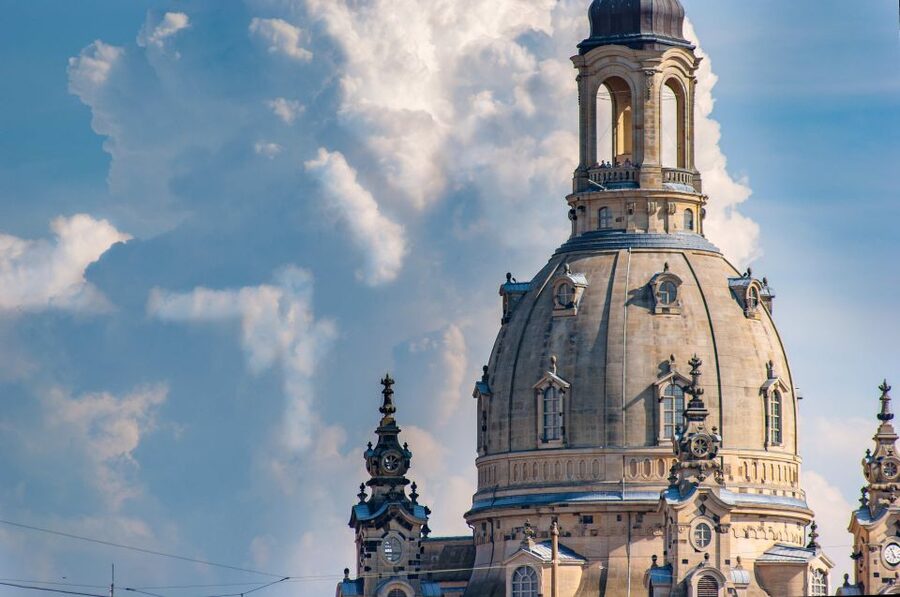
The walk begins at Dresden Information in the QF Passage basement at Neumarkt 2. This is a practical starting point because Neumarkt places you right beside the Frauenkirche, the most recognizable church in Dresden’s center.
The Frauenkirche is also the right place to begin the city’s modern story. Its dramatic reconstruction after the Second World War and its role in the restored old town give your guide a natural way to explain Dresden’s destruction, division, and renewal. You will not simply see a handsome Baroque facade. You will hear how Dresden’s past still shapes the square around you.
Starting at Neumarkt also helps you get your bearings quickly. The tour remains in the historic center, so you do not spend your short two-hour booking walking between distant districts. That is one reason this works well as an arrival-day orientation or as a first look before returning to selected museums on your own.
The meeting point is easy to miss if you expect to meet outside in the open square. Look for Dresden Information inside the QF Passage and go to the basement floor. If your group has mobility concerns, the tour is listed as wheelchair accessible, though the practical ease of every section will depend on the route and conditions on the day.
More Walking Tours in Dresden
- Dresden: City & Semperoper Guided Walking Tour
★ 4.8 · 2,293 reviews - Dresden: Guided City Walk with a Cup of Coffee
★ 4.7 · 1,568 reviews - Dresden: Complete Walking Tour with Frauenkirche Visit
★ 4.8 · 700 reviews
Baroque Dresden from Semperoper to the Zwinger
From the central square, the route takes you toward two of Dresden’s major cultural landmarks: Semperoper and the Baroque Zwinger.
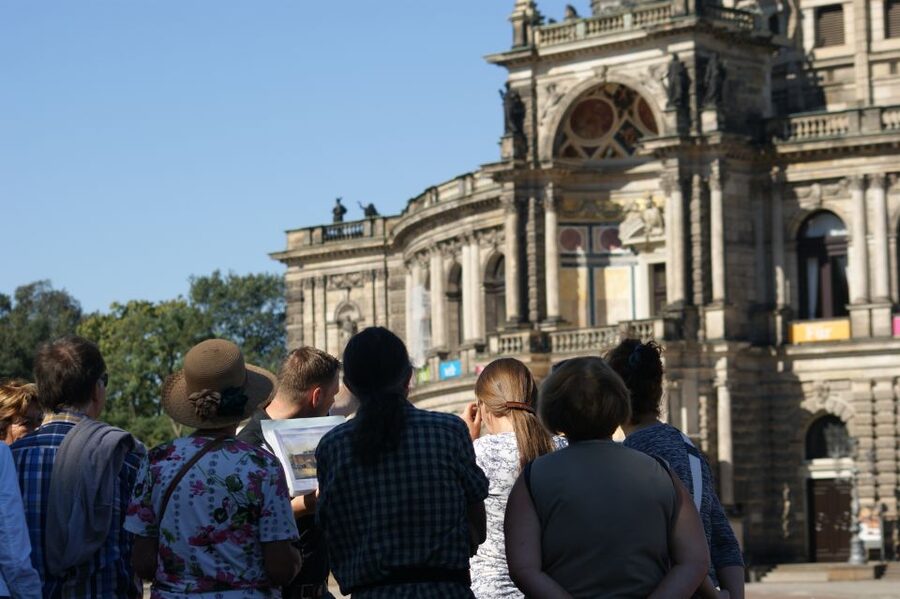
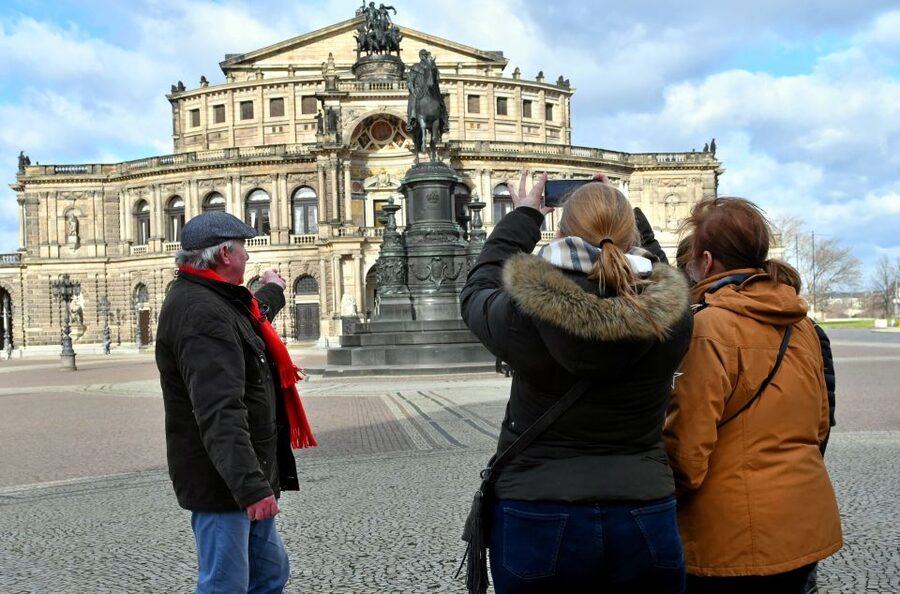
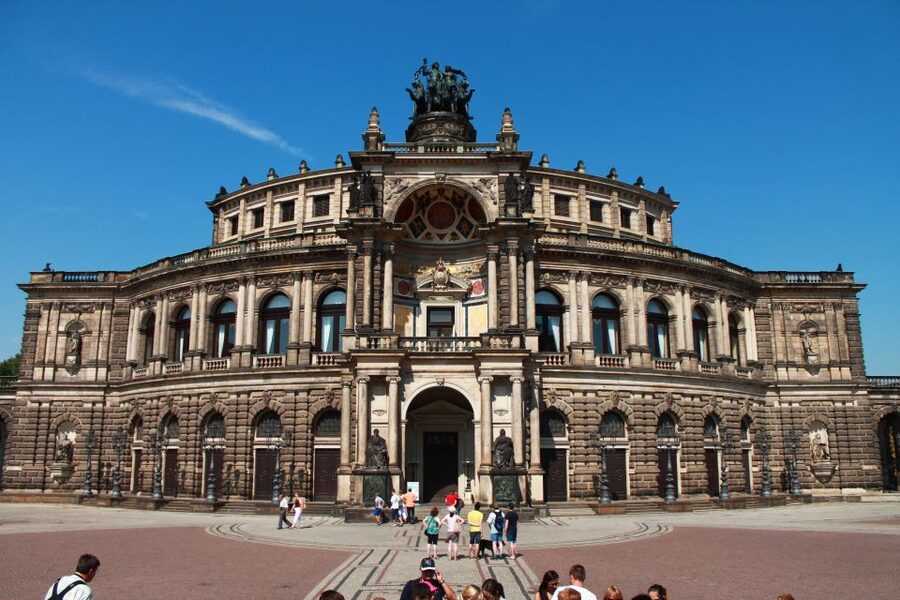
Semperoper is Dresden’s famous opera house, and it represents the city’s grand cultural ambitions. Your guide can place the building within the larger story of Dresden as a royal residence and center of art, music, and ceremony. This is a good point to listen for the difference between a building designed for daily public use and one created to impress a court.
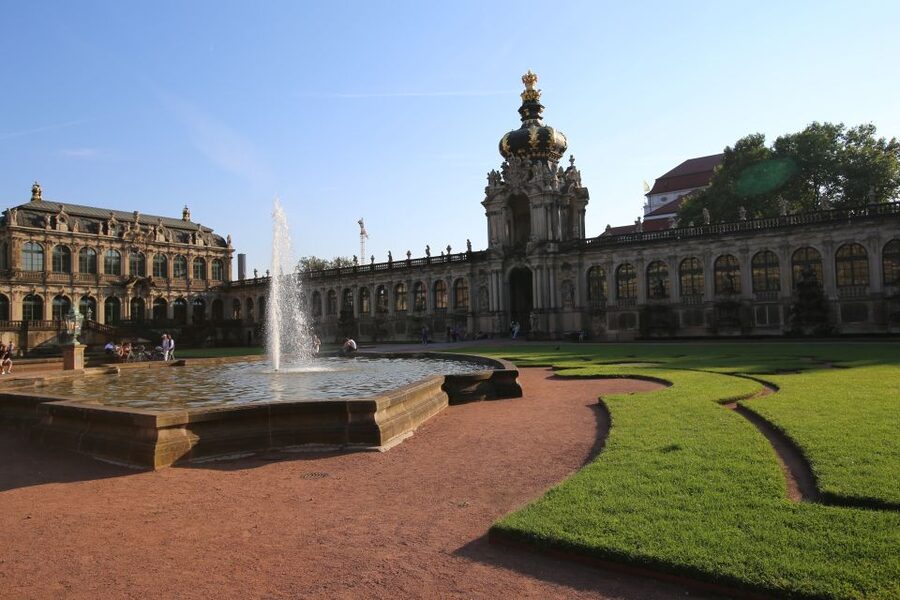
The Zwinger provides the tour’s biggest burst of Baroque display. Its courtyards, pavilions, sculpture, and theatrical scale show how architecture could be used as entertainment and political theater. You will appreciate this stop more if your guide explains how the spaces worked, rather than simply naming the architect or pointing out decorative details.
The route is especially helpful here because Dresden’s buildings can blur together when you explore alone. A private guide can point out the visual links between the opera, palace buildings, churches, and ceremonial spaces. The supplied tour information does not promise museum entry, so think of this as an exterior walking tour rather than a substitute for visiting the Zwinger’s collections.
That distinction matters. Two hours is enough to understand the city center and identify places you may want to enter later. It is not enough for a long museum visit, an extended look inside the opera house, and a full treatment of every landmark.
Dresden Castle and the royal center
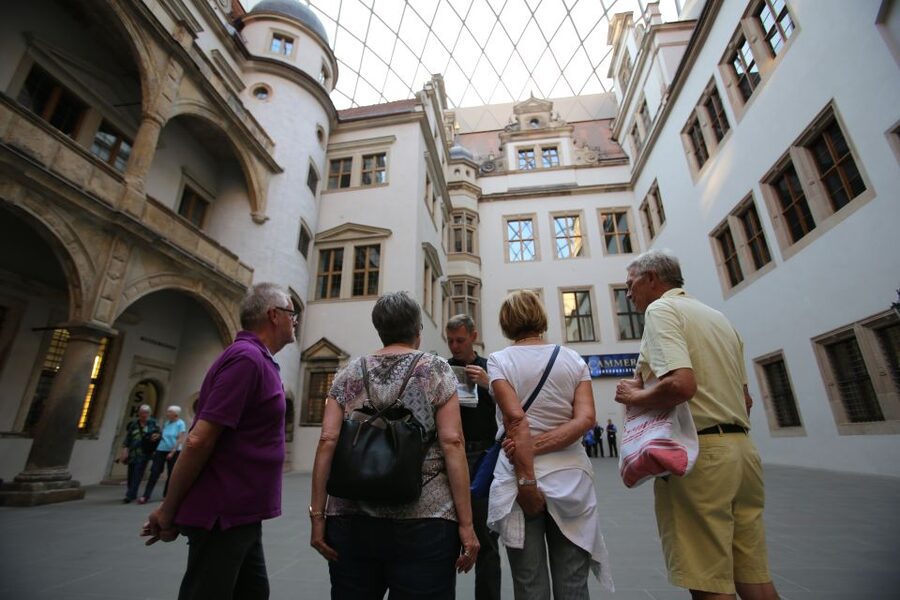
Next comes Dresden Castle, a key stop for understanding how the city’s rulers organized power. The castle links the grand public spaces of the old town with the royal and administrative heart of Dresden.
Here, the guide’s storytelling should help you move beyond pretty stonework. The tour promises stories from the Middle Ages, the Renaissance, and the Baroque period, so you can expect the castle to act as a timeline as much as a monument. Dresden’s character changed as its rulers expanded their court, commissioned grand buildings, and turned the city into a stage for ceremony.
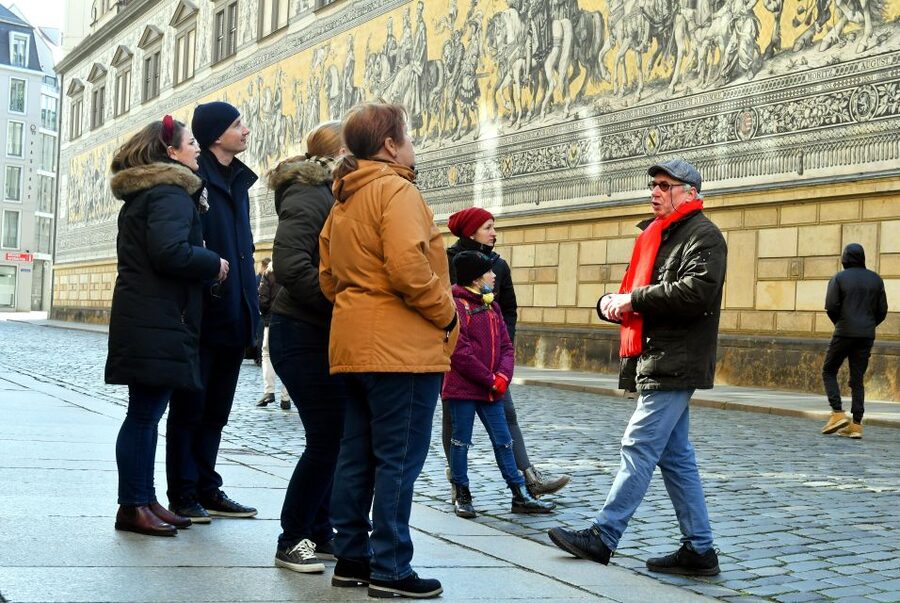
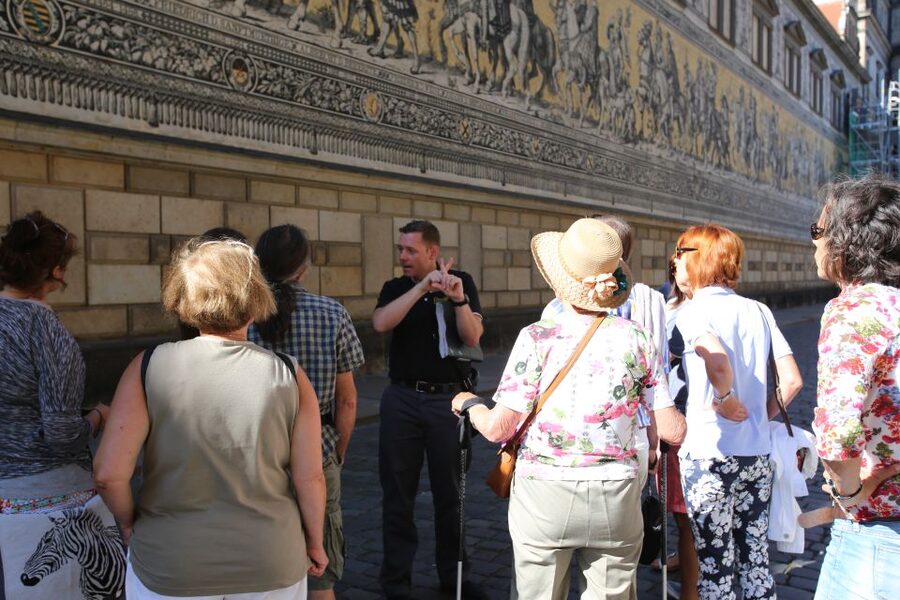
The route then reaches the Procession of Princes, one of the most memorable outdoor artworks in the center. This long mural presents Saxon rulers in a highly visual format, making it easier to follow a complicated succession of names and dates. It is also a smart stop on a walking tour because you can view it without spending time indoors.
The nearby Stallhof adds another layer. Its name and setting recall the court’s horses, tournaments, and formal life. The contrast between the working functions of a royal complex and the showy Baroque buildings nearby gives you a clearer sense of how Dresden’s center operated.
I would pay close attention here if you enjoy political history. The route does not treat Dresden as a collection of pretty facades. It uses these buildings to explain who held power, how the city presented itself, and how that image changed over time.
Dresden Cathedral and the road to Brühl’s Terrace
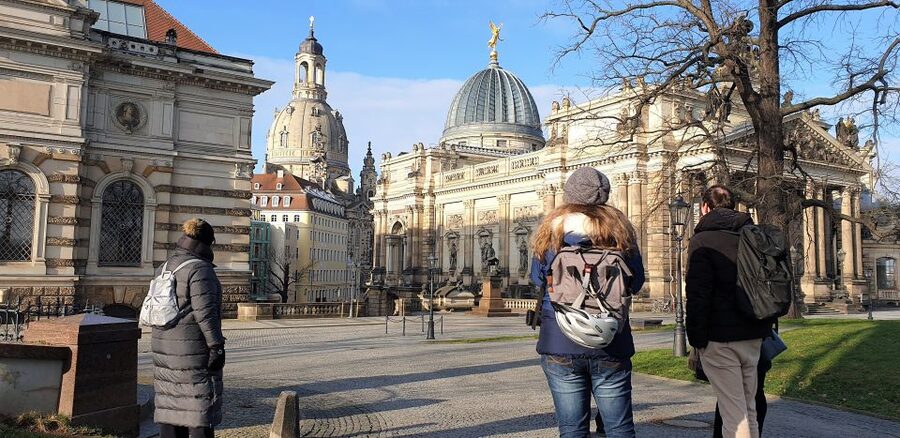
Dresden Cathedral is another important stop, both for its architecture and for the way it fits into the old town’s royal setting. Its position near the castle and the former court spaces shows how closely religion, monarchy, and civic identity were tied together.
The tour then follows the route toward Brühl’s Terrace. This elevated promenade is one of Dresden’s best-known viewpoints and gives the walk a change of rhythm after the enclosed streets and courtyards of the old town.
At Brühl’s Terrace, you can look toward the Elbe and Augustus Bridge while your guide explains the city’s relationship with the river. The view also helps you understand Dresden as a planned royal city rather than a random collection of surviving buildings. You get a little breathing room, a broader view, and a useful pause in the story.
The terrace is likely to be one of the most pleasant parts of the walk, but it can also be exposed to weather and crowded conditions. The tour lasts two hours, so do not expect a long rest stop. Wear shoes suited to steady city walking and bring protection from sun or rain.
Same city, a completely different kind of day:
- Dresden: Semperoper Tickets and Guided Tour
★ 4.7 · 12,102 reviews - Dresden: The Original Night Watchman Tour in Lantern Light
★ 4.6 · 6,653 reviews - Dresden: Semperoper and Old Town Tour
★ 4.8 · 5,735 reviews - Dresden: River Sightseeing Boat Cruise
★ 4.3 · 5,323 reviews
From the Taschenbergpalais to Augustus Bridge
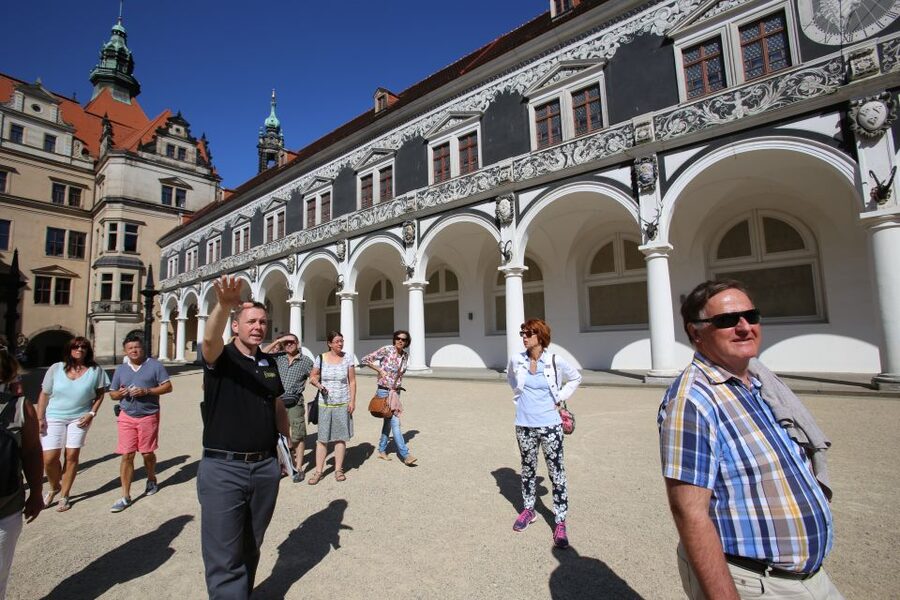
Taschenbergpalais brings the route back toward Dresden’s courtly world. Like the castle and Zwinger, it helps show how much of the old town was shaped by royal taste and ceremonial needs.
The final stretch leads toward Augustus Bridge. This is a fitting way to close the central part of the tour because the bridge connects the old town with Dresden’s wider urban setting. It also gives you a last chance to place the buildings you have seen within the riverfront view.
The walk concludes near Frauenkirche, close to where it began. That circular shape is useful. You finish in a central spot with easy access to the rest of the old town, and you can return to the church, choose a restaurant, continue toward another sight, or follow the guide’s local suggestions.
The exact restaurant and event advice will depend on the guide and the day of your tour. Still, that offer is valuable because a guide who works locally can help you make better use of the hours after the tour. Ask directly for suggestions that fit your budget, schedule, and preferred type of meal.
What the guide adds to the buildings
The strongest part of this experience is not the number of monuments. You can find the names of Dresden’s major sights in any guidebook. The value lies in having someone connect them through stories.
The tour covers more than 1,000 years, including the Middle Ages, Renaissance, Baroque period, the years of East and West Germany, and the Peaceful Revolution of 1989. That broad span keeps the walk from becoming a single-period architecture lesson.
The 1989 section is especially important. Dresden’s old town can look like a polished royal setting, but recent German history is just as important to understanding the city. A guide can explain what division meant in daily life and what the peaceful protests meant to people living in East Germany. The supplied information specifically promises attention to how people in former East and West Germany experienced that period.
Anecdotes also matter. The tour promises both small personal stories and large historical events. That combination usually makes a short walk easier to remember than a string of dates. Feedback has specifically praised guides for humor, flexibility, and keeping different age groups interested. Frau Schulz was praised for engaging both young and older members of a group, while Idiko was described as exceptional. Those details suggest that the guide’s personality can make a noticeable difference.
Because the tour is private, you can ask for clarification as you go. If your group cares more about wartime history, Baroque architecture, the Peaceful Revolution, or practical city advice, say so early. The format gives you a better chance of shaping the conversation than a large public walk.
Is $212 good value for your group?
The listed price is $212 for a group of up to 25 people. If you divide the full amount among 25 people, it comes to about $8.50 per person. A smaller group pays more per head, but you also get a private guide rather than joining an open group.
For a couple, $212 is a considerable price for two hours. You are paying for privacy, a licensed guide, and the ability to ask questions, not for entry to a museum or a meal. I would choose it for a special occasion, a family group, or a party that values a tailored introduction to Dresden.
For a larger family, business group, or reunion, the price looks much better. At ten people, it works out to about $21 per person. At the full 25-person limit, the value is strong if everyone wants the same introduction and can stay together.
The private format is also useful for groups with mixed interests. A public tour may move at one fixed pace. Here, you can ask the guide to spend more time on the Procession of Princes, explain the 1989 period, or offer restaurant advice before the walk ends.
Still, keep the group-size wording in perspective. A maximum of 25 is not an intimate walk for two or four people. If your party is large, make sure everyone can hear the guide and remain close enough to follow the commentary.
Timing, language, and practical details
The experience lasts two hours, with starting times available according to the selected date. That makes it easy to place before dinner, after a train arrival, or between other central Dresden plans.
The tour is offered in English or German. If you need another language, you must send a request rather than assume it will be available. The same applies if you want a different meeting point.
The tour is listed as wheelchair accessible. Since the route is outdoors and moves through historic streets, it is sensible to confirm any specific needs when booking, especially if your group includes someone who needs a particular surface or pace.
You can cancel up to 24 hours before the start for a full refund. The reserve-now, pay-later option also gives you flexibility while your Dresden plans are still taking shape. One poor booking experience involved a guide not appearing and a refund not yet being received at the time of the complaint. That was an isolated serious warning in an otherwise highly positive set of feedback, but I would still save your confirmation and check the meeting instructions before setting out.
Who should book this Dresden walking tour?
I would recommend it most strongly to a group that wants a fast, organized introduction to the old town without arranging several separate visits. It suits first-time visitors, families, English- or German-speaking groups, and anyone who prefers stories and context to simply photographing buildings.
It is also a good choice for people interested in the full arc of Dresden’s past. You get royal Baroque architecture, medieval and Renaissance references, the destruction and rebuilding of the city, and the political changes of 1989 in one compact route.
I would be more cautious if you want extensive interior visits. The tour passes major attractions, but the two-hour schedule is built around walking and explanation. You should plan separate time for museums, the Frauenkirche interior, the Zwinger collections, or other paid sights.
Should you book it?
Book this tour if you want Dresden’s famous center explained as one connected story. The route is efficient, the private setup is useful for families and larger groups, and the guides have been praised for warmth, humor, and adapting to different ages.
For one or two people, compare the price with a standard group tour before committing. For a group of several people, $212 becomes much easier to justify, especially if you value a private English or German guide and local advice at the end.
The best use of this tour is to take it early in your stay, then return to the places that catch your interest. It gives you the map, the major sights, and enough historical context to make the rest of Dresden easier to understand.
FAQ
Where does the Dresden walking tour begin?
Meet your guide at Dresden Information, Neumarkt 2, 01067 Dresden, inside the QF Passage on the basement floor.
How long does the tour last?
The walking tour lasts two hours.
What sights are included on the route?
The route includes Frauenkirche, Semperoper, the Baroque Zwinger, Dresden Castle, Brühl’s Terrace, the Procession of Princes, Stallhof, Dresden Cathedral, Taschenbergpalais, and Augustus Bridge.
Is this a private tour?
Yes. The tour is arranged as a private group experience with a maximum group size of 25 people.
Which languages are available?
The tour is available in English or German. Requests for other languages must be made separately.
Is the tour wheelchair accessible?
Yes, the activity is listed as wheelchair accessible.
Does the tour include museum or attraction entry?
The provided details describe a private guided walking tour and do not list museum or attraction admission.
Can I cancel for a refund?
Yes. You can cancel up to 24 hours in advance for a full refund.
Can I reserve now and pay later?
Yes. The booking option allows you to reserve your place and pay later.
Just added in Dresden
- Test Drive Electric Vehicles from the VW brand (ID. model)★ 4.8 · 190 reviews
- SRF CoBi | City Tour by ConferenceBike★ 4.7 · 38 reviews
- Dresden: Scavenger Hunt to Elbe River & Castles★ 4.7 · 15 reviews
- Dresden: Bike Rental – City Bike with Option Children Seat★ 4.5 · 13 reviews
- Private trip from Prague to Dresden, Moritzburg & Meissen★ 5.0 · 5 reviews
- Moritzburg: Scavenger Hunt Self-Guided Walking Tour★ 4.8 · 12 reviews
- Historical tour of the old town including a Saxon dinner★ 4.7 · 23 reviews
- Climb the mountains together with goats★ 4.8 · 8 reviews
Walking Tours, compared.



Berlin’s Best: 2 Hour Walking Tour Third Reich and the Cold War
Read our review →
Third Reich Berlin: Hitler and WWII Walking Tour
Read our review →Browse the lists this tour appears in