
Reviewed · HOP-ON HOP-OFF TOURS
Bonn: 24-Hour Hop-On Hop-Off Sightseeing Bus Ticket
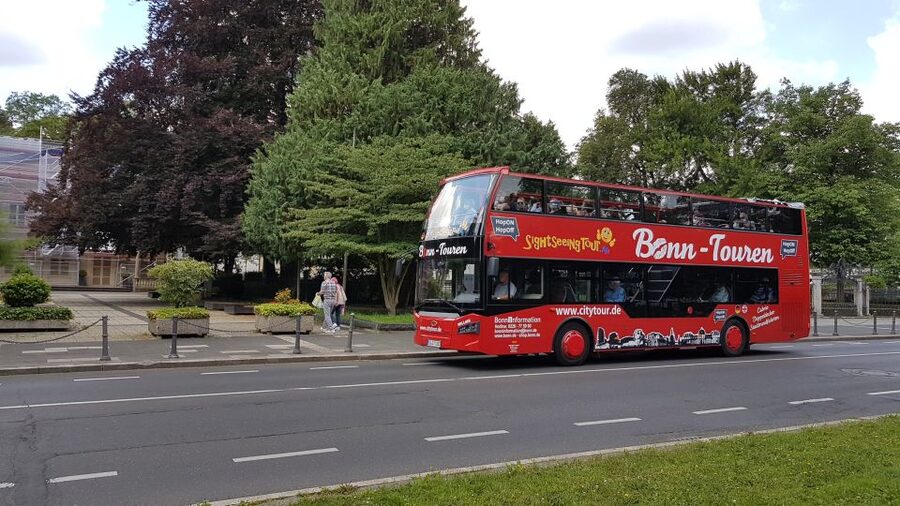
Bonn’s story is unusually varied for a city this size: Roman settlement, West German capital, international center, and Rhine-side resort town. This 24-hour hop-on hop-off route lets you connect those chapters without piecing together several local buses.
I like the easy access to 11 stops, especially the Museum Mile, UN Campus, and Bad Godesberg. I also like the open-deck views and the choice of six audio languages. The main catch is the timetable. Departure details can be hard to find online, and seats are not reserved when demand is high.
Key points to know before you ride
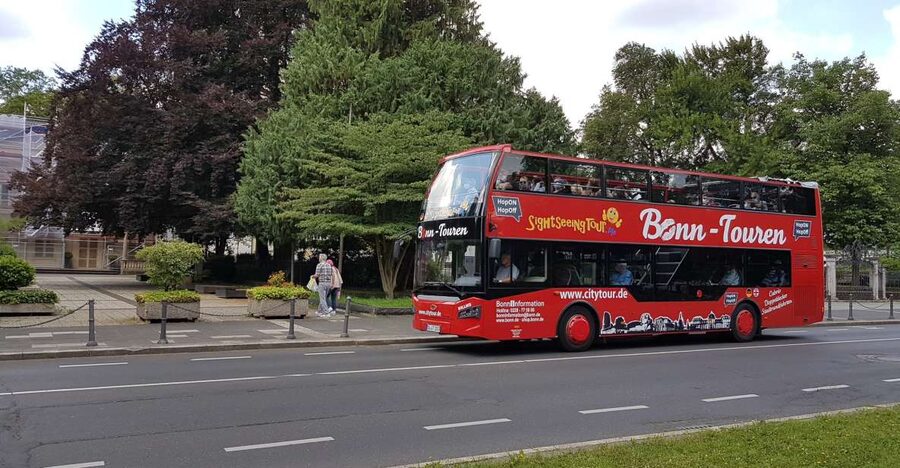
- Roman roots to modern diplomacy: The route links Bonn’s ancient past with its former capital district and international institutions.
- 11 useful stops: You can get off at the Minster, Museum Mile, Rhine bank, Bad Godesberg, and several major cultural sites.
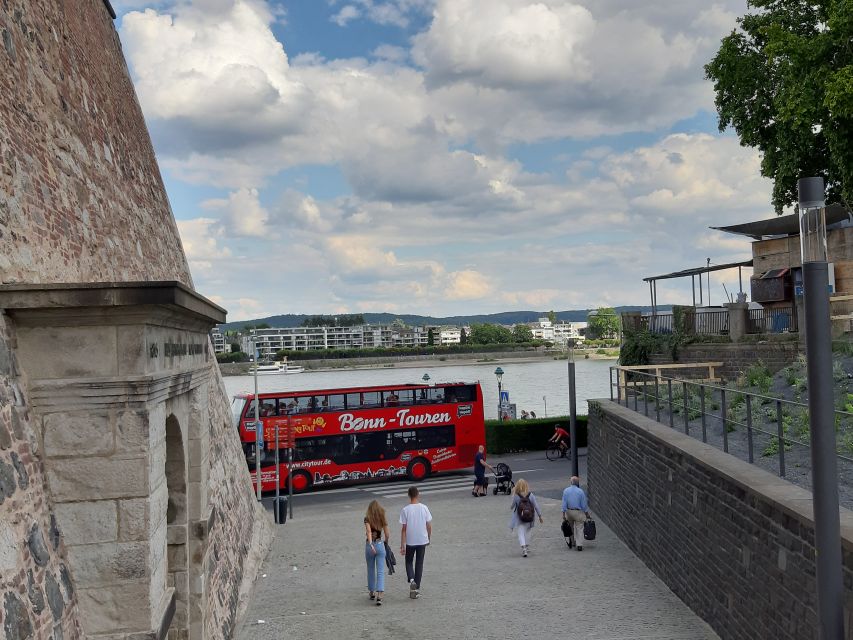
- Best panoramic section: The Rhine-side route gives you views toward the Siebengebirge hills and the gateway to the Rhine.
- Audio in six languages: Commentary is offered in Dutch, English, French, German, Japanese, and Spanish.
- Plan around the timetable: Times may change, and the online schedule has not always made midday departures clear.
- Accessible lower deck: The lower level is barrier-free for wheelchair users, and dogs are allowed there.
Why Bonn works so well from the top deck
Bonn is easy to underestimate. It does not have the instant visual punch of Cologne, but its appeal grows as you move between districts. The city carries more than 2,000 years of history, and its neighborhoods have very different personalities.
From the bus, you get a useful first look at the city’s layout. You pass older central streets, elegant southern neighborhoods, museums, former government districts, office headquarters, Rhine-side areas, and Bad Godesberg. That range is the main reason I would consider this tour during a first day in Bonn.
The open upper deck is the best place to watch the city unfold. You get a broad view rather than a narrow look through a train window. Bring a light jacket, even in pleasant weather, since the ride is exposed. If the weather turns poor, the lower deck gives you a more sheltered option.
The audio guide adds context as you ride. It is not a live tour, so you will not be able to ask questions or adjust the commentary to your interests. Still, it helps explain why Bonn matters beyond Beethoven and the old capital label.
More Hop-On Hop-Off Tours in Bonn:
- Berlin: Hop-on Hop-off Bus Tour with Live Commentary
★ 4.3 · 8,579 reviews - Hamburg: Line A Sightseeing Hop-On Hop-Off Bus Tour
★ 4.6 · 6,958 reviews - Berlin: City Sightseeing Hop-On Hop-Off Bus Tour
★ 4.1 · 4,233 reviews
Start at Budapester Straße or join farther along
The first stop is at Budapester Straße, at the corner of Sternstraße. You can begin there, but you are not required to. The ticket allows you to board at any of the 11 stops along the route.
Starting at Budapester Straße makes sense if you want to take the full circuit before choosing where to get off. It is also the safest choice if you want a clear introduction to the route. The bus returns to Budapester Straße, so the stop works as both a starting point and a reference point for the day.
You can also use the bus as a sightseeing connection rather than a full loop. For example, board near the city center, ride to the Museum Mile, get off for museums, then continue later from another stop. This is where the ticket earns its keep. You are paying for freedom to shape the day, not only for a narrated ride.
Keep the printed timetable available at the stop. Departure times can change, and the online information has not always clearly shown every midday option. One passenger who wanted a 13:00 ride ended up taking the 10:30 departure because the available online schedule was unclear. The driver and printed program provided better information on site.
Bonn Minster and the central city
The Bonner Minster stop gives you access to one of Bonn’s most recognizable central landmarks. The surrounding city center is a practical place to break the ride, especially if you want a short walk, a meal, or a look at the older heart of town.
The Minster stop is also useful for getting your bearings. After riding through several districts, you can pause in the center and decide how much time you want to spend on museums, neighborhoods, or the Rhine. If you are using the bus as a first-day orientation, this is one of the more natural places to get off.
The route’s central section helps explain Bonn’s long history without turning the experience into a formal walking lecture. The audio commentary fills in background while the streets provide the visual evidence. You see a city that has been reshaped many times, rather than a place preserved in only one historical period.
Nussallee and Bonn’s southern neighborhoods
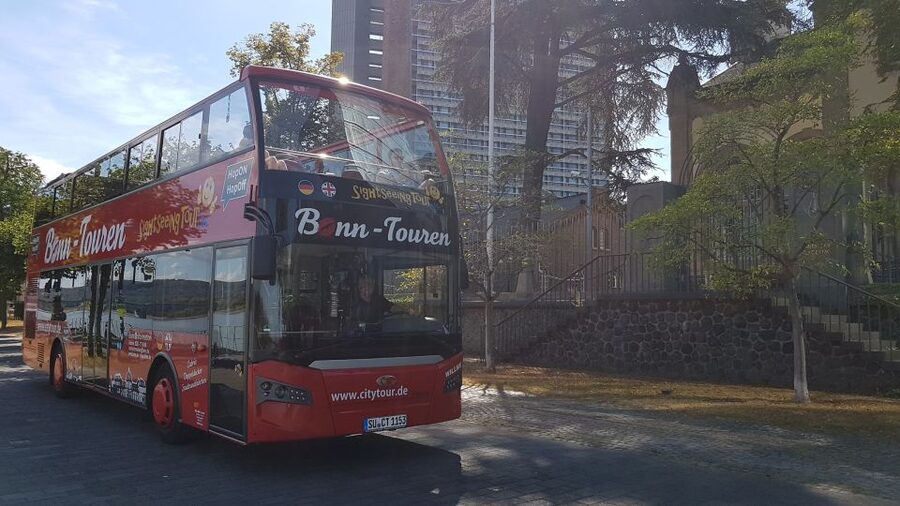
Nussallee leads you toward Bonn’s southern district, known for picturesque late 19th-century houses. This part of the route is less about one famous sight and more about seeing how the city lives between its major attractions.
I like this stop for travelers who want a break from landmark collecting. The older houses offer a sense of Bonn’s growth during the late 1800s, when the city developed beyond its medieval center. You might find this stop more rewarding as a short neighborhood walk than as a quick photograph from the bus.
The practical drawback is simple: the route information does not provide a detailed walking program from Nussallee. If you get off, use the stop as a starting point for your own exploration rather than expecting a guided neighborhood circuit.
A few more half-days in Bonn worth comparing
- From Bonn: Rhine River to Linz Sightseeing Boat Tour
★ 4.5 · 358 reviews - Bonn: Former Government District Private Tour
★ 5.0 · 127 reviews - Bonn: 1.5-Hour River Cruise on the Rhine
★ 4.5 · 109 reviews - Bonn: Evening Sightseeing Cruise on the Rhine River
★ 4.5 · 78 reviews
The Museum Mile: Bonn’s strongest cultural stop
The Museum Mile is one of the most useful reasons to buy the bus ticket. Several renowned institutions are concentrated in this part of the city, and the bus gives you a direct way to reach them without worrying about parking or navigating between districts.
The stop works best if you choose one or two museums in advance. The ticket covers transportation only. Museum admission is not included, so you should allow for separate entry costs and enough time to visit properly.
Do not treat the Museum Mile as a quick hop-off photo stop. If museums are your main reason for visiting Bonn, this is where you may spend much of the day. The bus remains useful because you can return to the route afterward instead of arranging a separate trip back to the center.
The audio commentary is especially helpful here because it connects the museums to Bonn’s role as a former capital and international city. You get a better sense of why this stretch of town has such a high concentration of cultural and public institutions.
Museum König, WCCB, and the former capital district
The Museum König stop and the WCCB stop take you through Bonn’s modern political and international identity. Bonn was once the capital of West Germany, and parts of the city still reflect that period of government, diplomacy, and public administration.
The World Conference Center Bonn, or WCCB, points to the city’s continuing international role. This is not simply a route through old buildings. Bonn now serves as a center for global organizations and international affairs, and the bus helps connect that present role to its capital-era past.
Museum König adds another cultural reference point. If you are interested in how Bonn balances science, public institutions, and politics, this section of the ride gives you useful context. If your interest is limited to medieval buildings, you may find this stretch less immediately exciting, but it is important to understanding modern Bonn.
Kennedyallee and the UN Campus
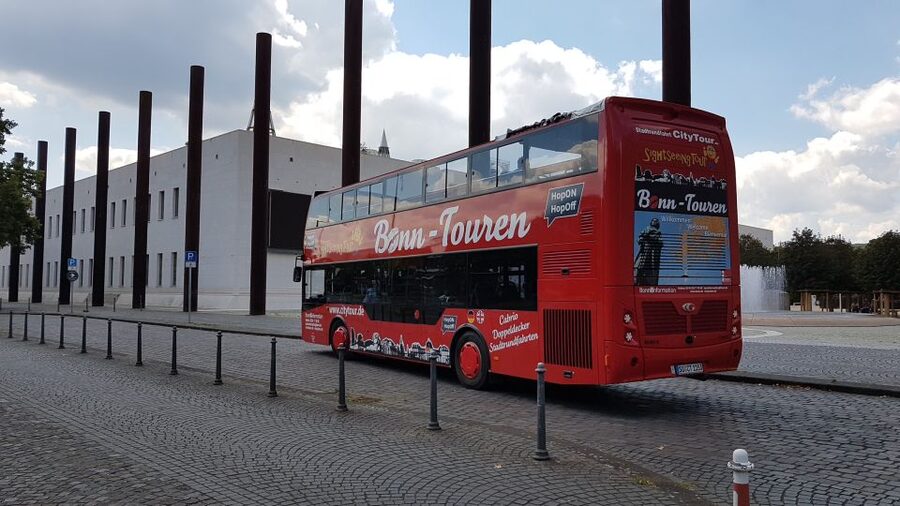
Kennedyallee is part of Bonn’s newer international center. Along this section, you pass the UN Campus and the global headquarters of Deutsche Telekom and Deutsche Post DHL.
This is one of the route’s more distinctive features. Many sightseeing buses focus only on old town monuments. Bonn’s bus route shows you the city as it actually functions today, with international organizations and major companies shaping its identity.
The UN Campus is best appreciated from the bus unless you have a separate reason to visit. The activity does not include attraction tickets or a special guided entry, so plan on viewing the district from the route and using the audio guide for background.
I would pay close attention during this part of the ride. The contrast between older residential districts and the international business center explains more about Bonn than a postcard view alone.
Kameha Hotel and the Rhine bank
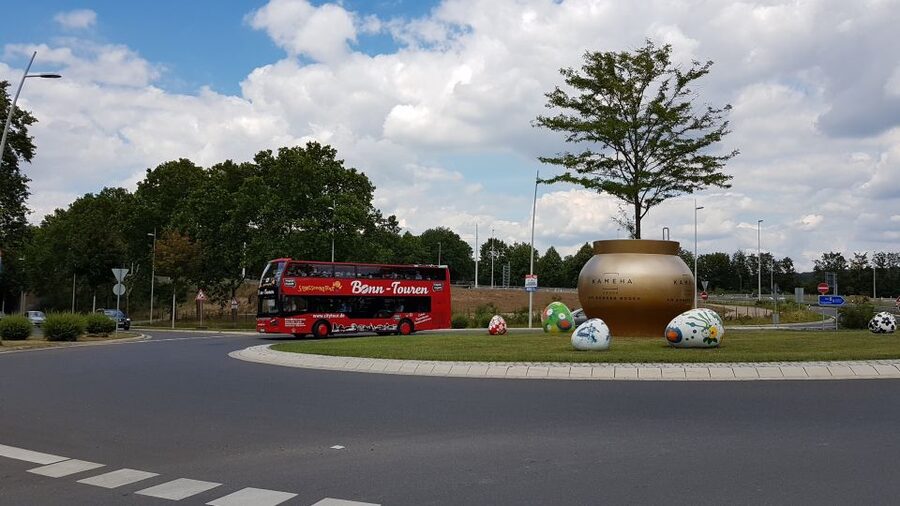
The Kameha Hotel stop brings you into a more contemporary part of Bonn. Its place on the route helps link the international district with the Rhine-side areas.
The Rhine bank stop is one of the most scenic points for a break. The river gives the ride breathing room, and you can enjoy the open views toward the Siebengebirge hills. This is also a good place to pause if you have spent several hours indoors at museums.
The route presents the Rhine as part of Bonn’s daily geography, not merely as a scenic backdrop. You see how the city relates to the river and how the river opens the view toward the hills to the south.
Do not assume every ride will provide the same view from the upper deck. Seats are not reserved, and high demand can mean that your preferred seat is unavailable. If the panorama matters to you, board early at your chosen stop and consider the weather before committing to the full circuit.
Bad Godesberg Redoute and the spa-town feel
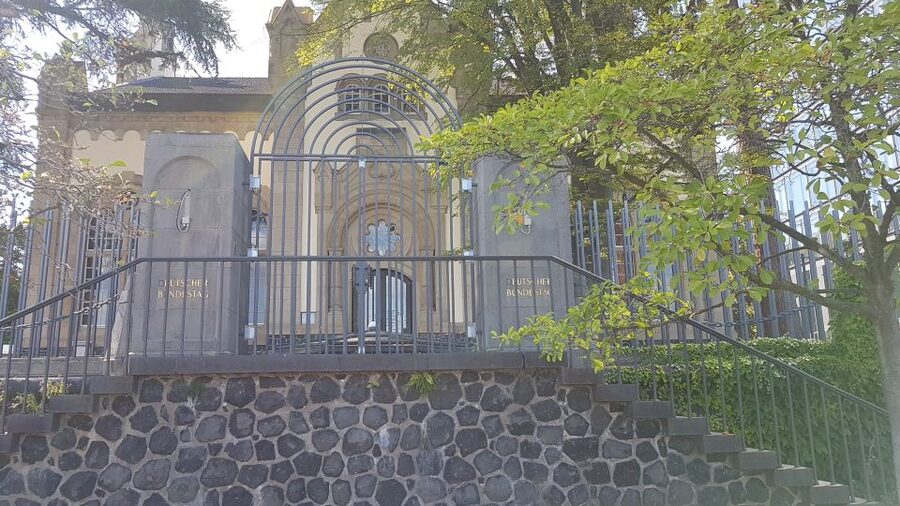
The Bad Godesberg Redoute stop takes you toward a district with a different mood from central Bonn. Bad Godesberg was known as a spa and residence town, and its elegant villas reflect that past.
This is one of the most rewarding sections for people who enjoy architecture and changing city character. The villas and former resort atmosphere show Bonn’s social history in a quieter, more refined setting. It feels separate from the central city, which is precisely why the bus is useful here.
Bad Godesberg is also a good place to get off if you want to slow the day down. The route lets you reach it without making a separate transport plan. The tradeoff is time. If you stop at the Minster, Museum Mile, Rhine bank, and Bad Godesberg, you may not have enough time to explore every area deeply during one operating day.
Brassert Ufer and the Rhine connection
Brassert Ufer adds another Rhine-side viewpoint and helps complete the route’s connection between central Bonn, the river, and the southern districts.
This stop is most useful as part of a larger plan. You might use it for a river walk, a pause between bus sections, or a different boarding point. The information provided does not specify a separate attraction at Brassert Ufer, so I would not choose it over the Museum Mile or Bad Godesberg if your time is short.
Still, that is part of the value of a hop-on hop-off ticket. Not every stop needs to be a major sight. Some are useful because they position you near a neighborhood or give you another way to break up the ride.
What the audio guide can and cannot do
The included audio guide is available in Dutch, English, French, German, Japanese, and Spanish. Headphones are provided, so you do not need to bring your own equipment.
The driver speaks German, and there is no live guide included. That distinction matters. The audio commentary gives you a set route and prepared information, while a live guide could respond to questions or adjust the pace.
Try to listen during the stretches between stops, when the bus is moving through areas without a single major sight. The commentary is most useful when it explains the connection between Bonn’s Roman beginnings, capital years, and current international role.
A quiet ride makes a real difference. One passenger found that loud phone calls nearby made the audio difficult to hear. Smoking is not allowed, but there is no stated rule here banning phone calls. If you want the commentary, choose a seat away from noisy conversations and bring patience during crowded departures.
Is $28 a fair price for one day?
At $28 per person, the ticket is reasonably priced if you use it as transportation plus orientation. A single ride is harder to justify at that price, especially if you already know Bonn and plan to walk only in the center.
The value improves when you get off at several distinct areas. A day that includes the Minster, Museum Mile, Rhine bank, and Bad Godesberg uses the route for exactly what it does best: connecting places that have different characters and are not best understood as one compact sightseeing zone.
You still need to budget separately for food, drinks, and attraction tickets. The bus does not include museum entry. You should also avoid buying it solely for guaranteed top-deck seating, since reservations are not possible and seats are not guaranteed during busy periods.
The flexible cancellation policy helps if your schedule is uncertain. You can cancel up to 24 hours in advance for a full refund, and the reserve-now, pay-later option allows you to hold a place without paying immediately.
Accessibility, dogs, and practical comfort
The lower level is barrier-free and suitable for wheelchair users. One companion for a person whose disability pass is marked Category B can travel free of charge. Dogs are allowed on the lower level.
This makes the bus a practical choice if stairs or long walks are a concern. The upper deck is not the accessible option, so you should plan to ride downstairs if you use a wheelchair.
Comfort depends partly on timing. Seats cannot be reserved, and busy rides may limit your choice. If you are traveling with a group, ask about group discounts before boarding. A discount was available for one group but had not been explained during the earlier booking conversation, so it is worth checking directly.
Who should book this Bonn bus tour?
I would choose this tour for a first visit, a short stay, or a day when you want to understand Bonn’s full geographic spread. It suits you especially well if you are interested in the city’s former capital role, international institutions, museums, and Rhine scenery.
It is also a good fit for anyone who wants a low-effort overview before deciding where to spend more time. The audio guide, open deck, and 11 stops give you enough structure without forcing you into a fixed walking group.
I would be more cautious if you want a highly personal historical tour, exact departure times, or guaranteed seats. The German-speaking driver and recorded commentary are functional rather than intimate, and the timetable needs checking at the stops.
Should you book it?
Book it if you want to connect Bonn’s central sights with the Museum Mile, UN Campus, Rhine bank, Siebengebirge views, and Bad Godesberg in one day. The strongest value comes from using several stops, not simply riding the full loop once.
Before you go, confirm the day’s timetable at a bus stop, arrive early for the upper deck, and decide which museums or neighborhoods deserve your time. With those small preparations, the $28 ticket gives you a useful, flexible introduction to a city whose story reaches well beyond its former capital label.
FAQ
Where does the Bonn sightseeing bus start?
The first stop is Budapester Straße at the corner of Sternstraße. You can also board at any of the 11 stops along the route.
How long is the ticket valid?
The ticket is valid for 24 hours, described as one day of hop-on hop-off use.
Which stops are included?
The stops are Budapester Straße, Bonner Minster, Nussallee, Museum Mile, Bad Godesberg Redoute, Rhine bank, Kennedyallee, Kameha Hotel, WCCB, Museum König, and Brassert Ufer.
Is a live tour guide included?
No. The driver speaks German, and a multilingual audio guide is included instead.
Which audio guide languages are available?
Commentary is available in Dutch, English, French, German, Japanese, and Spanish.
Are museum and attraction tickets included?
No. The ticket covers the bus, audio guide, and headphones, but attraction admission, food, and drinks cost extra.
Is the bus wheelchair accessible?
Yes. The lower area is barrier-free and suitable for wheelchair users. Dogs are also allowed on the lower level.
Just added in Bonn
- Panorama tour between Bonn and Königswinter★ 4.7 · 63 reviews
- RhineRiverBoatTour from Bonn to Königswinter with Live Guide★ 4.3 · 13 reviews
- Bonn: Sunset Boat Tour on the Rhine★ 4.7 · 11 reviews
- Bonn Regio WelcomeCard with Guidebook★ 4.3 · 15 reviews
- Bonn: Sunday Brunch Buffet with Cologne live music★ 5.0 · 5 reviews
- Bonn: Private Guided Walking Tour★ 4.3 · 15 reviews
- Bonn : Private Walking Tour With A Guide ( Private Tour )★ 4.5 · 9 reviews
- Bonn: Former Government District Private Tour★ 5.0 · 127 reviews
Hop-On Hop-Off Tours, compared.
Munich Hop-On Hop-Off Tour: 1-Day or 2-Day Ticket
Read our review →
Hop-On Hop-Off Sightseeing Bus with Boat Options
Read our review →
Browse the lists this tour appears in