
Reviewed · CYCLING TOURS
Hamburg: City Tour by Bike with Elbphilharmonie
Hamburg’s story makes the most sense from a bicycle seat. In about three and a half hours, you move from the calm waters of the Alster to brick warehouses, former harbor districts, designer streets, flood defenses and the glass-topped Elbphilharmonie. It is a good way to see how Hamburg grew from waterways and trade into a modern port city.
I like the wide range of neighborhoods packed into one route, and I like that the ride includes places you may otherwise connect only by subway or on foot. The old Gängeviertel, Deichstraße, Speicherstadt and St. Michael’s Church give the tour plenty of character. Guide Bernhard is known for having a lot to say about his city, and the comments in German also praise the guide for being very informative.
The main consideration is pace. You will cover a lot of ground, so this is better for confident cyclists than for anyone hoping for long visits inside museums or churches. Access to the Elbphilharmonie plaza can also be restricted during major events or other unpredictable situations.
Key points to know before you book
- A full Hamburg cross-section: The route links Alster Lake, the old and new towns, Speicherstadt, HafenCity, St. Michael’s Church and the St. Pauli Piers.
- A bicycle included: You do not need to arrange your own bike, and a city map is part of the package.
- Strong local guiding: Tours run in English or German. Bernhard is one guide named in the feedback, with a reputation for giving plenty of city information.
- An unusual history route: You pass the former harbor, the old working-class Gängeviertel, the birthplace of Johannes Brahms, and the district reshaped after the great fire of 1842.
- Elbphilharmonie time is conditional: The route reaches the building and includes time for the plaza when access is possible, but major events can close or restrict it.
- Good value at $39: The price covers the bicycle, guide, map, and photo series, making it useful if you want broad orientation in one outing.
Starting in Rotherbaum beside the university
The tour begins outside the Fahrradstation of the University of Hamburg at Schlüterstraße 11, in the Rotherbaum district. This location gives you a practical starting point near the city center, though you should allow enough time to find the exact meeting spot.
The ride lasts around three hours on the route, while the booking description lists a total duration of three and a half hours. That difference likely allows for stops, explanations, and photo breaks. Starting times vary, so check the available departure time when booking.
You receive a bicycle, a city map, and a guide. The map is useful beyond the tour itself, especially if this is your first day in Hamburg and you want to return to one of the districts later. A photo series about Hamburg is also sent by email after the ride, giving you a useful visual reminder of the places covered.
More Bike Tours in Hamburg
- Hamburg 3-Hour Bike Tour
★ 4.8 · 1,353 reviews - Guided Hamburg City Bike Tour
★ 5.0 · 642 reviews - Hamburg: Downtown, Alster & Creative Neighborhoods by Bike
★ 4.5 · 217 reviews
From Außenalster to the Binnenalster panorama
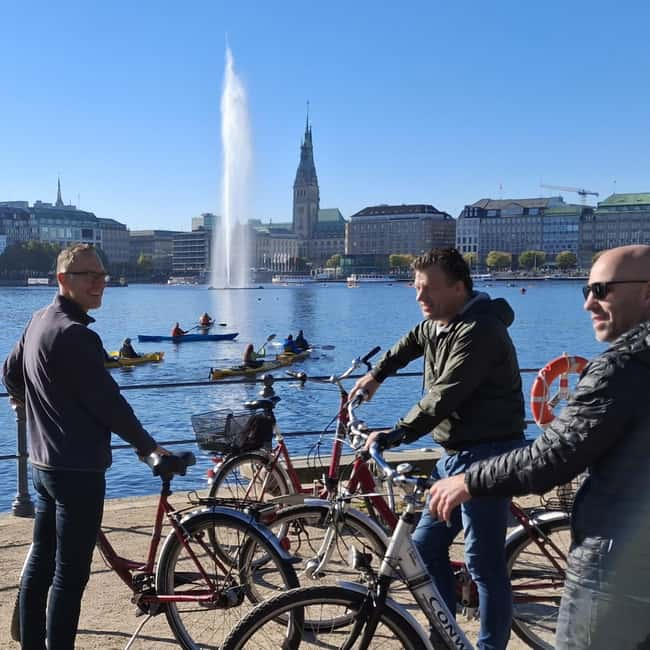
The first major stretch follows the Außenalster toward the Binnenalster. The Alster is one of Hamburg’s defining urban features, and cycling beside the water lets you see the city from a quieter angle than a standard street tour.
At the Binnenalster, the view opens toward Hamburg’s old and new town. This is an effective introduction because you can see the city’s mixed character in one sweep: established streets and grand buildings on one side, newer commercial and architectural projects on the other.
The Alster section is also a gentle way to settle into the ride. You get the smell of the water, open views, and a sense of Hamburg as a city shaped by waterways rather than simply built beside them. Still, this is a guided cycling tour, not a long lakeside stop. Expect a photo opportunity and commentary rather than extended free time.
Gängeviertel, Brahms, and the city after the great fire
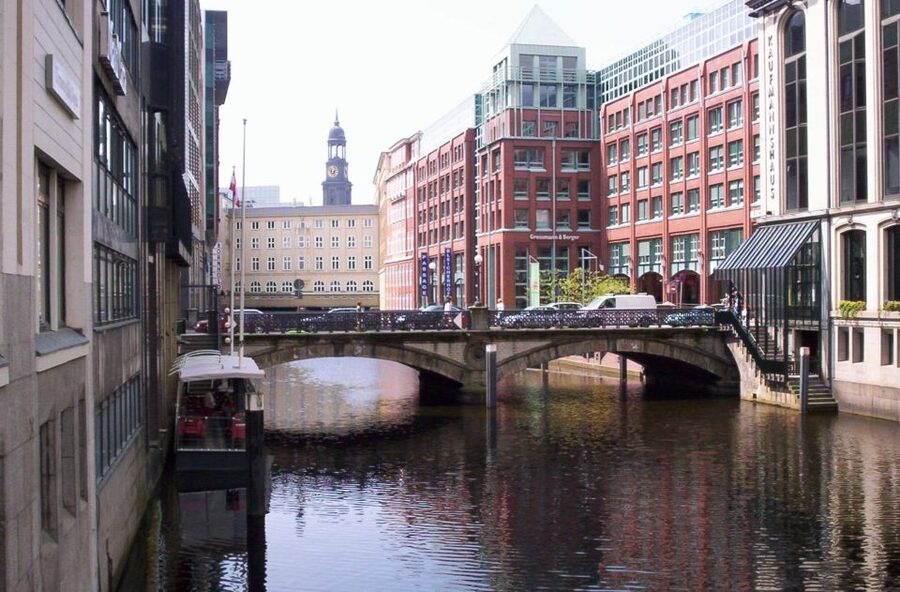
From the Alster, the route moves through the Gängeviertel of the Neustadt. This former working-class district dates to the 18th century and has preserved traces of its older urban pattern. Today, it is connected with Hamburg’s art scene, which gives the area a different feel from the polished shopping streets nearby.
The route also passes a memorial stone marking the birthplace of Johannes Brahms. That small detail is easy to miss when exploring alone, but it shows the kind of local information this tour adds. You are not only ticking off famous buildings. You are also getting small markers that connect Hamburg with music, working-class life, and urban change.
The ride then crosses Fleet Island, a former harbor area. The guide follows the route of the great fire of 1842 toward the modern city. This is one of the strongest historical threads in the outing. Hamburg is not presented as a city that simply grew in a straight line. Fire, trade, waterways, redevelopment, and changing business needs all altered its shape.
Rathaus, Neuer Wall, and Hamburg’s polished center
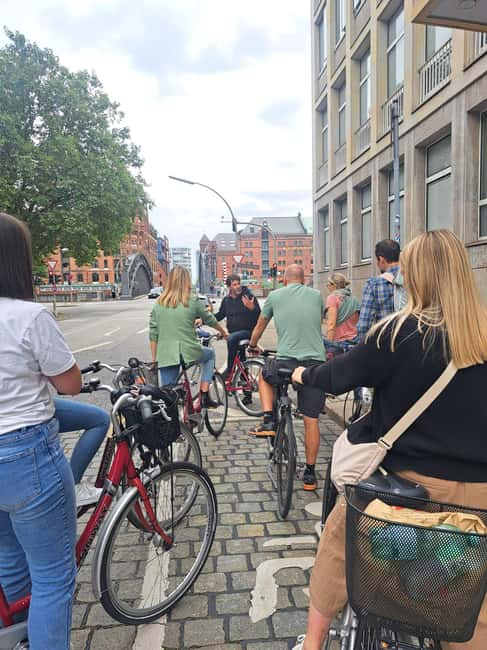
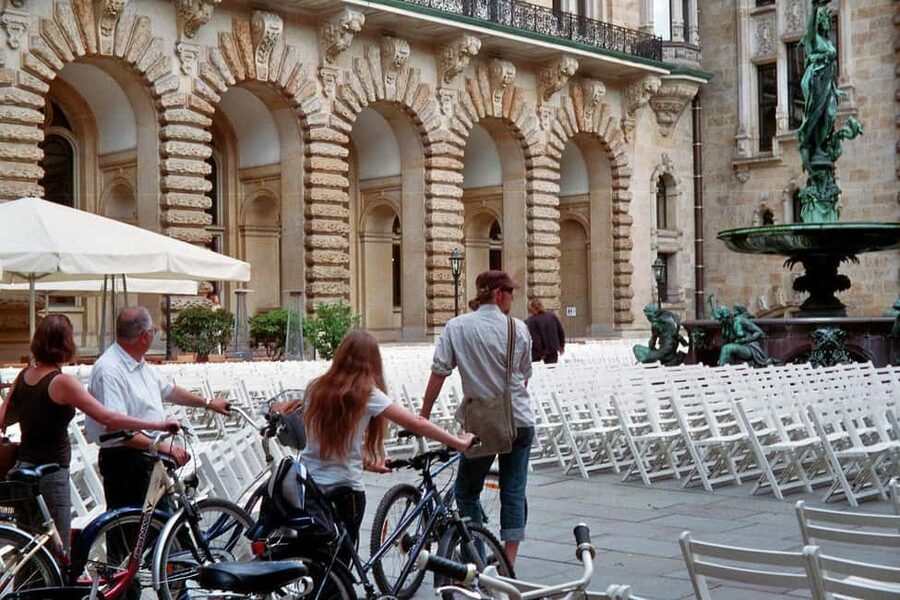
The old town section includes Hamburg’s Rathaus, or Town Hall, one of the main photo stops. You see it as part of a larger city-center sequence rather than as an isolated monument.
The route also passes Neuer Wall, known for its passages and designer shops. Here the tone changes. The older harbor and working-class districts give way to a more polished commercial side of Hamburg. That contrast is useful because it shows the city’s range without pretending every neighborhood has the same character.
You may enjoy this section if you like seeing how a city combines commerce with older architecture. If your main interest is medieval buildings or museum interiors, keep your expectations in check. The tour is designed to show the city in motion, and the explanation comes while cycling or pausing briefly.
Same city, a completely different kind of day:
- Hamburg: Sex and Crime in St. Pauli Tour for Ages 18+
★ 4.7 · 15,447 reviews - Hamburg: 1.5-Hour Harbor and Speicherstadt Day Cruise
★ 4.6 · 14,200 reviews - Hamburg: 90-Minute Evening Lights Harbor Cruise
★ 4.5 · 7,728 reviews - Hamburg: 2-Hour XXL Port of Hamburg Cruise Tour
★ 4.7 · 6,979 reviews
Deichstraße and the beginning of the old port
Deichstraße is one of the most atmospheric stops on the route. It marks the origin of port operations in Alt-Hamburg and leads toward the Speicherstadt. The street helps connect the city center with the harbor districts that made Hamburg wealthy and internationally important.
This is a good place to pay attention to how close the historic commercial city sits to the water. The route does not treat the port as a separate attraction at the edge of town. Instead, it shows how Hamburg’s business life grew around its channels, warehouses, and access to shipping.
Deichstraße is also a strong photo stop. The tour gives you the setting and the guide’s explanation, but it does not promise an extended architectural visit. If you want to study every building at leisure, note the location and return later on foot.
Speicherstadt, the brick warehouse district
Speicherstadt is likely to be one of the ride’s high points. The UNESCO World Heritage site is known for its massive 19th-century brick warehouses, built on millions of oak poles among narrow waterways called Fleete.
Cycling through this district makes its scale easier to grasp. From street level, the brick walls, bridges, water channels, and warehouse blocks form a tightly planned trading quarter. You are seeing the physical system that once stored goods moving through the port, not just a row of attractive old buildings.
The contrast with HafenCity comes quickly, which makes the route especially effective here. Speicherstadt represents Hamburg’s older port economy, while the next section presents a much newer vision of waterfront living, offices, culture, and public space.
There is one practical tradeoff. Speicherstadt can be visually busy, with narrow streets and plenty to look at. You will get more out of it if you stay alert to the guide and avoid treating the whole section as a fast transfer to the next stop.
HafenCity and the changing waterfront
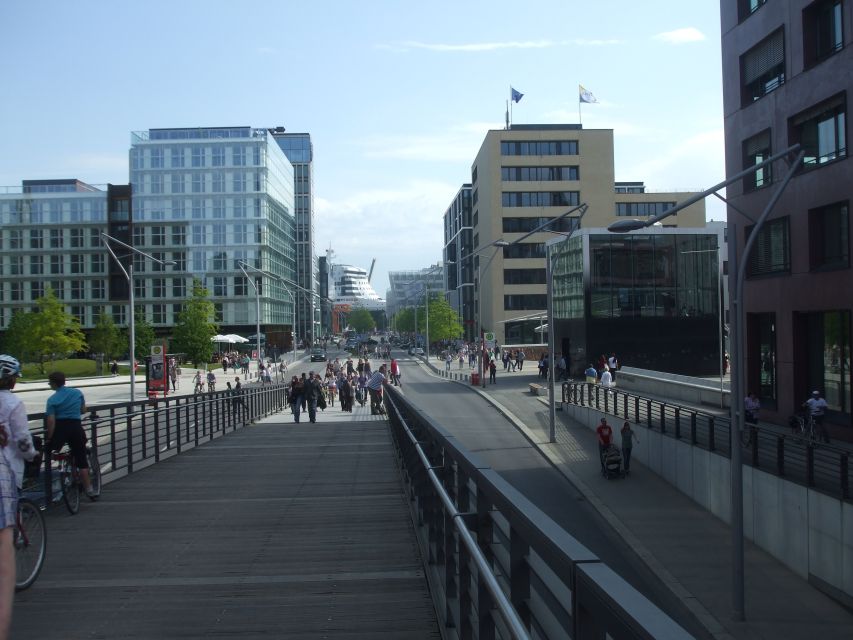
HafenCity occupies the former harbor area and gives the tour its clearest look at Hamburg’s modern redevelopment. The old port is no longer presented only as a working zone. It has become part of a large postmodern district with new buildings and public routes along the water.
The bicycle is particularly useful in HafenCity because it lets you cover more ground than walking while still seeing the district at street level. You get a better sense of how the new quarter relates to Speicherstadt and the Elbe.
This part may appeal most if you enjoy architecture, city planning, and waterfront renewal. It may feel less intimate than the old town or Gängeviertel, since the buildings and spaces are newer and more open. The value is in the contrast: Hamburg’s future-facing side is placed directly beside its old warehouse core.
Meeting the Elbphilharmonie from several angles
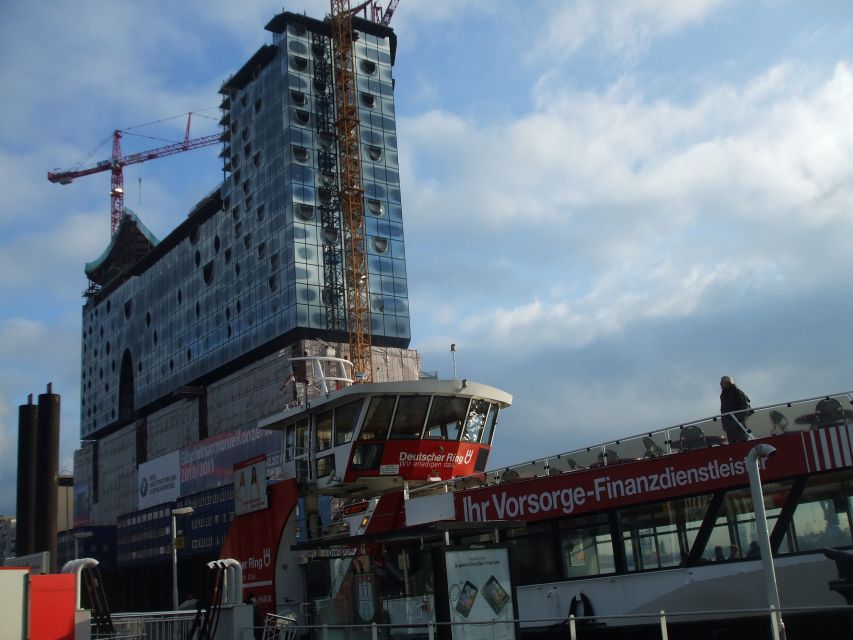
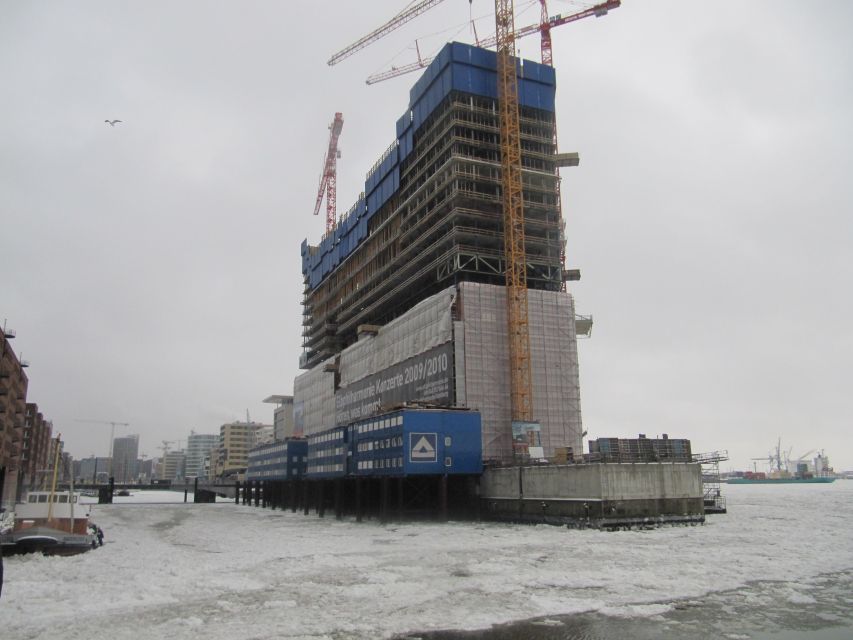
The 110-meter-high Elbphilharmonie is the visual centerpiece of the harbor section. Its glass upper structure rises above the former warehouse base, making it easy to spot from several points along the route.
The tour includes time to go to the plaza, subject to access. That condition matters. On days with major events, the plaza or building access may be restricted or closed, and the decision can also depend on other unpredictable situations. You should treat the plaza visit as an important possibility rather than an absolute guarantee.
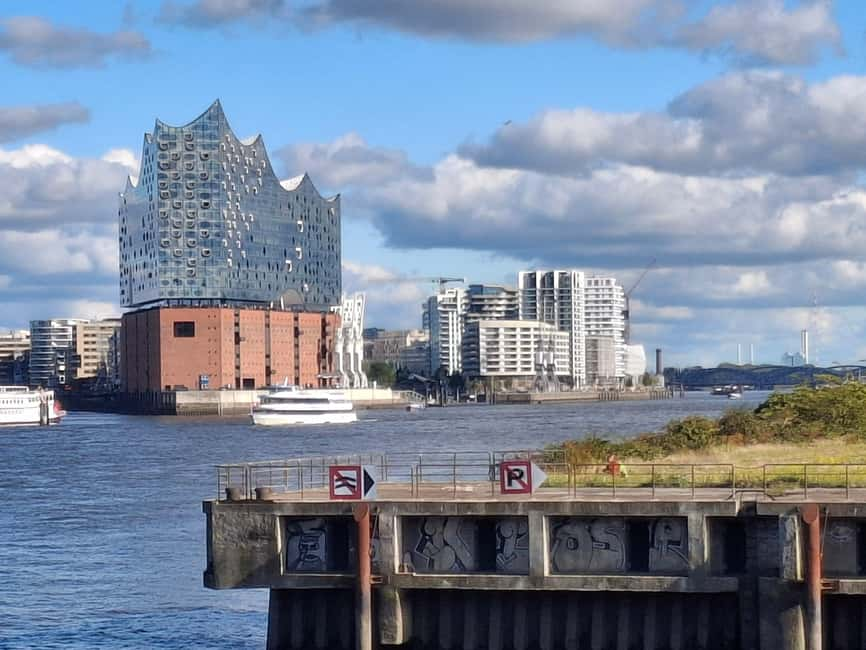
Even if access is limited, the route still gives you several views of the building. The final approach follows the new flood protection system, offering views of the Elbphilharmonie from below. This angle helps you appreciate the building’s height and its position above the old harbor.
For many people, this is enough to make the tour worthwhile. You get the major landmark, the surrounding waterfront, and context about why the building is part of such a large change in Hamburg. If your sole goal is to visit the interior, book with caution because the experience is primarily a city bike tour.
Baumwall, St. Michael’s, and Neustadt
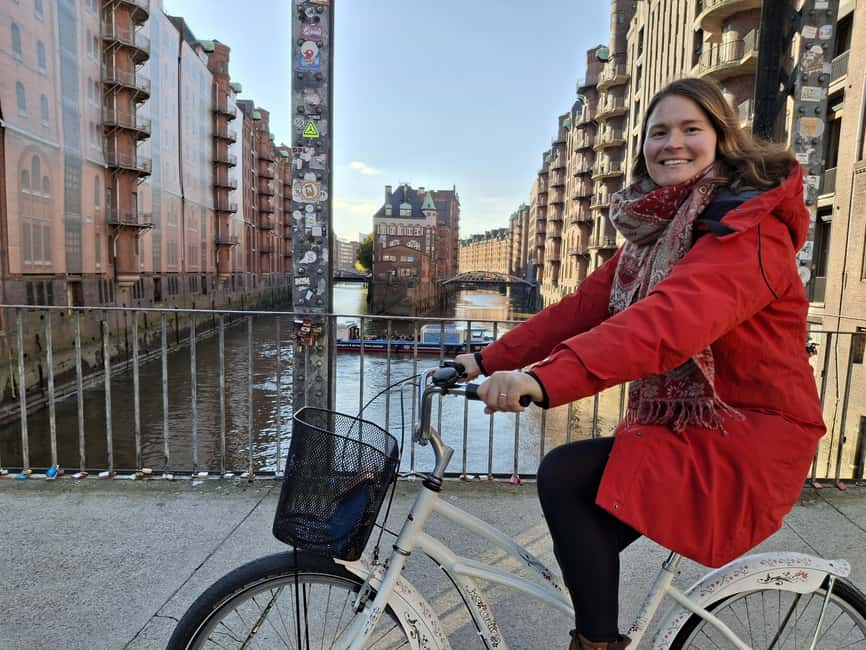
After HafenCity, the route follows the flood defenses and passes the steel publishing building at Baumwall. The description calls it an almost utopian-looking structure, and it adds another piece to the city’s modern architectural story.
The route then reaches St. Michael’s Church, Hamburg’s best-known church landmark. You see it as part of the Neustadt route, not as a separate interior visit. Its location helps bring the ride back from the waterfront toward the historic center.
Peterstraße follows, with the Brahms and Telemann museums nearby. This section returns to music and local culture after the large-scale port architecture. The route has already introduced Brahms through his birthplace memorial, so the museum area gives that thread a second point of reference.
You should not expect admission to the museums from the information provided. They function as landmarks along the route, and you can note them for a later visit if you want more time indoors.
St. Pauli Piers and the return to Schlüterstraße
The itinerary includes the St. Pauli Piers before the ride returns to the starting point. This brings you back to Hamburg’s maritime identity, now seen from one of its best-known waterfront areas.
The sequence is well chosen. You have seen the Alster, city center, old warehouses, new harbor development, church district, and piers. Instead of concentrating only on the postcard center, the tour links the places through the city’s main themes: water, trade, music, commerce, fire, redevelopment, and flood protection.
The activity ends back at Schlüterstraße 11. That makes planning easier because you do not need to arrange transport from a distant final stop. It also leaves you free to continue exploring the city from a familiar starting point.
What $39 includes and what it does not
At $39 per person, the tour offers solid value if you want a broad first look at Hamburg. The fee includes the bicycle, guide, map, and photo series by email. You are also paying for the route design, which connects several districts that would take more effort to organize independently.
The price is especially reasonable for a first or second day in the city. A guide can explain why Speicherstadt sits on oak poles, how the old harbor relates to HafenCity, and where the great fire changed the city. You can then choose which places deserve a longer return visit.
The tour is less useful if you already know Hamburg well or want long stops at individual attractions. You will spend much of the time moving between places. The value comes from range and explanation, not from admission to museums or a long indoor visit at the Elbphilharmonie.
The rating of 4.5 from 60 reviews fits the format: the strongest praise centers on the guide and the amount of information. German comments describe the experience as very good and full of information, while the English feedback specifically praises Bernhard and his detailed stories about Hamburg. That makes the guide a major part of what you are buying.
Who will enjoy this ride most
I would choose this tour for a first-time visitor who wants orientation without spending a full day inside a bus. It suits you if you are comfortable cycling for several hours and like seeing ordinary city streets between major sights.
It is also a good fit for people interested in architecture and urban change. The movement from Gängeviertel to Neuer Wall, Deichstraße, Speicherstadt, HafenCity, and the Elbphilharmonie gives you a clear comparison between old and new Hamburg.
Families and mixed-age groups should consider each person’s cycling comfort before booking. The route is long enough that anyone who dislikes bike travel may find the pace tiring. The supplied information does not give a minimum age, bike size details, or group size, so ask the provider if those points matter to you.
Choose an English or German departure according to your comfort. Since the tour depends on explanations, you will get the most from it in the language you follow easily.
Should you book the Hamburg bike tour?
Book it if you want one well-planned ride through Hamburg’s major contrasts rather than a narrow tour of one district. The combination of Alster views, the old town, Speicherstadt, HafenCity, the Elbphilharmonie, St. Michael’s, and the piers gives you a useful mental map of the city.
The strongest reason to book is the guiding. Bernhard’s detailed commentary and the repeated praise for informative guides suggest that the explanations are central to the experience. The main caution is the active format: you need to be ready to cycle for about three hours, and the Elbphilharmonie plaza is not guaranteed.
For $39, I find it a sensible choice early in a Hamburg visit. It gives you enough context to decide where to return, while the bike route adds waterfront views and neighborhood details that a simple sightseeing loop can miss.
FAQ
Where does the Hamburg bike tour begin?
The tour begins outside the Fahrradstation of the University of Hamburg at Schlüterstraße 11 in Rotherbaum.
Where does the tour end?
The ride returns to Schlüterstraße 11, the same location as the start.
How long does the tour last?
The activity lasts about three and a half hours, with approximately three hours described as the bike tour itself. Check the available starting times when booking.
Is a bicycle included?
Yes. A bicycle, city map, guide, and photo series about Hamburg sent by email are included.
What languages are available?
The live tour guide is available in English or German.
Is access to the Elbphilharmonie plaza guaranteed?
No. The tour includes time to go to the plaza when it is accessible, but major events or other unpredictable situations may restrict or close access.
Just added in Hamburg
- Hamburg: St. Pauli Food and Bier Tour★ 4.7 · 5 reviews
- Hamburg: Private Tour Red Light District Walking Tour★ 4.7 · 227 reviews
- St. Pauli Tour: Drag-Attack with Barbie Stupid & Lee Jackson★ 4.8 · 280 reviews
- St. Michael’s, Elbe Tunnel & Harbor 2-Hour Hamburg Tour★ 4.9 · 21 reviews
- Hamburg: Safari tour in St. Pauli★ 4.9 · 11 reviews
- Satt Pauli – der kulinarische Rundgang durch St. Pauli★ 4.8 · 12 reviews
- Hamburg: Reeperbahn Comedy Club★ 4.3 · 53 reviews
- Radtour um die Alster & durch traumhafte Alsterviertel★ 4.9 · 34 reviews
Cycling Tours, compared.
Sights and Highlights Bike Tour with a Local Guide
Read our review →
Classic Mike’s Bike Tour daily @ 11.30 incl Beer Garden & Surfers
Read our review →

Browse the lists this tour appears in