
Reviewed · DRESDEN TOURS
Dresden: Virtual Reality Time Travel Experience Ticket
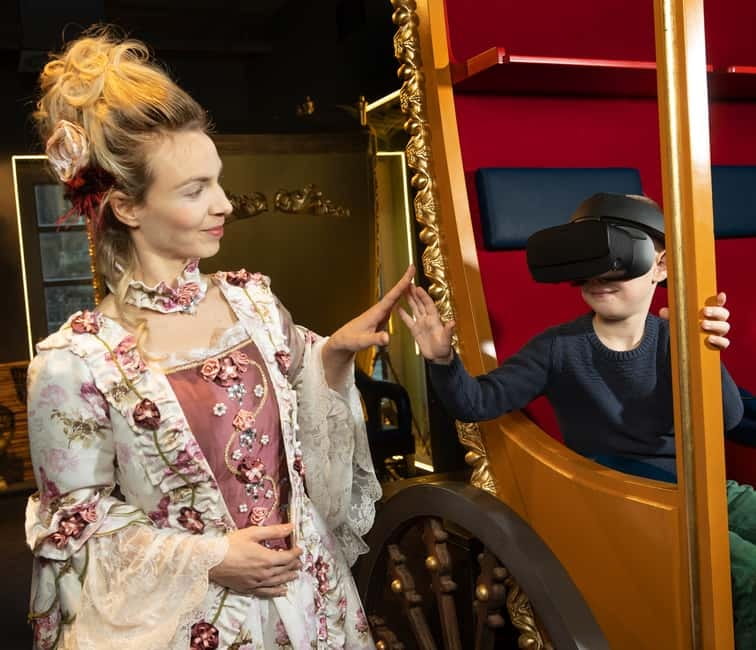
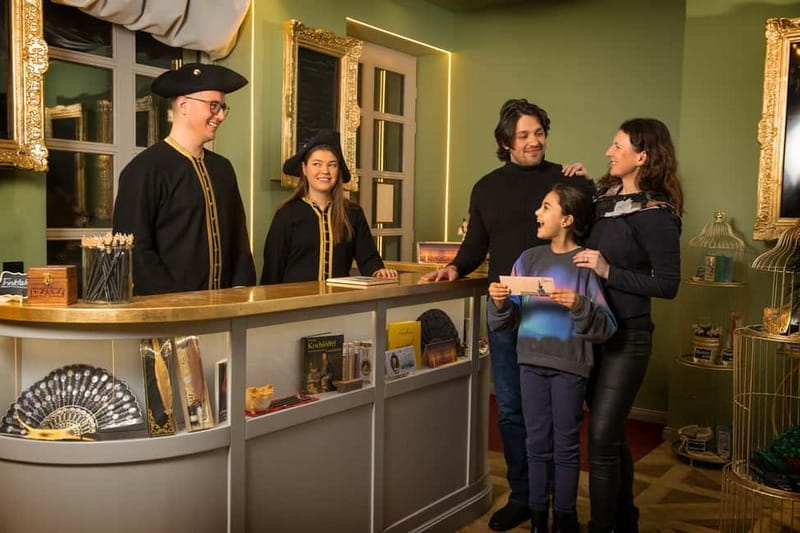
Dresden’s past comes alive in a 45-minute virtual-reality journey set in 1719. You begin in the Hall of Mirrors, meet a master of ceremonies speaking for Augustus the Strong, then move through a juggler’s show and a virtual carriage ride through the city. It is history with music, animation, and a touch of theater.
I like the clear three-part structure and the chance to see both court life and ordinary life. I also like the royal wedding finale inside the Dresden Zwinger, which gives the VR ride a real story instead of making it a simple sightseeing loop.
The main drawback is time. Each section lasts about 15 minutes, and one especially positive rating still noted that the VR time travel felt too short. At $23, this is a fair add-on, but not a full museum visit.
Key points to know before you book
- Dresden in 1719: See the city during the Baroque era, including its court, suburbs, and royal celebrations.
- Three 15-minute chapters: The Hall of Mirrors, Juggler’s Stage, and virtual carriage ride each bring a different side of Dresden to life.
- A guide leads the experience: Tours are available in English or German, with a live guide introducing the setting and story.
- The royal wedding is the finale: Ride through the city and attend the marriage of Friedrich August III and Maria Josepha at the Dresden Zwinger.
- Good value for a short stop: At $23 per person, it fits neatly between major Dresden sights.
- Wheelchair access needs planning: The venue is on ground level, but the Baroque carriages cannot accommodate wheelchair users.
Why this Dresden VR experience works
Dresden can be a hard city to picture before its destruction in the Second World War and later rebuilding. Modern streets and restored monuments tell part of the story, but they do not always show how the city looked when Augustus the Strong ruled Saxony.
This experience takes a direct approach. It places you in Dresden in 1719, when court ceremony, public amusements, and royal display shaped daily life. You are not only shown a building or given a date. You are guided through a short sequence of scenes that connect the palace, the suburbs, and the Zwinger.
The format is especially useful if you prefer history with a strong visual element. Baroque music, animation, theater, and virtual reality do much of the explaining. You do not need a detailed knowledge of the Wettin dynasty to follow along.
The tone is lively rather than academic. The master of ceremonies welcomes you on behalf of Augustus the Strong, and the presentation includes humor. One rating specifically praised the guide’s amusing delivery, while another praised the spoken presentation and animation. That tells you what kind of experience this is: theatrical, brisk, and designed to entertain as it informs.
A few more half-days in Dresden worth comparing
- Dresden: Semperoper Tickets and Guided Tour
★ 4.7 · 12,102 reviews - Dresden: The Original Night Watchman Tour in Lantern Light
★ 4.6 · 6,653 reviews - Dresden: Semperoper and Old Town Tour
★ 4.8 · 5,735 reviews
Starting in the Hall of Mirrors
Your first stop is the Hall of Mirrors. Here, the master of ceremonies welcomes you in the name of Augustus the Strong from the House of Wettin.
This opening gives the tour a formal Baroque setting. You learn about the Wettin dynasty while animations and period-style music set the mood. The guide then explains the route ahead and prepares you for the carriage ride.
The Hall of Mirrors section lasts about 15 minutes. It is an important setup, because the later scenes make more sense once you understand the royal world that shaped Dresden in 1719.
I like this opening because it establishes a clear point of view. You are not dropped into a random computer simulation. You are introduced to the court, the ruling family, and the public spectacle of the era.
It also gives you time to get used to the theatrical style before the VR carriage ride. If you prefer a quiet, traditional museum presentation, the music and ceremony may feel a bit showy. If you like a strong sense of occasion, it should be an easy way to get into the story.
The Juggler’s Stage and everyday Dresden
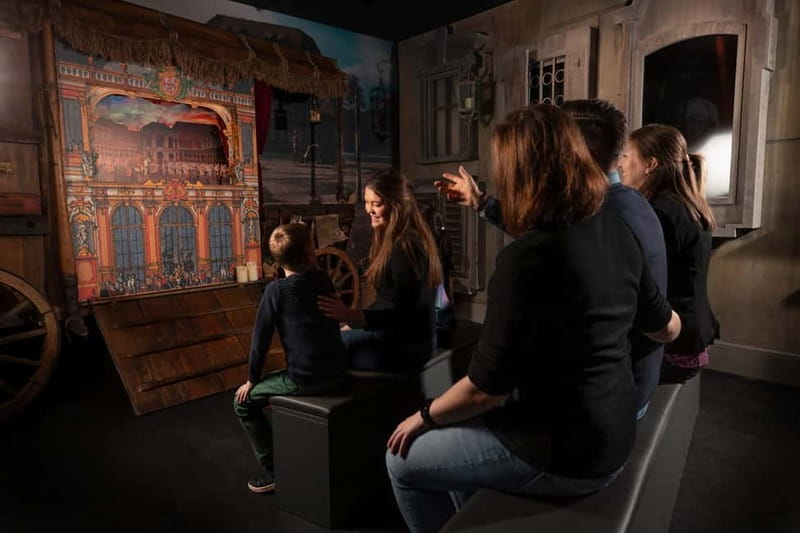
The second stop moves away from royal ceremony and into the world of common people. Called the Juggler’s Stage, this section uses a digital paper theater to present Baroque life outside the court.
That change of setting matters. Royal Dresden was only one part of the city. This chapter gives you a look at contemporary amusements and the daily world of the suburbs, using a visual style that recalls old paper theater.
The segment lasts about 15 minutes. It is not simply a pause before the main attraction. It helps balance the grand court scenes with a more ordinary view of Dresden.
I find this contrast one of the most useful parts of the experience. You see how the city’s identity depended on both royal display and public entertainment. The presentation also keeps the history moving, which is helpful if you are visiting with family members who might lose interest during a long historical talk.
The juggler scene is also a good reminder that this is not a conventional guided walk. You do not move through real streets or inspect original objects. Instead, you receive a staged interpretation of the period through animation and digital theater.
Riding through Dresden in 1719

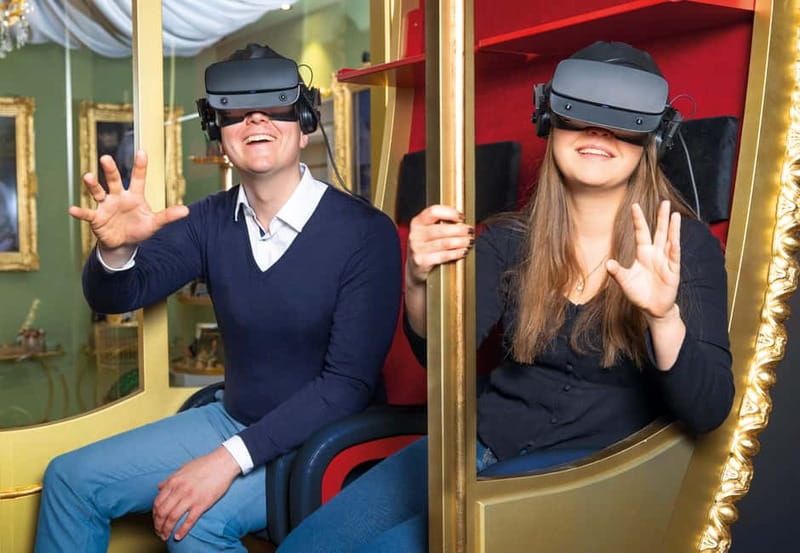
The main event begins when you take a seat in a magnificent carriage and put on the VR glasses. The ride carries you through the golden Dresden of 1719, with views of the city and its suburbs.
The virtual carriage gives you a moving viewpoint rather than a fixed scene. You can look around as the ride unfolds, which is why the instruction to keep watching in every direction matters. The experience aims to show what Dresden felt like from within the city, not only what it looked like from a postcard view.
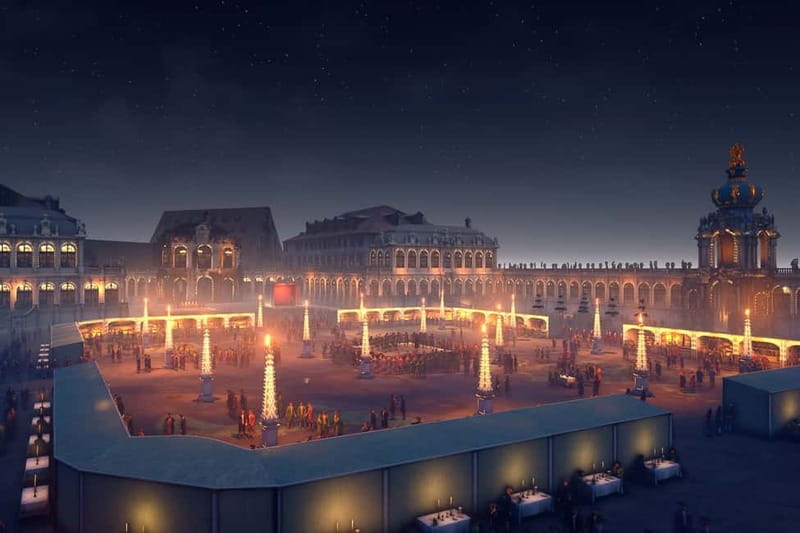
You also see the legendary wedding of Friedrich August III and Maria Josepha. The ceremony takes place inside the Dresden Zwinger, and you attend as a guest of honor.
That wedding gives the carriage ride a useful narrative goal. Instead of simply passing through old Dresden, you travel toward a major public event. The sequence links the city streets, the suburbs, the court, and the Zwinger in one short story.
The ride lasts about 15 minutes, which is both its strength and its limitation. It is long enough to create a clear impression of Baroque Dresden, but short enough to fit into a busy sightseeing day. At the same time, you may want more time to examine the virtual scenes, especially if you enjoy historical reconstruction. A rating praising the tour still pointed out that the VR time travel felt too short.
Same city, a completely different kind of day:
- Dresden: River Sightseeing Boat Cruise
★ 4.3 · 5,323 reviews - Dresden: Tour of VW’s Transparent Factory
★ 4.5 · 4,058 reviews - Dresden: 1-Day Hop-On-Hop-Off Bus Tour
★ 4.5 · 2,813 reviews - Dresden: Church of Our Lady Guided Tour of Gallery
★ 4.7 · 2,421 reviews
What the $23 price gets you
The ticket costs $23 per person and includes admission to the virtual-reality experience. Food and drinks are not included.
For this price, I would treat the experience as a focused historical attraction rather than a major half-day activity. The total time is 45 minutes, and the venue gives you three compact chapters. That makes the cost reasonable if you want a guided introduction to Dresden’s Baroque era without committing several hours.
The value is strongest for visitors who are already planning to see the city’s historic center. The VR scenes can help you understand the setting before or after you visit places connected with Dresden’s court and royal architecture.
The value is less convincing if you expect a long VR production with extensive free exploration. The route is carefully directed, and each section is short. You are buying a polished, guided presentation, not open-ended access to a virtual city.
The ticket also lets you skip the ticket line. Starting times vary, so you need to check availability when choosing your visit. Since the activity lasts less than an hour, it can fit between other Dresden plans.
Practical details at SENSEUM Dresden
The experience starts directly behind the cholera fountain. It ends back at the same meeting point, so you do not need to arrange transport between the beginning and end.
SENSEUM Dresden is at ground level. The tour is available in English and German, and a live guide leads the presentation. The experience is wheelchair accessible in part, but there is an important limit: wheelchair users cannot enter the Baroque carriages.
You can still take part in the VR tour alongside the carriage. The venue asks you to give advance notice so the staff can prepare the visit. That is worth doing before arrival, rather than hoping the arrangement can be made on the spot.
Children under six are not permitted. The information provided does not set a maximum age or give a recommended age range, so families should judge the format for themselves. The mix of animation, music, theater, and virtual reality may suit children old enough to follow a guided story, but the experience remains a historical presentation rather than a playground attraction.
Flash photography is not allowed. You do not need food or drinks for a 45-minute visit, and none are included with the ticket.
Who will enjoy this experience most
I would recommend this to you if you want a quick, visual introduction to Dresden’s Baroque period. It is particularly useful if you are curious about Augustus the Strong, the Wettin dynasty, the Dresden Zwinger, or the city’s royal wedding traditions.
It also suits first-time visitors who want a little historical context before seeing Dresden’s monuments in person. The three chapters give you a simple framework: court, common life, and royal celebration.
Families with children over six may find the short sections easier to manage than a long museum tour. The guide’s humorous tone and the animated presentation help keep the pace lively.
It is also a practical choice on a rainy day or when you have a spare hour near the historic center. The location, duration, and fixed meeting point make it easy to add to a day of sightseeing.
I would be more cautious if you dislike wearing VR glasses, prefer original objects, or want a detailed historical lecture. The experience focuses on atmosphere and storytelling. It gives you impressions rather than a large amount of written information.
How to get the most from the 45 minutes
Arrive ready to follow the full sequence. The first 15 minutes explain the royal setting, the second turns to ordinary life, and the final 15 minutes provide the VR carriage ride. Missing the beginning would weaken the story.
Pay attention to the guide’s introduction in the Hall of Mirrors. The explanation of the Wettin dynasty and Augustus the Strong helps you understand why the wedding and the Zwinger matter later.
During the carriage ride, look around rather than staring straight ahead. The experience is built for a wide view, and the city scenes are meant to surround you.
If the VR portion is your main reason for booking, set your expectations carefully. You will get a concentrated 15-minute ride, not a long virtual tour. I would choose this for its combination of history, live presentation, and theater, not for the VR glasses alone.
You can cancel up to 24 hours before the start for a full refund, and the reserve-now, pay-later option keeps your schedule flexible. Those policies are useful if your Dresden plans are still changing.
Should you book the Dresden VR time travel experience?
Book it if you want an entertaining, compact way to picture Dresden in 1719. The mix of the Hall of Mirrors, digital paper theater, and royal carriage ride gives you more variety than a single VR scene. The live guide, available in English or German, adds a human voice and a bit of humor.
At $23, it is a sensible choice for a short cultural stop, especially if you are interested in the Dresden Zwinger and Augustus the Strong. Just remember that the virtual carriage portion lasts about 15 minutes, and wheelchair users need advance planning because the carriages are not accessible.
If you prefer a traditional museum or want a longer virtual journey, spend your time elsewhere. If you want a brisk, colorful introduction to Baroque Dresden, this ticket earns its place in your itinerary.
FAQ
How long does the Dresden VR experience last?
The experience lasts 45 minutes. It includes three sections of about 15 minutes each.
Where does the experience start?
The meeting point is directly behind the cholera fountain in Dresden. The activity ends back at the same meeting point.
What languages are available?
The live guide is available in German and English.
What does the ticket include?
The ticket includes admission to the virtual-reality experience.
Are food and drinks included?
No. Food and drinks are not included.
Is the experience suitable for young children?
Children under six are not permitted to take part.
Is the experience wheelchair accessible?
SENSEUM Dresden is at ground level, but wheelchair users cannot access the Baroque carriages. A wheelchair user can take part in the VR tour alongside the carriage, and the venue asks you to notify it in advance.
Can I cancel the booking?
Yes. You can cancel up to 24 hours in advance for a full refund. You can also reserve now and pay later.
Just added in Dresden
- Test Drive Electric Vehicles from the VW brand (ID. model)★ 4.8 · 190 reviews
- SRF CoBi | City Tour by ConferenceBike★ 4.7 · 38 reviews
- Dresden: Scavenger Hunt to Elbe River & Castles★ 4.7 · 15 reviews
- Dresden: Bike Rental – City Bike with Option Children Seat★ 4.5 · 13 reviews
- Private trip from Prague to Dresden, Moritzburg & Meissen★ 5.0 · 5 reviews
- Moritzburg: Scavenger Hunt Self-Guided Walking Tour★ 4.8 · 12 reviews
- Historical tour of the old town including a Saxon dinner★ 4.7 · 23 reviews
- Climb the mountains together with goats★ 4.8 · 8 reviews
Dresden Tours, compared.

The Original Night Watchman Tour in Lantern Light
Read our review →




Browse the lists this tour appears in